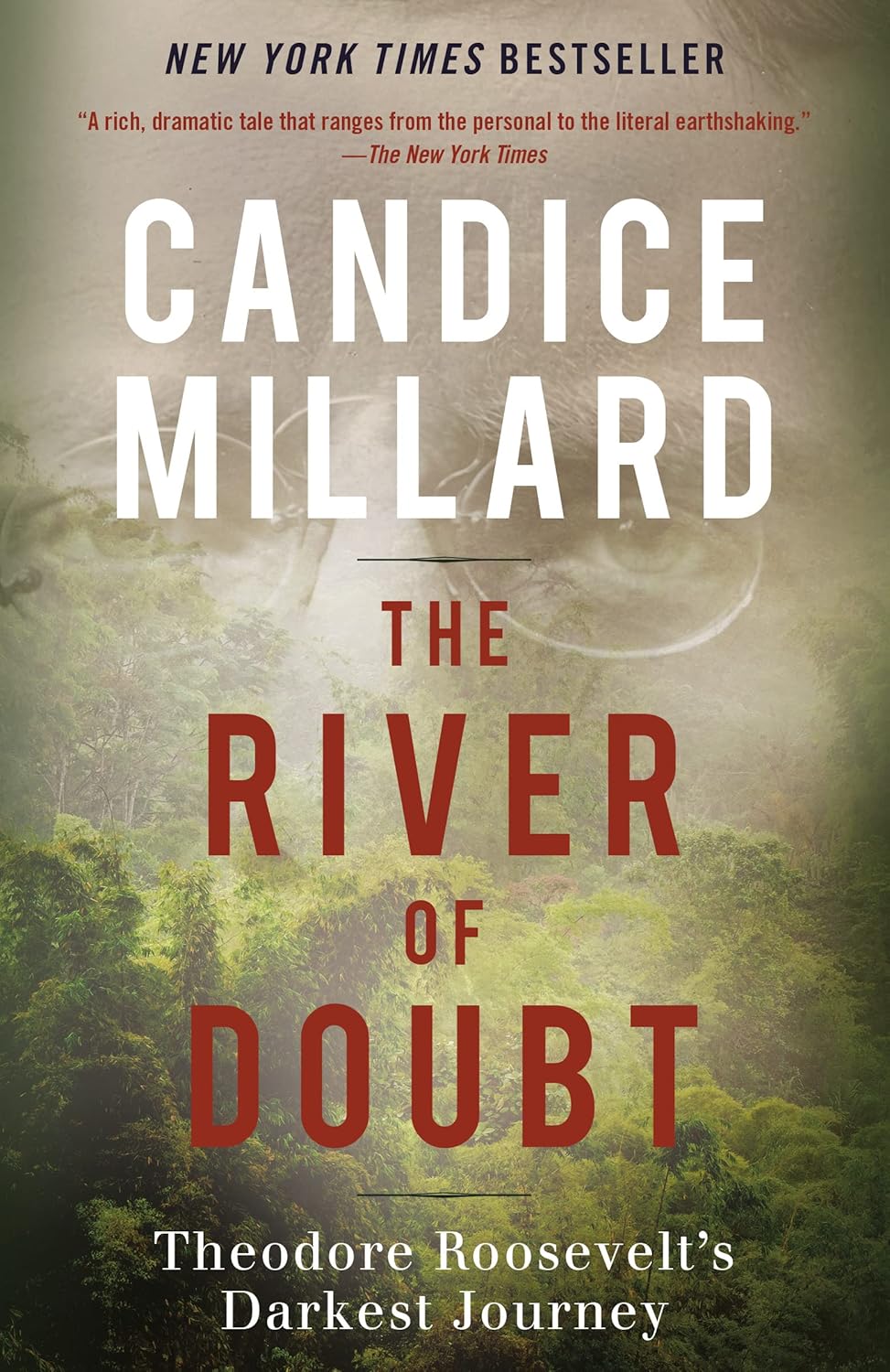
I love Teddy Roosevelt (full disclosure), and had read several academic biographies about him before picking up Candice Millard’s “The River of Doubt,” her popular narrative on the former president’s generally forgotten 1914 expedition in the Amazon. I’m glad I did, as Millard delivers a fast-paced and engaging history of a truly remarkable event in both Brazilian and American history.
In my opinion, there are two distinct, but related stories in “The River of Doubt”: one is the general narrative; the other is biographical.
First, there is the amazing story of the nearly ill-fated expedition itself. Teddy Roosevelt (TR) had just lost his controversial bid for a second full-term in the White House. He had represented his own, new third party, the progressive Bull Moose Party. After his crushing defeat – the first political defeat of his life – he was hated by his erstwhile allies, mainline Republicans, and scorned by Democrats, his traditional adversaries. He was, like a popular Southwest Airlines commercial when this book was published, “looking to get away.” The opportunity to leave North America and explore the South American rainforest for nearly a year seemed a perfect solution to his political and personal funk. Moreover, it offered the one thing TR found more irresistible than politics: physical high adventure.
The expedition, as originally planned and sponsored by the New York Museum of Natural History, an institution founded by the Roosevelt family, was supposed to be “safe and uneventful,” traveling solely by motorboats and along well-explored inland waterways. However, the intrepid TR was hardly deterred by the fact that it could, in theory, be dangerous, mainly because of the threat of tropical disease. Millard drills home a few points in the first quarter of the book. One is that the original idea for the trip had been planted many years before by the remarkable Catholic priest, Father John Zahm. Another is that TR took little interest in the preparations for the expedition, leaving everything up to the aged priest and his new quartermaster, the failed-arctic-explorer-cum-outdoorsmen-equipment-salesman, Anthony Fiala. It would be a failure of oversight that nearly cost the ex-president his life.
Once the expedition reached the rainforest (after TR’s month-long obligatory and occasionally controversial political tour of the southern cone), the team made the impetuous decision to descend the so-called River of Doubt, an unexplored waterway deep within the Amazon rainforest. To outsiders, especially the expedition’s backers in New York, the change of itinerary appeared “insane if not suicidal,” according to Millard. Furthermore, the original equipment and provisions purchased for the planned trip were instantly rendered irrelevant.
Millard creates tension and drama as a dramatically trimmed down crew (both Zahm and Fiala, the two primary planners, were summarily cast aside), already exhausted after a month-long overland march to the riverhead, finally descend into the unknown. The story that follows is not unlike former president Bill Clinton joining a group of a dozen daredevil astronauts on a trip to explore Mars; interior Brazil in 1914 was that dangerous and unknown.
The twenty-two-man expedition pushed off on February 27, 1914. The first one hundred miles would prove to be a tangle of frustrating rapids and cataracts. The author devotes much energy to the forbidding plants, animals and insects of the Brazilian rainforest, each highly efficient or deadly owing to “unceasing evolutionary combat” for survival. The bumbling expedition was nothing more than “clumsy, conspicuous prey” in this alien environment, she says. Indeed, “with drowning, disease, Indian attack, and starvation waiting to claim their lives, all of the men understood that they might never see home again.”
The narrative of the expedition then revolves around three fascinating men. The first is TR, obviously. In Millard’s telling of the story, the ex-president is every bit as courageous, indefatigable and affable as the most flattering legend would have it. Undaunted by the omnipresent danger, resilient in the grip of tropical disease and a badly infected, injured leg (he asked the expedition to leave him behind so as not to slow down and endanger everyone else), and more than willing to pull his weight on the trip, including doing the laundry of others and accepting the same rations as the Brazilian crew, TR seemed to love the expedition even during its darkest hours. It delivered everything he had always cherished: physical danger, untamed nature, masculine camaraderie, and scientific discovery.
Another hero of the narrative is TR’s second son, Kermit. With his mind more than half focused on getting married as soon as the expedition was finished, Millard writes that TR’s youngest son was a model of bravery and filial support, often embracing the hardest duties required, from navigating the lead canoe to hunting in Indian-filled jungles, all while remaining solicitous of his father’s deteriorating health and protective of his ultimate survival. It’s easy to see how, for Kermit, “the sky was the limit” in 1914; tragically, the arc of his career would never get very far off the ground, much like that of his uncle, Elliott. It was sad to read about his promise knowing he would ultimately squander his natural gifts and exceptional privilege. His fiancée, the young Belle Willard, whom he pined for so earnestly along the River of Doubt, would one day be the wife he would humiliate with his chronic alcoholism and open philandering, before committing suicide at an Army base in Alaska during World War II.
The last member of the biographical trio is Candido Mariano da Silva Rondon, perhaps the greatest hero of Millard’s narrative. Brazil’s greatest explorer and a man at once cut from the same clothe as TR – fearless, selfless, ambitious – Rondon nevertheless maintained “diametrically opposed ambitions” for the trip down the River of Doubt, according to the author. Millard describes the Brazilian colonel as a true humanitarian, a man who loved his country and his job exploring the endless rainforests of the Amazon, and who was fiercely protective of Brazil’s indigenous people, most of whom were viciously cruel to outsiders. No matter the physical threat, his standing order to his soldiers was: “Die if need be, but kill never.” It was the type of worldview that gave TR fits of rage, as did Rondon’s methodical surveying of the River of Doubt, even as the expedition’s supplies dwindled, some lost in the rapids, others stolen by nefarious members of the team, a great many poorly selected by Fiala and utterly useless in their present circumstances (e.g. barrels of mustard and olive oil). As the expedition finally limped into camp at the confluence of the Aripuana River on April 26, 1914, almost two months to the day from descending the River of Doubt, Rondon was the only member of the expedition in complete health. TR never fully recovered from the ordeal, dying at home at Sagamore Hill on January 6, 1919; Rondon lived till 1958, rising to Marshal of the Brazilian Army and remains one of the greatest heroes in Brazil’s history.
 What's Tim Reading Now?
Leave a comment