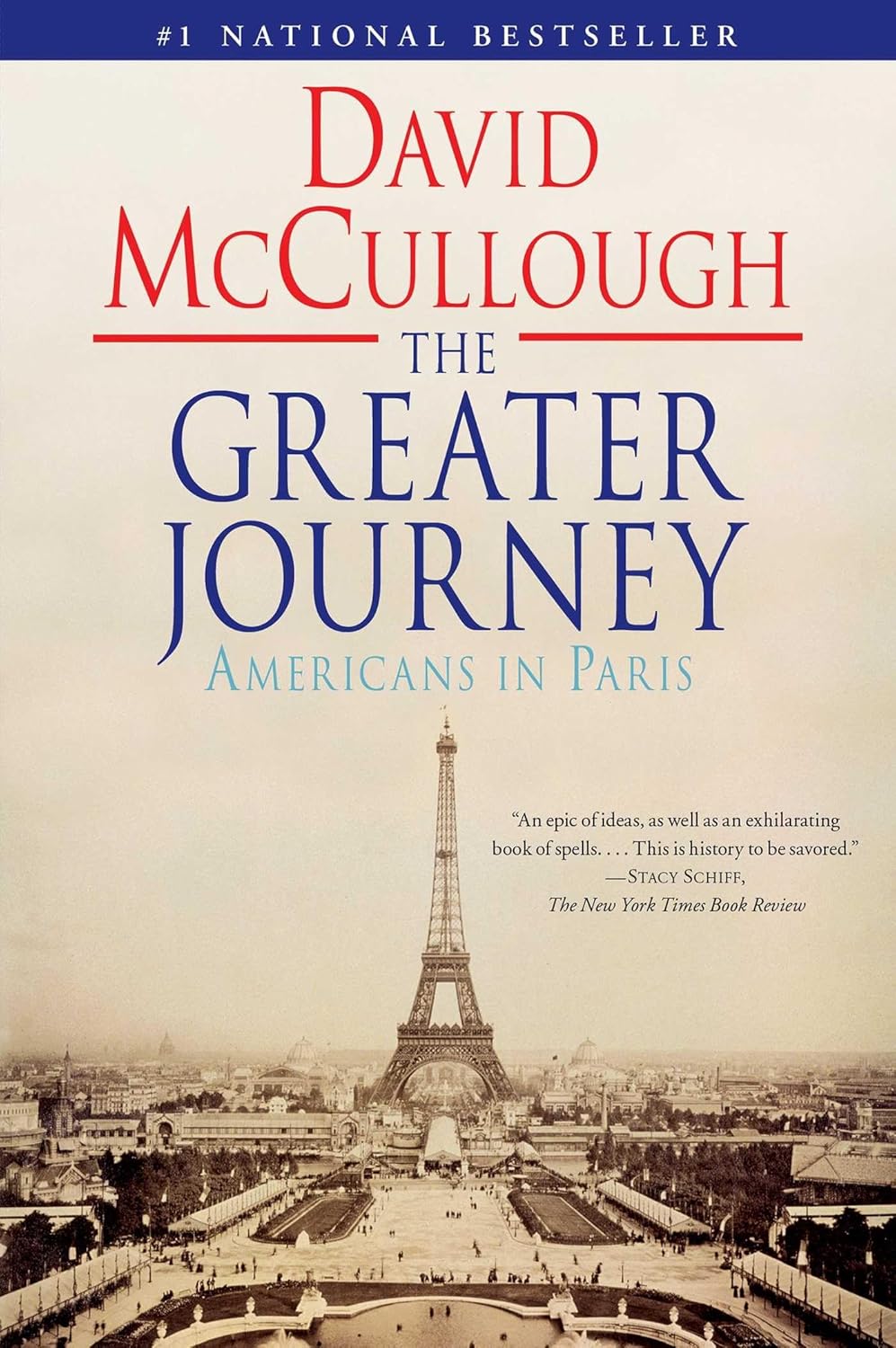
God bless David McCullough. With seeming effortlessness he does what most every historian hopes to achieve – recreate the life and times of the distant past. I was not prepared to like this book. How could anyone write over four hundred pages chronicling the experience of Americans in nineteenth century Paris and make it somehow readable? Well, McCullough did – and how!
There is no central narrative arc to the story. A cast of dozens, over the course of nearly a century, populates the storyline. It begins with the friendship of the celebrated New York novelist James Fenimore Cooper with the young artist (and future inventor of the telegraph) Samuel Morse. McCullough recreates the scenes of their collaborations with exquisite detail and vivacity. One can almost see Morse on his scaffold working diligently on his canvas at the Louvre.
Next, McCullough follows the experiences of “the Medicals,” the young American students who came to Paris in the 1820s and 1830s to learn from what were then the best and the brightest clinical minds in the world. One frustrating aspect here is that McCullough never once examines the state of medical science during that time. In what has been then called the “withered arm of science,” McCullough never challenges the quality of instruction the eager Americans may have received. In a time when even basic hygiene, such as washing one’s hands, wasn’t even recognized, I would have liked to know what exactly had been proven science by that time. Nowhere does McCullough tell us and the book suffers because of it.
A large part of “The Greater Journey” has to do with American artists coming of age in Paris: Samuel Morse, George Healy, John Singer Sargent, Mary Cassatt, Augustus Saint-Gaudens and many others. As someone virtually completely ignorant in art history, I found McCullough’s side narratives of each artist’s life and experience in Paris to be mesmerizing. He expertly captures the hardships and tediousness of life as a struggling artist in the greatest center of artistic life in the Western World. Also of interest is the mental suffering experienced by most. Saint-Gaudens and Cassatt, in particular, wrestled with life-changing depression. McCullough acknowledges the suffering, but does little to expand upon it and ask how it may have affected their art.
Perhaps my favorite part of “The Greater Journey” had to do with Elihu Washburne, American counsel during the Franco-Prussian War and the ensuing siege of Paris and the bloody commune. Originally from hardscrabble interior Maine, Washburne pulled himself up by his bootstraps and succeeded as a lawyer and politician in Galena, Illinois, befriending a struggling ex-Army officer by the name of Ulysses Grant in the process. I have read several accounts of the Paris Commune before, but none have captured the horror like McCullough does here. One can almost feel the impact of whizzing artillery shells and smell the gunpowder from executioner firing lines, like the one that claimed the life of the archbishop of Paris. “Numbers of his famous predecessors in diplomatic roles in Paris had written perceptively, often eloquently of their experiences and observations while there … But no one ever, before or after, wrote anything like Washburne’s Paris diary.”
All told, this is a marvelous book. I was genuinely disappointed when it ended. I learned a great deal and odds are you will too.
 What's Tim Reading Now?
Leave a comment