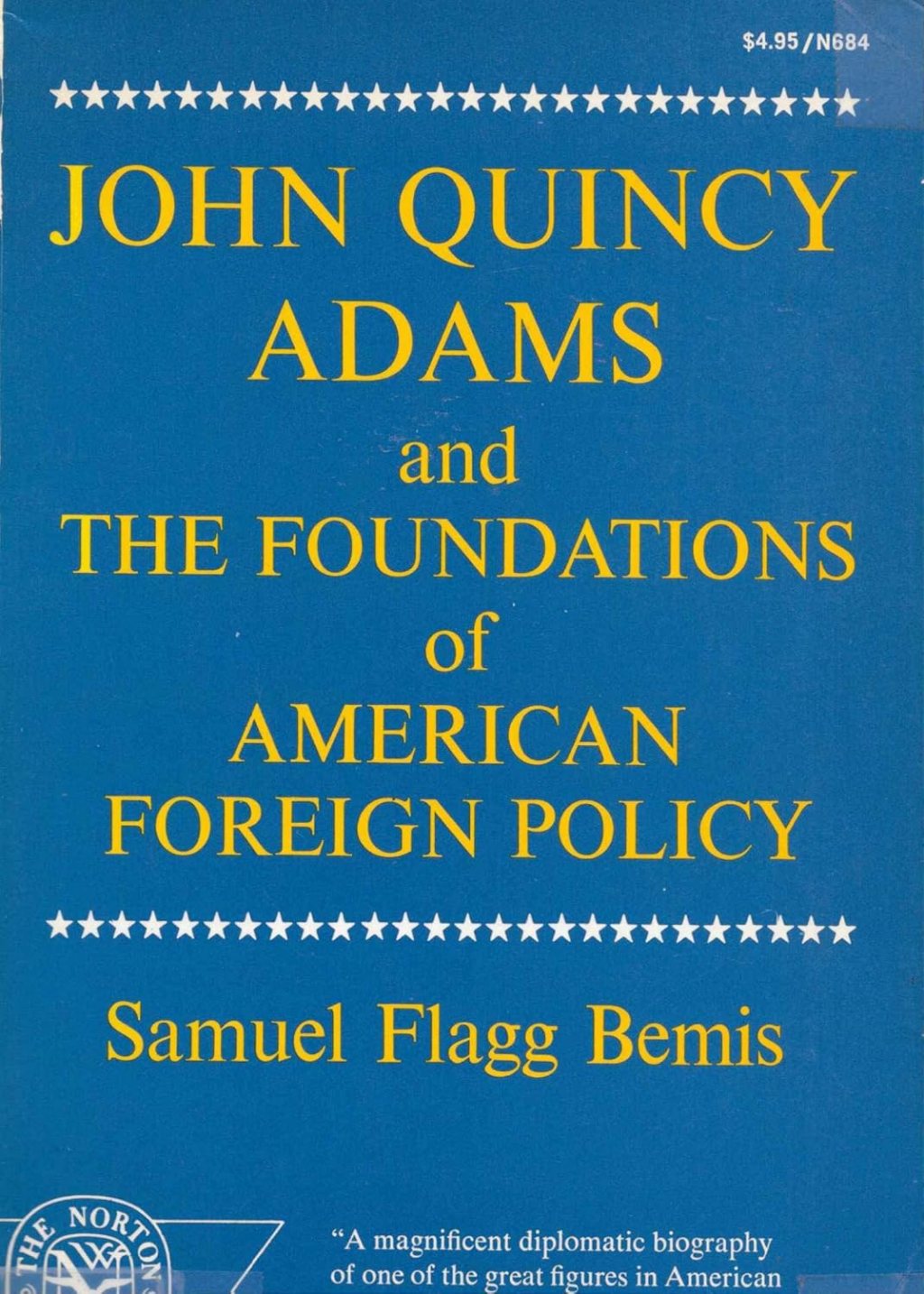
Samuel Flagg Bemis was Sterling Professor of Diplomatic History at Yale for decades in the mid-twentieth century. In 1950 he won the Pulitzer Prize for “John Quincy Adams and the Foundations of American Foreign Policy,” an incisive portrait of perhaps the greatest diplomat in American history. Bemis charts Adams’s early days as ambassador to many of the preeminent courts of Europe during the infancy of the American republic through to his celebrated tenure as secretary of state in the Monroe administration.
Born in 1767, John Quincy Adams was a child of the American Revolution. As a boy he witnessed the Battle of Bunker Hill and later accompanied his famous father on his diplomatic missions to the courts of Europe. Educated in the classics and fluent in Latin, Greek, French and Dutch while still in his teens, he learned the intricacies of Old World diplomacy firsthand from watching his father and Thomas Jefferson in Paris and Francis Dana in St. Petersburg. After graduating from Harvard in 1787 (his alma mater would hold a cherished place in his heart for the rest of his life), Adams took up the study of law. It would not be a happy career. He yearned to be a poet or maybe an historian. At the age of 28, Adams was plucked from his dull existence as a young Boston lawyer and named Minister Resident to The Hague by president George Washington. It marked the beginning of perhaps the most storied diplomatic career in American history.
Adams would spend the rest of the eighteenth century in the Netherlands and then in Berlin as Minister Plenipotentiary. He was an astute observer of the tumultuous affairs of European war and politics. George Washington, his father the vice president, and secretary of state Timothy Pickering read his dispatches closely. Adams proved to be a devoted supporter of Federalist foreign policy, including the controversial Jay’s Treaty with Great Britain. He was recalled to the United States after his father’s defeat in the presidential election of 1800 and grudgingly returned to building his law practice in Boston.
After a few dismal years trying to re-establish himself at the bar, Adams was elected to the United States Senate in 1803 at age 35. “An independent and refractory Federalist,” he courted controversy from the start with his stout support of the Louisiana Purchase. “John Quincy Adams was a nationalist first and foremost,” Bemis writes. He was not opposed to southern and western expansion like the High Federalists. From the perspective of the conservative Federalist’s Essex Junto, Adams was “getting more and more independent, more unmanageable.” He followed no party line but rather adhered unequivocally to a few central principles: “Indissoluble union was his watchword of Adams’s own politics, as independence and abstention from Europe’s wars were the beacon of his foreign policy.” By 1808, Adams had broken irrecoverably from the Federalist Party and was effectively recalled by the Massachusetts legislature. No sooner had he returned to Boston than he learned the recently elected Republican President Madison had appointed him Minister Plenipotentiary to Russia.
After four years struggling to make ends meet at the expensive diplomatic court at St. Petersburg, Adams was appointed head of an all-star delegation to negotiate peace with Great Britain during the War of 1812 that included former treasury secretary Albert Gallatin, Federalist Senator James Bayard, and Speaker of the House Henry Clay. The Treat of Ghent established peace on the basis of status quo ante bellum. Adams and his fellow commissioners had successfully fended off British attempts to establish a Native American buffer state in the North West and a permanent naval presence on the Great Lakes. “Everybody,” Bemis says, “East and West, North and South, was delighted with the peace … After two years of bitter humiliation the honor of the United States at last had been redeemed in the Cabinet and in the field.”
Adams next transitioned to Minister Plenipotentiary at the Court of St. James, the highest post in the Foreign Service, which his father had held before him and his son, Charles Francis Adams, would later hold during the Civil War. His two years in London before being named secretary of state were the most pleasant of his life, according to the author. He finally returned home in 1817 to take up the position he had been working a lifetime to achieve. No secretary of state, before of since, had been so well prepared for the role. “For the next seven years,” Bemis writes, “John Quincy Adams’s biography is little more than a succession of important chapters in the diplomatic history of the United States.” The entire second half of the book, well over 300 pages, is dedicated to Adams’s storied tenure as secretary of state.
He really hit the ground running. Immediately upon taking office, Adams negotiated the Convention of 1818 with Great Britain, which tied up a number of loose ends from the War of 1812, such as access to inshore fisheries, compensation for confiscated slaves, settlement of boundaries in the northwest, and transatlantic commerce regulation. Next, he completed the Transcontinental Treaty of 1819 with Spain, which acquired for the United States the territory of East and West Florida along with an established boundary all the way to the west coast at present day Oregon. Bemis writes that if Adams had negotiated harder he may have acquired Texas, too. “Even without Texas,” he writes, “the Transcontinental Treaty with Spain was the greatest diplomatic victory won by any individual in the history of the United States.” That’s high praise coming from the preeminent historian of American foreign policy in the twentieth century.
The most pressing foreign policy issue facing the American government during the Monroe administration was the status of Imperial Spain’s former colonies in the western hemisphere, the majority of which were clamoring for independence from the mother country. There existed a very real threat that the European Holy Alliance would back Spain’s attempt to use force to retain her colonial possessions. It was against this tense international backdrop that president Monroe delivered his historic message to Congress on December 2, 1823 declaring that the western hemisphere was henceforth off limits to European colonization and intervention. Bemis claims that there was no one author to what became known as the Monroe Doctrine, although John Quincy Adams played perhaps the central role in its creation. “It was only a pronouncement,” the author is quick to point out, “but it contained powerful words nevertheless, words that both served the immediate interests of the United States and exalted for the whole Hemisphere the ideals of independence and the sovereignty of the people.”
In the meantime, Adams endeavored to negotiate other nettlesome issues with Great Britain, such as freedom of the seas, impressment of American sailors, and the suppression of the slave trade. Time and again he was stymied in his efforts, most notably by British foreign minister George Canning, who Adams described as that “implacable and rancorous enemy of the United States.”
In closing, Bemis argues that “More than an other man of his time [John Quincy Adams] was privileged to gather together, formulate and practice the fundamentals of American foreign policy,” which the author claims embraced fourteen basic tenets. Among them include Freedom of the Seas; freedom of commerce and navigation (later to be dubbed the Open Door and Reciprocity); abstention from entangling alliances in European affairs; the No Transfer Principle for imperial domains; the support of American continental expansion (“John Quincy Adams was certainly one of the great apostles of Manifest Destiny”); the self-determination of peoples, as evidenced by the recognition of the independence of the revolted colonies of South America; objection to further European colonization in the New World; nonintervention, as manifested in the Monroe Doctrine; the right of expatriation and naturalization and the wrong of impressment; suppression of the African slave trade; Pan-Americanism; international arbitration of questions relating to points of international law or the interpretation of a treaty; and finally anti-imperialism.
Bemis, writing in the mid-twentieth century, notes that all of these principles, with exception of Freedom of the Seas and Isolation, remain core tenets of American foreign policy today. “John Quincy Adams did not make all these principles prevail in his day,” Bemis writes, “but he stood fast to them so that they lived to predominate in another day of greater national power.”
 What's Tim Reading Now?
Leave a comment