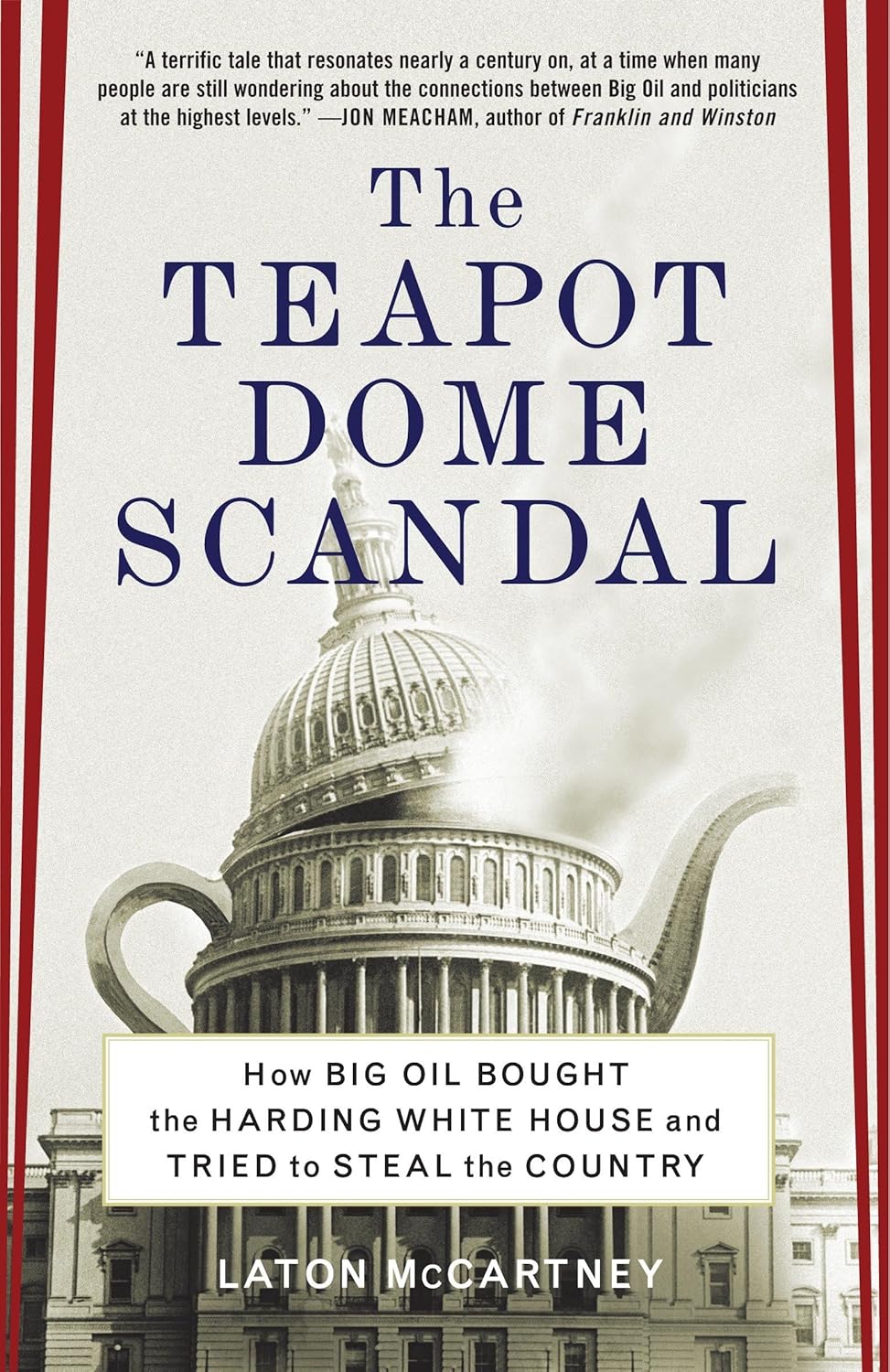
A century ago “Teapot Dome” made headlines from coast to coast for almost a decade. Today, only the most dedicated political junkies remember what it was all about. In “The Teapot Dome Scandal: How Big Oil Bought the Harding White House and Tried to Steal the Country” (2008) Laton McCartney seeks to bring the largest political scandal in American history up to that time back to life for modern readers. Unfortunately, I’d say he is only partially successful.
The conspiracy, as explained by the author, really is jaw dropping in its audacity. To understand the Teapot Dome scandal some context is required. First, it’s important to consider the state of American industrial development in 1920. The United States had just emerged from the First World War stronger than ever. Almost one million Model T’s rolled off the assembly line that year and went on sale for less than $400 (just $6,000 in today’s dollars). The massive oil deposits of the Middle East, Russia, the North Sea, and Venezuela had yet to be discovered. Oil prices were soaring to all time highs with no relief in sight. There was genuine concern that the United States, the only major oil producer in the world at the time, was quickly running out of petroleum deposits just as demand was exploding.
The largest known oil reserves in the country were controlled by the United States Navy – the Elk Hills and Buena Vista reserves outside of Bakersfield, California (Naval Petroleum Reserves No. 1 and No. 2) and Teapot Dome, north of Casper, Wyoming (Naval Petroleum Reserve No. 3). The three reserves totaled 300 million barrels of oil split almost evenly between the two states. The three naval reserves represented an enormous business opportunity. It was estimated that the oil companies could make a profit of $1 per barrel, minus a 17 percent royalty fee. In other words, $250 million in profit (almost $4 billion in today’s dollars) lay idle while the American consumer was screaming for affordable gas. The Navy had no immediate plans for the oil; it was simply husbanding its resources in case of some unforeseen national security emergency. To make matters worse, some argued that the wildcat drillers operating on the periphery of the naval reserves were slowly siphoning off oil from Teapot Dome and Elk Hills, a phenomenon known as “drainage.” Some of the leading oil executives in the country were determined to pry these precious reserves away from the United States government just as soon as they figured out how.
According to McCartney, the Teapot Dome scandal was years in the making; it was no mere target of convenience. What the oil executives needed first was a patsy in the White House, preferably some dim but electable non-entity who would do their bidding, no questions asked. Enter Senator Warren G. Harding of Ohio. The first-term senator and former small town newspaper owner with an interest in comely young women and not much else, was just what they were looking for: a malleable cipher who conveniently looked the part of an American president.
There were a record eighteen candidates heading into the 1920 Republican convention in Chicago. General Leonard Wood was the favorite. However, the Harvard-trained surgeon turned war hero was a candidate with far too much intelligence, independence and moral scruples for the oil men’s scheme. Oklahoma oil man Jake Hamon went to Chicago with one million dollars in cash on loan from Citibank to secure the nomination of the most electable candidate willing to go along with their plan. The amiable fifty-five year old senator from Ohio was a forty-to-one longshot, but he looked like a Roman statesman and was willing to work with the oil men. McCartney argues that the shrewd distribution of the oil men’s million was crucial in winning Harding the GOP nomination. In November, after hardly campaigning at all, Harding captured 60 percent of the national vote and 404 electoral votes, the greatest margin of electoral victory in American history up to that time.
In return for securing Harding the Republican nomination that he otherwise never would have won (and evidently never wanted, according to the author), the oil men had one seemingly modest request: they wanted to name the secretary of the interior. Their first pick was none other than Jake Hamon. The incoming Harding administration agreed, but there was just one problem. Hamon was living with his twenty-something mistress. That arrangement wasn’t going to work for a cabinet member. If he wanted the post, Hamon was going to have to move to Washington with his estranged wife and two children. Hamon agreed to the condition. Hamon’s mistress evidently did not. She pulled out a revolver and killed him.
Thus, the oil men needed a new nominee for interior secretary congenial to their plans. They settled on Albert Fall, a down-on-his-luck rancher and US senator from New Mexico. It seems as though Fall had no qualms with orchestrating one of the greatest acts of political corruption in American history, so long as it saved Three Rivers, his sprawling New Mexico ranch that he hadn’t paid taxes on in over a decade. McCartney writes that Fall “set the gold standard for corruption in American politics.”
After getting their candidate nominated and then elected president, and then appointing the interior secretary, the oil men next needed to have ownership of the oil fields transferred from the navy to the interior. For some reason this seemingly controversial move proved absolutely frictionless. Secretary Fall just requested that the new Secretary of the Navy, Edwin Denby, transfer the three naval oil reserves to the interior department and he happily complied, no detailed explanation or hefty venal compensation required. McCartney never explains why this critical piece of the plan was so easy. Denby was forced to resign years later under a cloud of suspicion, but he was never indicted on any charges related to Teapot Dome.
Finally, we have arrived at the crime itself – Secretary Fall’s April 1922 no-bid leasing agreement for the three naval oil reserves to major American oil companies in exchange for large (but by no means egregious considering the value of the oil deposits) sums of cash. The corruption details of the California leases are relatively simple and straightforward. Those for Teapot Dome are hazy.
Perhaps one of the most shocking things about the entire Teapot Dome scandal was how little Fall received for funneling essentially billions of dollars of petroleum deposits – “a bonanza so rich that it was almost beyond comprehension,” McCartney says – into the hands of the wealthiest oil companies in the world. One of the many frustrating things about “The Teapot Dome Scandal” is that McCartney never clearly summarizes all the illicit payments and where they came from. Here is my best effort to summarize the timeline and payments involved in the scandal.
Once Fall had control, he leased the reserves without competitive bidding, in violation of normal procedure. He quickly leased Elk Hills to Edward L. Doheny, head of Pan American Petroleum and Transport Company, in December 1921 under the guise of “conservation.” A few months later he leased the Teapot Dome reserve to Harry F. Sinclair, head of Mammoth Oil Company (a subsidiary of Sinclair Oil), in April 1922, supposedly to develop the field to prevent oil seepage and waste. On paper, these seemed legitimate government contracts for oil development – but the real deal was what Fall received behind the scenes. Fall was in dire financial straits in 1921 and within months of granting these leases, he began receiving large, covert payments.
In December 1921, Doheny sent his son, Ned Doheny, and a company associate to Washington with a black bag containing $100,000 in cash (equivalent to about $1.7 million today) directly to Fall’s apartment. Doheny later claimed it was a “loan”, but there were no records of repayment, collateral, or interest. Fall used to buy land adjacent to his New Mexico estate and secure water rights for his property. A verbal agreement was struck whereby Fall agreed to work for Doheny after leaving the government and could repay his loan from his future oil company salary. In addition, Doheny agreed to build a large storage facility for the US Navy at Pearl Harbor. In exchange, Doheny’s Pan American Petroleum Company would receive the exclusive (perpetual?) rights to both naval oil reserves in California.
Meanwhile, Sinclair provided about $260,000 to $300,000 in cash, Liberty Bonds, and livestock to Fall over the next year or two. This included $36,000 in Liberty Bonds (channeled through a Denver banker friend to disguise the source), $230,000 in cash payments, and expensive gifts such as cattle and the financing of improvements on Fall’s Three Rivers Ranch in New Mexico. Additionally, over the years McCartney says that Sinclair frequently lost prodigious sums of money at the poker table to Fall. Just how much is anyone’s guess.
Fall tried to disguise the payments as legitimate transactions. First, Fall claimed to have made money from ranching and cattle sales, but his finances had been bleak before the leases. Moreover, he did not report any of these payments on his taxes, but quickly paid off mortgages, bought livestock, and made major improvements to his property shortly after receiving the funds. Investigators later discovered the money trail through bank records, Liberty Bond serial numbers, and witness testimony.
The author stresses that Teapot Dome may have been the most sensational case of corruption in the Harding administration, but it was hardly unusual. Indeed, the twenty-ninth president’s administration was corrupt to the core, according to the author. McCartney says that Harding’s closest advisors, known colloquially as the Ohio Gang, were actually “a complex criminal enterprise that was run like a well-organized, well-coordinated enterprise.” For example, according to the author, Dougherty, the “attorney general with a larcenous bent,” openly sold permits to bootleggers and pardons to convicted felons.
McCartney never adequately explains why just two men and two oil companies profited exclusively from the vast naval oil reserves. Harry Sinclair from Mammoth Oil Company received the lease to the Wyoming reserves while Edward Doheny of Pan American Petroleum Company (and possibly the richest man in America after John D. Rockefeller) received the California leases. Despite the vast fortunes involved and their eventual acquittals on all the major charges, I’m not sure it was all worth it. In 1928, before he was finally acquitted of bribing Albert Fall, Sinclair would appear before eleven congressional committees, was subject of three civil lawsuits and four criminal cases, and gave 175,000 words in total testimony. His legal fees must have been astronomical, although McCartney doesn’t hazard a guess at their total cost. In the end, Sinclair ended up serving seven months on contempt charges in 1929.
Albert Fall resigned from the cabinet in January 1923, less than a year after completing the oil field leasing agreements. President Harding died suddenly while staying in San Francisco eight months later. In October 1923, Democratic senator from Montana Thomas Walsh began investigating Teapot Dome for the Senate Committee on Public Lands and Surveys. McCartney writes that “Sherlock Holmes could not have been presented with a more tantalizing case” surrounded by “so much obfuscation, confusion, and controversy.”
In the early days of the investigation, Fall successfully explained away many of the charges lodged against him. When asked to explain his actions before the committee, Fall said he needed to offload the naval reserves before they were drained away by peripheral wells (the drainage argument that other scientists eventually refuted). The $100,000 loan came from his old friend, Ned McLean, the owner of the Washington Post, who had nothing to do with the oil business. (This was a flat out lie that he was eventually caught in.) Fall said he conducted his actions in secret because of the national security implications related to oil reserves. He didn’t accept multiple bidders because he thought he could get a higher price by dealing directly with a handful of major oil producers. The Republicans argued that the entire investigation was a baseless, partisan witch hunt and at first many people seemed to agree. But Senator Walsh, the only hero in McCartney’s character-packed narrative, was relentless.
It took almost a decade, but Walsh finally got his man. Fall was convicted of receiving a bribe in 1930, the first cabinet member in US history to be convicted of a felony. He ended up serving nine months in the New Mexico State Prison in Sante Fe and received a $100,000 fine, which the bankrupt former senator never bothered to pay. President Hoover, his one-time colleague in Harding’s cabinet, refused all requests to pardon him. Six months later, in the same courtroom with the same judge presiding, Doheny was acquitted of bribing Fall in the case where Fall had just been convicted of being bribed by Doheny. No, really.
Interestingly, Teapot Dome was simultaneously the biggest political news story in the country and a non-issue in the presidential election of 1924. In the midst of Walsh’s headline-grabbing investigation, the Democrats nominated John W. Davis for president and made the Teapot Dome scandal the touchstone of his entire campaign. He even sought Senator Walsh to serve as his running mate. Yet, the dour Calvin Coolidge thrashed Davis by more than seven million votes. Americans just didn’t seem to care about the biggest political bribery scandal in their country’s history.
By 1927, Senator Walsh was starting to get some vindication. The government later voided both oil leases, and the Supreme Court in 1927 ruled they had been obtained through corruption and must be returned to federal control. First, in McGrain vs Daugherty, the Supreme Court ruled against the administration, returning all three Naval Oil Reserve sites to government control, where they would remain for nearly a century. (California’s Elk Hills reserve was sold to Occidental Petroleum in the 1990s; Teapot Dome was sold to Standard Oil Resources Corporation in 2015 for $45 million, a small fraction of what it was worth in 1920.) Also, for the first time the court explicitly established that Congress had the power to compel testimony.
In closing, one of the most difficult things about reading “The Teapot Dome Scandal” is that there are literally dozens of characters that flutter in and out of the narrative from beginning to end. It would have been really helpful if McCartney and his editors had included a dramatis personae to keep the lineup straight. Finally, it would have been great if the author had summarized the corruption charges, especially those concerning Teapot Dome and Harry Sinclair, at some point, explicitly separating fact from assumption. All told, I enjoyed “The Teapot Dome Scandal” very much,but I can’t help but think it would have been quite a bit better in the hands of a more skilled historian.
 What's Tim Reading Now?
Leave a comment