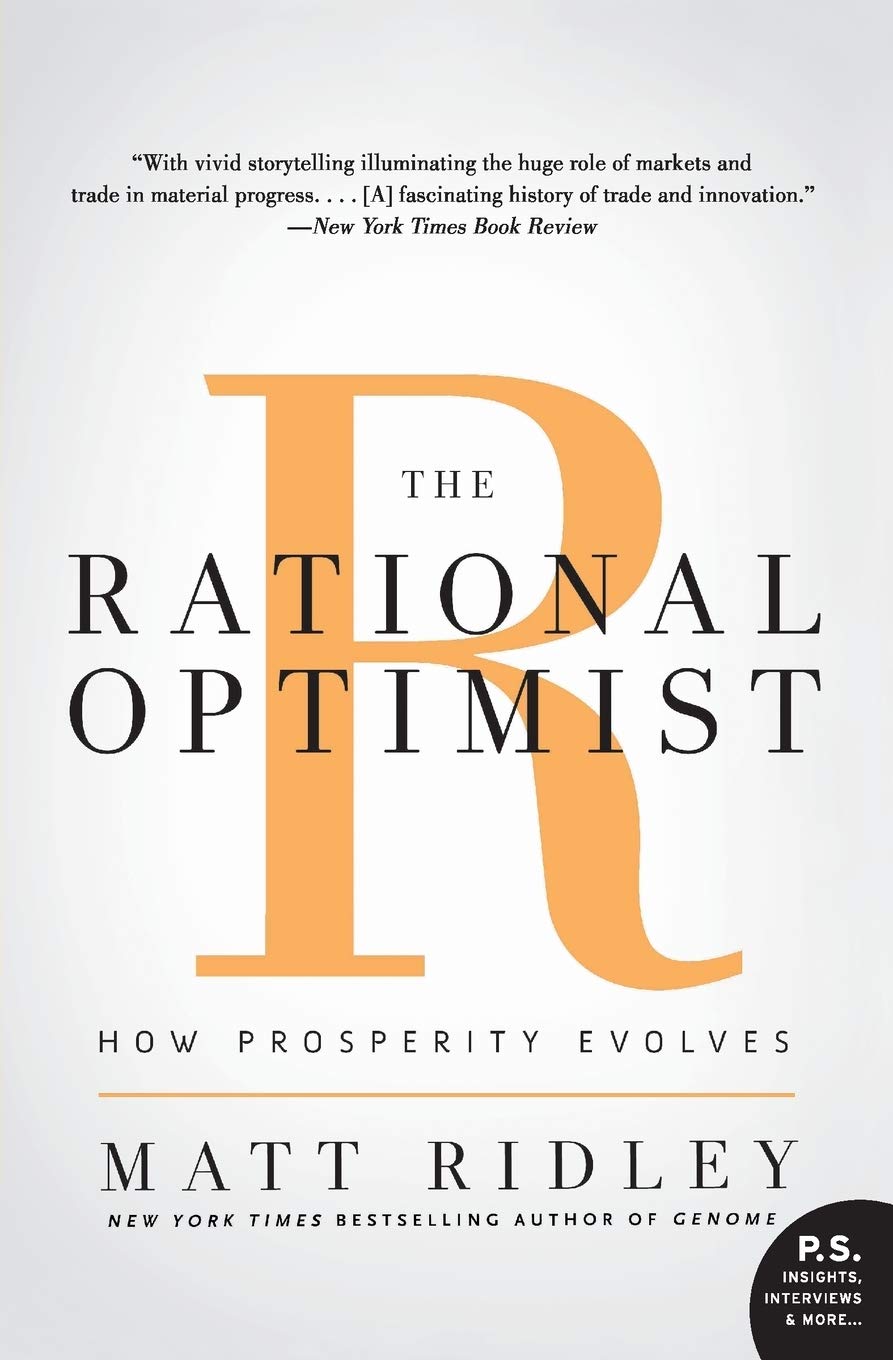
What if Adam Smith (invisible hand) and Charles Darwin (evolution) had a baby? The offspring might be pretty amazing: intelligent, dynamic, innovative, problem-solving. At least that’s what British science writer Matt Ridley argues in “The Rational Optimist: How Prosperity Evolves” (2011).
First, Ridley wants you to know that being an optimist is long been lonely, difficult work. “Implicit confidence in the beneficence of progress,” Austrian economist Friedrich Hayek once quipped, “has come to be regarded as the sign of a shallow mind.” Ridley couldn’t agree more. Worse yet, he says, “Pessimists have always been ubiquitous and have always been feted.” For centuries, sceptical scholars (what Gary Alexander has called “apocaholics”) of all different stripes have claimed that society was at some sort of “turning point” – a global calamity was always right over the next hill. Notable late twentieth century examples include carcinogenic synthetic chemicals, DDT, famine, population bombs, nuclear energy, a new ice age, ozone layer depletion, acid raid, imminent resource exhaustion (e.g. oil, clean air, clean water, copper, natural gas, zinc), AIDS, plagues, and most recently, climate change. In short, things have been getting better for a long time, and the rate at which things are getting better is accelerating. For instance, he says, poverty has reduced more in the past 50 years than in the past 500.
Ridley begins each chapter with a graph showing how some major societal metric has dramatically improved. Some are up and to the right, such as the explosive growth in world GDP per capita (from roughly $200 per year in 1990 dollars in the year 0 to $6,000 in 2000), life expectancy at birth (from 48 years in 1950 to 68 in 2000), global cereal harvests (from 800,000 tons harvested in 1965 to 2,250,000 tons in 2005), and IPCC projections for world GDP per capita over the next century (estimated to grow between a factor of four on the low end to twelve on the high). Other graphs show dramatic drops, such as homicide rate in Europe (from 35 per 100,000 in 1300 to 2 per 100,000 in 2000), US deaths from water-borne diseases (from over 300 deaths per million in 1900 to zero today), half-decade percentage increase in world population (from 1.75 percent in 1950 to 1.25 percent in 2000), metal prices to US wages (from 6,000 in 1800 to almost zero in 2000 for everything from aluminum to zinc), World Product (from hardly anything in 1800 to $40 trillion in 2000), and US air pollutant emissions (from 1.3 in 1980 to 0.5 in 2008).
If this book is about one thing (besides that things are getting much, much better over the long run) it’s that exchange or free trade is undeniably good. Tariffs are all over the news in early 2025. In 2011, Ridley wrote that it’s “blatantly obvious” that “free trade causes mutual prosperity while protectionism causes poverty.” (Evidently, Ridley will not be serving in any advisory capacity in the second Trump administration.) And nothing is better than the free exchange of ideas. “Exchange is to cultural evolution as sex is to biological evolution,” Ridley says. Exchange “breeds, explodes, grows, auto-catalyses,” and, according to the author, it took hold of humans roughly 100,000 years ago. “At some point, human intelligence became collective and cumulative in a way that happened to no other animal,” he says, and the results have been earth-shattering. By exchanging, human beings ultimately discovered the benefits of ‘the division of labor,’ the first expression of which was likely between the sexes (women collected staple carbohydrates while men secured precious protein). The division of labor led to specialization. In 1817, David Ricardo articulated his theory of comparative advantage. It has been called the only proposition in all of social science that is both true and surprising, and it forms a key pillar of Ridley’s overall argument. The primary takeaway is: “Make one thing – use lots.” Perhaps even more importantly, specialization led to innovation. “Without trade,” the author says, “innovation just does not happen.” The end result is what Friedrich Hayek called the “catallaxy”: the spontaneous order that emerges from voluntary exchanges and decentralized decision-making in a market economy.
If specialization is a sign of prosperity, self-sufficiency is a sign of poverty and a civilization under stress. In short, Ridley says self-sufficiency is technologically regressive, while “rural self-sufficiency is a romantic mirage.” He cites the example of natives on the island of Tasmania, which was isolated from Australia when rising seas filled the Bass Strait some 10,000 years ago. Archaeological evidence demonstrates that the tools and methods employed by the Tasmanian natives slowly but inexorably degraded over centuries. “Isolation – self-sufficiency – caused the shriveling of their technology,” he says. The Tasmanian market was too small to sustain many specialized skills and they lost contact with the wider human “collective brain.” Something similar happened in the eighteenth century when the Japanese deliberately retreated from technology and trade.
When anthropologist/anarchist David Graeber first published the book “Debt: The First 5,000 Years” in 2011, the same year “The Rational Optimist” came out, he famously argued that despite what you’ve read in your introductory economics textbooks, there are no known examples, past or present, of true barter economies. Despite criticism from mainstream economists, no definitive archaeological or anthropological evidence has emerged proving the widespread existence of a pure barter economy before the advent of money. Nevertheless, Ridley argues that “Barter was the trick that changed the world.” And agriculture kicked barter trade into high gear.
Much has been written about the “misery, disease, and despotism” generated by the agricultural revolution. Pulitzer Prize-winning scholar Jared Diamond has called it “the worst mistake in the history of the human race.” It began (in a “phenomenal coincidence,” Ridley says) independently around the globe roughly 10,000 years ago in Mesopotamia, the Andes, Mexico, and China. Natural climate change was likely the cause. Average temperatures around the world 11,500 years ago increased by a staggering 20 degrees fahrenheit in 50 years (by way of comparison, global temperatures have increased less than 2 degrees over the past half century of climate change). Ridley argues that farming is simply the extension of specialization and exchange to include other species, namely certain plants and animals. Agriculture led to stored surpluses of food, which could be used for trade. Moreover, Ridley says that trade comes before agriculture, not the other way around. Farming arose along pre-established trade routes. Hunter-gatherer groups morphed into herder-farmer societies. According to anthropologists Peter J. Richerson and Robert Boyd, “The denser societies made possible by agriculture can realize considerable returns to better exploitation of the potential cooperation, coordination, and the division of labor.”
The whole interconnected system hinges on some level of trust and cooperation, which does not come naturally to humans. Researchers have found that the more cooperative a species is within groups, the more hostility there is between groups. Ridley cites as evidence the warfare endemic to isolated subsistence farming cultures in the Amazon and New Guinea even to this day. In the words of British economist Paul Seabright: “Where there are no institutional restraints on such behavior, systematic killing of unrelated individuals is so common among human beings that, awful though it is, it cannot be described as exceptional, pathological or disturbed.” Yet, “trade with strangers,” Ridley says, “and the trust that underpins it, was a very early habit of modern human beings.” Indeed, he says, humans are the only animal that smiles, an instinctive and intrinsic gesture of trust. Today, the more people trust each other in a society, the more prosperous that society is (e.g. 65% of Norwegians report that they trust each other whereas only 5% of Peruvians do). Ridley’s point is simple: “trust has gradually and progressively grown, spread and deepened during human history, because of exchange” – that is, non-zero-sum bargains that benefit both sides. “The lesson of the last two centuries,” Ridley writes, “is that liberty and welfare march hand in hand with prosperity and trade … Where commerce thrives, creativity and compassion both flourish.”
Somebody, (perhaps Niels Bohr, Yogi Berra or Mark Twain) once said, “It’s difficult to make predictions, especially about the future.” Ridley’s main point is that people are so bad about predicting the future – particularly future calamities – because they look at the way things are now and simply extend those conditions, unaltered, out decades or even centuries into the future. In short, they consistently fail to account for human ingenuity in the face of daunting challenges. The famed pessimistic prognostications of Thomas Malthus were rooted in many facts and it’s entirely possible that his worse case scenario may have come true if it were not from the developments of tractors (which saved 30 percent of farmland used to raise food for draft animals), fertilizers, and new crop variants (which dramatically increased the growing range and yields of many crops). If 1961 crop yields had remained frozen, the 2010 global agricultural production would have taken 82 percent of the earth’s land to produce, rather than the 38 percent used. Human beings in the time of hunter-gather bands each needed thousands of hectares of land to support him or her; today, thanks to specialization, technology and innovation, a human can be supported on one-tenth of a hectare.
So, in Ridley’s view, acephalous and organic trade routes led directly to agriculture, which in turn led to the rise of cities and then empires. The urban revolution was another extension of the division of labor. However, the largest empires led to “rigid dirigisme, extravagant bureaucracy, and feeble individual rights,” the combination of which was the stifling of technology innovation. Strong governments, Ridley says, are a form of monopoly, and all monopolies eventually grow “complacent, stagnant, and self-serving” (the author says that the pharaohs of Egypt were about as innovative as the US Postal Service). Political fragmentation is a key to innovation and prosperity. Large and highly centralized states, such as China, have traditionally underperformed smaller, more nimble nation states (China’s per capita real GDP in 1950 was lower than what it was in the year 1000, according to the author). Citizens of China could not flee to other economies and eventually the tax collectors outnumbered the tax payors.
Ridley also tackles the looming “demographic transition” as countries shift from high mortality rates with high birth rates to low mortality with low birth rates. It took the earth hundreds of thousands of years to first reach one billion humans around the year 1804. It took 123 years to add another billion in 1927, and then thirty-three more to reach three billion in 1960. It only took 39 more years to add three more billion by 1999. However, Ridley says, we may never get to 10 billion humans. Birth rate collapse seems to be a bottoms up cultural evolution – “a mysterious, evolutionary, natural phenomenon” that cannot be controlled or facilitated.
Ridley hammers home his core proposition that the engine driving prosperity is the open exchange of ideas, which reproduce sexually, Ridley says. This accelerating generation of useful knowledge has created a technology-driven perpetual innovation machine. “The history of the modern world,” he writes, “is a history of ideas meeting, mixing, mating and mutating” in ways that are “gloriously unpredictable.” The machine is not fueled by science, money, patents, or governments, he says. Beginning with the industrial revolution, technological innovation has been a bottoms-up, organic phenomenon, what economist Joel Mokyr has called “a semi-directed, groping, bumbling process of trial and error by clever, dexterous professionals with a vague but gradually clearer notion of the processes at work.” In other words, modern scientists are more often the beneficiaries of new technologies than they are benefactors. “Today’s scientists’ job,” Ridley says, “is really to come along and explain the empirical findings of technological tinkerers after they have discovered something.” Simply put, Ridley says, “The more you prosper, the more you can prosper. The more you invent, the more inventions become possible.” In such a world, equilibrium and stagnation are impossible. As Heraclitus put it millennia ago, “Nothing endures but change.”
Every economic boom in history ended in a bust once the renewable energy sources (timber, peat, water, labor) ran out, Ridley says. That is, until fossil fuels were discovered. Coal took a century to compete on price with water power in factories in Britain, although it was used for few new technologies after the steam engine. “It was coal that gave the industrial revolution its surprising second wind.” By 1870, the capacity of the country’s steam engines was the equivalent of six million horses or forty million men, who would have eaten three times the national wheat harvest. By 1930 Britain was using 68 times more coal than it was using in 1750. With the industrial revolution, real wages rose faster than real output. The people who produced the manufactured goods could also increasingly afford to consume them. In 1900, the average American spent $76 out of every $100 on food, clothing, and shelter. Today, that number is $37.
Finally, Ridley tackles the two main doomsday prophecies of the early twenty-first century: Africa and climate change. For Africa, Ridley is skeptical of large-scale foreign aid programs, believing they often create dependency rather than fostering long-term prosperity. Instead, he champions a system where individuals and businesses can freely exchange ideas and resources to drive economic progress. For climate change, he acknowledges that climate change is real and influenced by human activity, but argues that its risks are often exaggerated. His recommendations for addressing climate change focus on innovation, adaptation, and economic growth, rather than drastic and exceedingly expensive government intervention. “In short,” Ridley concludes, “the extreme climate outcomes [predicted by some models] are so unlikely, and depend on such wild assumptions [such as some of the poorest countries in the world today using fossil fuels to achieve an inflation adjusted average annual income of $66,000 by the year 2100], that they do not dent my optimism one jot.”
In closing, exchange makes cultural evolution cumulative and intelligence collective. “Ideas are having sex with each other more promiscuously than ever,” Ridley says. The upshot is that intelligence is becoming more and more collective while innovation becomes more bottoms-up and work more specialized. Because of this, Ridley is wildly optimistic about the late twenty-first century and beyond. He urges the reader to have faith in the future and not believe the pessimistic hype where “Optimists are dismissed as fools, pessimists as sages, by a media that likes to be spoon-fed on scary press releases.”
 What's Tim Reading Now?
Leave a comment