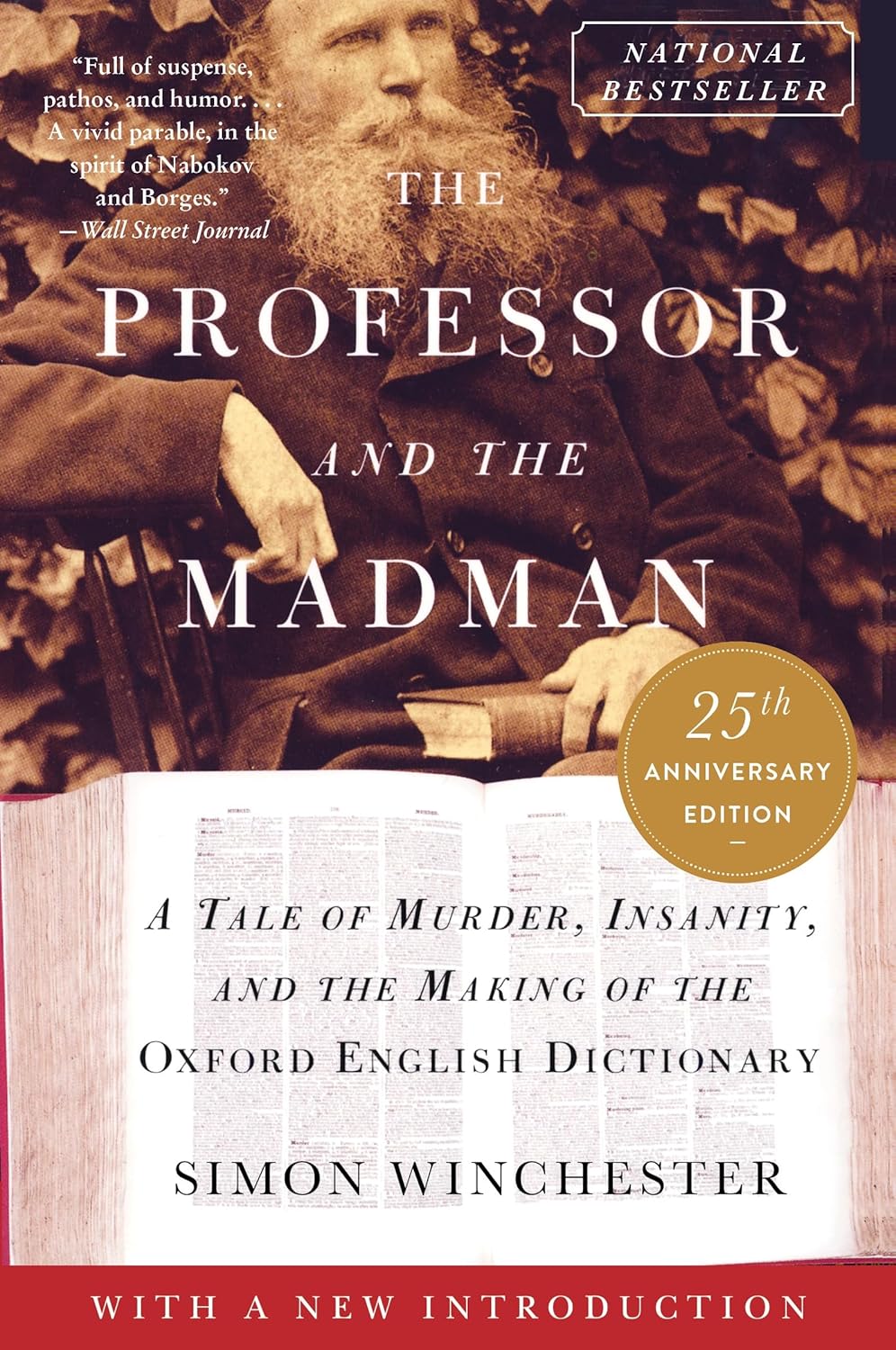
In 1879 Dr. James Murray, editor in chief of the Oxford English Dictionary (OED), published an open invitation calling for volunteers to read rare books and collect quotations for use in the dictionary. Thousands of participants signed up. It was a sort of nineteenth century form of Wikipedia. The dictionary would take many decades to complete. When finished in 1927, the OED took up twelve huge leather-bound volumes and defined 414,825 words that were illustrated by over 1.8 million volunteer-supplied quotations. It was, according to author Simon Winchester, “The greatest effort since the invention of printing.”
The most dedicated, prodigious, and reliable volunteer reader for Dr. Murray was a Yale-educated former US Army surgeon named Dr. William Minor, who, as it turned out, was also a paranoid schizophrenic and convicted murderer incarcerated at a nearby asylum for the criminally insane. And there you have it. That is the beginning, middle, and end of “The Professor and the Madman: A Tale of Murder, Insanity, and the Making of the Oxford English Dictionary.” It is sort of like a movie that reveals all relevant plot twists in the two-minute trailer.
Winchester writes well and does an admirable job crafting a cohesive narrative around the basic plot points. At just over two hundred pages in length, “The Professor and the Madman” can easily be read in just a few sittings. You learn that Dr. Minor was raised in Sri Lanka by missionary parents and served as field surgeon in the Wilderness campaign of 1864 where one of his disagreeable duties was to brand captured Irish deserters on the cheek with the letter “D.” After the war, he was tormented by irrepressible sexual urges and persistent fears that Irish nationalists were targeting him. He was living in a seedy hotel in London’s rough Lambeth neighborhood in 1872 when he shot an innocent working class father of six during a paranoid delusion. He was found not guilty by reason of insanity and sent to live in surprisingly humane conditions at a new facility for the criminally insane at Broadmoor, located some forty miles from Oxford University.
In addition to his energetic contribution to the OED, which Winchester calls, “singular, astonishing, memorable, and laudable,” Minor also painted and, surprisingly enough, kept up a close correspondence with Eliza Merritt, widow of the man he murdered. She scoured London’s bookstores for rare volumes to bring her husband’s murderer at Broadmoor. Despite his ceaseless work on the OED and his ongoing relationship with Mrs. Merritt, Minor remained a sick man. In Winchester’s words, “William Minor remained profoundly and irreversibly mad.” How mad? In 1902, he sawed off his own penis with a penknife.
Winchester really wants you to get excited about the world of lexigraphy and fully appreciate the importance of the OED. “It is an awe-inspiring work,” he says, “the most important reference book ever made, and, given the unending importance of the English language, probably the most important that is ever likely to be.” The author peppers his narrative with unnecessarily complicated words like “rebarbative,” hoping that it will send his readers scurrying to their dictionary for assistance, I guess. For whatever reason, it just didn’t do it for me.
 What's Tim Reading Now?
Leave a comment