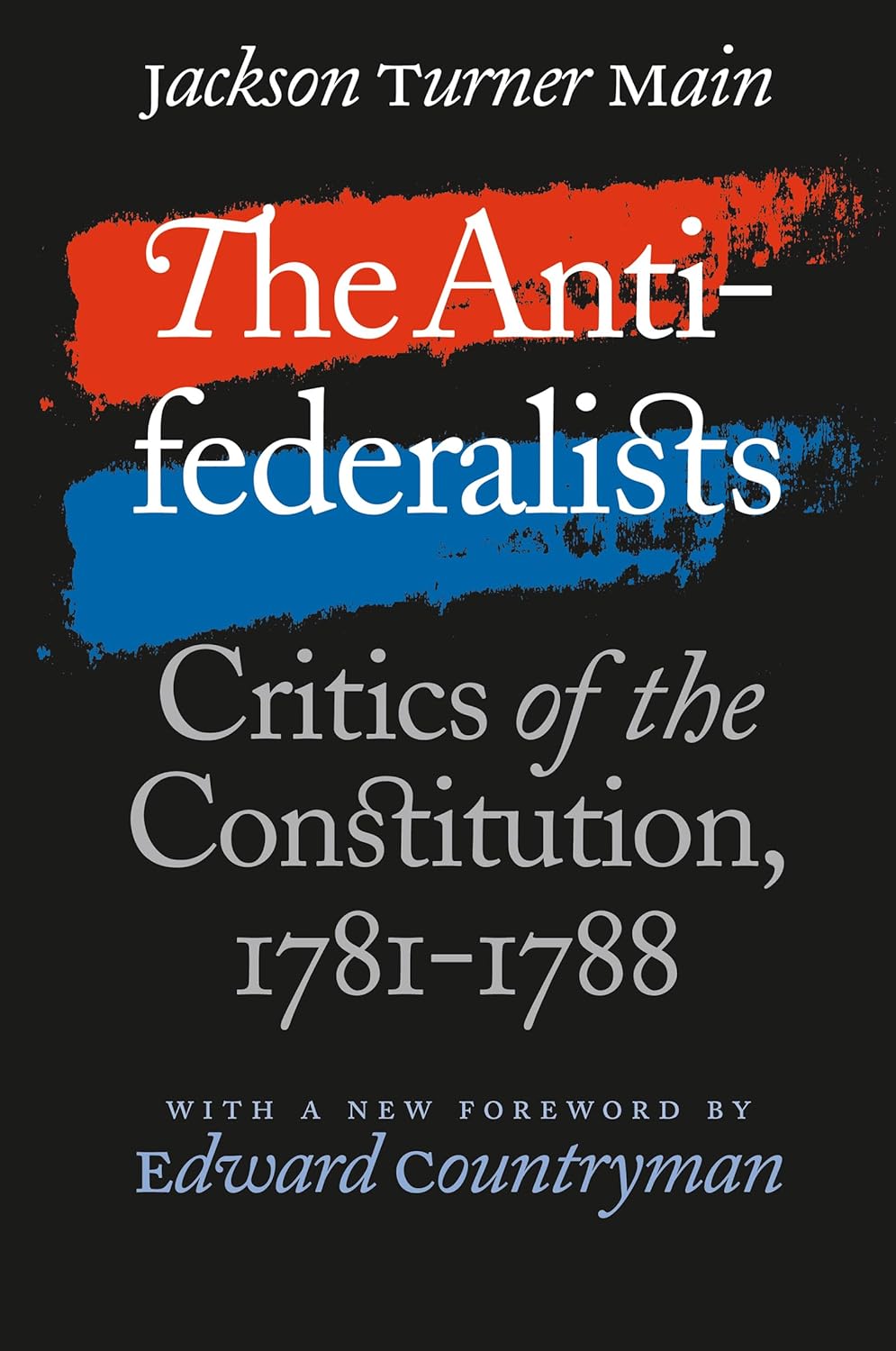
It is astounding that the United States Constitution has survived 235 years. No doubt the Founding Fathers would find the powers of the modern American presidency and the extensive system of federal taxation terrifying, but overall I think they’d be impressed and proud to see how well their handiwork has stood up over the centuries. Of course, there were many who believed the new government devised at Philadelphia in 1787 was a bad idea. Their voice – and frankly even their names – has been almost expunged from American history. I wanted to learn more about these men who opposed the Constitution. Who were they? Where did they come from? What did they believe? What did they want? “The Anti-Federalists: Critics of the Constitution, 1781-1787” by Jackson Turner Main, a doctoral dissertation first published in 1961, answers virtually all of these questions and answers them quite well.
Main’s “major generalization” is that the struggle over the ratification of the Constitution was primarily a contest between the commercial and non-commercial elements in the population. “This is the most significant fact,” he says, “to which all else is elaboration, amplification, or exception.” He claims that geography determined this bifurcation. Federalism was found along the coasts and navigable rivers that possessed a rich alluvial plain. Antifederalism was found in the interior, in places with weak soil and distant from navigable waters. For instance, in Massachusetts the Federalists were found in Boston and the other urban centers along the coast, as well as the towns on the Connecticut River in the western part of the state. Antifederalists were found everywhere else. In short, the split came down to those who depended on commerce and those who were largely self-sufficient. Main argues that these two geographic areas – coastal merchants and interior farmers – produced two fundamentally different local economies. The first was based on trade, both foreign and domestic. The second was largely self-sufficient and based on subsistence farming. Simply put, “The Federalists included the merchants and the other town dwellers, farmers depending on the major cities, and those who produced a surplus for export. The Antifederalists were primarily those who were not to concerned with, or who did not recognize a dependence upon, the mercantile community and foreign markets.”
Main stresses that wealth, talent, and position supported the Constitution: “lawyers, judges, merchants, planters, high-ranking army officers and state officials, and men of education and prestige.” On the other side were “principally small farmers.” There were genuine fears that the Federalists aimed to establish an aristocracy; that is, a government by the better sort of people, and it’s not hard to see why. As one Federalist newspaper of the time observed, “Of all the evils which attend the republican form of government, there are none that seem to have more pernicious effects than the insolence which liberty implants into the lower orders of society.” These small farmers from the interior were being looked down upon and they knew it. In the Connecticut state legislature, an Antifederal delegate from my hometown of Enfield observed that the Federalist were “delicately bred” men from “affluent circumstance” who “could not feel for the people in this day of distress.”
Indeed, the poor economy provided a critically important backdrop to the whole debate over the Constitution. The country was reeling from a major post-war depression. Heavy debt, both public and private, and a shortage of money crippled the economy. John Jay wrote in 1786: “Our affairs seem to lead to some crisis, some revolution – something I cannot foresee or conjecture. I am uneasy and apprehensive; more so than during the war.” Shay’s Rebellion in August 1786 demonstrated unmistakably the seriousness of the situation. Something had to be done, or so it seemed.
“Antifederalism was not a single, simple, unified philosophy of government,” Main says. Rather, those who believed in the benefits of local democratic control and the dangers of a strong central government embraced it. Two works of political philosophy were relevant to informing the ideas of the Antifederalists, Main says. First was “Cato’s Letters” by Thomas Gordon and John Trenchard, written in 1720. Second was “Political Disquisitions” by James Burgh, which was published in America in 1775. The central theme in both was the evil effect of power. “The love of power is natural,” Burgh wrote, “it is insatiable; it is whetted, not cloyed, by possession.” Antifederalists stressed the importance of short terms of office as well as rotation of office, and especially the dangers of central power and standing armies. For Antifederalists, taxation was the root of tyranny. Thus, they jealously guarded the power of taxation at the local level. Their overriding fear was a central government with the power of direct taxation and in possession of a standing army to enforce collection.
So what did the Antifederalists want in practical terms? Main claims the Antifederalists denied that the Articles of Confederation had failed. They believed that the Federalists were exaggerating the weaknesses of the present government, but recognized that the existing system had flaws that needed to be addressed. If they had dominated at Philadelphia, the author says, they would have maintained a confederation of sovereign states and emphasized the democratic principle of local self-government. Main claims they were willing to give Congress the power to regulate commerce and even collect duties on imports. If the member states failed to comply with their allotted requisition requirement, Main says, the Antifederalists were even prepared to authorize the levy of direct taxes to collect the delinquent funds. The President, Congress, and federal judiciary would have been accepted with limited changes, such as a shorter term for the executive, possibly a unicameral house, and the denial of federal jurisdiction over cases between states or between citizens and states. In other words, the two sides weren’t wildly apart.
The Federalists politically outmaneuvered the Antifederalists in a number of ways. First, they essentially hijacked the Constitutional Convention of 1787 by crafting an entirely new central government when they had been tasked with simply reforming the existing Articles of Confederation. Next, they sprinted out of Philadelphia and quickly arranged for ratifying conventions in the states where they had the most support before the Antifederalist opposition even had time to put their pants on. By the time the states controlled by the Antifederalists held their conventions eight states had already ratified. As the fight for ratification progressed, the Antifederalists suffered from a lack of eloquent writers and forceful speakers in support of their cause, let alone anyone to match the prestige of Washington or Franklin. What few notable leaders they did have largely resembled the Federalists themselves: mostly affluent men of education and property, such as Elbridge Gerry, George Mason, Patrick Henry, Samuel Adams, Richard Henry Lee and one future president, James Monroe. These men tended to be relatively moderate in their views – one might call them “Antifederalists In Name Only,” to borrow a modern political epithet. Nowhere do we hear from a disaffected small landholder with trenchant Antifederal beliefs like Daniel Shays. Furthermore, the Federalists controlled virtually all of the most influential newspapers nationwide, which often refused to carry the Antifederalist viewpoint and were not above disseminating outright misinformation. “The Federalist domination of news coverage permitted them not only to obtain more space for their own publications,” Main says, “but to conceal or distort the facts.” Finally, Main stresses the importance of the Federalist’s offer to amend the new Constitution in swaying a number of prominent moderate Antifederalist fence-sitters. Even with such commanding advantages and canny political subterfuge the Federalists were barely able to carry the day.
Finally, reading “The Anti-Federalists” in 2022, I was amazed how much the volatile political situation in 1787 seemed familiar. On the one side, you have the elites, urban men and women of high education and wealth, in control of most of the media, centers of higher learning, and large business. On the other side, men and women of the interior, with limited education and wealth, suspicious of large government and opposed to high taxes, who feel looked down upon and disrespected. The analogy isn’t perfect, of course, but it’s compelling. For whatever it’s worth, it should be remembered that the Federalist victory was short-lived. All of their wealth and education and prestige weren’t enough to hold back the tide of popular resistance to their aristocratic pretensions. The popular democratic movement of Jefferson and Jackson quickly and permanently overwhelmed them. It gives you something to think about.
“The Anti-Federalists” is top-notch scholarship. Main’s primary research into the background and voting records of hundreds of local and national political leaders on both sides of the debate is astounding. He shows that real research involves a lot of grunt work and the results can be incredibly illuminating.
 What's Tim Reading Now?
Leave a comment