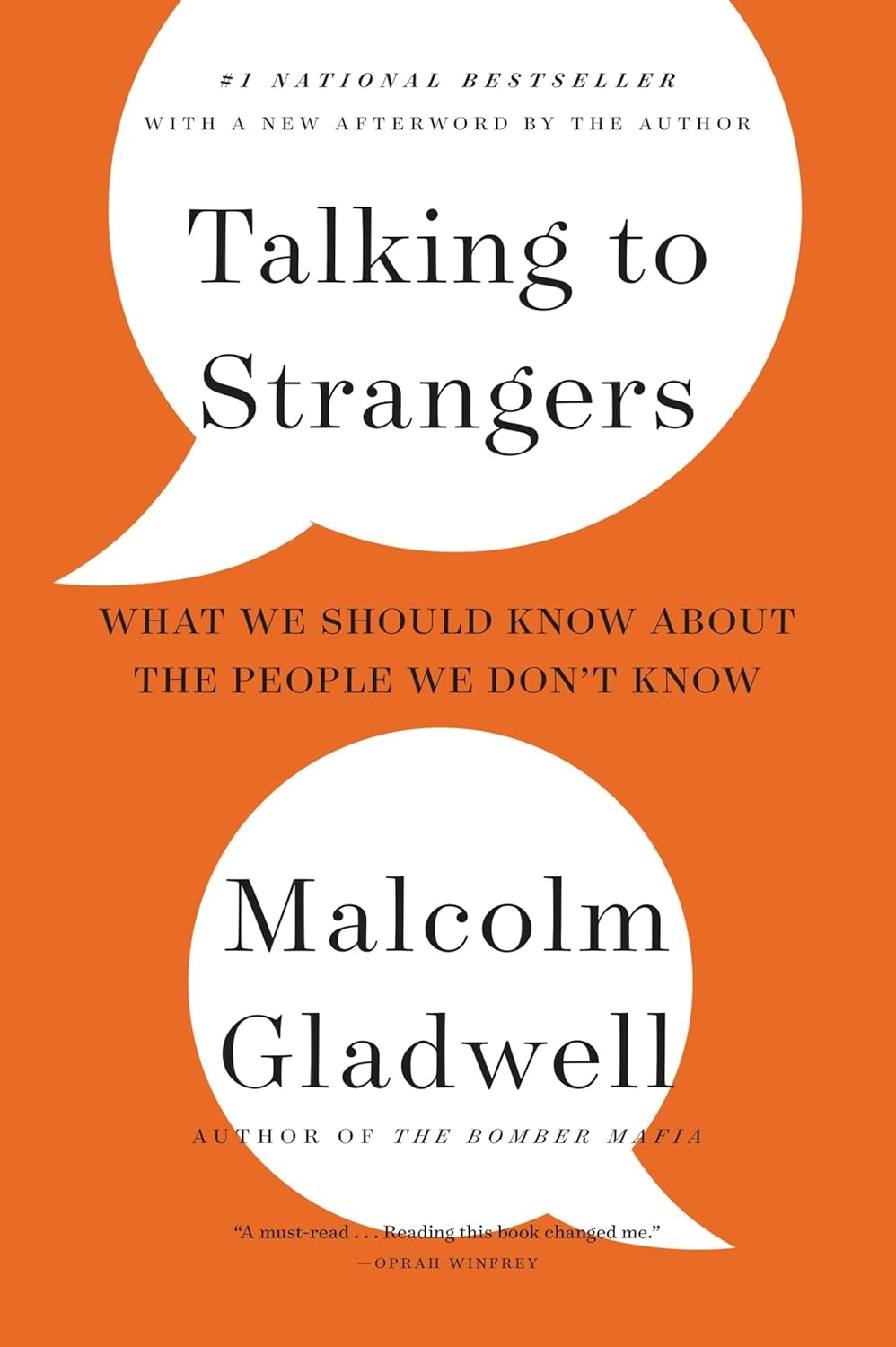
Malcolm Gladwell has had tremendous commercial success following a relatively simple formula: Ask an interesting question and then provide an unusual or unorthodox response through a variety of colorful vignettes. Many of his books have become mega hits (Blink, The Tipping Point, Outliers) and I have become a huge fan. Thus, I was surprised when I stumbled upon Talking to Strangers (2019) at a library book sale, because I hadn’t heard anything about it before. It turns out that Talking to Strangers was a rare flop for Malcolm Gladwell, and I think I know why.
Consider one example from one of his big hits – Outliers: The Story of Success (2008). Canada produces the world’s greatest hockey players. How do the best players rise to the top? On the surface, Canadian hockey player development is perfectly meritocratic. But, if you look closer, it’s actually terribly unfair. Team Canada begins advanced player development in the third grade (8-year-olds). The best pee-wee hockey players are selected to participate in a special development league that offers better coaches, twice as many games against elite competition, and three times the practice. The selections are made each year and participation one year does not guarantee selection the next. It sounds fair. But first consider the advantage an 8-year-old kid born in January has over his classmate born in December. He’s an entire year older and thus more developed. He’s almost certainly bigger, faster, and stronger. When it comes time for selection he has an enormous unearned advantage. And then once he’s selected and his younger classmate is not, it’s almost impossible for the younger player to catch up. The older, bigger kid just spent a year playing against elite competition with world class coaches. Consequently, every year when the absolute best Canadian junior hockey teams compete, roughly half of their rosters are made up of kids born in January and February. If you’re a Canadian kid born on December 20th and have dreams of playing in the NHL, you’ve really been set up for disappointment, even if you have the skill of Connor McDavid (born on January 17th, by the way).
Talking to Strangers doesn’t have any similarly compelling narrative explanations and I think that’s why this book never captured the public’s imagination. The main question Gladwell asks is a good one: Why are humans so bad at “getting” people? Why couldn’t Neville Chamberlain read Adolf Hitler? Why did the Cuban spy Ana Montes, the fraudster Bernie Madoff, and the pedophiles Jerry Sandusky and Larry Nasser get away with their crimes for so long – often decades – when in hindsight there were red flags all over the place? Gladwell offers up two simple explanations to answer this question (and one unorthodox, but minor one). The problem, I think, is that the explanations are almost too simple, too obvious – and thus unsatisfying. In other words, there’s no twist ending in Talking to Strangers, no “ah-ha!” moment.
“If I can convince you of one thing in this book,” Gladwell writes, “let it be this: Strangers are not easy.” The author says there are two main reasons people fail to accurately read strangers: 1) default to truth (i.e. we assume that people are telling the truth, which biases us in favor of the most likely interpretation of actions or events); and 2) transparency (i.e. we think we can easily see into the hearts of others based on the flimsiest of clues or as Gladwell writes, “we believe the face is the billboard of the heart”). Consequently, Gladwell says that humans are terrible at reading people, and that includes even people highly trained in reading people: “Students are terrible. FBI agents are terrible. CIA officers are terrible. Lawyers are terrible.”
Can anything be done about it? In some cases, possibly yes. Gladwell highlights the abysmal track record judges have in assigning bail. It was found that a rudimentary artificial intelligence application was capable of assigning bail far more effectively in reducing crime. The computer system only evaluated a few facts about each defendant and was not subject to the default-to-truth or transparency problems. In another example, Gladwell shows how purposely training police officers to overcome their default-to-truth bias by replicating the aggressive policing model known as the Kansas City model has led to a variety of tragic consequences with little to no upside in enhanced crime prevention. “To assume the best about another is the trait that has created modern society,” Gladwell writes. “Those occasions when our trusting nature gets violated are tragic. But the alternative – to abandon trust as a defense against predation and deception – is worse.”
Finally, Gladwell offers up a third explanation called “coupling” that adheres more to his unconventional explanations. In short, coupling means that behavior is tied directly to context and place. He uses the unusual example of post World War II suicide rates in Great Britain to illustrate his point. For several decades, nearly all British homes were equipped with what was called Country Gas. It was relatively dirty and contained high levels of deadly carbon monoxide. At the time, nearly half of all British suicides occurred inside the home using gas. By the mid-1970s, a nationwide change-over to harmless natural gas was complete and the suicide rate plunged by fifty percent. In other words, most of those gas suicides, such as the American poet Sylvia Plath, were inextricably tied to place. In the absence of a convenient, easy, painless, and mess-free was to kill themselves, most people would never have committed suicide. Gladwell argues that the same phenomenon often happens with crime. Most crime occurs on a few city blocks. If the police subject that neighborhood to saturation patrolling, the crime does not simply move around the corner, as one might naturally assume it would. At least not at first.
So what are the big takeaways from Talking to Strangers? First, Gladwell says that our primary approaches to dealing with strangers (defaulting to truth and trusting transparency) are deeply flawed, but socially necessary. In other words, those approaches may set us up for disappointment or worse, but a world without those behaviors would be much worse. Second, Gladwell writes that “the right way to talk to strangers is with caution and humility.” Understand that you naturally have these biases toward the truth and transparency, recognize their weaknesses, and consider the context of your engagement (i.e. coupling) with the stranger to further avoid misinterpretations.
 What's Tim Reading Now?
Leave a comment