George Orwell’s debut novel, “Burmese Days” (1934), is one of my all-time favorites. Orwell brilliantly captures the class obsessed and condescending superiority of late Imperial Britain. The vain and dashing cavalry officer, Lieutenant Verrall, is surely one of the more execrable characters in twentieth century fiction. He is also a spot-on caricature of the type of ambitious and well educated young man who once made the British Empire tick.
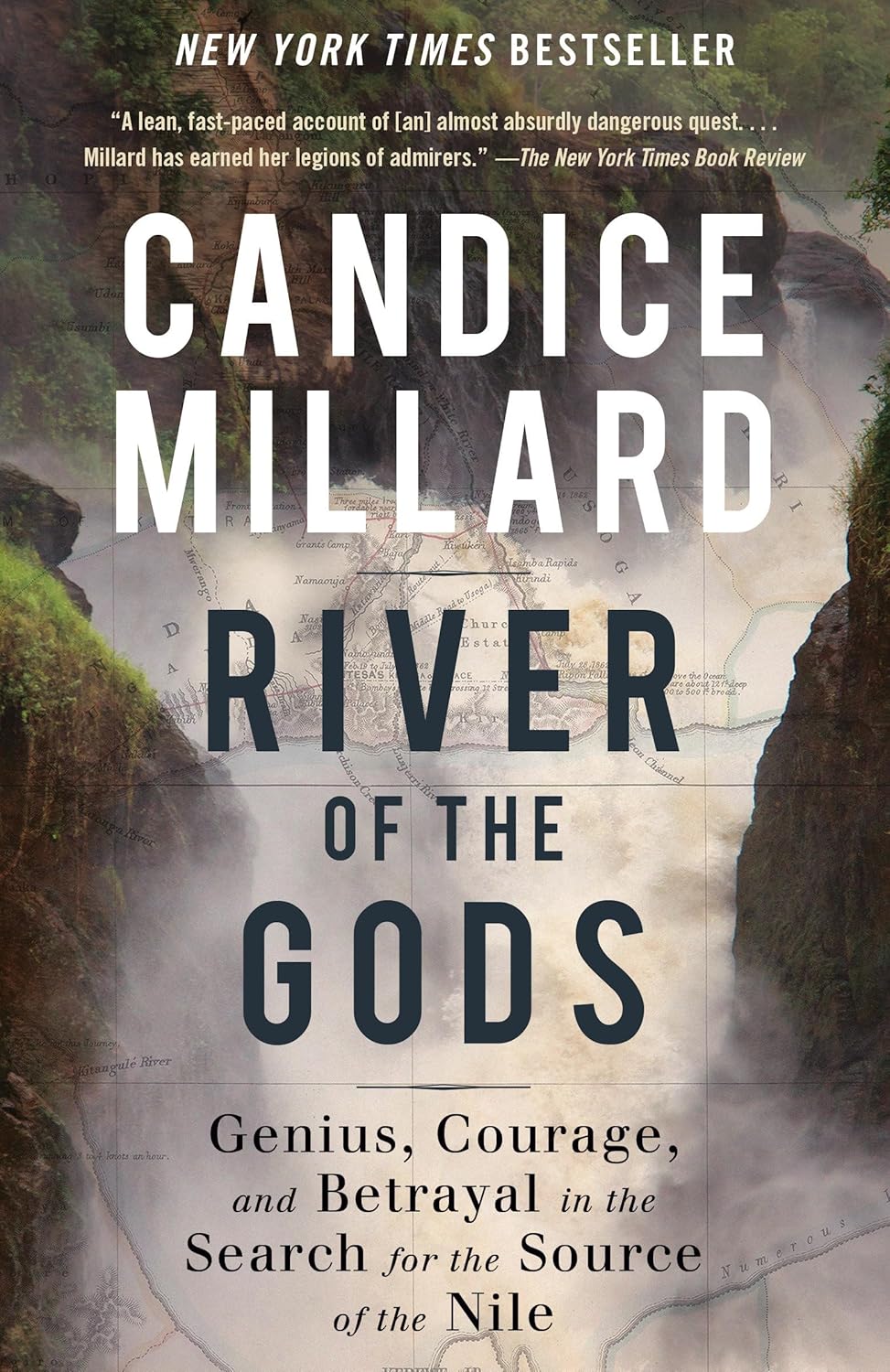
Candice Millard tells a real-life “Burmese Days” story in her most recent bestseller, “River of the Gods: Genius, Courage, and Betrayal in the Search for the Source of the Nile” (2022). Orwell’s Lieutenant Varrell comes to life in the form of two intrepid and rivalrous mid-nineteenth century explorers with names pulled right from the pages of Dickens: Richard Francis Burton (1821-1890) and John Hanning Speke (1827-1864).
By the year 1850, there weren’t many “firsts” left in the world for fearless young explorers looking to risk life and limb in the hopes of achieving everlasting fame – and perhaps furthering the knowledge and understanding of mankind. But one age-old question remained unresolved: what was the source of the White Nile? It was “the Holy Grail of exploration,” Millard says, and had been for a very long time. The Romans even had a saying: Facilius sit Nili caput (“It would be easier to find the source of the Nile”).
The Nile is the longest river in the world, flowing over four thousand miles from central Africa to the Mediterranean. Some 1,400 miles upstream from the delta, the mighty river splits in two at the city of Khartoum, Sudan. One fork is the Blue Nile. In 1770, Lake Tana in northern Ethiopia was discovered to be its source.. The other, the White Nile, remained a mystery. South of Khartoum the river emerges from an impenetrable morass known as The Sudd, which prevented earlier exploration parties, some dating from the time of the Roman empire, from identifying the ultimate source of the river. The only way to determine the source of the Nile was to approach it from the rear. That is, land an expeditionary force from Zanzibar, an island some twenty miles off the coast of modern day Tanzania, and march overland into the vast “Mountains of the Moon” region of central Africa in modern day countries of Rwanda and Uganda.
Millard’s narrative focuses on three attempts that were made to locate the source of the White Nile beginning in 1854 and the acrimonious aftermath between all parties involved. The actual expeditions themselves, I found, were somewhat anticlimactic. Unlike the author’s previous adventure tale, “The River of Doubt” (2005), about Teddy Roosevelt’s perilous journey down an unexplored river in the Amazonian rainforest, the harrowing experience of trekking hundreds of miles across lion- and crocodile- infested jungle while dodging head-hunting natives play small part in the overall drama of Millard’s character-driven story.
The characters in “River of the Gods” certainly are characters. Richard Burton is just the type of improbable personality that the British Empire seemed to produce with inexplicable regularity during the nineteenth century. Burton spoke dozens of languages and dialects, evidently fluently, and somehow developed the ability to acquire new languages in a matter of months. While agnostic himself, he was an authority on all of the world’s major religions and a pioneer in the field of anthropology. He was handsome and valiant – and controversial. In 1854 Burton became the first Englishman to enter the holy city of Mecca. He did so by disguising himself as an Arab merchant and leaning heavily on his flawless Arabic. Burton went so far as to get circumcised to complete his disguise. He was nothing if not committed. “Nothing for Burton was out of bounds or impure,” Millard writes, “and he never feared heavenly and certainly not earthly condemnation.”
Speke was six years younger than Burton and far less talented. He possessed none of Burton’s African language skills nor his appreciation for foreign cultures. Speke was, however, better born and better connected, not inconsiderable advantages in Victorian Britain.
In 1854, at the age of 33, Burton made his first attempt at locating the source of the White Nile. He appointed Speke as his surveyor and second in command. It would be perhaps the worst decision of Burton’s long and eventful life. The expedition didn’t make it very far. They were attacked by natives in Harrar, Ethiopia before they even got started. Burton received a grievous javelin wound to the face. In the aftermath, Speke would question Burton’s leadership and Burton would question Speke’s bravery. When Burton published Speke’s travel journal without his permission as part of Burton’s book on the ill-fated expedition, “First Footsteps in East Africa” (1856), Speke was appalled. The incident filled Speke “with impotent fury and a thirst for retribution,” according to Millard.
Somewhat inexplicably, Burton extended an invitation to Speke to join his followup campaign, known as the East Africa Expedition. Speke accepted because he hadn’t been able to independently fund an expedition of his own. Their relationship was tense from the start and deteriorated further over the course of the campaign. The Expedition departed Zanzibar in the summer of 1857 with the objective of reaching Lake Tanganyika in the Rift Valley, which Burton believed was the source of the Nile. It took the expedition 134 days to travel the six hundred miles to Tanganyika, the longest and, at almost a mile deep, the second deepest lake in the world. Burton and Speke became the first Europeans to reach the lake, but it came at a price. The expedition’s supplies were nearly exhausted, most of their porters had deserted, and Burton was prostrated by disease.
On the return voyage to the coast, the expedition stopped at Kazeh so Burton could rest and others could re-equip. Speke set out on his own to explore another large lake in the region, known as Lake Nyanza, later renamed Lake Victoria. He was accompanied by an accomplished guide, a former slave named Sidi Mubarak Bombay, who was, according to Millard, the true hero of the entire story – “steadfast, honest, and brave.” Lake Nyanza is the largest lake in Africa and the second largest freshwater lake in the world. Speke did not fully or carefully explore Nyanza, but he was immediately convinced that he had discovered the true source of the White Nile. So far as Speke was concerned, he was the hero and true leader of Burton’s East Africa Expedition.
The expedition returned to Zanzibar in February 1859. The trip to the African great lakes regions and back had taken 18 months. Burton was still on death’s door. Speke hurried back to London to spread the news of “his” discovery and contrast his energetic and daring conquests with Burton’s tired and sickly incapacitation. He buttonholed and won over Sir Roderick Murchison, three-time president of the Royal Geographical Society, and quickly convinced him to fund a return mission to Nyanza, this time commanded by Speke. Burton returned to London two months later. “Speke was no longer his friend and protege but his adversary,” Millard writes.
Burton rarely helped himself in these situations. He took delight in being unconventional and deliberately shocked proper society with his speech and acts. According to Francis Galton, the founding father of eugenics, “[Burton’s] usual conversation in those days was not exactly of a stamp suitable to Episcopal society.” Speke, on the other hand, while a poor speaker and writer, did boast aristocratic blood and relatively good manners. Not only did he win support from the Royal Geographical Society for a return trip to Nyanza, but he was granted five times more funding than Burton had been.
Speke’s plan was simple. He would lead his twenty-man expedition overland some five hundred miles from the East African coast directly to Lake Nyanza. From there they would explore the northern shore of the lake looking for a river flowing northward out of the lake. Speke would then follow that river north until he rendezvoused with a British officer named John Petherick at the German mission town of Gondokoro. Speke would eventually show up thirteen months late and was miffed that Petherick hadn’t waited around for him. Speke returned to London the man of the hour. Meanwhile, Burton slowly faded into obscurity, serving in a minor consular post on the pestilent island of Bioko off the coast of Cameroon.
Burton possessed an extremely valuable advantage over Speke in their intense rivalry for the admiration of the Royal Geographical Society and British public opinion at large. Burton was a brilliantly articulate writer and captivating speaker, whereas Speke wrote, according to his own publisher, in such “an abominable, childish, unintelligible way” that nobody could make sense of what he was trying to communicate. Speke’s adventure tale, “Journal of the Discovery of the Source of the Nile,” had to be ghostwritten. The book came out in December 1863. Speke and the book were immediately pilloried for flagrant errors in cartography and for falsely accusing Petherick of having had a role in slave trading, a baseless accusation that ultimately cost him his job.
The debate confirming the true source of the Nile was taken up in September 1864 at the 34th annual meeting of Section E of the British Association for the Advancement of Science. The silver tongued Burton would make the case for Lake Tanganyika; the inarticulate Speke would defend his argument that it was Lake Nyanza. The highly anticipated showdown never happened. Speke shot himself in the chest with a shotgun the day before the debate. The death was ruled accidental, but the details and circumstances point strongly to suicide.
Burton lived long enough to see his irascible former partner proven correct. “Poor, aging, sick, and angry,” according to Millard, Burton was now also “wrong.” In 1871, the legendary explorer David Livingstone circumnavigated Lake Nyanza and confirmed that the enormous lake was, indeed, the principal source of the mighty Nile. Despite having conclusively solved “the problem of all ages,” according to the Royal Geographical Society, John Hanning Speke was quickly and completely forgotten. Over the past century and a half, only one slender biographical sketch has been written about him. Burton, meanwhile, has been the subject of over a dozen biographies. He died in 1890 after having served the British government at posts in Brazil, Damascus, and Trieste. Burton at least enjoyed the tireless and faithful support of his devoted wife of over thirty years, Isabel, a British aristocrat and devout Catholic who had married the famed and controversial explorer over the strenuous objections of her family. She too would have made a great character in a Victorian novel.
 What's Tim Reading Now?
Leave a comment