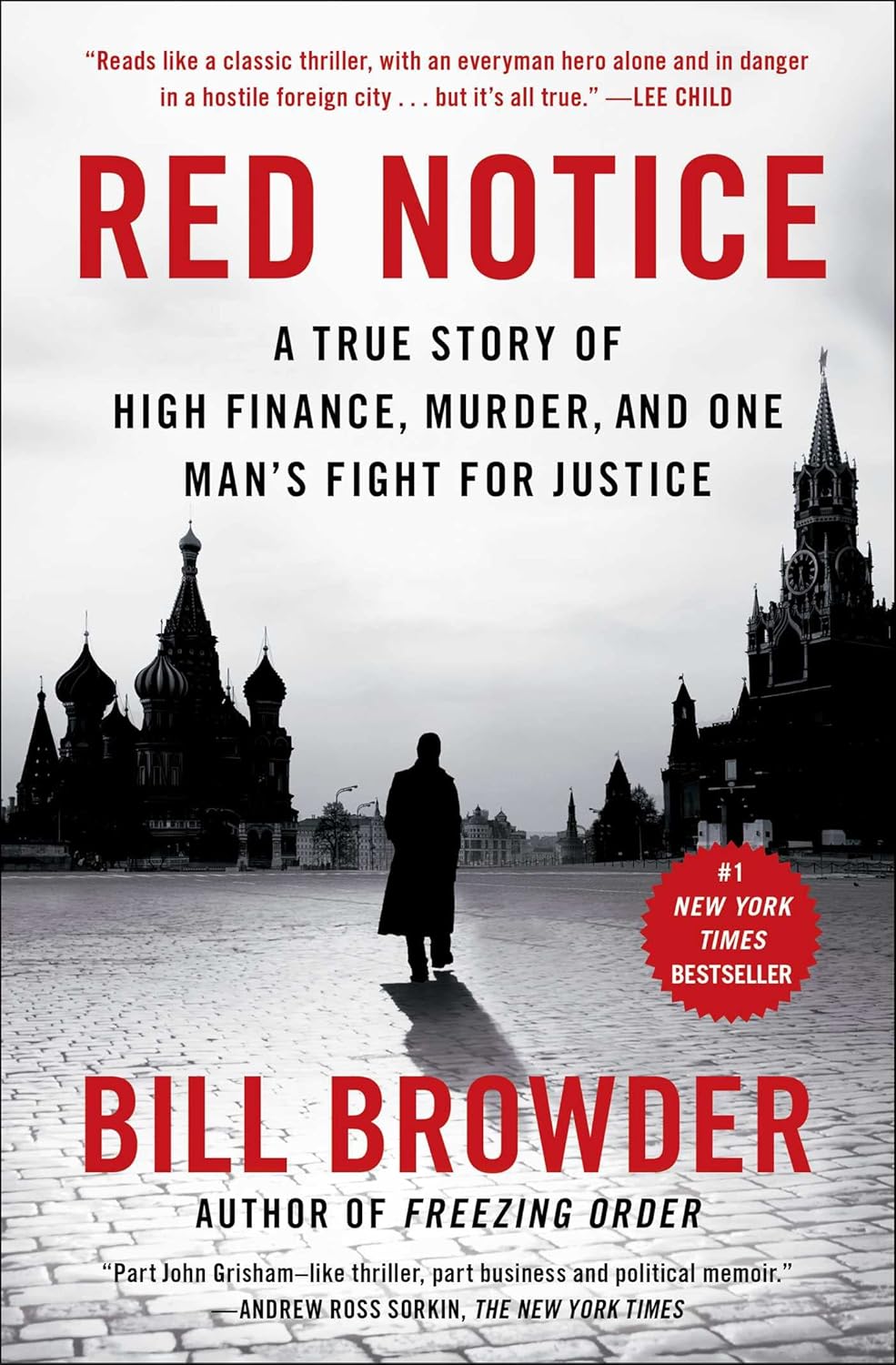
The best part about writing a memoir is you get to be the hero of your own story. And believe me, Bill Browder is the hero of “Red Notice: A True Story of High Finance, Murder, and One Man’s Fight for Justice” (2013).
But is Browder a hero? Some hedge fund titan cum fearless Galahad exposing the corruption and lies of a dangerous autocratic regime? Perhaps. But I can’t help believing that there is a lot more to the story than you’ll find in the pages of “Red Notice.”
Bill Browder’s personal narrative is no doubt exceptional. His grandfather, Earl Browder, was president of the American Communist Party. His parents and siblings are all world class Ivy League mathematicians who generally embraced the elder Browder’s leftist politics. Bill Browder, on the other hand, was something of a family misfit and rebel. When you’re a young man and want to rebel against your radical left-wing family, what do you do? Become a cutthroat capitalist, of course. Browder checked all the right boxes in that pursuit: straight A economics student at the University of Chicago; stint at Bain & Company, one of the best strategy consulting firms in the world; an MBA from Stanford; back to strategy consulting with Boston Consulting Group in London, where he worked on the first privatization initiatives in the former Eastern Bloc. By the late 1990s Browder had landed at Salomon Brothers and was pushing hard for the firm to invest in Russia. When the firm eventually embraced his idea but looked elsewhere inside the bank for someone more seasoned to run it, he left to form his own fledgling hedge fund, Hermitage Capital Management.
Browder’s early years investing in Russia are the most interesting parts of the book. Russia possessed vast natural resources and a sprawling, but antiquated industrial base. The country had 24 percent of the world’s natural gas, 9 percent of the world’s oil, and produced 7 percent of the world’s steel. Yet, at the time of privatization after the fall of the Soviet Union, the entire economy was only valued at $10 billion. Clearly, lots of things were being undervalued.
The author discovered that many Russian companies, particularly oil and gas operations, were dramatically undervalued based on their enormous reserves and potential growth. For instance, in terms of hydrocarbon reserves, the Russian oil & gas giant Gazprom was 8 times bigger than ExxonMobil and 12 times bigger than BP, but traded at literally 1 percent of those companies. The reason was Gazprom’s management was a kleptocracy. Employees were stealing literally billions of dollars from the company. In one case, Gazprom officials purchased a gas field in Siberia owned by a Gazprom subsidiary with half-a-billion dollars in gas reserves for the bargain basement price of $1.3 million. It introduced Browder to the “dirty dishonesty of Russia…a completely lawless society…a place where lies reign supreme.”
It’s unclear exactly when Browder began to feel this way: before he made billions betting on Russian firms or after he had been permanently kicked out of the country? I suspect it is the former because Hermitage invested in Gazprom nevertheless and ultimately struck it rich with a hundred times return on their investment. Browder writes that “It was, without question, the single best investment I have ever been involved with in my life.”
Browder recognized from the very beginning that the business rules in Russia were quite different from those in the West. In fact, he compares it to a prison yard where survival depends on building a reputation for brutality and then defending that reputation ruthlessly whenever it’s challenged. It didn’t take long before Browder was traveling with a large security detail.
I was enjoying “Red Notice” quite a bit, more or less accepting everything I was reading as fact or something close to it. But there were parts of Browder’s story that struck me as odd, almost inexplicable. For instance, by his own admission, Browder never learned to speak Russian. Like, not even a little bit. Russian is a notoriously difficult language to learn. I know that from firsthand experience. I studied Russian in college, spent a semester at Moscow State University, and continued my Russian training in graduate school. Learning Russian is one of the hardest things I’ve ever done. But I did it. Browder is undoubtedly an incredibly intelligent man; his academic record is clear evidence of that. He was living in Moscow for almost a decade, traveling all around the country, interviewing anyone he could find who knew anything reliable about Russian companies, and eventually married a beautiful Russian woman. And he never learned to speak Russian?! I just don’t know how you explain that, other than it’s some combination of arrogance and cultural insensitivity. At one point in the book Browder notes how Russian stories never have happy endings. He writes, “As anyone who has read Chekhov, Gogol, or Dostoyevsky will tell you.” Well, the more I got to know Bill Browder in the pages of “Red Notice” I would be shocked if he ever so much as leafed through a Russian literary classic.
My doubts about Browder intensified when he began to fight back against the Russian government’s efforts to expel him from the country in 2005. After years living and working in Moscow, Browder was back in London where he had retained a home from his days at BCG and Salomon Brothers. Browder was leaning heavily on the British government to help him straighten things out with the Russians. He met with the former British ambassador to Moscow and coordinated with the British Foreign Office to escalate his situation to then prime minister Tony Blair. As I was reading this I kept thinking, “Why is this American businessman spending all of his time trying to get the British government to help him and not the US State Department?”
Well, there was a simple explanation for Browder’s behavior, but he never once mentions it in “Red Notice.” The reason is he was no longer an American citizen when his troubles with Vladimir Putin and the Russian government arose. That’s right, I learned on the Internet that Bill Browder renounced his American citizenship back in 1998 for reasons that are a bit unclear, but were likely politically motivated and not tax-related. I was dumbstruck that Browder failed to disclose this piece of information that is incredibly germane to his story and the subsequent behavior of the Russian government.
First, and perhaps most importantly, I’m certain it had a significant impact on how the Russian government – and Putin in particular – viewed Bill Browder. Being a traitor is about the worst thing you can be in Russian culture and I’m sure that’s exactly how the Russians looked at Browder. Remember that Putin is a former KGB agent. Moreover, he served in counterintelligence, the spy hunters. To Putin, a man like Browder, a filthy rich capitalist who turned his back on his own country, is the scum of the earth. Putin’s evident obsession with getting back at Browder no matter the cost makes a lot more sense when viewed from the perspective of a former KGB counterintelligence agent dealing with a snake with no international protector.
Second, what motivation do these governments have in getting involved with some hedge fund manager who ran into trouble with the Russian authorities? From London’s perspective, they’re probably thinking “You’ve only been a British subject for a minute and you more or less live in Moscow with a pied a terre in London while making millions investing in shady Russian oil companies. Why should we help you?” From Washington’s perspective, they’ve got to be thinking, “We don’t usually come to the rescue of hedge fund managers operating in notoriously corrupt countries after that person has renounced their citizenship. Sorry.” Browder had to know this, right? Putin and his henchmen in Moscow certainly had to.
I kept reading “Red Notice” expecting Browder to finally divulge the truth about his citizenship. But he never did. After he got nowhere leveraging British diplomatic resources, he finally tried working with the Americans. On page 289 he writes: “Given my personal history, the next logical place to turn was the United States.” In other words, given that I was born and raised in the United States, afforded the absolute best possible education the country could provide at both the undergraduate and graduate levels, and then went on to work at some of the most prestigious American consulting and bankings firms, only to renounce my citizenship from that very country that gave me everything, I was hoping Washington would let bygones be bygones and come to my rescue. I can’t figure out if he’s genuinely delusional or just hoped no one would notice.
This leads me to my final nagging question about “Red Notice” – why did Browder go to such great lengths to fight the Russian government after the tax fraud had been discovered? The core issue at the heart of “Red Notice” involves a massive tax fraud allegedly perpetrated by government officials long after Browder and Hermitage Capital had left Russia. In other words, Browder and his family were safely out of Russia and living peacefully in London. Browder’s people back in Moscow had successfully liquidated all of Hermitage’s holdings in Russia and returned all the money back to investors. Moreover, most of Hermitage’s Russian workers had managed to flee the country and settle abroad. Thus, when some corrupt officials at the Russian tax office siphoned off $230 million in tax rebates from a couple of Hermitage’s former investments, it really had nothing to do with Browder or his investors. The money was stolen from the Russian people, not Hermitage or any of its people. Bill Browder could have just walked away and focused on his next chapter. I’m sure Putin and the Russian government would have been happy to see him go. Instead, Browder pushed to expose the crime, thus setting in motion of train of events that killed one of his lawyers and, in all likelihood, led to his conviction in absentia for tax evasion, a nine-year prison sentence, and an Interpol “Red Notice,” the closest things we have to an international arrest warrant.
Browder dedicated “Red Notice” to Sergei Magnitsky, a man who never worked for Hermitage Capital. Frankly, Magnitsky and Browder may have never physically met. Magnitsky was head of the tax practice at Firestone Duncan, a Moscow-based law firm headed by a couple of American expats. Magnitsky’s name doesn’t appear in “Red Notice” until page 202, long after Browder had been barred from re-entering Russia. It wouldn’t surprise me if Browder never actually met Magnitsky face to face. Maybe he did, but if so, Browder likes to pepper his narrative with heartwarming stories about his time with other friends and lovers, but never with Magnitsky, the ostensible hero of the story. Perhaps I’m reading too much into things, but even the dedication in the front of the book raises my suspicions: “To Sergei Magnitsky,” Browder writes, “the bravest man I’ve ever known.” Not “met,” but “known.”
Browder’s greatest victory is perhaps the Sergei Magntisky Act of 2012, which authorized the US government to sanction individuals it found to be human rights offenders, including the freezing of assets and banning them from entry to the United States. The author notes, over the past few years 13,195 bills have been proposed in Congress but only 386 have made it out of committee and been voted into law. He writes, “We had completely defied the odds.” For once, he’s not exaggerating.
In closing, Browder tells a truly amazing tale. I just wish someone more reliable and objective had told it, someone like Michael Lewis.
 What's Tim Reading Now?
Leave a comment