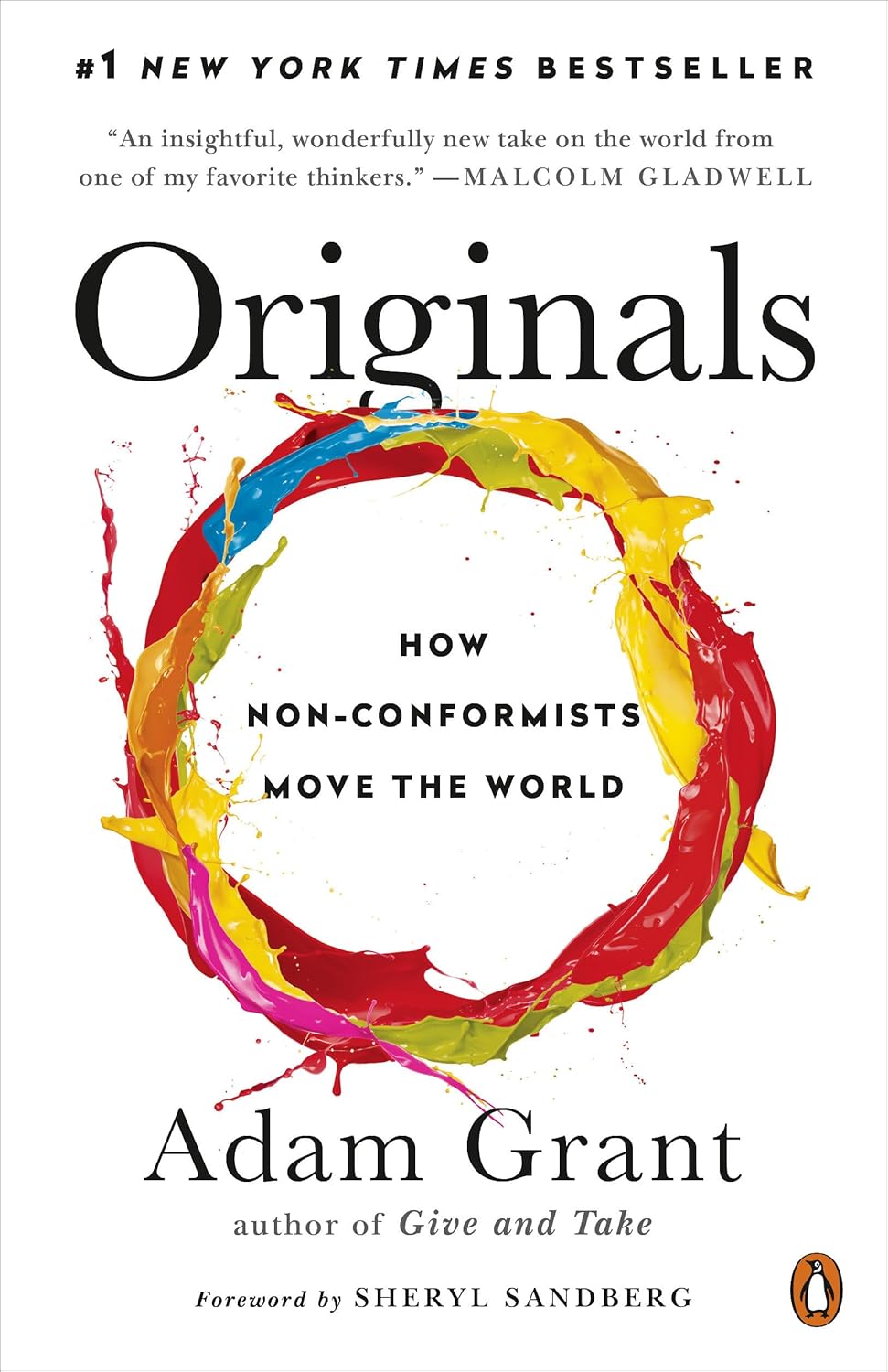
Wharton professor Adam Grant has carved out a respectable niche in the space between academic behavioral economics and pop business management. I had heard him on various podcasts over the years, but I had never read any of his material. I found “Originals: How Non-Conformists Move the World” (2016) to be pretty disappointing.
My disappointment stems from three perceived shortcomings of the book. First, many of the author’s supposed insights don’t feel very insightful. Consider the case of “Seinfeld,” the most commercially successful television program of all time that very nearly never got on the air because of how poorly it tested. The person most responsible for getting “Seinfeld” made was Rick Ludwin, the executive at NBC who fought for the groundbreaking comedy when nobody else would. Why did Ludwin see the show’s incredible potential when no one else could? Grant puts forward two explanations. First, Ludwin understood comedy in a way the other executives didn’t. Earlier in his career he did standup and was a comedy writer for the Tonight Show. Second, he wasn’t in the sitcom division at NBC and thus didn’t have any preconceived notions of what a successful comedy show had to look like. Thus, Grant concludes the key to picking winners is being something of an expert in the core field, but not too close to things so as to develop blinders. This is an interesting idea, but is it defensible? Could you demonstrate these finding with ten other similar examples? I doubt it.
Second, some of Grant’s other findings are so obvious as to be nonsensical. In one case he talks about a CIA analyst who fought against the agency’s conservative bureaucracy to get a classified internal website launched. She first began lobbying for the website in the mid-1990s and was rebuffed. She tried again in the early 2000s and lo-and-behold she was successful the second time around. Grant postulates a framework from successful change management based on the analyst’s decade-long endeavor. But isn’t a more obvious explanation simply that the CIA inevitably caught up with the times? Are we really to believe that if it weren’t for this renegade woman’s efforts the CIA would still be using nothing but paper reports to this day? Again, I doubt it. In another example, he talks about the benefits of procrastination. Two of the most famous political speeches in American history were cobbled together at the last minute: Lincoln’s Gettysburg Address and King’s “I Have a Dream” speech. Grant tells us that sometimes if you just wing it you’ll get better results – or at least more creative results. Sure, if you have no time to prepare you might come up with some really off-the-wall ideas, but would anyone in their right mind use this as a strategy? I’d hope not.
Third, some of the case studies don’t have much to do with the basic premise of the book. Consider the feud between the nineteenth century suffragists Lucy Stone and Susan B. Anthony and Elizabeth Cady Stanton. Their dispute erupted over the Fifteenth Amendment giving African-Americans the right to vote. Stone supported it; Anthony and Stanton opposed giving anyone else the right to vote before women. Grant writes that, “the narcissism of small differences reared its ugly head.” How this sad case adds up to help us better understand “how non-conformists move the world” is unclear to me.
Grant does gather some interesting facts along the way, although it’s unclear what you’re supposed to do with them. One is that geniuses are uncommonly productive. For instance, Mozart composed 600 musical pieces before he died at age 35; Picasso’s portfolio includes over 1,800 paintings; Angelou published 165 poems; Edison had almost 1,100 patents; Shakespeare produced 37 plays and 154 sonnets. Grant says that these creative geniuses “simply produced a greater volume of work, which gave them more variation and a higher chance of originality.”
And then there is the curious case of later born children. Unlike their firstborn siblings, later born children are born rebels. They are statistically more likely to steal home base or do standup comedy, for whatever that’s worth.
In closing, I found a few nuggets in “Originals” but it doesn’t add up to a worthwhile read. If this topic of success and originality interests you I would recommend that you read Malcolm Gladwell’s “Outliers” instead.
 What's Tim Reading Now?
Leave a comment