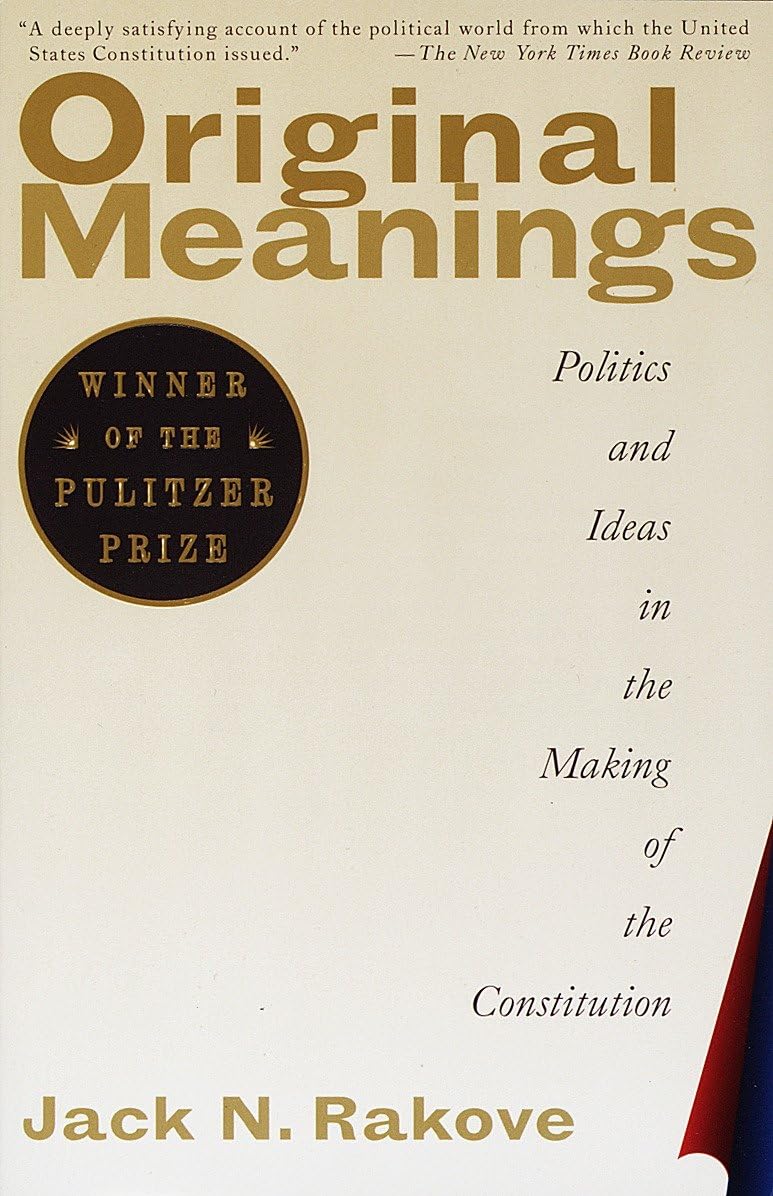
“Original Meanings: Politics and Ideas in the Making of the Constitution” by Jack Rakove is one of the most challenging books I’ve ever read. Normally, I plow through books like this in a week or two. I found that I could only read “Original Meanings” for maybe six to ten pages before my eyes glazed over. But I kept at it, month after month, until I was finished. And I’m glad I did as I learned a lot from this 1996 Pulitzer Prize winner.
“Original Meanings” is jam-packed with insights and arguments concerning the crafting and ratification of the United States Constitution in 1787-88. But one thing stood out above everything else: James Madison and his deep disillusionment and fear of the new state governments. Indeed, Rakove writes: “We simply cannot understand how or why the Constitution took the form it did unless we make sense of Madison,” and it turns out that you cannot make sense of Madison without appreciating his visceral aversion to grassroots democracy.
Shortly after the Declaration of Independence, 11 of the 13 colonies quickly instituted democratic state constitutions. Only two states (Delaware and Pennsylvania) framed their constitutions by specially elected conventions. None of the new state constitutions were submitted to the people for approval. In each executive power was eviscerated; the legislature predominated. Madison would gain personal experience with the issue as a delegate to the Virginia state assembly in the 1780s. The Articles of Confederation limited members to serving only three years out of every six. When Madison’s term limits were reached in Philadelphia, he would cycle back to serve in the state government in Richmond. What he saw there – and heard about other state governments around the fledgling republic – shocked and dismayed him. The quality of the representatives was low. The nature of the debates was parochial. The power of the state legislatures was terrifying. In Madison’s opinion, the people of the United States needed to be saved from the weaknesses and excesses of legislative misrule. He arrived in Philadelphia in May 1787 determined to do something about the dangers inherent in the majoritarian premise of republican government. No longer did lawmakers have to rely on the theories of Montesquieu; they now had a decade of practical experience to draw from. “Madison went to Philadelphia in the grip of a deep passion,” Rakove writes, “convinced that he had found a complete remedy for the vices of the American political system.”
Madison’s core argument was that state politicians and politics were essentially and hopelessly parochial. Neither state legislators nor their constituents could be relied upon to support the general interest of the Union. “[Madison’s] ideas of federalism, representation, and the separation of powers – the crucial theoretical issues that the Constitution would face – all reflected his disillusion with the failings of the state legislators and citizens alike.”
Anti-Federalist opponents to the Constitution claimed that it was designed to be an aristocracy, the rule of the few and the best. Based on Rakove’s analysis of Madison, they were absolutely correct in their fears. “In contrast to the petty demagogues and untutored novices who gave state assemblies their sorry tone,” Rakove writes, “a national congress could recruit a superior class of lawmakers whose decisions and deliberations would rise far above the corresponding proceedings in the states.” The net aim of the Federalist program was “to render the Union politically independent of the states and the states legally dependent on national oversight.”
Madison endeavored to keep the new federal government small and exclusive. It was believed that the prestige and power of national office would draw a better class of leaders to acquire political power. Anti-Federalists, meanwhile, quailed at the small size of the proposed House of Representatives, fearing it would quickly become “a haven for ambitious aristocrats.” Madison blasted back in Federalist 55: “Had every Athenian citizen been Socrates, every Athenian assembly would still have been a mob.” In the eyes of the Anti-Federalists, the proposed Senate was even worse than the House. “Like the Convention that had created it,” Rakove writes, “the Senate loomed as a conspiratorial den.” Interestingly, of the three branches of government, the executive branch worried the Anti-Federalists the least.
Madison took away three critical lessons from the recent experience under the state constitutions. First, the abuse of legislative power was more ominous than arbitrary acts of the executive. Second, minorities and individuals needed to be protected from fractious popular majorities acting through government. Finally, national government was less dangerous than state and local despotisms. It is amazing how far Madison had come from the early days of the Revolution when he was primarily opposed to the arbitrary and distant authority of an all-powerful monarch. By 1787, his overriding concern was taming the power of political factions operating democratically through the state legislatures.
Madison now argued that the problem of rights was “no longer to protect the people as a collective whole FROM government but to defend minorities and individuals against popular majorities acting THROUGH government.” That is, the people themselves, acting through their representatives, were the chief danger. Madison believed that these popular threats to liberty were most likely to arise within the states. Shay’s Rebellion in Massachusetts in the summer of 1786 was top of mind and illustrative of the impending danger. Economic legislation, such as paper-money and debtor-stay laws, pushed by a local and vocal faction, directly threatened property rights, one Madison’s most deeply held concerns. He aimed to protect citizen’s fundamental rights and liberties from the encroachment of legislative tyranny. Madison’s main argument was that central government must act as a “disinterested & dispassionate umpire in disputes between different passions & interests in the State … [and thus curb] the aggressions of interested majorities on the rights of minorities and of individuals.”
In closing, Rakove makes much of Madison’s “theory of faction” as articulated in Federalist 10: Factions are groups “united and actuated by some common impulse of passion, or of interest, adverse to the rights of other citizens, or to the permanent and aggregate interests of the community.” Danger arises when these factions achieve political power and put their interests above the common good. “The public good is often decided,” Madison writes, “not according to the rules of justice and the rights of the minor party, but by the superior force of an interested and overbearing majority.” Madison believed these factions posed the greatest threat at the state level operating through the local legislatures. It was mainly to curb these excesses of legislative misrule that Madison’s United States Constitution of 1787 was crafted. If any branch of the new national government were to prove despotic, Madison felt it would be the House of Representatives, the most democratic of all the branches. There is much more to “Original Meanings” than what I’ve laid out above, but these are the points that impressed me the most. If you’re looking to learn more about the framing and ratification of the Constitution, particularly James Madison’s central role in the process, “Original Meanings” is a deeply researched, very insightful but turgidly written analysis.
 What's Tim Reading Now?
Leave a comment