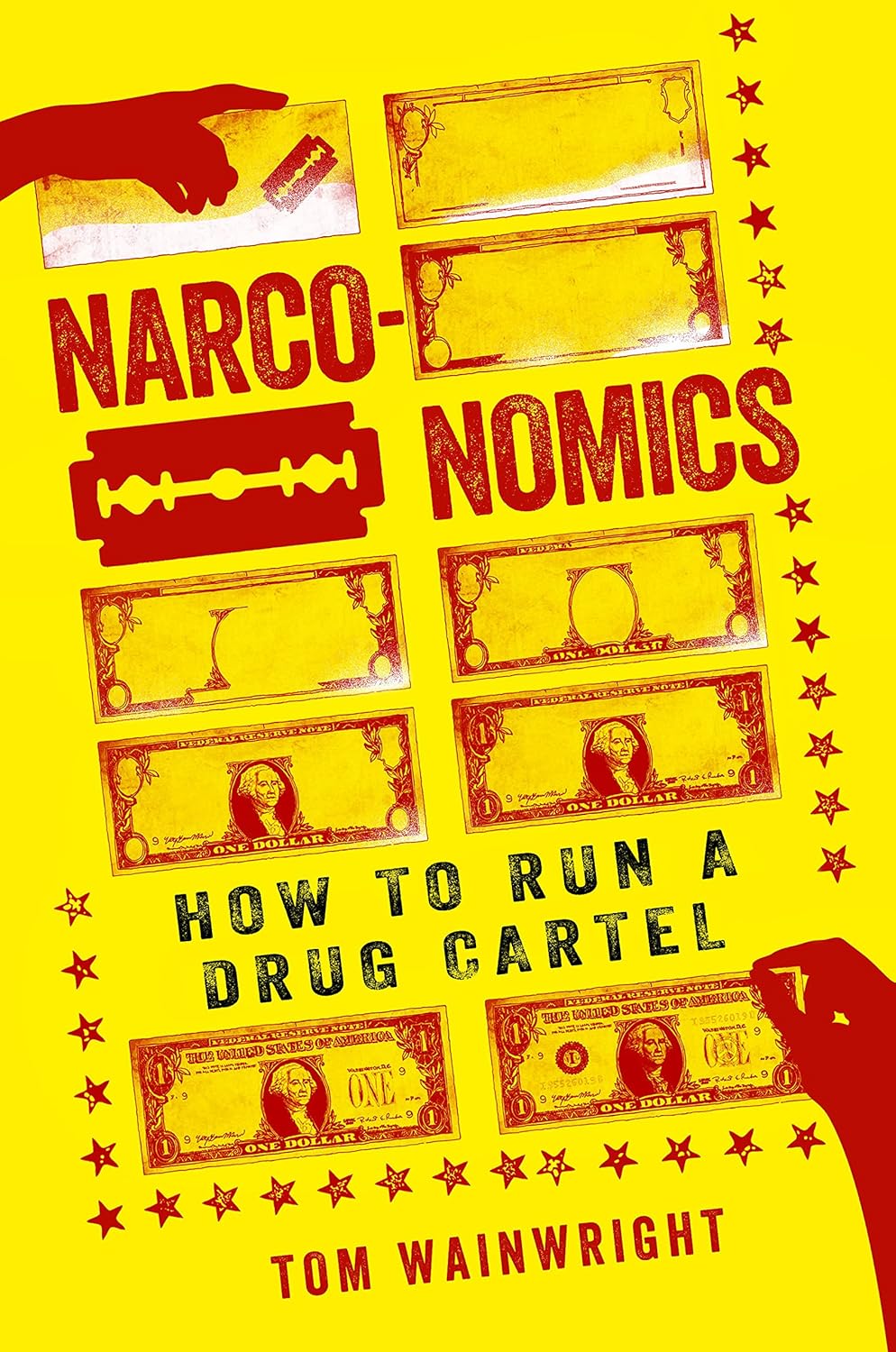
It’s often said that you shouldn’t judge a book by its cover. Over the years I’ve learned that you could say the same thing about its title. Consider the case of “Narconomics: How to Run a Drug Cartel” by longtime Economist reporter Tom Wainwright.
It seems to me that there are four basic components to building and operating a successful drug business: raw materials, production, transportation, and distribution. If Wainwright were serious about his promise to tell you how to run a drug cartel he might want to build his book around these four topics, describing the costs and strategies associated with each and combining them all at the end to create a rough sketch of a profit & loss statement for the business. Instead, he delivers half-a-dozen essays showing how the drug business often wrestles with the same challenges as legal enterprises. “The similarities between mobsters and ordinary managers is striking,” Wainwright says, “from the headaches caused by human resources to the threat posed to brick-and-mortar businesses from online retailers.” To illustrate the point, Wainwright shows how the Mexican drug cartels have experimented with outsourcing in an effort to take advantage of the lower labor costs in neighboring Guatemala and Honduras and have tried “concentric diversification” by leveraging their skills in cross border smuggling operations to get into the lucrative human trafficking business. Each is an interesting story, but says little about the core business of running an international drug operation.
To start, like any good businessman let’s consider our addressable market. The global drug trade (e.g. cocaine, heroin, marijuana, meth) is estimated at $300 billion. To make things easier, we’ll just look at cocaine, which has an estimated global market of $90 billion. According to Wainwright (on page 231), it’s estimated that the Mexican cartels make $2.4 billion annually from cocaine in the United States, which would mean the US only represents about 2% of the global cocaine market and that can’t be possibly be right. He claims that 1.5 to 2 million Americans use cocaine, which would mean that each user spends about $1,200 annually on the product. That feels low but plausible. The US had a total population of 330 million in 2020 with an adult population (ages 15-65) of 215 million. Thus, cocaine has a market penetration of less than 1% of target users. My first take away in thinking like a drug cartel is that my product appears to have a lot of room from growth.
If you approached “Narconomics” from the four key parts of the drug trade as I lay out above here is what you’d learn. First, raw materials are the subject for which the author has the most to say. The global cocaine industry gets its start in Colombia, Bolivia, and Peru, the only three countries where the coca plant grows Wainwright tells us that it takes 350 kilograms of dried coca leaves to make a single kilogram of pure cocaine. The market price for dried coca leaves is $1.10 per kilo and has proven remarkably stable over the years despite massive government efforts to clamp down on coca production. Wainwright says that the major cartels possess monopsony-buying power in the wholesale markets of Colombia much the same way Walmart does with the producers of inexpensive consumer goods in the United States. Thus, the cartels have been able to reliably acquire the raw materials to produce a kilo of cocaine for roughly $385 (350 kilos of dried coca leaves for $1.10 per kilo).
Next comes production. Simply put, the cartels need to turn their 350 kilos of dried coca leaves into cocaine. Wainwright says almost nothing about this process. For instance, how much labor is required (a couple of people or dozens of people)? What machinery, if any, is necessary and how much does it cost? How long does it take to convert the leaves into cocaine? While Wainwright skips right over these questions, based on the financial numbers he provides cocaine production doesn’t appear to be terribly difficult. He says that once the dried coca leaves are converted into cocaine the kilo is worth $800, suggesting that the cost of production is just $415. These numbers are astonishingly small and helps to explain why all efforts to eradicate the drug trade at the source have proven unsuccessful for once that $800 kilo reaches the streets of Los Angeles it will be cut and distributed with a street value of $122,000.
Raw materials and production, therefore, are relatively simple and inexpensive. Transportation is where things start to get challenging. In short, how do you get a brick of cocaine in central Colombia, where it is worth $800, to central Los Angeles, where it is worth over $120,000? Based on Wainwright’s work in a few separate chapters, here’s what I was able to patch together. First, cocaine flows almost exclusively through the US-Mexico border, particularly through Ciudad Juarez across the Rio Grande from El Paso, Texas. In fact, Wainwright tells us that as much as 70% of all cocaine trafficked into the United States squeezes through the Ciudad Juarez bottleneck. That’s an incredible claim and Wainwright provides no explanation as to why that is. During the 1980s, Colombian cocaine flowed northward through the Caribbean and then into Miami. Wainwright says that a concerted effort by the US government successfully choked off the Miami portal, forcing the drug traffickers to move to Mexico in the 1990s. If 70% of all cocaine flowing into the United States now crosses at just one border city why doesn’t the government shut it down? He doesn’t say. What makes Ciudad Juarez such a great place to get cocaine across the border compared to, say, Tijuana? He doesn’t say. What he does say is that the price of the $800 kilo climbs to $2,200 by the time it reaches the Colombian border and is set for export and jumps again to $14,500 by the time it gets to the US border, presumably in Ciudad Juarez.
Once again backing into the numbers, transportation costs are $13,700 per kilo, broken down into two parts — $1,400 for overland shipping from the production facility to the export platform and $12,300 to get it from Colombia to Mexico and then to the US border. Wainwright says nothing about smuggling operations. I presume that there are a variety of smuggling practices that vary widely in volume, cost, and effectiveness. For instance, you can use human mules traveling on commercial flights (low volume, low cost, low effectiveness?) or shipping containers on cargo ships (high volume, high cost, high effectiveness?). If I were running a drug cartel I’d want to know: Does it pay to put all of your eggs in one basket and hope the shipment gets through or spread the shipment out across dozens of mules knowing that some are certain to get caught? Given that authorities somewhat regularly seize massive shipments of cocaine, it would seem that the cartels figured out it is more cost effective to go big and take their chances. A sophisticated business operation would likely use some kind of regression analysis to determine the best course of action. These are the kinds of things I was hoping “Narconomics” would get it but doesn’t.
The last piece of the puzzle is distribution. This is evidently where almost the entire product markup is added, which I found curious because it seems to be the least value added step in the process. Once it safely passes into the United States, Wainwright tells us that the kilo is transferred to a midlevel dealer where the price climbs to $19,500. Who is this midlevel dealer? Does he work for the cartel or is he independent? What does he do exactly? By now you should know the answer: Wainwright doesn’t say. Next, the midlevel dealer sells the kilo to a street-level dealer for $78,000, meaning that this midlevel dealer captures $58,000 for performing what appears to be a relatively straightforward and low risk task. Why would that be? Finally, the street level dealer dilutes or “cuts” the kilo with filler material to make it go further and then packages it up into single sale packets, which has a final street value of $122,000, meaning he makes $44,000 per kilo. This dealer therefore takes the cocaine “the last mile” and gets paid handsomely for it.
In closing, “Narconomics” is a great idea for a book that is rather poorly executed. Learning how drug cartels invest in building local churches as a form of “corporate social responsibility” is amusing but not terribly insightful when it comes to understanding how a cartel turns a profit. When it comes to understanding the drug trade as a business here are the main takeaways from reading “Narconomics”: 1) the raw materials required for producing cocaine are cheap and relatively plentiful, making efforts to disrupt the business at the source doomed to failure; 2) shipping the product from Colombia to the US border is surprisingly inexpensive (about $14,000 a kilo); and 3) the distributers within the United States capture the lion share of the profits. These insights might very well be incorrect as I mostly distilled them indirectly from what I read in “Narconomics.” Maybe one day someone else will tackle the challenge of deconstructing the cocaine business in close detail.
 What's Tim Reading Now?
Leave a comment