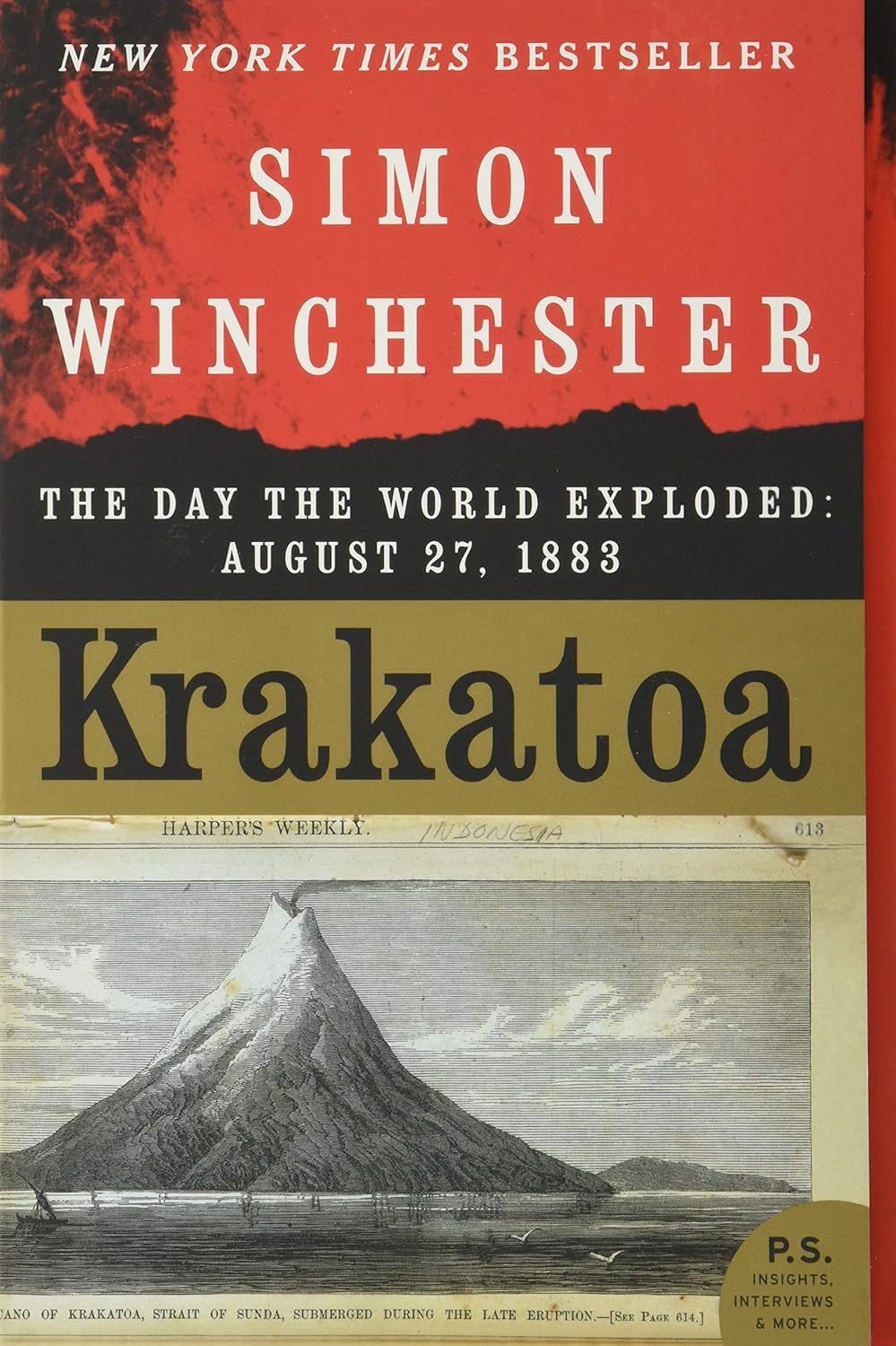
The word “Krakatoa ” has become synonymous with almost unthinkable natural disaster, an extinction level event locally, if not globally. Simon Winchester, an increasingly successful British pop historian, delivers a lively, albeit highly discursive account of the great eruption in “Krakatoa: The Day the World Exploded: August 27, 1883” (2003).
Krakatoa, a small volcanic island situated in the Sunda Strait between the Indonesian islands of Sumatra and Java, blew itself to bits in August 1883. “It was the greatest detonation, the loudest sound, the most devastating volcanic event in modern recorded human history,” Winchester writes breathlessly, “and it killed more than thirty-six thousand people.” Winchester proceeds to tell the reader virtually everything anyone could possibly want to know about the event, why it happened, and what happened afterward.
Winchester starts by explaining how the Dutch happen to be in political and economic possession of these far flung islands and how Jan Pieterazoon Coen, the founder of the Dutch East Indies, came to found a capital city called Batavia on the western end of Java, some ninety miles from Krakatoa as the crow flies. The Dutch’s iron grip on the largely Muslim archipelago would be shaken by the events of August 1883.
Modern science was just beginning to better understand the natural world, including volcanoes, in the late nineteenth century. In 1863, Alfred Russel Wallace – a close collaborator of Charles Darwin’s and “one of the most prescient figures of twentieth century science,” according to Winchester – first identified the “Wallace Line,” the strangely weaving dividing line between Australian (cassowaries, emus, and kangaroos) and Asia (cows, monkeys, and elephants) species located in the eastern Indonesian archipelago.
The Wallace Line and other curious geological occurrences led a German meteorologist named Alfred Wegenger to put forward the theory of “continental drift.” At first met by implacable hostility and ridicule from the academic community, opinions slowly began to change by the mid-twentieth century. “There was now solid new evidence to underpin [Wegener’s] notion that convection currents were at work under the earth’s crust, and that the continents were indeed being moved about upon it, like gigantic rafts, colliding and bouncing and plunging down back into the earth’s molten heart, in a ceaseless supra-terrestrial dance.” This work culminated in a landmark essay in Nature magazine in 1965 in which Canadian geophysicist J. Tuzo Wilson introduced the concept of “plate tectonics.”
Next, Winchester switches gears and explains how Krakatoa was perhaps the first near real-time global event, “the first true catastrophe in the world to take place after the establishment of a worldwide network of telegraph cables – a network that allowed news of disaster ot be flashed around the planet in double-quick time.” Readers learn about the laying of undersea cables and the central importance of “gutta-percha,” a rubber-like secretion from a rare plant only found in Indonesia, that served as critical cable insolation and made submerged telegraph cables feasible.
Krakatoa was a ticking time bomb in 1883, but nobody knew it. The Dutch and the native islanders all believed that Krakatoa was extinct. All that changed on May 10, 1883 when unnerving vibrations began emanating from the island. For the next ten weeks the twenty-five hundred foot island peak rumbled to life and eventually burst into flame. The traveling Wilson’s Great World Circus was in Batavia and carried on as normal despite the ominous sights and sounds from Krakatoa.
Finally, at 10AM on August 27, 1883, Krakatoa literally exploded. It was “the most violent explosion ever recorded and experienced by modern man,” according to Winchester. An estimated thirteen percent of the earth’s surface shook. The shock wave from the explosion traveled around the world seven times. Six cubic miles of rock instantly disintegrated. Debris was shot twenty-four miles into the air. The explosion was heard three thousand miles away on the other side of the Indian Ocean. Tsunamis wiped out 165 native villages, killing 36,417 people. The Dutch steam gunship Berouw, with a crew of thirty, was later found almost two miles inland and sixty-feet above sea level with all hands aboard dead. The volcanic dust and ash generated brilliant sunsets around the world for over two years, much to the delight of Impressionist painters.
Just as earthquakes are measured by the Richter Scale, Volcanoes are measured by the Volcanic Explosivity Index (VEI), which measures the amount of material ejected by a volcano and the height at which it is hurled into the atmosphere. The most explosive earthquake in history occurred 74,000 years ago in northern Sumatra at Mount Toba. That eruption scored a perfect 8.0 on the VEI. Krakatoa is not second. It is fifth, with a score of 6.5. (Second is Tambora, also in Indonesia, in 1815 with a score of 7.0. Taupo in New Zealand in 180 AD and Katmai in Alaska in 1912 are three and four, respectively.)
Krakatoa was so violent because of its geology. It lies in a subduction zone and at the pivot point where two plates are colliding and the islands of Sumatra and Java are folding in upon each other. The forces that created Krakatoa are simply unstoppable.
Fire and lava were not the only things unleashed by the eruption of Krakatoa. So too was Indonesian nationalism. In the weeks after the catastrophe, while the Dutch were working hard at relief efforts, several isolated Dutch were physically assaulted by locals, all of them devout Muslims. Many saw in the eruption of Krakatoa an omen of God’s displeasure with the occupying Dutch infidel and the quiescent native Muslims. The Day of Judgement appeared to be at hand. The events triggered by Krakatoa culminated in the bloody Banten Peasants Revolt five years later. “The geological processes that destroyed Krakatoa,” Winchester says, “appear to have played no small part in creating the political mood of the moment.”
Hardly had the lava of Krakatoa cooled when a new island began to emerge from the ocean. It was named Anak Krakatoa (Son of Krakatoa). The ocean bubbled and lava squirted to the surface for decades. By 1950, the world’s newest island already stood fifteen hundred feet above sea level and boasted 621 species of animals and over one hundred species of spider. These may be the most incredible facts of the entire story.
In closing, “Krakatoa” is an incredibly informative and generally entertaining read. There were times I wished the author would pick up the pace a bit, but overall this is a great book for the reader interested in the event of Krakatoa’s eruption or simply looking to learn more about Indonesia.
 What's Tim Reading Now?
Leave a comment