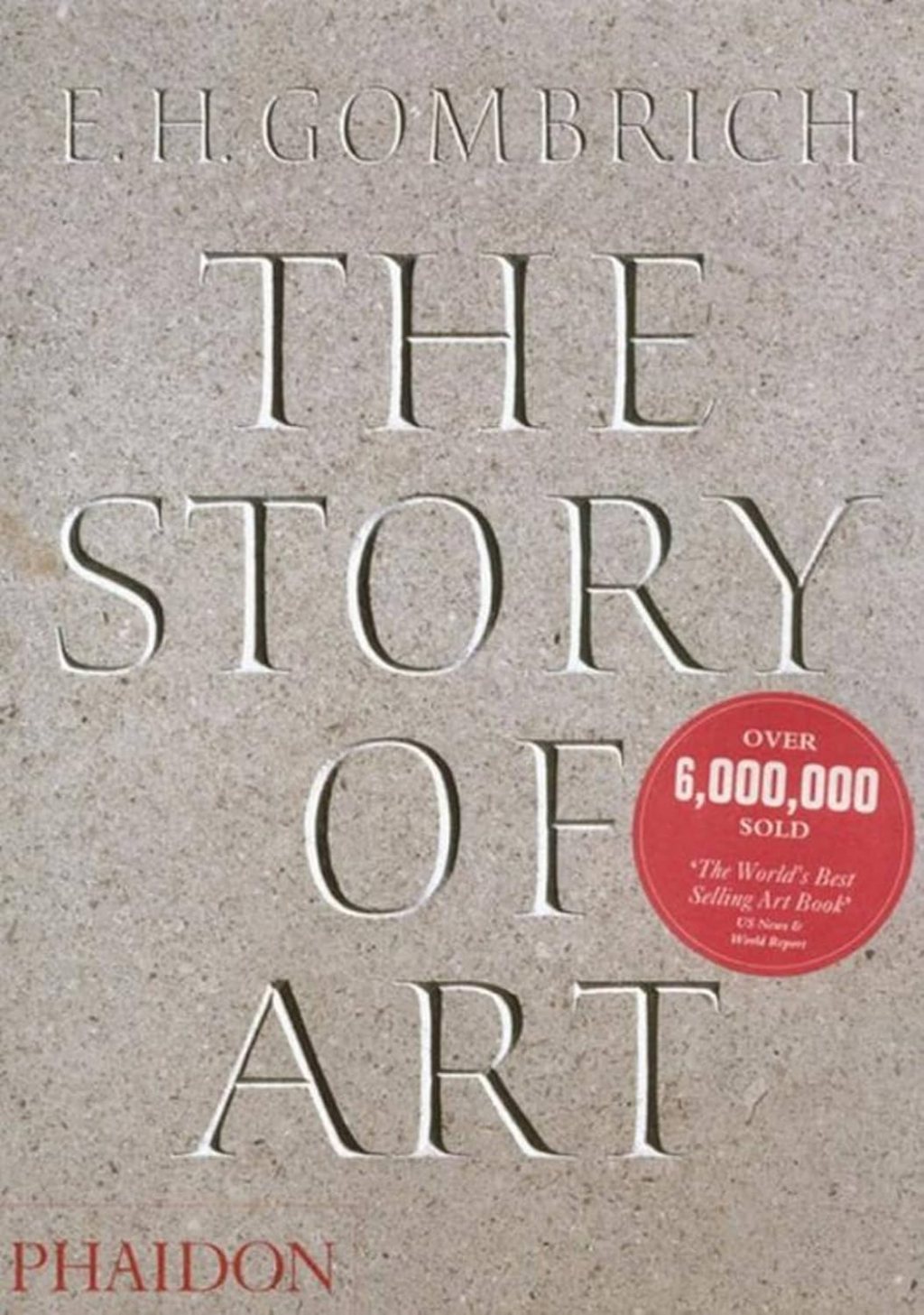
“There really is no such thing as Art,” E. H. Gombrich famously declares at the opening of his 1955 classic The Story of Art, “there are only artists.” Art with a capital “A,” he continues, “is a bogey and a fetish.” For Gombrich, art is ultimately about feeling and expression rather than abstract definitions or rigid theories. There are no wrong reasons for liking a work of art, he suggests, but there are certainly wrong reasons for disliking one. To appreciate art properly, we must shed certain habits and prejudices and instead try to understand the time, place, and purpose behind each individual work. No one, he reminds us, ever finishes learning about art, and no one should imagine they have mastered it completely. In that spirit, The Story of Art remains a remarkably enduring introduction to the rich and ever-evolving world of art history.
One of Gombrich’s first principles is that the story of art is not primarily a tale of steadily advancing technical skill, but rather a history of changing ideas and purposes. The first artistic tradition he examines is that of Ancient Egypt, which he considers foundational: the Greek masters, he notes, learned from the Egyptians, and we in turn are all students of the Greeks. Egyptian artists combined a strict and enduring geometric order with a sharp observation of human nature. Their goal was clarity and permanence. In this sense, their approach resembled that of a mapmaker more than a painter – each element was shown from its most characteristic angle. Thus both feet are depicted firmly planted and seen from the inside, giving many figures the curious appearance of having two left feet. Importance was also conveyed through scale: the more significant the subject, the larger the figure appeared in the composition. Remarkably, this artistic system endured with little change for nearly three thousand years, interrupted only briefly during the mystical reign of Pharaoh Akhenaten (1353–1336 BC during Egypt’s 18th Dynasty).
The author calls the period of Ancient Greek art between 520 and 420 BC “The Great Awakening.” “The Egyptians had based their art on knowledge,” Gombrich observes, “the Greeks began to use their eyes.” Greek sculptors started experimenting with new ways to depict the human body. No longer did they assume that everything they knew to be present had to be shown. Once this long-standing Egyptian rule was broken, Gombrich says, it set off a kind of artistic landslide. Artists began carefully studying the natural forms of muscles, bones, and movement, while also refining the elegant balance and arrangement of figures in a composition. They experimented with techniques such as foreshortening, which allowed poses to appear more lifelike and closer to what the eye actually sees. During the age of Classical Athens under the leadership of Pericles, artists and architects such as Pheidias (the statue of Athena in the Parthenon), Iktinos (one of the architects of the Acropolis), Polykleitos (Spear Bearer), and Myron (the famous Discus Thrower) achieved both renown and a level of social prestige rarely granted to artists in earlier ages.
Eventually, distinct “schools of art” emerged in Greece, fostering competition and further innovation among the Doric (strong and robust), Ionic (graceful and balanced), and Corinthian (delicate and refined) styles. By the third century BC, Greeks were discussing painting and sculpture with the same seriousness they brought to poetry and drama. Among the most celebrated artists of the late fourth century BC were Praxiteles and Lysippus, whose works “idealized” nature – presenting figures that were harmonious, well-proportioned, and beautiful. Famous examples include Hermes with the Young Dionysus, the Apollo Belvedere, and the Venus de Milo. The faces of these sculptures typically avoid strong individual expression; instead, emotion is conveyed through the posture and movement of the body. It was also toward the end of this period that wealthy patrons began collecting works of art. Gombrich notes that painters – who produced landscapes, portraits, and even genre scenes from everyday life – were often more famous than sculptors in their own time, though tragically almost none of their paintings have survived.
The next great epoch in Western art was Roman, which in many respects remained stylistically consistent for centuries. Ancient Rome produced remarkable achievements – particularly in civil engineering and architecture – but unlike Classical Greece, very few individual Roman artists are known by name. The Romans excelled above all as builders. The famous Colosseum, for example, combines three architectural orders – Doric, Ionic, and Corinthian – stacked in successive stories. A defining feature of Roman architecture was the arch, and Roman engineers became masters of vaulting through a variety of techniques, most famously demonstrated in the vast dome of the Pantheon. Sculpture also played an important role in Roman life. Busts and portraits of prominent family members were central to the culture’s reverence for ancestors, and these works were rendered with striking realism rather than the idealized beauty favored by the Greeks. The Romans also innovated by incorporating detailed and often historically accurate narrative reliefs into their triumphal arches and monuments. By the late Roman Empire, with the rise of Christianity, the quality of art is often said to have declined; however, Gombrich argues that the true change was one of intention rather than a loss of the technical virtuosity inherited from the Hellenistic world.
Once the Church became the most powerful institution in the Western world, its relationship to art had to be reconsidered. Pope Gregory the Great (r. 590–604) played a central role in this shift when he endorsed religious imagery as an important tool of education and instruction in a largely illiterate society. Stories from the Bible and the life of Christ needed to be presented as clearly and simply as possible. In doing so, Christian art revived certain qualities reminiscent of ancient Egyptian art – clarity, symbolism, and strict conventions – while the naturalistic mastery of movement and expression achieved by the Greeks gradually faded. Gombrich therefore argues that the spirit of observation awakened in Greece around 500 BC was, in many respects, laid to rest again around 500 AD. Over time, these instructional religious images came to be seen not merely as teaching tools but as reflections of the supernatural world itself, and they slowly acquired a sacred status of their own. In the Byzantine world, artists were expected to adhere closely to established traditions, observing strict conventions in the depiction of Christ, the Virgin Mary, and other holy figures – much as Egyptian artists had once followed rigid rules of representation.
The period between 500 and 1000 was not only what historians once called the Dark Ages, Gombrich writes, but also an artistically “patchy” era, as styles varied widely across regions and social classes. Yet out of this diversity something entirely new began to emerge in Western Europe, particularly around the time of Charlemagne, who in 800 was crowned the first Holy Roman Emperor and sought to revive the traditions and craftsmanship of the Roman Empire. What developed was the foundation of a new medieval style. Gombrich suggests that just as the Egyptians largely depicted what they knew to exist, and the Greeks what they saw, medieval artists increasingly learned to draw what they felt. Their goal was not to create a convincing likeness or even a conventionally beautiful image, but to convey the deeper meaning and emotional force of a sacred story. As a result, these images emphasized what mattered most – the central message and spiritual significance of the scene.
Gombrich titles his chapters on the twelfth and thirteenth centuries “The Church Militant” and “The Church Triumphant.” He describes the period as one of ceaseless artistic experimentation. Massive Romanesque and Norman churches were built with heavy piers, rounded arches, and barrel vaults supported by crosswise beams. In many ways, Western visual art still reflected Byzantine ideals, with figures that could appear as stiff and motionless as those of ancient Egypt. Yet unlike the East, Gombrich argues, art in the West was never truly static; it remained fluid, restless, and constantly evolving. The “earthy, heavy, and humdrum” character of the Romanesque style was eventually swept aside by the soaring ambition of the Gothic. Gothic artists also revived the ancient techniques for convincingly depicting bodies draped in cloth, while continuing to emphasize the expression of intense feeling rather than the recreation of a literal scene. Gombrich suggests that artists of this period were likely capable of producing more lifelike figures and more balanced compositions, but such goals simply did not matter as much as conveying the spiritual message their art was meant to express.
The entire trajectory of Western art was transformed by Giotto di Bondone (c. 1257–1337). In his frescoes at the Arena Chapel, Giotto introduced techniques – such as the foreshortening of limbs, subtle shadows in the folds of drapery, greater accuracy in bodily features, and the convincing illusion of depth on a flat surface – that had not been achieved for more than a millennium. Gombrich observes that, rather than merely telling sacred stories with heightened emotion, Giotto created the impression that the events themselves were unfolding before the viewer’s eyes. For Giotto, painting was no longer simply a visual substitute for the written word; it became something closer to a stage performance, with figures acting out the drama of the scene. “From his day forward,” Gombrich suggests, “the history of art, first in Italy and then in other countries also, is the history of the great artists.”
Just as the thirteenth century had been dominated by the construction of grand Gothic cathedrals, the fourteenth century increasingly turned toward the refinement and elegance of new works. The most characteristic works of architecture and sculpture of the 1300s – such as the Doge’s Palace in Venice – placed greater emphasis on delicate detail, including intricate decoration and elaborate tracery. During this period, the graceful narrative tradition of Gothic art began to merge with the careful observation of nature inherited from the Classical world, a development that would ultimately come to fruition in the Renaissance. Gombrich writes that “the art of Giotto had changed the whole idea of painting,” though Giotto’s master, Duccio (1255–1315), had already breathed new life into the older Byzantine forms through gentle curves and the subtle grace of slender figures. Over the course of the fourteenth century, artistic interest gradually shifted away from the medieval priority of telling sacred stories as clearly and memorably as possible toward the challenge of representing the natural world with increasing fidelity.
The revival of Classical art in Italy was closely linked to the idea of a broader cultural rebirth – a restoration of the lost grandeur of ancient Rome. From this perspective, the intervening centuries came to be understood as a “middle age,” a period separating the greatness of antiquity from its rediscovery in the fifteenth century. The art of this long interval was retrospectively labeled “Gothic,” associating it with the Goths who had overrun Rome nearly a millennium earlier.
Just as Giotto helped inaugurate a new age of painting, Filippo Brunelleschi (1337–1446) transformed architecture while also developing the mathematical principles that allowed artists to solve the long-standing problem of perspective and create a convincing illusion of spatial depth. Masaccio (1401–1428) was among the first painters to employ these innovations fully, most famously in his work in the church of Santa Maria Novella in Florence around 1428. At roughly the same time, Donatello (1386–1466) was revolutionizing sculpture with a powerful new naturalism that departed sharply from medieval conventions, particularly in the expressive rendering of the human face and the anatomically faithful depiction of the body. To audiences accustomed to the stylized grace and narrative clarity of Gothic art, Donatello’s frank realism in gesture and expression must have appeared strikingly lifelike. Few subjects illustrate this shift in artistic sensibility more clearly than the treatment of Adam and Eve in the early Renaissance. In works such as Masaccio’s Expulsion from the Garden of Eden (c. 1425) and Jan van Eyck’s depiction of Adam and Eve in the Ghent Altarpiece (1432), artists portrayed figures marked by unmistakable humanity – pain, shame, and remorse rendered with an emotional intensity largely absent from earlier Gothic representations.
Until about 1400, art across much of Europe developed along broadly similar lines, which is why it is often described as the International Style. European society was largely feudal, and Latin served as the common language of the educated elite. Around the turn of the fifteenth century, however, this cultural unity began to break down. Gombrich identifies this moment as the true turning point separating the Middle Ages from the Renaissance. Cities – home to burghers, merchants, and artisans – grew steadily more important than castles and their feudal barons. As urban life expanded, individual cities became increasingly proud and protective of their identities and privileges. Across Europe, but especially in Italy and the Netherlands, artists began experimenting in new directions, searching for novel and sometimes startling visual effects. The once relatively unified International Style gradually fragmented into a variety of regional – and even municipal – styles. In many cases, the old and the new coexisted. This was particularly evident in architecture, where the Gothic tradition often blended with emerging Renaissance forms. A common theme was the widespread introduction of light and shadow, but regional differences could be stark.
Whereas Italian painters emphasized bold outlines, clear perspective, and a confident anatomical understanding of the human body, artists in the Netherlands distinguished themselves through their extraordinary attention to detail. Northern Renaissance art was less focused on beauty and attaining an ideal harmony. Their paintings brought the everyday world vividly to life, rendering background trees and buildings, flowers, jewels, animals, and richly patterned fabrics with remarkable precision; every hair, every stitch are reproduced in faithful detail.
Gombrich says that the relentless experimentation led to a variety of new discoveries, each of which created a new difficulty somewhere else. For instance, once the effect of depth perspective was unlocked, it opened the question of how best to arrange the composition of characters in depth. How could the artist make the painting both beautiful and harmonious? A composition too clear and symmetrical suddenly looks fake no matter how lifelike the individual figures. So a new sense of capturing natural movement became essential. Gombrich writes that the dramatic changes over the two centuries from 1300 to 1500 are often more sensed than described.
The invention of printing in Germany in the mid-fifteenth century had a profound impact on the development of art. The printing of images actually preceded the printing of books by several decades. Woodcuts and copper engravings became enormously popular and played a crucial role in distributing high-quality images across Europe. Gombrich argues that the circulation of printed images helped secure the triumph of the Italian Renaissance style throughout Italy during the Quattrocento (the 1400s). By the Cinquecento, the great individual artist had emerged as a prominent figure in Renaissance society and was gradually freed from the strict constraints of traditional commissions, which often dictated not only the subject and composition but even the specific materials and pigments to be used. “At last,” Gombrich declares, “the artist was free.”
This new freedom of expression manifested itself in several ways, perhaps most noticeably in the depiction of human figures. Quattrocento masters such as Masaccio and Jan van Eyck were unsurpassed in their ability to capture minute detail and precise perspective. Yet the figures in their paintings can sometimes appear rigid and severe, more like statues than living beings. Gombrich credits Leonardo da Vinci (1452–1519) with helping to solve this problem through his development of sfumato, a technique of soft transitions and subtle shading that brought subjects such as the Mona Lisa vividly to life. Meanwhile, other masters of the period, including Michelangelo (1475–1564) and Domenico Ghirlandaio (1449–1494), advanced the more natural arrangement of figures within large fresco compositions. These developments seemed to culminate in a new standard of artistic harmony in the work of Raphael (1483–1520), whose paintings achieved an extraordinary balance of freely moving figures and idealized beauty. Gombrich writes that Hans Holbein the Younger (1497-1543) is notable as the one artist who combined the strengths of both the Italian and Northern Renaissance, and applied them from his seat as royal painter in the court of Henry VIII.
Venice emerged as a leading center of art for the first time in the early sixteenth century. The distinctive atmosphere of its lagoons and canals encouraged Venetian painters to be especially attentive and deliberate in their use of color. Artists such as Giovanni Bellini (1431–1516), Giorgione (1478–1510), and Titian (1485–1576) were among the first to treat color as a principal means of unifying forms and figures into a coherent visual pattern. The colors they employed were not always bright or striking; more often they were mellow and richly modulated. This subtle palette allowed Venetian painters to experiment with new compositional arrangements – for example, shifting the Virgin Mary away from the central position traditionally assigned to her. Gombrich argues that the Venetian artists’ masterful handling of color prevented such unconventional compositions from appearing unbalanced or awkward. In essence, color and light themselves could serve to balance forms and guide the viewer’s eye across the painting.
By the beginning of the sixteenth century, the Italian masters had achieved three major advances: the development of scientific perspective, a deep understanding of human anatomy, and a renewed knowledge of classical architectural forms. These accomplishments made a powerful impression on artists north of the Alps. Albrecht Dürer (1471–1528) was perhaps the most important Northern Renaissance artist to study in Italy and bring these lessons back to Germany, where he blended them with the Netherlandish tradition of close and faithful observation of nature. Gombrich notes that Dürer saw himself as a reformer and innovator in the art of his country, aspiring to be something more than a mere craftsman.
At the same time, Gombrich emphasizes that artistic greatness does not necessarily depend on new discoveries or adherence to the latest theories. He points to the German painter Grünewald – sometimes called the “German Correggio” – who rejected many of the artistic rules developed during the Renaissance while retaining aspects of the medieval style. For example, he continued the medieval practice of varying the size of figures according to their symbolic importance rather than strict spatial realism. Yet despite this departure from Renaissance conventions, Grünewald created profoundly memorable works that preserved the medieval aim of presenting “sermons in pictures.”
Other German artists of the sixteenth century followed different paths. Lucas Cranach (1472–1553), for instance, helped introduce landscape painting as an independent subject – something that would have been almost inconceivable in the Middle Ages. This period also produced the enigmatic Hieronymus Bosch (d. 1516), whose haunting and imaginative depictions of Hell remain as striking and unforgettable today as when they were first painted.
Around the year 1520, Gombrich argues, the world of art was seized by a continent-wide crisis. The achievements of Michelangelo and Raphael were widely regarded as the pinnacle of artistic perfection. Many believed that nothing new or better could surpass their work. As a result, younger artists often resorted to imitating the style – or “manner” – of these High Renaissance masters, which is how the term Mannerism came into use. Yet some artists responded to this challenge by deliberately pursuing bold and unconventional inventions designed to surprise and even shock their audiences.
Notable figures of this Mannerist period include Benvenuto Cellini (1500–1571), Tintoretto (1518–1594), and El Greco (1541–1614). Their works are often characterized by elongated human figures, unusual proportions, and compositions that seem intentionally dramatic or unstable. Natural colors and classical balance were frequently set aside in favor of striking effects. In doing so, these artists sought to demonstrate that the classical solution of perfect harmony was not the only possible approach to beauty.
In this sense, Mannerism can be seen as an early precursor to modern art – a conscious effort to avoid the obvious and to achieve expressive effects that depart from conventional notions of natural beauty. Their works aimed to be more than merely pleasing; they sought to be emotionally powerful, exciting, and provocative, breaking many of the compositional and coloristic conventions established during the Renaissance. Though they continued to depict traditional sacred stories, they did so in a new and far more dramatic manner.
The early seventeenth century witnessed the emergence of the next major artistic style: the Baroque. Like Gothic, Mannerism (and later Impressionism), the term Baroque originally began as an epithet. It meant something absurd, irregular, or grotesque. To many contemporaries, its disregard for the ancient rules of classical architecture seemed a deplorable lapse in taste and judgment. One of the earliest examples of Baroque architecture is the Church of Il Gesù in Rome, built for the Jesuits and completed in 1575, with its façade designed by the architect Giacomo della Porta (1541–1602). The building introduced dramatic architectural elements – bold curves, scrolls, and volutes – that departed strikingly from the restrained harmony of Renaissance design.
Baroque painting developed along similar lines. Artists embraced dramatic contrasts of light and shadow, bold color, dynamic movement, and complex, often crowded compositions. Annibale Carracci (1560–1609) and Caravaggio (1571–1610) were among the pioneers of this new style, though their approaches were very different. The notorious and volatile Caravaggio pursued truth through uncompromising naturalism, striving to evoke powerful emotions with little regard for the Renaissance ideal of perfect beauty. His paintings brought biblical stories to life with an intensity even greater than that achieved by earlier masters such as Giotto or Dürer. Carracci, along with Guido Reni (1575–1642), followed a different path, seeking instead to revive and refine the classical harmony associated with Raphael, avoiding anything coarse or ugly that might detract from their elevated subjects. Both Carracci and Caravaggio fell out of favor during the nineteenth century, but their reputations were revived in the twentieth century as art historians and critics came to appreciate the originality and power of their work.
They also profoundly influenced the next generation of artists, such as Diego Velázquez (1599–1660), who absorbed Caravaggio’s program of naturalism and devoted his art to capturing the dispassionate intensity and penetrating truth of nature, setting aside convention to arrest a fleeting moment in time. Whereas Jan van Eyck had sought to render every strand of hair in his pursuit of reality, Velázquez, two centuries later, achieved a similar effect by suggesting the impression of detail rather than delineating it explicitly. From this point forward, the artist’s essential task became one of seeing anew – of observing nature with fresh eyes and employing color, light, and brushwork to create novel effects and harmonies. It is for this reason, as Gombrich observes, that the Impressionists of the nineteenth century admired Velázquez above all other artists.
Peter Paul Rubens (1577–1640) was perhaps the greatest of the Baroque painters. He fused the meticulous observational realism associated with the Dutch masters—an almost total fidelity to what the eye could see – with the Italian revival of classical history, myth, and grandeur. As a young man, Rubens studied in Rome, returning north with a distinctly Italian taste for monumental canvases and expansive themes. The result was artwork of unprecedented dynamism – richer in movement, light, space, and sheer profusion of figures than anything attempted before. His extraordinary gifts enabled him to orchestrate vast, colorful compositions infused with buoyant, almost kinetic energy, propelling him to a level of celebrity nearly unmatched in his own lifetime. Classical fables and allegories sprang vividly to life under his meticulous brush. Yet Rubens had little interest in the restrained ideal beauty of classical tradition; instead, he depicted human bodies as they are – fleshy, vital, and real. At the height of his career, he held what was effectively a near-monopoly on the most prestigious commissions across Catholic Europe.
By the seventeenth century, the Protestant Reformation had curtailed the development of many forms of art, particularly religious and genre painting, as well as sculpture of almost every kind. As a result, art in these areas struggled to attract the highest levels of talent. The one branch that endured – and indeed flourished – was portraiture. In the Dutch Republic, masters such as Frans Hals (1580–1666) and Rembrandt van Rijn (1609–1669) elevated the form to new heights. Their portraits were bold and unconventional, remarkable for their ability to capture the inner life of the sitter, so that the images feel less like posed compositions and more like moments seized in passing. They evoke the spirit of a scene with little reliance on theatricality, movement, or dramatic gesture. Like Caravaggio, Rembrandt showed little concern for idealized beauty, valuing instead truth and sincerity over harmony and perfection.
Dutch artists of this period, such as Jan van Goyen (1596–1656), were among the first to pursue landscape painting with a sustained focus on sky and horizon. Others, including Goyen’s son-in-law Jan Steen (1626–1679), revived scenes of everyday life in a manner reminiscent of Pieter Bruegel, infusing them with narrative and humor. Johannes Vermeer (1632–1675) worked within the same genre but transformed it, stripping away overt humor to depict domestic life with quiet honesty and luminous restraint. Meanwhile, painters such as Willem Kalf (1619–1693) turned their attention to the objects of daily existence, elevating the still life into a distinctly Dutch and highly refined art form.
At roughly the same time that the Dutch masters were charting new directions in painting, Gian Lorenzo Bernini (1598–1680) was redefining the possibilities of deeply moving religious art for the Catholic Church in Rome. His works – especially his sculptures – evoked fervent passion and mystical rapture through an unprecedented intensity of expression. Bernini’s achievement set a new standard, and his style was soon emulated across Europe.
The grand Baroque era peaked around 1700 and was followed by the emergence of the Rococo, a style made famous by the French artist Antoine Watteau (1684–1721). Characterized by delicate colors and refined ornamentation, Watteau’s work conjured a vision of life removed from hardship and care—what Gombrich describes as “a dream life of gay picnics in fairy parks where it never rains.” This imagined world helped shape the tastes and fashions of the French elite in the early eighteenth century. Though brief, the Rococo period proved to be a pivotal chapter in the history of art.
The coming of the Enlightenment (c. 1720–1780) ushered in an age of reason, reflected in art by a return to clarity and restraint. The curves, volutes, and elaborate ornamentation of the Baroque and Rococo periods fell out of favor, giving way to a more disciplined aesthetic. Portraiture came to dominate eighteenth-century artistic production, capturing the ideals and status of a rising elite. Joshua Reynolds (1723–1792), both an intellectual and a leading figure of society, exemplified this shift toward the Neoclassical period. Drawing on the techniques of the Italian masters – such as Raphael, Carracci, and Titian – he focused on elevated and dignified subjects, most often portraying the wealthy and powerful. Unlike Baroque painters, particularly Caravaggio and Rembrandt, Reynolds did not sacrifice beauty and harmony in pursuit of stark realism, but instead sought to ennoble his subjects through idealization.
Reynolds’s greatest rival was Thomas Gainsborough (1727–1788), a largely self-made artist who, like Caravaggio, resisted slavishly imitating the Italian masters. His work was Rococo-influenced and anticipates elements of early Romanticism. Although the portraits of Reynolds and Gainsborough may appear similar to the modern eye, Gombrich notes that Gainsborough’s freer, more unconventional brushwork enabled him to capture texture and surface with remarkable subtlety. This quality is especially evident in his landscapes – his true passion – though they were less commercially successful than his portraits. A contemporary in France, Jean-Honoré Fragonard (1732–1806) blended Gainsborough’s fluidity with the lighthearted, theatrical spirit of Watteau, adding a distinctly French refinement to the period.
Gombrich argues that the Age of Reason, roughly spanning 1680 to 1800, marked the moment when people became fully self-conscious about artistic styles. There had long been a divide between those who might be called “idealists” – Raphael, Carracci, Reynolds – who sought to elevate and perfect nature, and “naturalists” – Caravaggio, Rembrandt, Gainsborough – who aimed at the faithful and skillful imitation of it. Yet there remained common ground between these camps: idealists still studied nature closely, while naturalists continued to admire the art of classical antiquity. What changed in the eighteenth century was a perceptible break in the chain of tradition in painting and sculpture. A new kind of art, for a new kind of public, began to emerge—one that was more self-aware, even philosophical, rather than rooted purely in inherited craftsmanship.
The new centers of artistic life were the academies, whose name deliberately evoked the grove where Plato taught his pupils. These institutions, particularly in London and Paris, began staging annual exhibitions of their members’ work, helping to shape public taste. One immediate effect was a dramatic expansion in subject matter. Artists were no longer confined to the familiar themes of the Bible or classical antiquity. In 1785, the American artist in London, John Singleton Copley (1737–1815), exhibited a striking historical painting of King Charles I demanding that Parliament surrender the five impeached members at the outset of the English Civil War in 1641 – a subject that must have felt startlingly modern to contemporary viewers.
The French Revolution gave a powerful impetus to the depiction of heroic figures drawn from contemporary events, though often cast in the visual language of ancient Greece and Rome. The leading artist of this Neoclassical style was Jacques-Louis David (1748–1825), whose work emphasized heroism and noble beauty through a striking simplicity of color and composition. By contrast, the Spanish painter Francisco Goya (1746–1828) also turned to modern subjects but rejected David’s idealization. Instead, he portrayed his patrons with unflinching honesty, revealing, as Gombrich observes, “all their vanity and ugliness, their greed and emptiness.” No court painter before or since has left such a penetrating record of those he served.
British artist and mystic William Blake (1757–1827) may be considered the first truly modern artist. His approach was strikingly unorthodox – dreamlike, visionary, and deeply personal. He rejected both idealism and naturalism, choosing instead to depict what he perceived in his inner imagination. As Gombrich observes, Blake was the first artist since the Renaissance to consciously revolt against established artistic conventions. Though little understood in his own time, he is now recognized as one of the most important figures in British art.
Just as Reynolds and Gainsborough stood in opposition in mid-eighteenth-century Britain, so too did J.M.W. Turner (1775–1851) and John Constable (1776–1837) in the early nineteenth century. Both belonged to the Romantic movement, roughly spanning 1800 to 1850, yet they embodied very different interpretations of it. Turner, like Reynolds, achieved great success in his lifetime and remained deeply engaged with artistic tradition. His Romanticism was that of the sublime – driven by drama, power, and emotional intensity. He sought to rival, even surpass, the effects of the celebrated seventeenth-century French landscape painter Claude Lorrain (1600–1682). But where Lorrain depicted calm, sunlit scenes, Turner’s works are bold, turbulent, and often verging on chaos.
Constable, by contrast, pursued a quieter vision. His Romanticism was rooted in the familiar – nature as directly observed and honestly rendered. As Gombrich notes, Constable continued where Gainsborough left off, seeking nothing but truth in what he saw. He rejected both the contrived compositions of academic art and the dramatic excesses of Turner, preferring sincerity over spectacle. Gombrich suggests that Turner and Constable left later nineteenth-century artists with a fundamental choice: to follow Turner and become poets in paint, striving for emotional and dramatic effect, or to follow Constable and depict the visible world with fidelity and feeling. In the end, Gombrich concludes that those who pursued Constable’s path – grounded in observation rather than invention – achieved something of more enduring significance.
Gombrich titles his chapter on nineteenth-century art “Permanent Revolution.” Just as the Industrial Revolution disrupted traditional craftsmanship, so too did art undergo a profound transformation – from a practiced craft to Art with a capital “A.” Artists increasingly saw themselves as a distinct class, often marked by a growing disdain for the conventional and the respectable. For the first time, art became a primary vehicle for the expression of individual personality. As Gombrich writes, “The idea of the true purpose of art was to express personality could only gain ground when art had lost every other purpose.” No longer valued chiefly as a display of technical skill, art came to be judged by its originality and expressive power.
This shift made nineteenth-century art fundamentally different from any period before it. It was also the first era in which the most celebrated and financially successful artists of the day often failed to leave a lasting legacy, while the misunderstood and unconventional figures – those who struggled for recognition and income in their lifetimes – came to define the age. During this period, Paris emerged as the center of Western art, much as Florence had been in the fifteenth century and Rome in the seventeenth.
The leading conservative painter of this period was Jean-Auguste-Dominique Ingres (1780–1867), a former pupil of Jacques-Louis David. His paintings were strikingly lifelike, and he had a deep aversion to messiness or improvisation. Ingres cultivated the “Grand Manner” and regarded Raphael as his lodestar. He was opposed by Eugène Delacroix (1798–1863), who rejected the precise forms of the Academy in favor of color, emotion, and imagination. Drawing inspiration from Rubens and the seventeenth-century Venetian masters, Delacroix challenged everything that David and Ingres represented – clarity of line, controlled light and shade, carefully staged compositions, and edifying or patriotic themes.
Another major revolution in the nineteenth century concerned subject matter. The art academies still maintained that serious painting should depict elevated figures or grand historical events. Yet artists increasingly turned their attention to ordinary life, making workers and peasants engaged in everyday activities a central theme. Gustave Courbet (1819–1877) gave this movement its name when he exhibited Le Réalisme, G. Courbet in 1855. Like Caravaggio before him, Courbet was determined to paint the world as he saw it, valuing truth over prettiness – eschewing graceful poses, flowing lines, and striking color effects. In this sense, Realism emerged as a direct challenge to, and rejection of, the ideals of the Grand Manner.
The third wave of artistic revolution in France – following the first led by Delacroix and the second by Courbet – was spearheaded by Édouard Manet (1832–1883) and his circle. Manet served as a crucial bridge between Realism and Impressionism. He and his contemporaries challenged the traditional claim that art should strive to represent reality as faithfully as possible, arguing instead that such representations were often constructed under artificial conditions of light and shade. This reflected a long-standing assumption that art should depict what we know to be true, rather than what we actually perceive and feel.
Manet and his followers ushered in a revolution in color and tone—one that Gombrich likens to the transformative impact of ancient Greek developments in form. As the author notes, it is difficult for modern audiences to fully grasp the “derision and indignation” these works provoked when first exhibited in 1874. The emerging Impressionists drew inspiration from masters such as Giorgione, Titian, Velázquez, and Goya.
Gombrich describes the triumph of Impressionism over the Salon and its established critics as a watershed in art history. The old orthodoxies – “dignified subject matter,” “balanced composition,” and “correct drawing” – were effectively swept aside. In the process, art criticism lost a measure of authority from which it never fully recovered. The Impressionists blazed a defiant trail that future innovators would follow, helping to ignite the modern art movement. This transformation was further accelerated by the advent of photography, which largely undermined the market for traditional portraiture – the primary livelihood of many established artists. Gombrich argues that photography dealt a blow to Western art comparable to the Protestant abolition of religious imagery in the early sixteenth century. That said, the Impressionists did not fundamentally diverge in their aims from the artistic traditions that had developed since the Renaissance. Like their predecessors, they sought to depict nature as it is seen; their innovation lay not in the goal itself, but in the methods they employed to achieve a more faithful rendering of visual experience.By the turn of the twentieth century, it seemed that the challenges of art aimed at capturing visual impressions had largely been resolved – much as the depiction of human form and beauty had been perfected by Raphael and the artists of the High Renaissance.
At the same time, late nineteenth-century artists drew inspiration from the bold, rule-defying compositions and color combinations of Japanese art, often encountered in the packaging materials of Paris tea shops. This insouciant disregard for established European conventions opened the eyes of Impressionist painters to just how constrained they had become. Among those most deeply influenced was Edgar Degas (1834-1917), who depicted ballet dancers from unconventional angles and in innovative compositions, as well as the sculptor Auguste Rodin (1840-1917), who embraced new expressions of movement and form. These Impressionist rebels rejected the polished “finish” prized by academic art, helping to solidify the emerging image of the artist as a defiant outsider challenging the conventions of bourgeois society.
Paul Cézanne (1839–1906) regarded the work of his Impressionist contemporaries as brilliant but ultimately lacking structure. He set out to unite the vibrant color and optical effects of Impressionism with the clarity and compositional order of Renaissance art, which underpinned academic tradition. In doing so, Cézanne sought to marry intense color with enduring form, abandoning conventional techniques in favor of simple, clearly defined shapes that conveyed balance, poise, and tranquility. As Gombrich observes, Cézanne was less concerned with illusion than with expressing solidity and depth. His disregard for “correct drawing” helped trigger a profound shift in the direction of modern art.
Dutch artist Vincent van Gogh (1853–1890) was deeply influenced by the Impressionists, the pointillism of Georges Seurat, the bold, fluid brushwork of masters such as Tintoretto, Hals, and Manet, and the striking color effects of Japanese prints. Yet Van Gogh had little interest in “stereoscopic reality” – a photographically precise rendering of nature. Like Paul Cézanne, he moved away from the traditional goal of art as an imitation of nature, seeking instead to express what he felt rather than simply what he saw.
Within the evolving artistic landscape of the late nineteenth century, Van Gogh is most closely associated with Post-Impressionism, pushing beyond Impressionism’s focus on light and perception toward a more emotional, expressive, and symbolic use of color and form.
The third of these solitary revolutionaries was Paul Gauguin (1848–1903). In search of a new artistic language, he traveled to the South Seas, where he developed a style marked by intensity, simplicity, and bold, unmodulated color. His work confounded many contemporaries, and, as Gombrich notes, Gauguin seemed to relish being labeled a “barbarian.” He sought to immerse himself in the spirit of Tahitian life and to see the world through what he believed to be a more “primitive” and unspoiled lens. He is most closely associated with Post-Impressionism, particularly the Symbolist branch of the movement, and his work would prove highly influential on later developments such as Fauvism and Primitivism
Unlike Cézanne, Gauguin was unconcerned if his simplified forms and flattened color schemes defied traditional depth and perspective, so long as they conveyed a raw, elemental intensity. Where Cézanne pursued structural harmony and Van Gogh sought emotional expression, Gauguin aimed for directness and symbolic clarity. All three rejected the Impressionist preoccupation with the fleeting moment, which they felt came at the expense of the solid and enduring forms of nature. What we now call modern art emerged from this shared dissatisfaction: Cézanne helped inspire Cubism in France, Van Gogh influenced Expressionism in Germany, and Gauguin pointed the way toward Primitivism.
The next generation of artists in the early twentieth century sought to break decisively with the forms and ideals of the classical masters such as Raphael and Correggio, which many now viewed as overly polished and emotionally distant. Rather than imitating nature, these artists aimed to confront the realities of human experience more directly, emphasizing the expression of feeling through bold color, distorted form, and dynamic line—an approach often described as art functioning like visual music.
It is important, however, not to group this diverse group too tightly. Russian Wassily Kandinsky (1866–1944) and Dutch Piet Mondrian (1872-1944) became central figures in Expressionism and the pioneers of abstraction; French Henri Matisse (1869–1954) led the Fauvist movement; and Spanish Pablo Picasso (1881–1973) would go on to co-found Cubism.
A key moment came in 1905 with the emergence of the Fauves (“the wild beasts”), a group of artists – including Matisse – whose radical use of intense, non-naturalistic color shocked critics and audiences alike. Their bold experimentation liberated color from descriptive function and helped open the door to the major developments of twentieth-century modern art, from Expressionism to abstraction. As art became increasingly detached from portraiture and commissioned works shaped by demanding patrons, it evolved into a more personal expression of the artist’s vision and values – one in which traditional rules and conventions held almost no authority.
The Primitivism championed by Gauguin arguably exerted one of the most far-reaching influences on twentieth-century modern art, inspiring artists like Marc Chagall (1887-1985). It helped spark a profound shift in artistic taste, evident by 1905 in the first exhibition of the Fauves, whose bold use of color and rejection of naturalistic convention signaled a new direction. This transformation also encouraged a renewed appreciation for medieval art, which had been largely overshadowed by the Renaissance’s turn toward naturalism in the fifteenth century.
The legacy of this break with tradition extended further into movements such as Surrealism, which sought not to depict external reality at all, but to explore the inner workings of the mind – dreams, memory, and the unconscious – often through startling, symbolic imagery. In this sense, the trajectory from Gauguin to the Fauves and beyond reflects an ever-deepening shift away from representation toward interpretation and imagination. As Gombrich concludes, the story of art is “a continuous weaving and changing of traditions in which each work refers to the past and points to the future.”
 What's Tim Reading Now?
Leave a comment