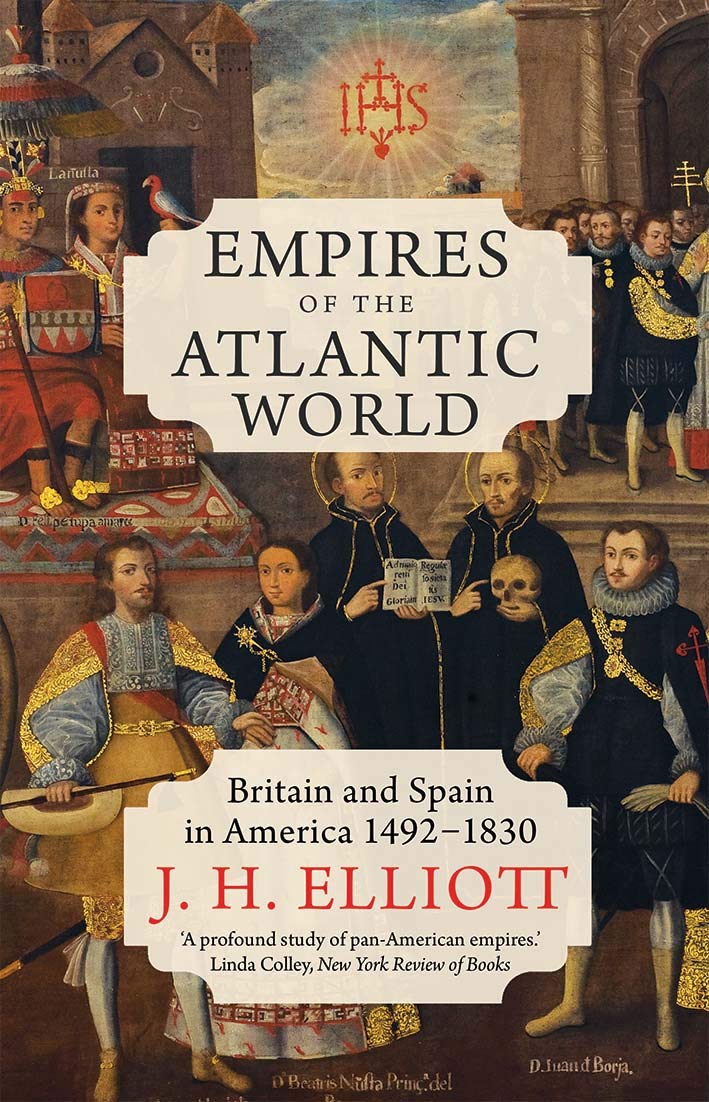
J. H. Elliott’s Empires of the Atlantic World: Britain and Spain in America, 1492–1830 is a sweeping comparative history that attempts something both ambitious and intellectually disciplined: to explain not simply how two empires conquered and colonized the Americas, but why they produced such profoundly different societies – and why those differences endured long after independence. The book moves chronologically from conquest to consolidation to emancipation, but its real structure is thematic, weaving the Spanish and British experiences together in a continuous comparative narrative.
In the 1970s, James Lang reduced the Spanish and English empires in the Americas to a simple dichotomy: the former an “empire of conquest,” the latter an “empire of commerce.” More recently, Claudio Véliz cast the contrast in more evocative terms, likening the Spanish to a Baroque hedgehog and the English to a Gothic fox. Elliott argues the comparison is far more complex. While he acknowledges the broad truth of the distinction between conquest and commerce, he insists that the early phases of both empires were more similar than later outcomes would suggest. Both were driven by ambition, opportunism, and the lure of wealth; English colonizers were inspired in part by Spanish successes, even if they failed to replicate them. Yet over time, structural differences – some contingent, some deeply rooted– produced diverging colonial worlds.
Motivations, he says, are not easily compartmentalized and approaches to colonization resist straightforward classification. The two imperial ventures began nearly a century apart, unfolded in distinct geographic settings, and drew on very different natural resources. “The differences in sizes and densities of the indigenous population,” Elliott writes, “would profoundly affect the subsequent character of the two colonial worlds.” Moreover, they were not isolated systems; each observed, adapted, and at times emulated the other, making any neat comparison inherently misleading.
At the outset of their imperial ventures – for the Spanish in early sixteenth-century Central America and for the English in the early seventeenth-century Chesapeake – the two powers faced markedly different challenges and brought with them very different kinds of men. For all his wealth and authority, Montezuma proved hesitant in the face of Cortés and his small band of hardened hidalgo adventurers. By contrast, the smaller and less centralized Indian polities under Powhatan displayed far greater confidence and resolve in resisting the English settlers – many of whom were ill-prepared colonists, composed largely of gentlemen unaccustomed to labor and individuals lacking skill or discipline.
Elliott notes that both the Spanish and the English arrived in the Americas with prior experience in colonization. For the Spanish, this experience came from the conquest and subjugation of the Guanche people in the Canary Islands; for the English, from their efforts to control and settle Wales and Ireland. As a result, the Caribbean and its indigenous populations seemed comparatively familiar to the early conquistadors, who had already undergone the cycle of conquest, subjugation, and attempted religious conversion in recent decades.
One of the most enduring and consequential differences between the two empires lay in their treatment of religious minorities. The Spanish Crown rigorously excluded Jews, Muslims, Protestants, and, more broadly, non-Spaniards from migrating to New Spain, while the English actively encouraged the settlement of Separatists, Puritans, other dissenters, and even foreigners such as Germans. Differences in the size and wealth of indigenous populations also shaped imperial policy. Despite this unabashedly exploitative policy and the persistent “Black Legend” of Spain’s mistreatment of natives, Elliott says that the Spanish Crown consistently showed sincere interest in justice for their indigenous populations, including a decree in 1542 that outlawed the enslavement of Indians, which led directly to the importation of black Africans in huge numbers. The large, organized societies and rich deposits of precious metals in Central and South America drew the Spanish Crown and the Catholic Church into a direct and sustained role in colonial administration and the deliberate policy of Hispanicization. The scale of the indigenous population meant that Spanish settlement focused less on land ownership than on lordship over people. The encomienda system, for example, granted rights over specified numbers of Indians rather than acres of land, making towns the central units of Spanish dominion. By 1630, there were 331 towns in New Spain and Peru. During the first century of Spanish colonization, approximately 250,000 migrants crossed to the New World, most settling in towns despite limited economic opportunities after the initial phase of conquest. Perhaps as many as one in five ultimately returned to Spain.
Religion further reinforced these differences. The Spanish empire operated under a near-monopoly of the Catholic Church, which served as both a stabilizing force and an instrument of control. It provided institutional continuity, education, and moral authority, but also constrained intellectual diversity. In British America, the absence of a single dominant church and the presence of multiple Protestant sects fostered a more pluralistic and decentralized religious culture. This pluralism, Elliott suggests, encouraged habits of self-organization and dissent that would later prove politically significant.
Unlike the British colonies, Spanish America was rapidly and formally integrated into a highly organized imperial framework. In 1523, the Spanish Crown established the Council of the Indies as a central administrative body within the monarchy – a level of institutional coordination the British would not approximate until the creation of the Board of Trade in 1696. From an early stage, Spain possessed a centralized mechanism for shaping and implementing policy across every aspect of life in its American territories. This system built upon administrative practices developed during the unification of Spanish kingdoms on the Iberian Peninsula in the fifteenth century. As Elliott describes it, the empire functioned as “an elaborate administrative chain of command,” extending from the Council of the Indies through viceroys in Mexico City and Lima down to local treasury and judicial officials. This secular structure was reinforced by a parallel ecclesiastical hierarchy, which divided Spanish America into 31 dioceses overseen by four archbishops. The result, Elliott observes, was a system that became “the envy of European monarchs,” many of whom struggled to exert comparable authority over their own fractious societies at home.
In contrast, the relative scarcity of both population and mineral wealth in English North America encouraged a more hands-off approach by the English Crown and the Anglican Church. Of the estimated 20 to 80 million people living in the Americas at the time of Columbus, only one or two million likely resided in North America. Unlike the all-embracing Catholic Church, Puritanism was more exclusive and made only limited efforts to convert the relatively small and rapidly declining indigenous populations of New England. The Anglicans of the Chesapeake were only marginally more committed to missionary work. Over time, attitudes toward Native Americans hardened significantly in both Virginia and New England, especially in the wake of violent conflicts. By the time of King Philip’s War (1675), many colonists viewed indigenous peoples as irredeemably barbarian – likened to Canaanites in league with the devil – a perception similar to that which earlier generations had applied to the Irish. Colonists increasingly feared that close contact would lead to their own cultural degeneration. As Elliott observes, the strong impulse to Christianize that fostered a degree of accommodation in Spanish America was largely absent in the British colonies.
In stark contrast to Spanish America, representative forms of government took root in British America within the first years of settlement. By 1640, eight distinct elected assemblies had been established across the colonies. Many of these bodies evolved from the practice of electing leaders within the joint-stock companies that financed early English colonization. Their primary responsibility was to raise revenue to sustain colonial operations—a function handled in Spanish America by the Crown through mechanisms such as its twenty percent share of precious metals, a portion of ecclesiastical tithes, indigenous tribute, and duties on transatlantic trade. In British America, by contrast, colonists largely funded themselves without the support of a centralized royal bureaucracy.
The English Civil War and the execution of the king in 1649 further complicated the colonies’ relationship with the mother country, raising unresolved questions about whether ultimate authority rested with the Crown or Parliament. Elliott argues that, over time, the British state moved haltingly toward a more centralized system that echoed aspects of the Spanish model. Institutions such as the Board of Trade and policies like the Navigation Acts bore some resemblance to the Council of the Indies and Spain’s efforts to regulate imperial commerce. The short-lived Dominion of New England (1686–1689) can likewise be seen as an attempt by the Crown to impose a more centralized, quasi-viceroyal authority over the colonies. The Glorious Revolution of 1688, however, decisively affirmed the primacy of the principle of representation and religious pluralism on both sides of the Atlantic.
British colonists were more focused on acquiring land than saving souls, even as settlement remained uneven and largely uncoordinated for over a century. Yet these expansive landholdings became the foundation of the British colonial experience. This relative lack of oversight inadvertently encouraged widespread private ownership and enterprise, embedding the profit motive deeply in colonial life. Even as the population of British America grew substantially in the seventeenth and eighteenth centuries, it remained predominantly rural in contrast to the more urbanized Spanish colonies. Economic opportunities for immigrants were also more abundant and enduring. In the seventeenth century, indentured servitude became the primary engine of migration, accounting for perhaps two-thirds of all emigrants to British colonies and as much as 85 percent to the Chesapeake. During the first century of British colonization, roughly 530,000 settlers crossed the Atlantic – more than twice the number who arrived in Spanish America during its first century. About seventy-five years after their respective beginnings, the white population of Spanish America stood at roughly 150,000, compared to approximately 250,000 in British America.
A network of relatively short Atlantic trade routes between England and North America supported a wide variety of settlements and produced a diverse range of goods, making it difficult to compare with the Spanish system of fixed annual convoys that transported vast quantities of silver and gold over long, tightly controlled voyages. One consequence of this difference, Elliott notes, was that overseas colonization during the reign of King Charles I remained notably haphazard and almost freewheeling. The absence of precious metals, abundant labor, or a dominant staple crop in many regions encouraged improvisation and experimentation. Compared with the Spanish, the English state was slow to develop a coherent strategy for exploiting American resources or imposing regulatory control over transatlantic trade. Yet, despite these differences, Elliott observes that both empires shared similar assumptions about the proper subordinate relationship between colony and mother country. The question was how to best manage overseas possessions in such a way as to maximize the benefit to the home metropolis.
Early settlers in both Spanish and British America sought to recreate the orderly hierarchies of their homelands, even as the Spanish and British crowns worked to prevent the emergence of a distinct American aristocracy. Elites in Europe often regarded colonists as inferior provincials, ensuring that any new hierarchies in the colonies would develop along different lines. In the Chesapeake, social tensions among white settlers gradually gave way to a racial order defined primarily by the divide between white and black populations. In much of Spanish America, by contrast, the coexistence and intermixing of Spanish, African, and Indigenous peoples – within a far more urbanized environment (Mexico City, for example, had a population of 100,000 by 1692, compared to about 4,500 in New York) – produced the complex, color-coded casta system, often described as a “pigmentocracy.” While this social order was more intricate than that of British America, it was also more uniform across a vast territory, supported by shared civic institutions and a common form of worship. The mainland colonies of British America, by contrast, remained more fragmented and self-contained, each developing its own distinct social character and religious identity.
One important contrast lay in the religious outlook of the two Atlantic empires. As Elliott observes, they came to embody opposite wings of the Reformation. The spiritual landscape of British America reflected the Protestant Reformation from north to south, marked by the absence of shrines, saints, and sacred images. Spanish America, by contrast, bore the imprint of the Catholic Counter-Reformation, shaped by the pervasive influence of the Franciscans, Dominicans, and Jesuits. The friars and Jesuits served as the advance agents of Spanish frontier policy – where the frontier was less a fixed boundary than a porous borderland – aimed at including, absorbing and ultimately assimilating indigenous populations. British colonists, on the other hand, aspired to create a “republic of the chosen” where natives played little to any positive role. Both efforts ultimately fell short. The supposed saints proved, in Elliott’s words, “backbiting and backsliding,” while the indigenous peoples were seen as “wayward and dissembling.” In both empires, the “sacred soil of America lent itself all too readily to turf wars.” Yet the inherently fissiparous nature of Protestantism fragmented British America, leaving it in a near-constant state of religious contention, as no orthodoxy – Puritan, Anglican, or Separatist – could long prevail. By contrast, the relative uniformity of Catholic faith gave Spanish America, despite its social and ethnic diversity, a degree of internal cohesion that never fully emerged in the British colonies.
Slowly, piece by piece, a distinctly British ideology of empire – grounded in commerce and sustained by maritime power – took shape over the course of the late seventeenth and early eighteenth centuries. As Elliott observes, this system was conceived in deliberate contrast to Spain’s land-based empire of conquest. The rapid expansion of transatlantic trade became the engine of imperial integration, and as British aims grew clearer and administrative capacity expanded, a framework of regulation followed. The Navigation Acts helped propel the British mercantile system to new heights, even as the Spanish Empire showed signs of decline. By 1700, Spanish America could still claim nineteen universities, compared to just two in British America – Harvard and William & Mary (with Yale soon to follow in 1701) – yet the broader momentum was increasingly shifting in Britain’s favor.
Britain and Spain finally came to blows in 1762 during the Seven Years’ War, dealing a devastating blow to Spanish prestige and morale. The British captured Havana and Manila, the crown jewels of Spain’s far-flung empire. At the Treaty of Paris in 1763, London returned both cities in exchange for Florida and Spain’s lands east of the Mississippi, while France ceded Louisiana to Spain to compensate its ally.
In North America, Britain and Spain remained rivals, each grappling with how to divide the costs of imperial defense. Britain stationed 21 battalions – about 10,000 troops – permanently in the colonies, where taxpayers paid far less toward defense than those at home (26 shillings per head in Britain versus just one shilling in the colonies!). The British Army in America was estimated to cost £400,000 per year when total revenue from the colonies was only £80,000. Spain, meanwhile, heavily fortified its Atlantic ports and maintained roughly 40,000 troops across Spanish America, many of them militia. Both empires, as Elliott observes, concluded that colonial defense was too important to be left to the colonists themselves.
The British administration responded to its fiscal crisis with a series of reforms that directly reshaped the economy and society of British America: (1) strengthened vice-admiralty courts to enforce customs duties; (2) the Currency Act of 1764, curbing colonial paper money; (3) the notorious Stamp Act of 1765, taxing printed materials; and (4) the Sugar Act, imposing duties on molasses. Together, these measures shocked and profoundly unsettled the American colonists.
Elliott emphasizes that the Spanish empire’s very strength – its complex, integrated social and administrative system – made its collapse more traumatic. Independence in Spanish America was prolonged, violent, and socially disruptive, in part because colonial elites (creoles) had more to lose from upheaval and because indigenous and mixed populations were deeply embedded in the existing order. In British America, by contrast, the relative simplicity and autonomy of colonial institutions allowed for a more cohesive and ultimately more successful break with the metropole.
The timing of global events also mattered. The American Revolution occurred in a context that allowed the new United States to stabilize and expand economically, while the wars of independence in Spanish America coincided with less favorable international conditions, leaving the new republics economically fragile and politically fragmented. The result was a stark divergence in post-independence trajectories.
Elliott’s central argument is that these colonial differences produced enduring social, economic, and political legacies. In Spanish America, the legacy of hierarchical, centralized governance contributed to political instability, with power often concentrated in elites and contested through coups and revolutions. Socially, the persistence of racial and class hierarchies limited the development of broad-based civic identity. Economically, the reliance on extractive industries and the disruption of independence left many regions struggling to achieve sustained growth.
In the United States, by contrast, the legacy of local self-government and economic diversification fostered a more stable political system and a more dynamic economy. This is not to say that British America was more “virtuous”—Elliott is careful to avoid triumphalist narratives—but rather that its institutional and social structures were more conducive to long-term stability and expansion.
One of the book’s greatest strengths is its refusal to reduce these outcomes to simple cultural or moral differences. Elliott consistently emphasizes contingency – timing, geography, and historical accident – as well as structural factors. He also resists the “Black Legend” that portrays Spanish imperialism as uniquely cruel or backward, instead presenting it as a sophisticated and often effective system that nonetheless produced unintended consequences.
As a work of history, Empires of the Atlantic World is both impressive and demanding. Its comparative method requires the reader to hold two complex narratives in mind simultaneously, and its scope can at times feel overwhelming. Yet this is also its greatest virtue. By placing the British and Spanish experiences side by side, Elliott forces the reader to see each more clearly—not as isolated stories, but as parallel experiments in empire whose outcomes continue to shape the modern Americas.
The book ultimately leaves the reader with a powerful insight: that the divergence between North and Latin America was not inevitable, nor was it the result of a single factor. It emerged from a combination of timing, environment, institutional choices, and historical contingencies that interacted over centuries. Elliott’s achievement is to show how these forces operated in tandem, producing two worlds that began with similar ambitions but ended with profoundly different destinies.
In summary, Elliott argues for three critical divergences. The first major divergence lies in timing and initial conditions. Spain entered the Americas first and encountered large, organized indigenous civilizations, particularly in Mexico and Peru. This allowed for rapid conquest and the appropriation of existing systems of labor and tribute. Britain, arriving later, encountered less densely organized societies in North America and therefore could not replicate Spain’s model of conquest and extraction. As Elliott argues, Spain’s early arrival was both an advantage and a burden: it gained access to immense mineral wealth but had to build imperial institutions from scratch across vast territories. Britain, by contrast, benefited from hindsight, learning from Spanish successes and failures while operating on a smaller and more manageable scale.
From these initial conditions flowed a second major divergence: the relationship with indigenous populations and the structure of colonial society. Spanish America became a racially mixed, hierarchical society in which indigenous peoples were incorporated – often brutally – into the imperial system as laborers and subjects. Over time, a complex caste system emerged, blending European, indigenous, and African populations. British America, by contrast, tended toward exclusion. Indigenous peoples were more often displaced than incorporated, and colonial societies developed along more rigidly European lines. Elliott characterizes this as a fundamental difference between an “inclusive” and an “exclusive” model of empire, though both rested on coercion and inequality.
A third critical divergence lies in political organization and governance. The Spanish crown constructed an elaborate, centralized bureaucratic system to administer its colonies, complete with viceroys, audiencias, and a dense network of officials. Authority flowed from the top down, even if in practice it required negotiation with local elites. British colonies, by contrast, developed more organically, with institutions such as representative assemblies emerging from local conditions rather than being imposed from the metropole. This produced a political culture in British America that emphasized participation, local autonomy, and legal tradition.
In sum, Empires of the Atlantic World is a dense, rich and authoritative comparative review of the two colonial empires that shaped two continents over the course of four centuries. It is not likely to be surpassed in scope or command of the subject for decades to come.
 What's Tim Reading Now?
Leave a comment