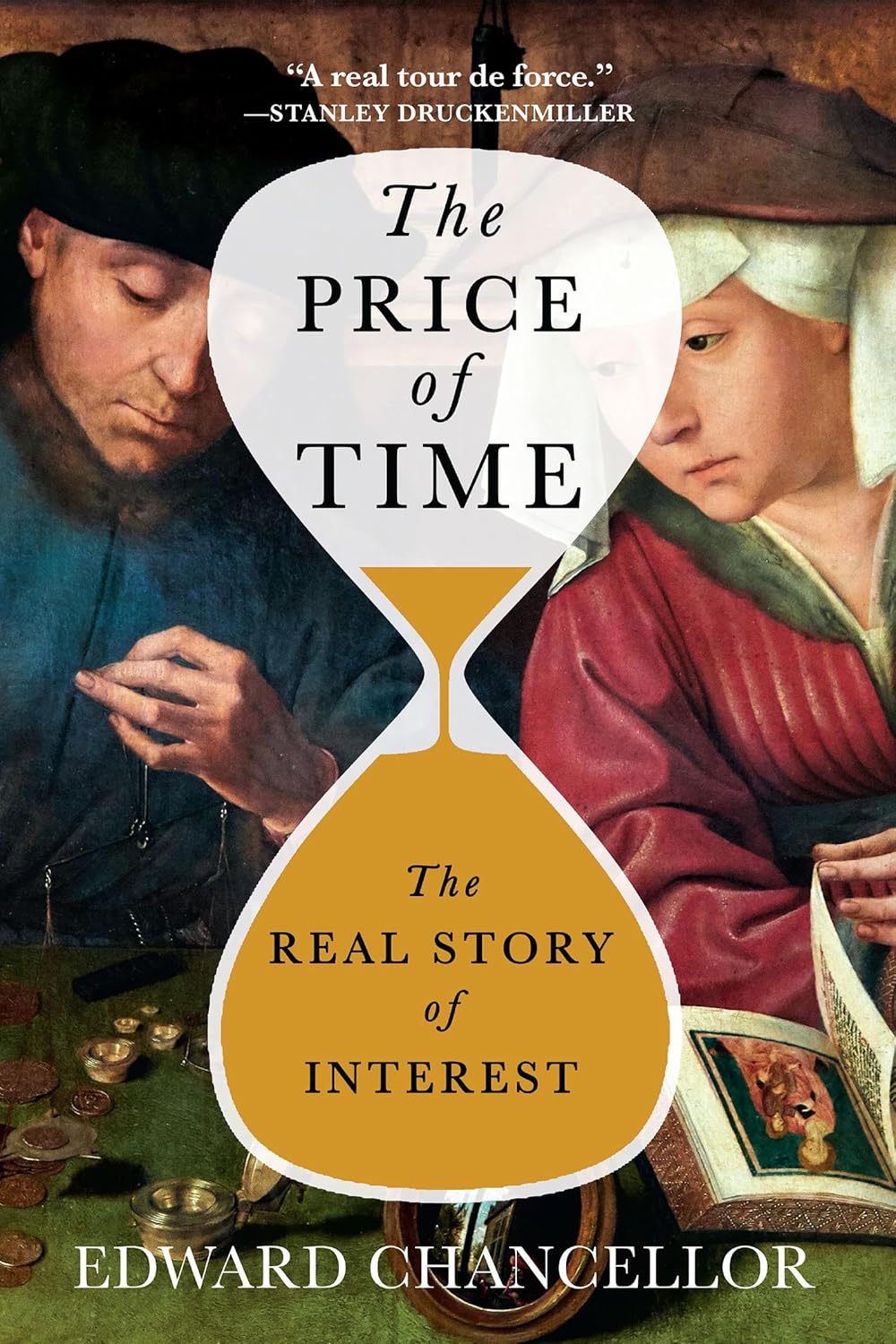
Some books are good, fewer are great, and only a rare handful amount to an education. These are the works that fundamentally reshape how you see the world—how you understand the past and imagine the future. The Price of Time: The Real Story of Interest (2022) by Edward Chancellor is one of those rare books.
This book, Chancellor explains, examines the role of interest in the modern economy. Paradoxically, for something so ancient and consequential – interest rates long predate coined currency and were addressed in Hammurabi’s Code around 1750 BC – the concept remains surprisingly elusive. As Chancellor observes, “How the level of interest is determined remains one of the most perplexing problems in the field of economics.” Competing schools of thought attribute interest to factors such as population growth, productivity gains, or the return on real assets. Yet Chancellor finds the most comprehensive explanation in the so-called “time theory of money,” which holds that interest is simply the price of time. Chancellor says “there is no better definition” than that. Yale economist Irving Fisher once characterized this their of interest as “human impatience crystallized into a market rate.” The central question he explores is whether a capitalist economy can function properly without a market-determined interest rate. His answer is unequivocal: it cannot. Artificially suppressed rates, set by modern central banks, distort the allocation of capital and make rational investment valuation exceedingly difficult.
In the ancient world, interest rates were generally stable, even trending downward over the centuries. In Babylon, loans denominated in silver were commonly pegged at twenty percent. Loans issued by the Temple of Apollo on Delos were set at ten percent. In Republican Rome, interest stood at 8.33 percent, fell to four percent after the acquisition of Egypt, and later rose to twelve percent during the crisis of the third century. In the thousand years following Rome’s collapse – when annual economic growth is estimated to have averaged just 0.01 percent – rates typically ranged between six and twelve percent. Early modern Europe witnessed a steady decline in interest rates beginning around 1500, and by 1700 rates across the leading economies – France, England, the Netherlands, and Italy – had fallen to roughly four to five percent. In 1691, a bill was introduced in Parliament to cap the maximum rate of interest at four percent; by 1713, the legal maximum was set at five percent.
Across this long sweep of history, Chancellor notes, authorities found it far more difficult to manipulate interest rates than modern governments do today. Yet this extended record of largely market-determined rates offers no decisive support for any single theory of how interest itself is formed. Rather, the author suggests that interest appears to have emerged from “some combination of need and greed” when allocating scarce resources.
John Locke was among the first major thinkers to argue that interest rates should be allowed to find their own level, maintaining that interest was determined by the supply and demand for money – which he believed naturally settled closer to six percent. He was also the first writer to explore at length the potential damage caused by forcing rates below their natural equilibrium, warning that artificially cheap money would misallocate capital on a grand scale and fuel a succession of asset-price bubbles. “Locke was spot on,” Chancellor observes.
Today, central banks are focused on monetary policy as a lever to control inflation while tweaking economic output. Chancellor takes issue with this almost maniacal focus of using interest rates to peg inflation as close as possible to two percent per year. He argues that the concept of natural rate of interest (also known as the neutral rate or “r-star”) is a pure, unobservable abstraction that nevertheless remains indispensable to modern economists.
Next, Chancellor turns to John Law, the brilliant yet reckless Scottish financier who engineered one of history’s most spectacular financial bubbles. He portrays Law as “the original monetarist…the eighteenth-century forerunner of Milton Friedman,” a man who conducted the world’s first grand experiment with easy money. Law’s central thesis was that “money is not the Value for which Goods are exchanged, but the Value at which they are exchanged.” Because money lacked intrinsic value, he argued, it need not be backed by gold or other precious metals. A recurring theme in his writings was that trade depends primarily on the circulation of credit—and that credit could be secured by land rather than specie. By severing the link between money and precious metals, Law opened the door to the modern idea of a managed currency. Chancellor draws the parallel explicitly: “Central bankers, who resort to printing money, manipulating interest rates, and fueling asset price bubbles, exude a similar air of infallibility.”
To take it one step further, Law argued that interest was determined by the supply of gold. Furthermore, he argued that a central bank could reduce interest rates by printing money. Chancellor argues that the fundamental beliefs and actions that animated John Law also motivated the central bankers during the financial crisis of 2008. In 1719 Law arranged for the Mississippi Company to take over France’s entire national debt in exchange for an annual payment. Chancellor says that Law’s activities represented “the most ambitious economic experiment prior to the Russian Revolution.” Over the course of 1719 the share price of the Mississippi Company climbed by more than twenty times. “The world was turned upside down,” Chancellor writes. The main stimulus for the bubble came from the Royal Bank’s printing press, the author says. By 1720 the total circulation of notes exceeded twice the quantity of gold and silver coins in circulation. Mississippi shares were trading roughly fifty times earnings. Law’s personal stake in the Mississippi Company made him the richest individual who had ever lived. In the final analysis, Chancellor writes, “the System was simply too ambitious.” Law slipped out of France leaving his wife, daughter, fortune and dreams behind. Chancellor argues that the widely overvalued Mississippi stock was only supported by the two percent discount rate.
Chancellor then covers the banking crisis of 1825, which was the first modern stock market crash driven by speculative mania, easy credit, and sudden loss of confidence. It began in Britain after years of aggressive lending and exuberant investment, particularly in newly independent Latin American countries. Following the end of the Napoleonic Wars, Britain had abundant capital and expanding financial markets. Investors poured money into foreign government bonds, mining ventures in places like Mexico and Peru, and a wave of newly formed joint-stock companies. Many of these ventures were poorly understood, wildly overvalued, or outright fraudulent. Easy money from country banks and the Bank of England fueled the boom.
By late 1825, doubts began to spread about the viability of many of these investments. When a few firms failed, panic set in. Investors rushed to withdraw deposits, and dozens of small country banks collapsed as they could not meet demands for gold and silver. Credit froze, businesses failed, and the economy contracted sharply. The crisis threatened to bring down the entire British financial system until the Bank of England intervened aggressively, lending freely to stabilize the system – an early example of a central bank acting as a lender of last resort.
The crisis revealed just how deeply intertwined banking, speculation, and credit had become in the modern economy. It also exposed a recurring pattern that would come to define future financial crises: prolonged periods of easy money foster speculative excess, confidence eventually collapses, banks fail, and central banks are forced to intervene to restore stability. Chancellor suggests that the Panic of 1825 left as deep and lasting an impression on those who experienced it as the Great Depression would a century later.
The failure of Overend, Gurney & Co. in 1866 was one of the most significant financial collapses in nineteenth-century Britain. Originally a conservative bill-broking firm, the company gradually expanded into riskier long-term investments — particularly railroad financing — while continuing to rely on short-term funding, leaving it dangerously exposed. Much of this expansion occurred around 1862, when the Bank of England was lending at the dreaded rate of two percent. When doubts about the firm’s solvency surfaced, a run quickly followed. The Bank of England refused to rescue Overend, Gurney directly, and its suspension of payments triggered widespread panic, multiple failures, and a sharp economic downturn. In response, however, the Bank injected substantial liquidity into the broader financial system, helping to solidify the modern principle that central banks must act as lenders of last resort during crises.
The episode closely echoed the Panic of 1825, Britain’s first modern credit-driven crash, which had similarly followed a period of speculative excess and collapsing confidence. Both crises revealed the fragility created by rapid credit expansion and the speed with which financial panic can spread. While 1825 exposed the pattern of boom and bust, the crisis of 1866 helped refine the institutional response, shaping the doctrine – later articulated by Walter Bagehot – that central banks should lend freely in times of panic to prevent systemic collapse.
A central pillar of Chancellor’s argument is that the specifics of Walter Bagehot’s timeless guidance have been diluted by time – or forgotten altogether. Bagehot advised central bankers to act as lenders of last resort, but only at high interest rates and only for short durations, thereby stabilizing the system without encouraging recklessness. “Modern central bankers,” Chancellor writes, “show far less concern for moral hazard than Bagehot.” In his view, prolonged easy money – interest rates held below two percent – pushes savers into riskier investments, encourages imprudent lending, and ultimately weakens the financial system.
Chancellor argues that the legendary New York Fed chairman Benjamin Strong embraced the emerging monetary orthodoxy that interest rate policy should be guided by the pursuit of price stability. In 1921, Irving Fisher founded the Stable Money League to advocate legislation that would compel the Federal Reserve to stabilize the price level. Yet by smoothing the business cycle and dampening volatility, the Fed may have inadvertently encouraged speculative behavior.
Between 1923 and 1928, U.S. GDP grew by roughly eight percent per annum, driven by extraordinary productivity gains associated with electrification and modern management techniques – often grouped under the label “Fordism.” But this prosperity came with side effects. As Chancellor notes, easy money fueled credit expansion, and expanding credit fostered speculative excess. Meanwhile, relatively low interest rates in the United States encouraged substantial capital outflows to higher-yielding markets abroad, further distorting global financial conditions.
Austrian economist Friedrich Hayek used the phrase “coup de whiskey” to describe the Federal Reserve’s decision in 1927 to lower interest rates following a meeting of leading central bankers on Long Island. At that meeting, figures such as Benjamin Strong and Montagu Norman coordinated efforts to ease monetary conditions, partly to help Britain maintain its strained return to the gold standard. The resulting U.S. rate cuts injected additional liquidity into an already expanding American economy.
Hayek likened this policy to giving “a shot of whiskey” to a market that was already overheated. Instead of cooling speculation, the easier money encouraged more credit expansion and stock market speculation, helping fuel the late-1920s boom. The phrase captures the criticism that central bank intervention, intended to stabilize the global financial system, may instead intensify financial excesses and contribute to a more painful crash later on. That said, the New York Fed cut the discount rate from six percent in October 1929 to 1.5 percent by the summer of 1931. Yet between August 1929 and March 1933 the US money supply collapsed by as much as 35 percent.
Many leading twentieth-century economists treated the Great Depression as the ultimate case study in the mismanagement of financial crises. From this experience emerged a core doctrine: that monetary stability is a prerequisite for price stability, and that price stability, in turn, is a prerequisite for financial stability. Chancellor argues that this thesis is fundamentally flawed and lies at the heart of the problems with modern monetary policy and economic management. As a result, he contends, policymakers became obsessively focused on controlling near-term inflation, largely to the exclusion of other concerns. “The model posits a world filled with rational actors possessed of perfect foresight,” Chancellor writes. Within this framework, consumer price instability is treated as the only reliable signal of monetary policy errors, while instability or dramatic distortions in asset prices are largely ignored.
Surprisingly, the widespread adoption of official inflation targets by central banks only started in the 1990s. In 1998, the European Central Bank opened for business with a treaty-mandated target. The US Fed formally adopted an inflation target in 2012. The two-percent target quickly acquired “talismanic significance,” Chancellor says.
Here the author introduces a concept at the heart of his argument: Goodhart’s and Campbell’s Laws. Each describes a similar phenomenon: when a metric becomes the target of policy or incentives, the metric stops being a reliable measure of the underlying reality it was supposed to track. The two ideas emerged independently in different fields and emphasize slightly different aspects of the same problem. Goodhart’s Law comes from economics and monetary policy and is associated with British economist Charles Goodhart. In simple terms, the law states: “When a measure becomes a target, it ceases to be a good measure.” Campbell’s Law, developed by social scientist Donald T. Campbell in the 1970s, describes a similar dynamic but focuses more on institutional corruption and behavioral distortion. Campbell argued that the more a quantitative indicator is used for decision-making or rewards, the more people will manipulate behavior to improve the indicator rather than the underlying reality. This can lead to gaming, data manipulation, or perverse incentives. For example, schools judged by test scores may “teach to the test.” In short, Goodhart’s Law focuses on the failure of indicators as policy targets, while Campbell’s Law focuses on the corruption of indicators under incentive pressure.
“Metrics serve to stifle innovation and creativity,” Chancellor writes. “They imitate science but resemble faith.” In the real world, human behavior adapts to attempts at control. Central bankers, in particular, harbor a deep fear of price deflation – something economists of the Austrian School, including Friedrich Hayek, argued should be allowed to rise and fall naturally in response to market forces. This persistent fear of a deflationary spiral, Chancellor contends, has led central bankers to repeatedly overshoot their targets, creating a systemic bias toward easier monetary policy and lower interest rates.
In this context, the pursuit of inflation targets has come to resemble, in Chancellor’s words, “a massive real-life Milgram experiment,” in which obedience to authority overrides individual judgment and conscience. The result has been an era of near-zero interest rates – often negative in real, inflation-adjusted terms– which discourages saving, weakens productivity growth, and sustains “zombie” companies that would otherwise have failed in a more disciplined financial environment.
Markets did not respond as expected to the prescription of ultra-low interest rates, Chancellor argues. Economists, he writes, “thrashed around,” attempting to explain how long-term, historically low rates could coincide with weak economic growth and stagnant productivity. The explanation that gained traction was “secular stagnation” – a combination of slowing population growth and aging demographics, new technologies requiring less investment capital, and a global savings glut. Chancellor dismisses this argument as misguided: it focuses on what economists call “real” factors, such as savings, population, and investment, while largely ignoring monetary and financial dynamics. In his view, it is the ultra-low interest rates themselves that cause secular stagnation, not the other way around.
The author is also an admirer of David Hume, who argued that money is “neutral” and largely a representation of real goods. Hume believed that changes in the money supply would affect prices, but not interest rates, which were instead determined by frugality (savings) and industry (the return on capital). Modern economists, by contrast, have taken a very different approach: the solution to a sluggish economy is always the same – lower interest rates. The slower the economy, the lower rates are pushed. “Low rates begat low rates,” Chancellor writes; they have become a kind of hair-of-the-dog remedy, fueling a “debt supercycle.”
Ultra-low interest rates typically spur construction booms, which, Chancellor points out, contribute little to productivity growth. The resulting stagnation in economic output gives central bankers yet another reason to push rates even lower, creating a persistent downward bias on interest rates and an upward bias on debt. Taken together, this cycle produces a form of moral hazard, encouraging excessive risk-taking and over-leveraging throughout the financial system.
Chancellor concludes his book with a detailed analysis of the many functions of interest, showing how it helps allocate capital efficiently, finances businesses, capitalize wealth (i.e. turning things you own into sources of income), influence the level of savings, shape the distribution of wealth, measure risk, and regulate the flow of international capital.
Concerning the efficient allocation of capital, Chancellor argues that ultra-low interest rates generate a process of “unnatural selection” that prevents the necessary pruning of inefficient businesses – what Joseph Schumpeter famously called creative destruction. “At zero interest rates,” he writes, “the economy progresses at the solemn pace of a funeral march.” According to Chancellor, periods of severe financial crisis – such as the Great Depression – can actually propel innovation and productivity. In The Great Leap Forward, historian Alexander Field contends that the 1930s were in fact the most technologically progressive decade in American history. Or, as airline executive Frank Borman once quipped, “capitalism without bankruptcy is like Christianity without hell.” Chancellor’s core argument is that financial stability deprives the economy of the active and natural purgation of inefficient firms, instead inducing sclerosis in the form of “zombie” companies kept alive by ultra-low borrowing costs. He notes that some of the worst-performing European economies – such as Greece, Spain, and Italy – also exhibit unusually low rates of corporate insolvency. The dynamic becomes self-reinforcing: “low interest rates beget zombies, and zombies beget lower rates.” He compares the situation to the U.S. Forest Service policy beginning in 1934 of suppressing all forest fires, not just those caused by humans. By preventing the natural, periodic fires that cleared undergrowth and made room for healthy new growth, the policy allowed dead and diseased vegetation to accumulate – highly combustible fuel for the catastrophic wildfires that eventually followed. Chancellor argues that ultra-low interest rates produce an analogous outcome in the economy, allowing weak firms to linger and gradually building the conditions for a much larger financial conflagration.
Chancellor’s second point is that ultra-low interest rates distort the financing of business, particularly through the widespread use of stock buybacks. He notes that America’s largest public companies have spent more than half of their total profits repurchasing their own shares. “In an era of finance,” he writes, “finance mostly finances finance.” This kind of financial engineering has been accompanied by a sharp rise in corporate borrowing. The author singles out Jack Welch’s tenure at General Electric as a prominent example: while the company’s earnings increased eightfold, its stock price rose fortyfold. In Chancellor’s view, this illustrates a broader problem: “running a company with the sole aim of maximizing the share price,” as Welch did, “leads to bad corporate decisions.”
Third, Chancellor calls out how unnaturally low interest rates distorted wealth capitalization. In the decades after the Great Recession of 2008 a great variety of assets soared to extreme valuations. Never before in history, Chancellor says, had so many asset price bubbles inflated simultaneously. As a collector of vintage Rolex watches, I can personally attest to this phenomenon. Essentially, the author says, in an era of ultra-low interest rates, time had no cost.” It was this pseudo-reality that propelled the most perfect object of speculation ever devised: cryptocurrencies. The authors says that Bitcoin’s rise makes John Law’s Mississippi Shares look positively pedestrian. Indeed, Chancellor argues, “the simplest and most effective way to inflate the value of productive (and not so productive) assets [is] by lowering the interest rates.” During this period, he says, the most important contributor to rising corporate profitability was the steep decline in corporate borrowing costs. He compares the post-Great Recession, low interest rate economies to the Jim Carrey movie The Truman Show, where we live “in a controlled environment, with its fake money, fake interest rates, fake economy, fake jobs and fake politicians.” In the end, he says, “too much is at stake to let the bubble burst.”
Fourth, interest rates influence how much people save. For centuries, interest has been understood as the difference in value between present and future consumption. When interest rates fall too low, Chancellor argues, the connection between present and future is effectively broken. For example, at a six percent interest rate, savings double roughly every twelve years; at one percent, it takes about seventy years. Below one percent, saving ceases to be a viable strategy for most people. Ordinary savers are effectively encouraged to borrow and spend as if there were no tomorrow. Much of this money then flows into asset markets – such as real estate or classic cars or high end art – driving prices sharply higher. But Chancellor argues that this represents only the illusion of wealth; the nation as a whole is not truly becoming richer. Although he concedes that the equilibrium or natural rate of interest is not easily determined, a safe rule of thumb is that the interest rate should never be below the economy’s GDP growth rate.
Fifth, interest rates affect the distribution of wealth in a society. The author notes that great fortunes – such as that of the banking house of Jakob Fugger in sixteenth-century Augsburg or John Law in 1720s France – are often made during periods of abnormally low interest rates. Chancellor argues that wealth inequality tends to widen when “financialization” outpaces economic growth. In such periods, ultra-low interest rates encourage money to flow increasingly into financial assets – stocks, bonds, real estate, and private equity – rather than into productive investment in factories, innovation, or wages. Profits come to derive more from financial activities than from productive enterprise. He notes that in 2010 the top twenty-five hedge fund managers earned four times more than all Fortune 500 CEOs combined – a truly staggering statistic. Meanwhile, companies focus on stock prices, share buybacks, and financial engineering instead of long-term investment. Financialization amplifies inequality, Chancellor argues, because financial assets are very unevenly distributed. In short, financialization describes an economy in which wealth grows mainly through owning financial assets rather than producing goods and services – and this dynamic strongly increases inequality, especially when the top ten percent of households own roughly two-thirds of all private assets. Chancellor summarizes the cycle with a frequently paraphrased line: “low rates begot inequality and inequality begot lower rates.” Yet, he concludes, central bankers pay little attention to the regressive effects of persistently low interest rates.
Sixth, ultra-low interest rates dramatically distort the assessment of risk. The connection between interest and risk is ancient in origin; interest has even been called “the price of anxiety.” In this sense, a bank functions somewhat like an insurance company: the spread between what it pays savers and what it charges borrowers operates as a kind of insurance premium. When interest rates fall very low, however, a form of moral hazard emerges – much like homeowners building on floodplains when insurance premiums become cheap enough. Investors willingly surrender the safety and liquidity of traditional savings in exchange for a bit of extra income. The resulting excess of capital chasing yield ultimately acts like “beer goggles,” blinding investors to mounting financial risks. Chancellor concludes that this dynamic produces another self-reinforcing cycle: “low rates begot more risk, and ever-present financial fragility required that rates remain low.”
Finally, Chancellor argues that when interest rates fall to zero or below, the normal logic of finance breaks down and money itself begins to behave unnaturally. The author ultimately treats negative interest rates as a sign that monetary policy has reached an absurd extreme. He describes them as possibly the “strangest innovation in the history of finance.” Chancellor shows how modern negative interest rates resemble Silvio Gesell’s (1862–1930) concept of demurrage, essentially making money “rot” if it is not spent or invested in an effort to dissuade people from hoarding cash. Gesell proposed a radical idea in the early twentieth century that money should lose value over time, like metal that rusts or fruit that spoils. Chancellor shows how modern negative interest rates resemble Gesell’s concept, essentially making money “rot” if it is not spent or invested. He notes that Fed Chairman Alan Greenspan kept interest rates below one percent for twelve months after the Dot Com crash of 2000; Fed Chairman Ben Bernanke kept interest rates close to zero percent for seven years after the 2088 financial crisis.
In the final section of the book, Chancellor describes how the monetary policy of the U.S. Federal Reserve reverberates through the global economy because of the United States’ “extraordinary privilege” in issuing the world’s reserve currency. Unlike other nations, the United States does not need to maintain large foreign-exchange reserves or worry in the same way about its balance of payments; it can, in effect, create dollars without limit. As Nixon-era Treasury Secretary John Connally famously remarked, “the dollar is our currency, but your problem.” When the United States adopts an easy-money stance, Chancellor argues, it effectively unleashes a “global monetary plague.” The rapid expansion of globalization from the 1980s onward pushed down the prices of traded goods, which dampened both inflation and wage growth. This environment allowed the Federal Reserve to lower interest rates, which in turn sent dollars around the world in search of higher yields. Much of this capital flowed into emerging markets, many of which began accumulating vast foreign-exchange reserves, which some identified as a “global savings glut” but Chancellor says was, in fact, a “global banking glut.” Between 2000 and 2013, Chancellor notes, global foreign reserves surged from about $2 trillion to $12 trillion – an annual growth rate of nearly fifteen percent. He contends that this surge of easy money overheated emerging-market economies and helped fuel the unrest that culminated in the Arab Spring in December 2010, when bread prices in parts of the region rose by roughly thirty percent in a single year.
Chancellor concludes this tour de force with a chapter on the financial policies of post-Mao China titled “Financial Repression with Chinese Characteristics.” The term financial repression was developed by economist Ronald McKinnon in the 1970s to describe a system in which a government deliberately keeps interest rates artificially low and tightly controls the financial sector in order to reduce its own borrowing costs and channel credit toward favored industries. In simple terms, the government traps domestic savings within the country. This typically occurs through policies such as caps on interest rates, requirements that banks hold large quantities of government bonds, restrictions on capital flowing abroad, and heavy regulation of financial institutions. Because savers cannot easily move their money or seek higher returns elsewhere, they are forced to accept very low yields – sometimes even returns that fail to keep pace with inflation. In effect, the state quietly transfers wealth from savers to itself, since it can repay its debts with money that costs it very little in real terms. McKinnon argued that such systems were common in many developing countries after the Second World War, including the so-called Asian Tigers – South Korea, Taiwan, and Singapore.
Chancellor’s central claim is that China’s extraordinary economic growth over the past several decades has relied heavily on this mechanism, though at the cost of severe distortions and mounting financial risks. In practice, Chinese households receive very low returns on their savings while state-controlled banks lend that capital cheaply to state-owned enterprises in favored sectors, infrastructure projects, and property developers. Chancellor describes this arrangement as a hidden transfer of wealth from savers to borrowers – particularly the Chinese state and well-connected firms – while systematically suppressing household consumption. With limited opportunities to invest abroad and underdeveloped domestic financial markets, Chinese savers poured much of their wealth into property, turning real estate into the primary store of value for many families. The result was vast speculative construction and the emergence of so-called “ghost cities” filled with largely unoccupied buildings. Chancellor argues that this resembles the asset bubbles produced by cheap money in Western economies, but on a far larger scale. From 2005 to 2015, China accounted for roughly half of all global credit creation. During roughly the same period, Chinese governments borrowed about $15 trillion – nearly half of the worldwide increase in corporate debt. By 2018, China’s “Great Wall of Debt” had climbed to roughly 250 percent of GDP, an increase of more than 100 percentage points in a single decade. In Chancellor’s view, China’s vast experiment in financial repression – “the grossest misallocation of capital since the heyday of the Soviet Union,” as he puts it – has produced unstable asset bubbles, uncoordinated investment, unsustainable debt, and an increasingly fragile shadow banking system.
In the conclusion of The Price of Time, Chancellor ties together the historical narrative of the book with a broader theoretical argument about the role of interest rates in economic coordination. The chapter serves as both a summary of the book’s themes and a warning about the long-term consequences of the modern era of ultra-low interest rates. Chancellor’s interpretation draws heavily on the economic framework developed by Friedrich Hayek, particularly Hayek’s ideas about how interest rates coordinate time, investment, and risk within a market economy.
Chancellor’s central claim is that interest is not merely a technical financial variable but the fundamental “price of time.” Like any price, it performs a crucial coordinating function. In a well-functioning market, the interest rate balances present consumption against future consumption by guiding the allocation of savings into productive investment. When interest rates are set by decentralized market forces, they transmit information about scarcity, risk, and the availability of capital. But when governments or central banks suppress interest rates for long periods, that informational signal becomes distorted. The result, Chancellor argues, is a cascade of economic misallocations – asset bubbles, excessive borrowing, declining productivity, and financial instability.
This reasoning closely parallels Hayek’s theory of the business cycle. Hayek argued that artificially low interest rates – particularly those engineered by central banks – encourage entrepreneurs to undertake long-term investment projects that appear profitable only because the cost of capital has been temporarily suppressed. These investments create what Hayek called “malinvestments,” projects that cannot ultimately be sustained once interest rates rise or economic reality reasserts itself. The boom therefore contains the seeds of its own collapse. Chancellor interprets the financial history of the past several decades through this Hayekian lens, suggesting that modern monetary policy has repeatedly generated cycles of speculation and crisis.
Another Hayekian theme in Chancellor’s conclusion concerns the limits of central planning in monetary policy. Hayek famously argued that no centralized authority possesses enough information to manage a complex economy effectively. Chancellor applies this insight to modern central banking. By attempting to fine-tune economic growth through interest-rate policy, central banks assume a degree of knowledge and foresight that may be impossible in practice. Instead of stabilizing the economy, prolonged intervention may simply replace market signals with bureaucratic judgment, increasing the risk of large systemic errors.
Chancellor ends the book with a broader historical reflection. Over centuries, societies have periodically attempted to suppress or manipulate interest—sometimes for moral reasons, sometimes for political convenience. Yet these efforts have repeatedly produced unintended consequences, from financial bubbles to economic crises. The lesson he draws is that interest rates cannot be permanently forced below their natural level without distorting the entire economic system. The price of time, like any other price, must ultimately be discovered through market processes rather than administrative decree.
In 1748, Benjamin Franklin wrote in Advice to a Young Tradesman, “Time is precious. Time is money—time is the stuff of which life is made.” Few sentiments would likely resonate more with Chancellor than The Economist magazine founder Walter Bagehot’s famous observation that “John Bull can stand many things, but he can’t stand two percent.” Together, these remarks capture the central insight of The Price of Time: the price of money is ultimately the price of time itself, and when that price is artificially suppressed, the consequences reverberate throughout the entire economy.
 What's Tim Reading Now?
Leave a comment