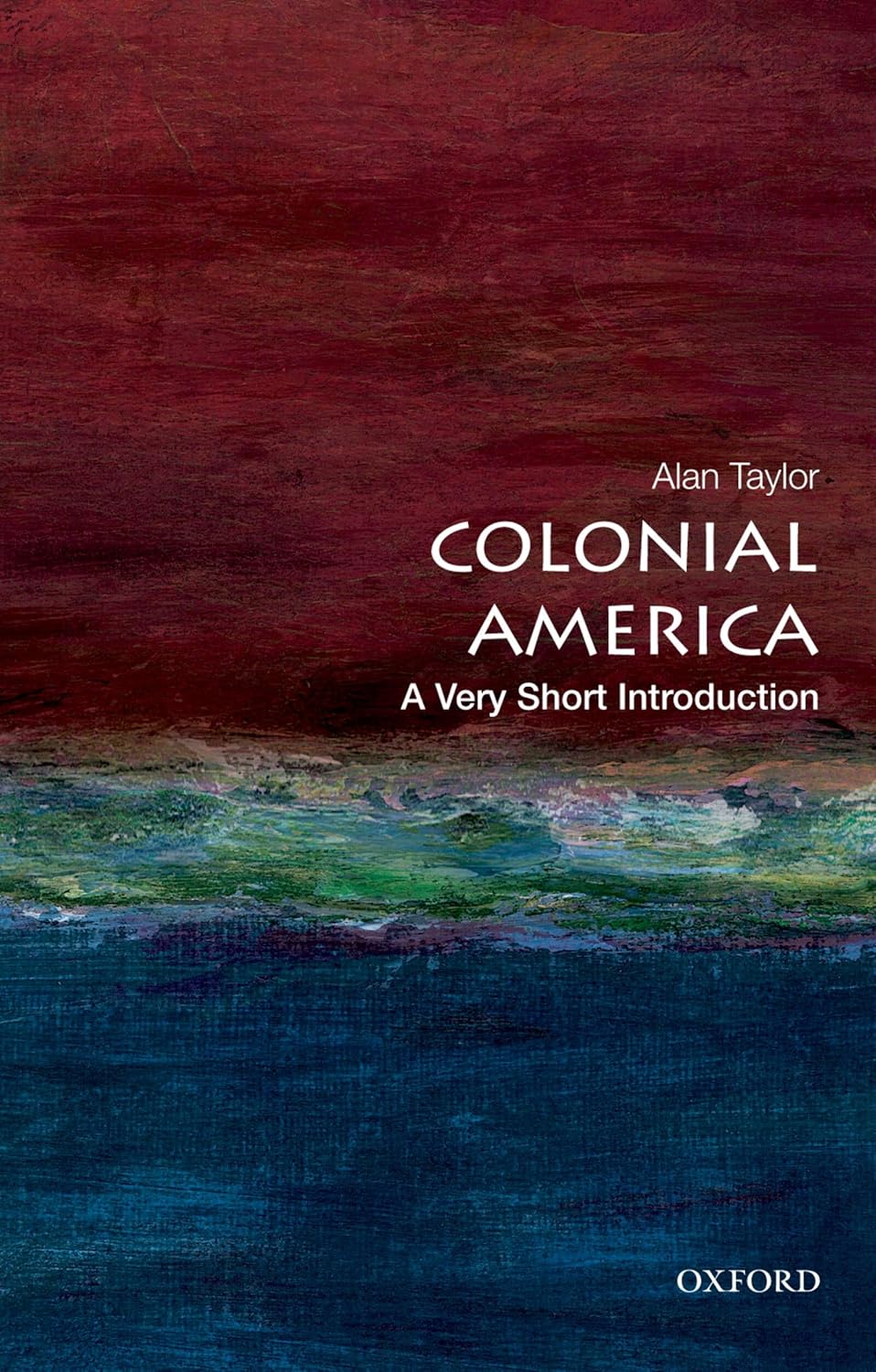
American Colonies: The Settling of North America (2001) by Alan Taylor is a sweeping and authoritative narrative of the European colonization of the Americas from 1492 to 1830. A decade later, the UC Davis historian distilled that expansive work into Colonial America: A Very Short Introduction (2013), part of Oxford’s acclaimed series of concise scholarly overviews. The latter volume serves as a compact and accessible synthesis of Taylor’s earlier, comprehensive history of the New World in the wake of European arrival.
From the American perspective, much of colonial history has been told telescopically backward. The story typically begins in the eastern seaboard colonies and moves steadily westward, as European immigrants – mostly English and Scottish – rapidly settled and “civilized” what is often portrayed as an empty wilderness. “American exceptionalism,” Taylor writes, “casts the colonial period simply as an anglophone preparation for the United States, defined as a uniquely middle-class society and democracy.” In reality, the story is far more messy and complex. Between 1492 and 1776, North America experienced a net population decline as disease and warfare devastated Indigenous societies. Moreover, during the eighteenth century, the largest single group of newcomers consisted not of free Europeans but of enslaved Africans transported across the Atlantic. The true history of the colonial era, then, is one of intense and unprecedented cultural intermingling – among Europeans, Native Americans, and Africans – alongside the global exchange of plants, animals, and microbes that reshaped the continent.
Taylor argues that the Americas were likely settled in three major waves of migration, occurring roughly 12,000, 9,000, and 5,000 years ago. The earliest inhabitants, often labeled by scholars as “Paleo-Indians,” lived before 9,000 years ago in small, mobile bands of hunter-gatherers. Beginning around 9,000 years ago – by which time humans had reached the southernmost stretches of South America – “Archaic” peoples emerged, forming larger communities within more defined territories and establishing villages along waterways rich in fish and fowl.
Around 3,000 years ago, the development of horticulture—centered on the calorie-dense trio of maize, beans, and squash – enabled some societies to generate food surpluses capable of sustaining specialized classes of merchants, artisans, priests, and rulers. Contrary to romanticized notions of universal Indigenous ecological stewardship, Taylor notes that several complex societies, including the Anasazi, Hohokam, and Cahokia, experienced decline in part due to environmental strain and resource mismanagement.
On the eve of European contact in 1492, the Americas are estimated to have held between 50 and 100 million people, with perhaps 5 to 10 million living north of Mexico with 375 distinct languages. Native Americans thus comprised roughly seven percent of the world’s population. By 1800, however, that share had fallen to less than one percent, while Europeans’ portion of the global population doubled from about 10 to 20 percent. Ironically, much of Europe’s demographic expansion was fueled by American crops – such as cassava, maize, and potatoes (7 to 10 million calories per hectare) – which yielded nearly twice as many calories per hectare as traditional European grains like wheat, barley, and oats (4 to 5 million calories per hectare), and could thrive in colder, thinner, and wetter soils. In this sense, the Columbian Exchange devastated Indigenous populations even as it nourished the rapid growth of Europe, whose settlers would come to occupy much of the demographic vacuum left behind.
The New World contained only two large-scale civilizations comparable in size and complexity to those of Europe: the Aztec and the Inca. The Aztec capital of Tenochtitlan, with an estimated population exceeding 200,000, was roughly three times the size of Seville, Spain’s leading city at the time. Unlike the English, who would later frame their colonial project in often messianic terms, the Spanish viewed the catastrophic decline of Indigenous populations with alarm. They regarded the Americas primarily as a source of taxable subjects and coerced labor to sustain the vast and extractive encomienda system, not as a “City upon a Hill.” The Spanish Crown even introduced reforms aimed at curbing the worst abuses committed by conquistadors. By 1550, as Taylor notes, “the Spanish had created the most formidable empire in European history by conquering and colonizing in the Americas,” acquiring territories ten times the size of Spain and governing some 20 million people – three times larger than Spain’s domestic population. Ironically, the Aztec and Inca – precisely because they were large, centralized, and hierarchical – proved the easiest to conquer and control. The Spanish pursued a policy of pacification and cultural transformation, seeking to Hispanicize Indigenous peoples through conversion to Roman Catholicism. By 1628, Franciscan friars had established fifty missions across New Spain. In the sixteenth century, roughly 250,000 Spaniards emigrated to the Americas, many intermarrying with Indigenous women. By 1700, mestizos – children of Spanish fathers and Indigenous mothers – outnumbered Indians in Mexico.
New France differed from New Spain in fundamental ways. Determined to avoid direct competition with the Spanish, the French concentrated their efforts in the far northern reaches of the continent, anchoring their colony in the isolated St. Lawrence River valley, where access to fisheries and, above all, the fur trade promised profit. From the outset, however, the French were drawn into long-standing rivalries among the Indigenous peoples of the Great Lakes region. The influx of European firearms, combined with intensifying competition over the most valuable beaver-hunting territories, fueled unprecedented violence among Huron, Iroquois, and Algonquin communities.
Compounding these tensions, Taylor argues, was the French failure to grasp Indigenous political culture. French officials likened themselves – and their king – to paternal figures presiding over Native allies. Yet in many Indigenous societies, authority rested more heavily with mothers and maternal uncles, while fathers were often regarded as generous but comparatively weak figures. The metaphor misfired.
In 1663, the French Crown assumed direct control of the colony from the fur-trading monopoly known as the Company of One Hundred Associates. At that time, only about 3,000 French settlers lived in New France – dwarfed by the 200,000 Spaniards in New Spain and the roughly 58,000 English colonists in New England and the Chesapeake. To stimulate population growth, the Crown briefly subsidized migration and sent several hundred young women from Franch orphanages – the so-called filles du roi (“daughters of the king”) – to become wives and mothers in the colony. By 1700 the population had grown to approximately 15,000 – still far behind the roughly 250,000 English colonists in North America and the Caribbean.
Taylor contends that both the push and pull factors for French colonization were weak. Canada’s climate was forbidding; Louisiana’s, oppressive. Neither offered the broad economic opportunities that drew settlers to English colonies, such as tobacco, rice and indigo. Both colonies were governed as tightly controlled regimes, overseen by a military governor, a civilian intendant, and a Catholic bishop, unlike the relative freedoms of British America with its elected assemblies. Ultimately, France subsidized Canada and Louisiana less for their intrinsic value than for strategic reasons: to secure Native alliances, hold the continental interior, and contain English expansion along the Atlantic seaboard. At considerable expense, France became enmeshed in complex Indigenous alliances at a time when Native societies were themselves struggling to adapt to the profound upheavals unleashed by European colonization. The introduction of guns and horses transformed power dynamics across the Great Plains, changes that ultimately slipped beyond colonial control – particularly for the Spanish, whose missions and presidios along their northern frontier were steadily eroded by increasingly mobile and formidable Indigenous powers.
The first permanent English settlements in North America arose in the Chesapeake and were driven by the “West Country men” of southwestern England, veterans of the English colonization of Ireland – a project that Alan Taylor describes as England’s counterpart to Spain’s conquest of the Canary Islands. These early promoters claimed colonization would alleviate England’s mounting crises of poverty, crime, and vagrancy while generating new cash crops and expanding markets for English manufactures. Between 1500 and 1650, real wages across the British Isles fell by roughly fifty percent, intensifying the search for relief abroad.
Unlike the Spanish and French, who dispatched missionaries from the outset to convert Indigenous peoples, the English initially sought to incorporate Native Americans as economic subordinates before undertaking sustained Protestant evangelization. In practice, however, English expansion achieved dominance less through design than through demographic catastrophe: epidemic disease, compounded by warfare, devastated Native communities. The Algonquian population of Virginia, estimated at about 24,000 in 1607, had declined to roughly 2,000 by 1669.
Meanwhile, Virginia offered opportunities unavailable in England – at least during its first half century. For those who survived the lethal conditions of the early Chesapeake – despite the importation of more than 15,000 indentured servants between 1625 and 1640, the colony’s population rose by only about 7,000 – there was a real chance for upward mobility. Formerly impoverished servants could acquire land and, in favorable years, prosper through tobacco cultivation.
By 1665, however, social and economic mobility had narrowed. Available land grew scarcer, and tobacco prices fell sharply, squeezing small planters. Mounting frustrations erupted in 1676 in an armed uprising against the royal governor known as Bacon’s Rebellion, led by the twenty-nine-year-old planter Nathaniel Bacon. Bacon demanded more aggressive westward expansion into Indigenous lands to open farms for land-hungry settlers. In the course of the revolt, his followers burned Jamestown to the ground.
Chastened by the upheaval, colonial authorities moved to stabilize the social order by accommodating the middling white population that formed the backbone of the militia. Over the ensuing decades, the reliance on indentured servants collapsed, while African slavery expanded dramatically: the enslaved population in Virginia grew from roughly 300 in 1650 (about 13 percent of the population) to approximately 150,000 by 1750 (around 40 percent). Fewer newly freed servants meant fewer landless men with grievances; instead, small white farmers became middling farmers who filled the ranks of the militia charged with policing an increasingly large enslaved population.
As Taylor observes, “Colonial Virginia developed the American interdependence of elite rule, popular politics, and white racial superiority.” That distinctive synthesis, he argues, set English America apart from both the British Isles and other European colonies in the New World.
The English colonial experience to the north differed sharply from the emerging tobacco plantation economy of the Chesapeake. New England was settled largely by Puritans drawn from across the social spectrum of English society. Unlike the predominantly male migration to Virginia, they arrived in nuclear family units, fostering social stability and rapid natural population growth. Their aim was to found a godly commonwealth – a virtually self-governing republic modeled on their understanding of the pure Christian communities that had existed after the Crucifixion.
The demographic contrast between the two regions was striking. Life expectancy in the Chesapeake hovered around fifty years, while in New England it exceeded seventy. Migration patterns in the seventeenth century further underscore the difference: of the roughly 330,000 emigrants who left for English America, more than half (about 190,000) went to the West Indies and roughly a third (120,000) to the Chesapeake, while fewer than a tenth (21,000) settled in New England. Yet by 1700 New England’s healthier climate and family structure had produced explosive growth. Of the approximately 209,000 English colonists in the Americas, nearly half (91,000, or 44 percent) lived in New England, compared to 41 percent (85,000) in the Chesapeake and just 16 percent (33,000) in the West Indies.
One grim reality united all English colonies: the catastrophic decline of Native populations. By 1670, New England’s 52,000 colonists outnumbered the region’s Indigenous peoples by more than three to one.
Unlike the cash-crop colonies of the South, New England’s economy rested on fishing, shipbuilding, and maritime trade. By 1690 nearly three-quarters of its exports were bound for the West Indies – primarily dried fish to provision enslaved laborers on Caribbean plantations. Each colony was incomplete without the other. At the same time, New England shipyards flourished, launching roughly 1,200 vessels between 1674 and 1714, often at half the cost of ships built in England.
Because it never developed a plantation system dependent on staple crops, New England largely avoided the stark class divisions and extreme income inequality that characterized the southern colonies. Indeed, in climate, resources, and population, it resembled the mother country more closely than did the plantation colonies – so much so that it was sometimes regarded less as a mercantilist appendage than as a budding capitalist rival within the empire.
In sum, New England was a society marked by relative equality, broad opportunity, and a culture of thrift, sustaining a diversified and expanding economy. Its healthier climate and more balanced gender ratio fostered social stability and steady population growth, enabling the gradual accumulation of property and widespread access to education and religious life.
The West Indies were the economic engine of England’s colonial empire, and sugar was king. By 1686, the value of exports from the Caribbean was three times greater than that of all the mainland North American colonies combined. On Barbados – just twenty-one miles long and fourteen miles wide – sugar grandees typically controlled plantations of 250 acres worked by an average of 115 enslaved laborers, with estates valued at roughly £4,000 (the equivalent of about $22 million in 2026 dollars). By 1713 Jamaica, an island ten times larger than all the other English West Indian colonies combined, had become the empire’s leading sugar producer.
Restless and hemmed in Barbadian planters carried this plantation model to the mainland, establishing Charles Town (later Charleston) at the mouth of the Ashley River in 1670. They were the first to transplant the West Indian slave-based plantation system to North America. Generous incentives – land grants of 150 acres for each white family member and for each enslaved person – fueled rapid population growth. From just 200 settlers in 1670, South Carolina’s population expanded to 6,600 by 1700, roughly two-thirds white and one-third black, quickly surpassing the 1,500 Spaniards in nearby Florida.
A tight-knit circle of powerful planters known as the “Goose Creek Men” soon dominated the colony and secured its transition to royal status. Their aggressive trade in firearms and enslaved people proved more effective as an instrument of expansion and control than the Spanish mission system. By 1730 South Carolina’s population had climbed to 64,000 (again about two-thirds white and one-third black), while the Indian population had plummeted to roughly 4,000. The introduction of rice cultivation in the 1690s transformed the colony’s economy: annual exports soared from 400,000 pounds in 1700 to 43 million pounds by 1740, accounting for more than 60 percent of the Carolinas’ export value and making the planter elite the wealthiest colonials on the Atlantic seaboard.
Georgia may have the most disappointing origin story in the entire British colonial experiment. Conceived as a reform colony that would prohibit slavery and alcohol while embracing religious toleration, it was founded in 1733 by a group of idealistic trustees led by General James Oglethorpe, who secured a charter from King George II and named the colony in his honor. Between 1733 and 1742, the Georgia Trustees transported some 1,800 charity settlers to small farms in the new colony. Yet the lofty vision soon faltered. As historian Alan Taylor observes, many of the newcomers came to regard the trustees and their regulations as “unrealistic, unresponsive, and dictatorial.” The discontented colonists rallied behind the blunt slogan “Liberty and Property without Restrictions” – with “property” pointedly including enslaved labor. In 1751 the trustees surrendered their charter to the Crown, abandoning their social experiment. Over the next quarter century, Georgia was transformed: its population surged from roughly 3,000 whites and 600 blacks in 1752 to 18,000 whites and 15,000 blacks on the eve of the American Revolution in 1775.
The British colonial population differed markedly from its Spanish and French counterparts – and, to a lesser extent, from the Dutch as well. Compared with other New World empires, the English monarch exercised relatively little direct authority over his colonies. Across English America, propertied elites – and often the middling classes – insisted on electing representative assemblies with control over colonial finances. As Taylor observes, “Propertied Englishmen cherished legislative control over taxation as their most fundamental liberty,” and the broad charters granted to many colonies left them functionally semi-autonomous from the Crown.
By the late seventeenth century, however, the strategic value of overseas colonies – as engines of commerce and instruments of national power – had become unmistakable. The Crown and Parliament responded by tightening regulation and taxation of colonial trade. The Navigation Acts of the 1650s and 1660s embodied this shift, as England asserted maritime supremacy and displaced the Dutch from their dominance in transoceanic shipping. These measures helped trigger three Anglo-Dutch wars between 1652 and 1674, conflicts from which England emerged victorious and in command of the Atlantic seaboard from Georgia to Maine.
The Glorious Revolution further consolidated national power by forging a durable partnership between Crown and Parliament to finance an expanded army and navy. Parliament, once a check against unpopular taxation and royal overreach, became, in Taylor’s words, “the great collection agency for the Protestant regime and a transatlantic empire.” It demanded – and secured – greater authority over expenditures and increasingly shaped foreign and military policy, domains previously guarded as royal prerogatives. Out of this transformation emerged a new conception of sovereignty: the authority of the “King-in-Parliament.”
After coming to power, William III reorganized the colonies and dissolved the recently created Dominion of New England, an entity modeled loosely on the Spanish viceroyalty system that had imposed higher taxes and curtailed local self-government. Going forward, all colonies – except Connecticut and Rhode Island, which retained their unusually liberal charters – were required to submit their legislation for approval first to their governor (whether proprietary or royal) and ultimately to the king and his Privy Council. As Taylor notes, this compromise bound colony and crown more closely together; they “became more intertwined in a shared empire.”
In the eighteenth century, the character of immigration to the English colonies shifted markedly. Between 1707 and 1775, roughly 225,000 emigrants left Great Britain, two-thirds of them coming from Scotland and about half of those leaving from Ulster in northern Ireland. During the same period, approximately 100,000 Germans crossed the Atlantic. Economic hardship – particularly the depressed linen market in Scotland – and chronic warfare in central Europe pushed hundreds of thousands to seek opportunity in the New World. Yet these 325,000 voluntary European migrants were far outnumbered by the 1.5 million enslaved Africans transported to Britain’s American colonies, three-quarters of whom were landed in the West Indies.
Between 1720 and 1770, British America experienced a remarkable economic expansion. Per capita colonial imports rose by 50 percent, while their total value more than tripled, reaching £1,500,000 by 1750. On the eve of the American Revolution, the colonies had become an indispensable market for British manufactured goods. Ironically, in the years immediately preceding the break with Britain, Taylor observes that American colonists remained “enthusiastic patriots of empire.”
In the late seventeenth century, England defeated the Dutch in three wars fought over the course of two decades. Between 1689 and 1763, Great Britain then emerged victorious over France in four global conflicts that reshaped the balance of power in North America and beyond. The first war (1689–1697) proved a costly stalemate. The second (1702–1713), however, yielded significant gains, including Acadia (present-day Nova Scotia), Newfoundland, Hudson’s Bay, and St. Kitts. The third conflict (1738–1748) was largely inconclusive but set the stage for the decisive fourth war (1754–1763). In that final struggle, Britain overwhelmed French and Native forces – deploying roughly 45,000 regular and colonial troops against fewer than 10,000 French soldiers – and secured control of French Canada.
Yet in conquering Canada, Britain inadvertently created a crisis within its own empire. The victory removed the common French threat that had long bound the colonies to the mother country and justified their reliance on British military protection. Expecting gratitude – and financial support to help service the immense war debt – British officials instead encountered colonial resistance and growing resentment. Matters were compounded by a postwar recession, so that new taxes and tighter imperial regulations arrived at precisely the worst possible moment.
In closing, Taylor’s summary is just as rewarding as his fuller treatment of the subject. I’d highly recommend either one depending on how deep the reader wants to go.
 What's Tim Reading Now?
Leave a comment