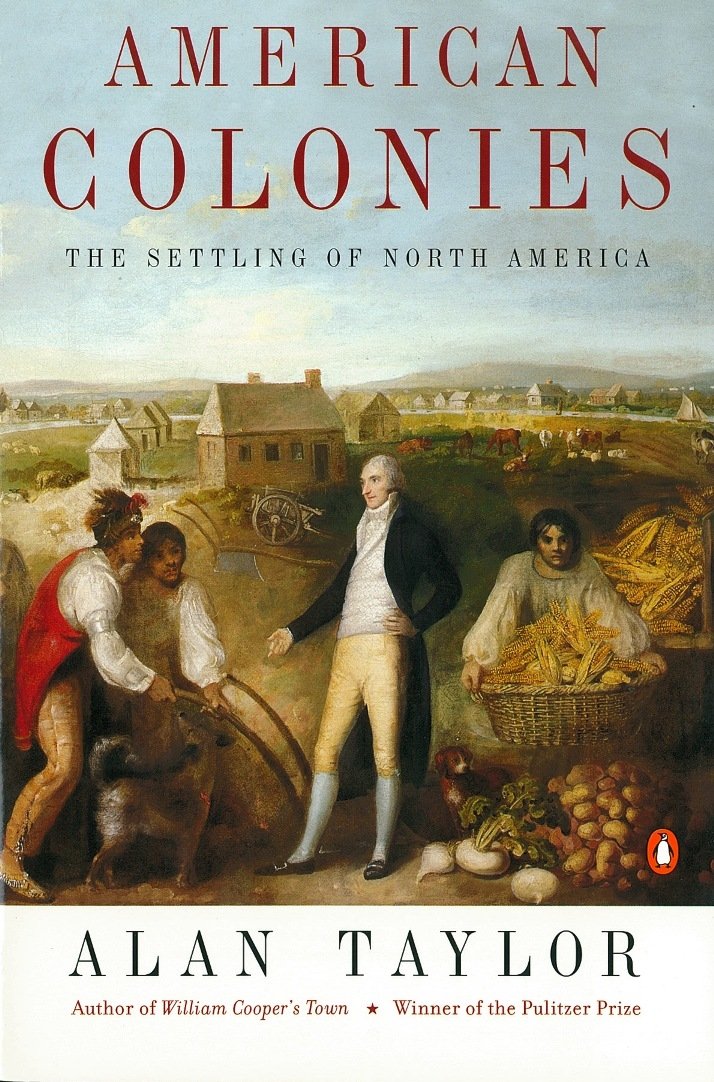
Each year I choose a broad historical subject to immerse myself in and, if possible, come close to mastering. In 2024 it was the Italian Renaissance; the year before, the Industrial Revolution. In 2025 I turned to early colonial America. Of the dozen or so books I read – ranging from accounts of the Spanish conquest of the Aztec and Inca empires to studies of the first English and French settlements in North America – none proved more comprehensive or illuminating than Alan Taylor’s American Colonies: The Settling of North America (2001).
To begin, Taylor takes a clear-eyed, unsentimental approach to evaluating the Americas and their first inhabitants. These descendants of the Asians who crossed the Bering land bridge were neither culturally uniform nor ecologically infallible. Instead, he argues, they quickly hunted many native megafauna – animals weighing more than one hundred pounds at maturity – such as mammoths, mastodons, horses, camels, and giant ground sloths, to extinction. By the time of Columbus’s arrival, some 375 distinct languages were spoken in North America alone. Several notable civilizations – the Anasazi, Hohokam, Cahokia, and Mississippian cultures – had already risen and fallen before Europeans appeared. Contrary to modern romantic notions of Native Americans living in seamless harmony with nature, Taylor contends that all societies placed heavy pressure on their local environments, often contributing to violence, collapse, or the relocation of major communities. He further notes that Native Americans practiced forms of animism, believing spirits inhabited plants and animals and could pose real danger. “Indian animism,” he writes, “should not be romantically distorted into a New Age creed of stable harmony.” Rather, the spiritual world was experienced as one of tension, danger, and uncertainty. European Christians, by contrast, believed that God commanded them to “subdue the Earth,” rendering it more productive for human use. To the colonizers, Indigenous practices of cautious coexistence with nature appeared both backward and impious.
Taylor estimates that roughly nine thousand years ago about one million people lived along the continent’s eight-thousand-mile north–south axis. By 1492 there were as many as fifty million people, with some five million living north of the Rio Grande. In that year Europe’s population was roughly eighty million with five million on the island of Great Britain. The global share of population between the Americas and Europe in 1492 was approximately seven percent and eleven percent, respectively; by 1800 the numbers had shifted to twenty percent and one percent. Just as the introduction of European diseases annihilated entire Indian societies, the introduction of calorie-rich New World crops contributed to the population explosion in Europe.
Taylor argues that “American colonization wrought an environmental revolution unprecedented in pace, scale, and impact in the history of humanity,” as an entire continent was rapidly inundated by a lethal mix of invasive weeds, vermin, and microbes – organisms forged in Europe through centuries of long-distance trade, urbanization, and animal domestication. “In sum,” he writes, “the remaking of the Americas was a team effort by a set of independent species led and partially managed (but never fully controlled) by European people.” The consequences were catastrophic: as historian Alfred Crosby observed, the resulting population collapse was “surely the greatest tragedy in the history of the human species.”
Long before Columbus reached the Caribbean, however, Europeans had rehearsed this process on the Atlantic islands. Colonized early by the Portuguese during the Age of Discovery, the Canaries, Azores, and Madeira became laboratories for imperial exploitation. With the exception of the Guanche on the Canaries, these islands were sparsely populated, making them easier to seize, remake, and convert into export economies. They supplied immediate commodities – especially sugar – and served as secure harbors for further exploration and permanent settlement. By the mid-fifteenth century, the Spanish had wrested control of the Canaries from the Portuguese, enslaving and quickly exterminating the Guanche before importing enslaved Africans to replace them. In Taylor’s view, “the conquest and transformation of the Atlantic islands prepared for the discovery, invasion, and remaking of the Americas,” with the Canaries functioning as “the training ground for the invasion.” Thus, when Columbus returned to the West Indies in 1493 with seventeen ships, twelve hundred men, sugarcane cuttings, and livestock, the Spanish were not experimenting – they were replicating a proven model of colonization and settlement.
The colonization of Hispaniola was genocidal in effect. The Taíno, the island’s native inhabitants, numbered roughly 300,000 in 1492; within half a century, only about 500 remained. “Dislocated, traumatized, overworked, and underfed,” Taylor writes, “they proved especially vulnerable to disease” – a pattern that would repeat itself across the Americas in the centuries to come. Early Spanish brutality helped give rise to the so-called “Black Legend,” the belief that the Spanish were uniquely cruel and destructive compared to other European colonizers. Taylor dismisses this as misleading: the Spanish were not singularly vicious, he argues, merely earlier and far more expansive in their conquests and landed amidst more centralized horticulture-based civilizations, which gave them greater opportunity to inflict harm and extract resources. Like the later English empire, the early Spanish empire was largely entrepreneurial. Conquistador expeditions – Cortés in Mexico, Pizarro in Peru, De Soto in the Southeast – were essentially private ventures led by independent military contractors seeking profit. Under the adelantado system, previously used in the Canary Islands, the crown granted licenses to conquer and tax Indigenous populations in exchange for twenty percent of the spoils and territorial sovereignty. A warrior hidalgo culture, combined with fierce competition for wealth and status, powered the system. Moreover, each conquistador typically assumed heavy debts to finance his expedition and needed a swift, lucrative payoff to satisfy creditors, a pressure that encouraged extreme aggressiveness and risk-taking. Hernán Cortés, after toppling the Aztec Empire, became one of the richest and most socially elevated men in the Spanish empire. Between 1500 and 1650 the Spanish shipped home 181 tons of gold and 16,000 tons of silver.
The Spanish flocked to the New World in droves – a quarter million Spanish emigrants arrived in the sixteenth century alone. Of all the European empires in the Americas, the Spanish empire – New Spain (Mexico, Central America and the Caribbean) and Peru (all of South America except Brazil) – developed the largest number of urban centers and cosmopolitan institutions. Madrid also sought the greatest degree of control via a council known as an audiencia, which drafted laws, advised the royally-appointed viceroys, and presided over major trials. But time and distance made control from Madrid nearly impossible.
By 1530, Spanish policy in the New World began to shift from conquest to pacification, seeking to co-opt rather than crush Indigenous populations. This approach was most fully implemented in the southwestern territory of New Mexico under the leadership of the Franciscan order. After early signs of success, however, it ultimately culminated in the only fully successful Native rebellion in colonial North America. Taylor notes that the Franciscans frequently denounced Spanish governors as “corrupt, vicious, and impious meddlers,” yet neither the friars nor their Christian God could shield Native converts from rapacious officials, epidemic disease, drought, and raids by Plains tribes. In the end, roughly forty percent of the hundred Franciscans who served in New Mexico died as martyrs. Venting their fury after decades of exploitation, the Pueblo Revolt of 1680 became the most significant setback Native peoples ever inflicted on European expansion in North America.
The French entered North America in a markedly different manner than the Spanish. In the words of historian Allan Greer, they arrived “not as conquering invaders, but as a new tribe negotiating a place for itself in the diplomatic webs of Native North America,” and, in many of those negotiations, Taylor notes, the French often occupied the weaker position. Along the St. Lawrence Valley, they quickly forged mutually dependent ties with Algonquian peoples centered on the fur and fish trades. Unlike the Spanish pursuit of gold and silver in Central and South America, the harvesting of beaver pelts proved faster, cheaper, and far less violent, requiring less capital and coercion. Canada offered additional advantages: it lay safely distant from the reach of the Spanish empire, its northern climate produced especially thick pelts, Indigenous hunters were highly skilled, and the St. Lawrence River and Quebec provided both a deep-water gateway to the interior and a defensible base for trade with a single point of entry. By 1620, French traders were exporting almost twenty thousand beaver pelts a year.
The French achieved these gains through alliances with the Algonquian and Huron nations, a strategy that brought them into direct conflict with the powerful Five Nations of the Iroquois Confederacy, who in turn gravitated toward the Dutch along the lower Hudson River Valley. Eventually, Taylor writes, “the Iroquois and the French needed each other as enemies.” The Iroquois of upstate New York acquired inferior quality beaver pelts, which they traded for higher quality goods, including weapons, from the Dutch. The French relied on the Iroquois as a buffer, hoping to shield their Algonquian and Huron allies from the lure of abundant, inexpensive, high-quality Dutch trade goods. By 1650, however, the Iroquois and Huron were locked in a war of unprecedented ferocity. As Taylor observes, “Trade, alliance, and war entangled colonizers and natives in ways they could never have predicted, could rarely control, and might not have chosen.”
If the Canary Islands served as a training ground for the Spanish Empire in the Americas, Ireland played a similar role for the English, emboldening them to carry their colonial ambitions across the Atlantic. Taylor notes that the English treated the Irish – whom they regarded as “dirty, lazy, treacherous, murderous, and pagan savages” – little better than the Spanish treated the Guanche. The only remaining territory open to “virgin” colonization – the mid-Atlantic coast – was considered too temperate for tropical cash crops and too warm for high-quality furs. Following Spanish and French precedents, Queen Elizabeth I subcontracted colonization, granting licenses and monopolies to private adventurers who assumed the risks in speculative pursuit of profit. Taylor describes these early English promoters as “dreamers and gamblers driven by their visionary imagination.”
At the same time, England’s population surged from three million in 1500 to five million by 1650, with 350,000 crowded into London alone. Wealthy landowners steadily enclosed common lands, and between 1530 and 1630 roughly half of England’s rural peasantry lost their holdings. The growing labor supply drove real wages down by half, while rising demand pushed up the price of food and housing. Elites feared that mounting poverty and displacement would tip the country into disorder and violence. Colonization offered a solution: a release valve for the restless poor and an opportunity to generate new wealth and power. As Taylor puts it, “England needed to expand outward lest it collapse from within.” The Atlantic colonies thus promised a tidy arrangement – export social instability while enriching those at the top.
The 1604 peace treaty with Spain freed English capital, ships, and sailors that had long been tied up in war with Madrid. Two years later, London incorporated the Virginia Company, and King James granted it a charter to colonize and govern Virginia. Promised a land of milk and honey, settlers instead found the Tidewater a lethal environment that consumed colonists almost as quickly as they arrived. A decisive turning point came in 1610 with the introduction of the headright system: emigrants who paid their own passage received fifty acres of land, plus an additional fifty for each family member or servant they brought at their own expense. This shift – from colonists as company employees to independent property owners farming their own land – had immediate and dramatic effects. Between 1616 and 1650, the population surged from 350 to 13,000, an astonishing eleven percent annual compound growth rate despite a staggering twenty-five percent yearly mortality rate. By 1670 the English population reached 41,000. Meanwhile, disease and war reduced the Virginia Alconguan from roughly 24,000 upon the English arrival in 1607 to 2,000 by 1669.
The other essential change was the discovery of a cash crop well suited to the mid-Atlantic climate: tobacco. During the 1620s, tobacco sold in England for five to ten times its cost of production in Virginia, and output exploded – from 200,000 pounds a year in 1624 to more than three million by 1638, and ten million by 1660. Yet success bred its own problems: as production soared, prices collapsed by more than ninety percent, from the equivalent of roughly $12 per pound to about $1. Even so, customs duties on tobacco imports supplied a quarter of the Crown’s revenue in the 1660s. The boom years of the 1640s and 1650s coincided with peak English migration, but by the 1660s and 1670s falling prices and dwindling good land choked off opportunity and fueled social unrest. The Navigation Acts – passed between 1651 and 1696 to confine colonial trade to English ships, channel exports like tobacco exclusively through England, and tighten anti-smuggling enforcement – only deepened the hardships facing Chesapeake planters.
It was during this period that enslaved African labor expanded dramatically. In 1650, only about three hundred enslaved Africans lived in the Chesapeake, roughly two percent of the population, while English indentured servants – more than 100,000 strong – made up three quarters of incoming migrants. By 1700, however, indentured servitude had largely disappeared from Chesapeake households, replaced by a rapidly growing enslaved workforce: some 13,000 Africans, about thirteen percent of the population. By 1750, that number had risen to 150,000, nearly forty percent of the region’s inhabitants.
The wealthiest and most ambitious colonists – many lacking the pedigree of a traditional ruling class – came to dominate colonial affairs. Unlike the more centralized Spanish and French empires, the English mid-Atlantic colonies, both Crown (Virginia) and proprietary (Maryland), developed in a decentralized and locally driven fashion. In 1676, frontier settlers led by Nathaniel Bacon launched an armed revolt against Governor William Berkeley, protesting his reluctance to wage war on Native Americans and his favoritism toward coastal elites. The rebels briefly seized Jamestown, exposing deep class divisions between wealthy planters and poorer settlers and helping to hasten Virginia’s turn toward racialized slavery as a system of social control. As Taylor observes, “Bacon’s Rebellion did not cause the switch from servants to slaves, but that shift did discourage poor whites from rebelling in the eighteenth century.” In time, both common settlers and great planters forged a new, shared identity rooted in racial hierarchy.
The English colonies of New England developed along lines strikingly different from those of the Chesapeake. Most settlers, Taylor notes, were of the “middling sort” – neither elites nor servants – and the population was relatively homogeneous: free, white, and English. The climate was healthier, though the prospects for sudden wealth were slim. They were also fortunate in their passage: during the 1630s nearly two hundred ships carried migrants to New England, and only one was lost. Once they arrived, most settlers lived on small farms clustered around largely self-governing towns, giving New England greater economic and political stability. In contrast, the Chesapeake was defined by sprawling, dispersed plantations, where the county served as the primary unit of government and a cash-crop economy left society vulnerable to cycles of boom and bust. Moreover, unlike the Chesapeake – whose economy was almost wholly dependent on exporting tobacco to the home country – New England directed most of its trade southward to the West Indies, sending cod, timber, and ships to provision the sugar plantations, which in turn supplied New England with rum. “Each was incomplete without the other,” Taylor writes. “New English freedom depended on West Indian slavery.” In many ways, New England’s economy operated more as a competitor to Britain’s than a complement.
Above all, Puritanism guided their society. The ambitious planters of the Chesapeake sought to create wealth, not a shining “City upon a Hill.” Colonists viewed piety and property as mutually reinforcing, and the Puritan virtues of thrift, diligence, delayed gratification, and the spiritual equality of the godly suited the region’s rocky soil and communal life. As a result, the harsh adjustment period proved shorter and less deadly than in the Chesapeake. Within a decade, Plymouth’s population had reached 1,500. Taylor argues that the early Puritans operated what amounted to a protection racket, compelling the tribes of southern New England – already devastated by infectious disease – to purchase peace with wampum, which the Puritans then used to buy beaver pelts from the Abenaki of Maine. Between 1634 and 1664, this system exported as much as £10,000 worth of high-quality pelts to England.
Beginning in 1630, the so-called Great Migration brought thousands of Puritans fleeing Archbishop William Laud’s reactionary policies. About fourteen thousand left England in the 1630s, roughly five thousand settling in New England. From there, strong family formation fueled rapid natural growth. By 1660, even as immigration slowed, some 33,000 colonists lived in New England, including 20,000 in Massachusetts alone, and only about two percent were enslaved Africans. By 1670, there were about 52,000 English settlers in New England, outnumbering Indigenous peoples by roughly three to one. The Puritans tried to assimilate the native population by clustering sixteen hundred Indians in fourteen praying towns across Massachusetts. King Philip’s War of 1676 claimed the lives of roughly three thousand Indians or roughly a quarter of the total remaining population.
Over the seventeenth century just 21,000 emigrants arrived and thousands were killed in Indian wars, yet by 1700 the population had swelled to 92,000 through natural increase. By contrast, although 120,000 English migrants went to the Chesapeake, its white population in 1700 stood at only 85,000. But the North American colonies proved of secondary importance to the British compared to the West Indies. By 1686, London was importing £882,000 worth of goods from its American colonies. The vast majority flowed from the Caribbean: 77 percent of all colonial imports came from the West Indies, and 87 percent of that West Indian trade was sugar alone. North America, by contrast, accounted for just 23 percent of total trade, with tobacco making up 68 percent of its exports. New England’s commerce provisioned plantations like Barbados with food and supplies, enabling the island to specialize ever more completely in sugar production and slave labor. As historian Alan Taylor observes, “in sum, at an immense cost in human suffering, the sugar islands served as the great economic engine of the English empire.”
England entered the race for North American colonization relatively late, but it quickly outpaced the French and Dutch in the Caribbean, which became the primary magnet for English migration across the Atlantic. Between 1640 and 1660, fully two-thirds of English emigrants to the Americas sailed to the West Indies. By mid-century, the region counted 44,000 white colonists – more than the combined populations of the Chesapeake (12,000) and New England (23,000).
By 1660, the tiny island of Barbados, just 166 square miles in area, generated more trade and capital than all other English colonies combined. The island’s sugar economy dominated the Atlantic market: by 1700, the West Indies produced nearly 60,000 tons of sugar, 42 percent (25,000 tons) of it from Barbados alone. That output exceeded even Brazil, which produced 34 percent (20,000 tons), as well as the French Caribbean at 17 percent (10,000 tons) and the Dutch at just 7 percent (4,000 tons).
Located roughly one hundred miles east of the Lesser Antilles, Barbados was the West Indian island closest to Africa, a position that made it a primary destination for slave ships crossing the Atlantic. As the supply of captives increased – much of it carried by Dutch traders – the price of enslaved people fell sharply, dropping by more than 40 percent in a single decade, from £35 in 1635 to £20 by 1645. The expanding sugar economy depended on this steady influx of forced labor, but the conditions were extraordinarily harsh. Work in the cane fields was relentless, disease rampant, and mortality staggering; for many, life was, in Hobbes’s grim phrase, “nasty, brutish, and short.” Of the roughly 130,000 Africans transported to Barbados between 1640 and 1700, only about 50,000 were still alive at the dawn of the eighteenth century. Across all of the English West Indies some 260,000 slaves were imported during that period and only 100,000 survived overall – a stark measure of the human cost that underwrote the island’s wealth.
The slave plantations were relentlessly effiient. Between 1650 and 1680 the price of a one hundred pound sack of sugar fell by two-thirds, from twenty-eight shillings to ten. But the local planters became fabulously rich nevertheless. That wealth translated into political power in Parliament back in London where the sugar lobby protected the planters from the nearly ruinous taxes the crown levied on Chesapeake tobacco. Taylor says that in 1669 tobacco traders paid over three times more in customs duties (£75,000 versus £18,000) than the sugar planters, even though the sugar crop sold for 44 percent more (£180,000 versus £125,000). “The Chesapeake planter worked primarily to benefit the crown,” Taylor writes, “the West Indian planter kept most of the value his slaves made.”
The English seized Jamaica from Spain in 1655. At 4,400 square miles – twenty-seven times the size of Barbados – the island immediately altered the balance of power in the Caribbean and posed a strategic challenge to the older English sugar colonies in the Lesser Antilles. It soon became a center of piracy based in Port Royal, which for a time ranked as the third-largest city in English America, after Boston and Bridgetown. Dubbed the “Sodom of the West Indies,” Port Royal was largely destroyed by an earthquake in June 1692.
By 1713, Jamaica had surpassed Barbados in sugar production and emerged as the wealthiest and most important colony in the English Empire. Yet it was also a tinderbox: enslaved Africans outnumbered whites by roughly eight to one (55,000 to 7,000), more than double the ratio in Barbados, where the imbalance stood at about three to one.
In 1670, the English founded a new southern plantation colony in the Carolinas, just 250 miles north of the Spanish outpost at St. Augustine. “Carolina promised ambitious and wealthy men the opportunity to get in on the ground floor of a new colony,” Taylor writes, though its economic foundation was initially uncertain: it lay too far north for sugar, too far south for the fur trade beyond deerskins, and tobacco prices were collapsing. To attract settlers quickly, the proprietors made the colony unusually appealing, offering large land grants, broad religious toleration (excluding atheists), political representation in an assembly with taxing and spending authority, and long exemptions from quitrents—annual fees paid by landholders to proprietors. From just two hundred settlers in 1670, South Carolina grew to 6,600 people by 1700 (about 3,800 whites and 2,800 enslaved Africans), an annual growth rate of roughly twelve percent.
Carolinians secured dominance over neighboring Native peoples through aggressive diplomacy, intermarriage, and trade – especially in guns and enslaved captives – while largely avoiding efforts at religious conversion. As the colony’s white and Black populations swelled to 64,000 by 1730 (37,000 whites and 27,000 enslaved Africans), the Indigenous population collapsed to roughly 4,000.
In its early years, Carolina relied on exports of deerskins, Native slaves, and naval stores such as tar from its pine forests – an unstable foundation for long-term prosperity. That changed in the 1690s with the introduction of rice cultivation, aided by enslaved Africans who brought knowledge of the crop from West Africa. Just as the Chesapeake specialized in tobacco and the West Indies in sugar, the Carolinas became the British Empire’s rice colony. Annual rice exports soared from 400,000 pounds in 1700 to 43 million pounds by 1740, accounting for 60 percent of the region’s export value. Indigo emerged as a second staple in the 1750s, with exports rising from 63,000 pounds in 1750 to 500,000 by 1760. Rice and indigo made Carolina planters the second-wealthiest colonial elite after the West Indian sugar barons. This expansion rested overwhelmingly on enslaved labor: by 1710, South Carolina had become the first mainland English colony with a Black majority, and in the Lowcountry enslaved Africans outnumbered whites by as much as nine to one – ratios comparable to those of Jamaica.
Georgia’s founding story – named for King George II – is a striking one. Established in 1732 by a group of London reformers and philanthropists, the colony was intended to relieve urban poverty by resettling England’s “worthy poor” in a new southern outpost. Until 1752, nearly all of Georgia’s funding came from Parliament, making it the first colony financed by British taxpayers. In deliberate contrast to the slave plantation societies of the Carolinas, Georgia initially prohibited slavery, along with alcohol and large landholdings. Property was limited to fifty acres per owner, and settlers were encouraged to cultivate compact, high-value crops such as hemp, flax, mulberry trees, and grapes.
By 1751, however, the “noble experiment” had unraveled. The Georgia Trustees relented – legalizing liquor, slavery, lawyers, and large plantations – and surrendered the colony to the Crown. Georgia quickly began to resemble South Carolina. From a population of roughly 3,000 whites and 600 Blacks in 1752, the colony surged within a few years to 33,000 people, divided almost evenly between black and white residents. Efforts to build an economy around wine, silk, hemp, and flax failed, and by 1760 the southern Atlantic colonies had largely replicated the West Indian slave plantation system.
Taylor argues that George II of England (1660–1685) and his brother, James II of England, “developed a violent envy of Dutch wealth,” born of the Netherlands’ powerful combination of overseas colonies, commercial expansion, and naval strength. By 1670, the Dutch employed 120,000 sailors on ships totaling 568,000 tons – more than the combined shipping of Spain, France, and England. They dominated the transport of tobacco and sugar to Europe and enslaved Africans across the Atlantic, and their shipping costs were often a third lower than those of the English. In 1628, a Dutch flotilla even captured the entire Spanish treasure fleet.
The English ultimately responded with the Navigation Acts, first enacted in 1651 and strengthened in the decades that followed. These laws rested on three core principles. First, only English ships were permitted to trade with English colonies. Second, the Acts designated certain high-value “enumerated commodities,” such as sugar and tobacco, that could be exported only to the mother country. Finally, all European goods bound for the English colonies were required to pass through England first, where customs duties were collected. The Dutch fought three wars in response to English enforcement of the Navigation Acts (1652–54, 1664–67, and 1672–74). These conflicts, waged primarily at sea, ended largely in stalemate but ultimately favored the English and weakened the smaller Dutch Republic. Among the consequences was the English seizure of New Netherland in 1664, a transfer formalized in 1667 under the Treaty of Breda.
As a result, English merchant shipping more than doubled between 1640 and 1686, expanding from 150,000 tons to 340,000 tons – though it still remained more than one-third smaller than that of the Dutch. Even so, the seventeenth century witnessed England’s dramatic transformation from an insular, largely agricultural society into a complex, globally integrated commercial economy.
The Dutch came to present-day New York primarily to trade and farm, making no concerted effort at Protestant proselytization. The Dutch West India Company controlled the fur trade flowing from the Great Lakes down the Hudson River, increasing exports from 4,700 pelts in 1624 to 35,000 in 1656. The company appointed the colony’s governor and permitted no elected assembly. Taylor describes the succession of Dutch governors as “contentious, arbitrary, and mostly incompetent.”
Although the Dutch were a minority in their own colony – New Netherland – it was home to a diverse mix of Jews, Puritan dissenters, French Huguenots, and various European traders. At least eighteen languages were spoken. Yet the population remained small: by 1660, only about 5,000 colonists lived in New Netherland, including 1,000 English settlers squatting on Long Island when total English settlers in Virginia and New England approached sixty thousand.
Taylor contends that the Dutch had a smaller pool of potential emigrants and fewer incentives for them to leave the prosperity and security of the Netherlands for the relative instability of New Netherland. In short, there was little pull—and even less push. “The English succeeded as colonizers,” Taylor concludes, “largely because their society was less successful at keeping people content at home.”
Compared with the Dutch, French, and Spanish, the English monarchy exercised relatively little direct control over its American colonies. By the late seventeenth century, the proprietary system of colonization – so central to the English experience in Virginia, New England, and the Carolinas – had become a liability as London sought to expand and consolidate its imperial ambitions. The wealthiest proprietary colonies built on cash crops—Virginia, Barbados, and Jamaica – were therefore converted into royal colonies under more direct Crown authority.
At the same time, the English intensified their efforts in Native diplomacy. The Covenant Chain was a series of diplomatic agreements forged in the late seventeenth century between the English colonies – especially New York – and the Iroquois Confederacy (Haudenosaunee), establishing a durable framework for alliance, trade, and mutual defense.
In 1680, William Penn received a grant of 45,000 square miles west of the Delaware River as repayment for a £16,000 debt the Crown owed his late father, Admiral William Penn. Two years later, in 1682, James II of England – then the Duke of York – added the former Swedish, Finnish, and Dutch settlements along the lower Delaware, territory that would later become the state of Delaware.
Taylor describes the younger Penn as “a devout Quaker and an ingrained elitist … both highly principled and habitually condescending.” As the Quakers moderated over the course of the seventeenth century, they found an influential ally in the Catholic-leaning Duke of York, who became King James II in 1685 and made common cause with dissenting Protestants. Like Puritan Massachusetts, Penn envisioned Pennsylvania as a “holy experiment” and an “example to the Nations” – but without a privileged church or tax-supported religious establishment.
Religious and ethnic diversity soon became the defining feature of Pennsylvania and the broader mid-Atlantic colonies. Taylor argues that “the middle colonies defined a distinctive culture and social order that precociously anticipated the American future.” Blessed with industrious settlers, a strategic location, favorable timing, and relatively peaceful relations with local Native peoples, Pennsylvania prospered rapidly. Between 1682 and 1686, its population surged from virtually nothing to 8,000 – one of the fastest and most efficient colonization efforts in the seventeenth-century English empire. By 1700, the population had reached 18,000, largely composed of nuclear families of modest but stable means. Unlike some earlier colonies, Pennsylvania experienced no periods of feverish speculation or “starving times.”
Yet despite the colony’s success, its paternalistic and often capricious founder fell into financial distress. Penn was eventually imprisoned for debt in 1707.
Taylor argues that James II of England viewed the American colonies primarily as a source of revenue – financial engines that could help fund a more authoritarian monarchy independent of Parliament’s taxing power. He increased the Crown’s share of treasure recovered from Spanish shipwrecks from 10 percent to 50 percent, doubled customs duties on sugar, and raised already onerous tobacco rates. In 1684, James moved to consolidate the colonies from the Delaware River to Canada into a single administrative unit, the Dominion of New England, modeled in part on the centralized authority of Spanish viceroyalties. Elected assemblies were abolished, and taxes were imposed at unprecedented levels. James appointed Edmund Andros as royal governor. Andros restricted town meetings, strictly enforced customs laws, challenged existing land titles, and promoted the Church of England in staunchly Puritan New England. These measures made the Dominion deeply unpopular, and it quickly unraveled in the wake of the Glorious Revolution.
The overthrow of James II also drew England into the Nine Years’ War against France (1689–1697), a conflict of unprecedented scale and expense. Parliament emerged as the central fiscal authority for the new regime, establishing both a funded national debt and the Bank of England to manage it. By 1698, the national debt had reached £17 million, with annual interest payments consuming roughly one-third of government revenues. These expanded fiscal powers enabled Parliament to exert lasting control over foreign and military policy. Never again would the Crown govern for long without summoning Parliament to authorize the taxes required to sustain an increasingly powerful state.
The peace lasted only five years before Europe once again descended into turmoil with the outbreak of the War of the Spanish Succession (1701–1714), which was fought over who would inherit the vast Spanish Empire after the childless King Charles II of Spain died in 1700. It was a conflict that threatened to upset the balance of power in both Europe and the Americas. The war was less about Spain itself and more about preventing any one European power – especially Bourbon France – from dominating the continent and its overseas empires. Unlike the Nine Years’ War, which ended largely in stalemate, this war brought Britain decisive victories and elevated it to the rank of a first-tier global power.
By 1713, Britain had secured substantial territorial and commercial gains, including Acadia, Newfoundland, and Hudson Bay – formerly under French control – as well as the coveted asiento de negros, a thirty-year monopoly granting the right to supply enslaved Africans to the Spanish colonies.
Meanwhile, in 1707, Scotland formally united with England and Wales to create Great Britain, a union shaped in part by the disastrous failure of Scotland’s Darien scheme on the Isthmus of Panama. In the decades that followed, Scots would outnumber English emigrants to America, underscoring the growing importance of the colonies to Great Britain’s expanding imperial and economic ambitions.
This period also marked the heyday of swashbuckling piracy in the Caribbean and along the Atlantic seaboard. Between 1716 and 1726, British authorities convicted and executed more than five hundred pirates and killed roughly twice that number in armed confrontations at sea. By the 1730s, the campaign against piracy had largely succeeded, resulting in a sharp decline in shipping costs and maritime insurance rates.
Taken together, these British triumphs—in major European wars, in the expansion of naval power, in forging the British Union, and in suppressing piracy—marked a revolutionary transformation in London’s global influence. France had been checked, and the Dutch were decisively surpassed; by 1713, the Dutch navy was only half the size of Britain’s. As Taylor observes, “In sum, although it seemed in 1688 that the Dutch had captured England, by 1713 it was clear that the English had captured and co-opted William, and through him had subordinated the Netherlands.”
British naval supremacy rested above all on superior financial resources and a durable political consensus that supported heavy public investment in maritime power. The costs were staggering. The long War of the Spanish Succession doubled the national debt to £36 million, and for the remainder of the eighteenth century, military expenditures and interest payments consumed roughly three-quarters of Great Britain’s substantial annual budget. Sustaining this system required a growing tax base, and global commerce was essential to that revenue stream, supplying roughly two-thirds of government income. The American colonies were central to that commerce – and therefore increasingly central to British national power. Initially controversial, by 1720 the Navigation Acts had become largely self-reinforcing, as colonial and imperial economic interests gradually converged.
The upshot of these converging interests, Taylor argues, was that “the ocean became less a barrier and more of a bridge between the two shores of the empire.” Between 1670 and 1730, annual transatlantic voyages tripled, rising from roughly five hundred to fifteen hundred. The cost of passage to America fell by half, making migration and commerce more accessible than ever before.
Paradoxically, however, British emigration declined during this period. Between 1700 and 1775, only about 80,000 English emigrated to America – more than half of them convicted felons and most of the remainder young, unmarried men with few economic skills – marking a 77 percent decline from the seventeenth century, when roughly 350,000 Britons crossed the Atlantic. As the domestic economy and religious tolerance strengthened and imperial strategy matured, the departure of subjects from the home islands increasingly appeared to be both an economic and strategic loss. More than any other eighteenth-century empire, Britain came to rely on foreign migrants for its colonial labor force and human capital. Scottish emigration surged to approximately 145,000 between 1707 and 1775, while another 100,000 German Protestant migrants arrived during the same period.
Most numerous of all, however, were enslaved Africans: an estimated 1.5 million were imported into the British colonies during the eighteenth century alone – more than three times the number of free immigrants. This demographic transformation generated profound security anxieties among many colonists. Over the course of the century, Britain dominated the Atlantic slave trade, transporting approximately 2.5 million Africans, about one million of whom were delivered to Spanish and French colonies. (By comparison, the Portuguese carried roughly 1.8 million and the French about 1.2 million during the same period.)
The majority of enslaved Africans were sent to the West Indies, whose brutal plantation regimes consumed human lives at staggering rates. On the North American mainland, colonists imported roughly 250,000 enslaved people during the colonial era, yet by the time of independence the Black population had grown to approximately 576,000 through natural increase. Regional variations were stark: on the eve of the Revolution, enslaved people comprised only about 2 percent of the population in New England and 8 percent in the middle colonies, but up to 50 percent in parts of the southern plantation colonies. The Chesapeake alone was home to roughly 150,000 enslaved people, compared to about 60,000 in the Carolina low country.
The contrast with the West Indies was striking. Although British Caribbean planters imported some 1.2 million enslaved Africans, the region’s enslaved population stood at only about 350,000 in 1780 – a grim testament to the extraordinarily lethal conditions of Caribbean plantation slavery.
The British American colonies were overwhelmingly rural and agricultural, yet they were also remarkably prosperous. Between 1700 and 1770, colonial gross domestic product rose from just 4 percent of that of the home islands to more than 40 percent. Annual per capita income in the colonies (approximately £13) was about 15 percent higher than in Great Britain (around £11) and more than 50 percent higher than in France (roughly £6). At the same time, colonists were largely exempt from imperial taxation and bore less than a quarter of the tax burden carried by British subjects at home. Moreover, the terms of trade tended to favor the colonists. Taylor notes that in the 1740s 100 bushels of colonial wheat could purchase 150 yards of woolen cloth, but by the 1760s the same amount could acquire 250 yards. Consumer purchases were propelled forward by debt spending as American consumers competed with one another for status. As a consequence, colonial imports ballooned from ten percent of British exports in 1700 to almost forty percent on the eve of the American Revolution. In short, the American market was critical to the growth and profits of British manufacturing.
At the same time that the American colonial economy was flourishing, a widespread Protestant religious revival known as the Great Awakening swept through the colonies (and parts of Britain) between 1739 to 1745. It was, Taylor writes, “a dramatic, widespread, and increasingly synchronized outburst of revival religion that astonished and polarized the colonists.” It divided eighteenth-century American Protestants – between “rationalists,” who emphasized orderly worship, learned clergy, and a faith grounded in reason and established church authority, and “evangelicals,” who stressed personal conversion and the immediate experience of God’s grace – into rival camps. The so-called and more populist New Lights embraced revivalism and the dispensation of divine grace through heartfelt conversion, while the conservative establishment of the Old Lights defended established institutions, clerical oversight, and traditional interpretations of Scripture. Emphasizing emotional preaching, personal conversion, and a renewed sense of spiritual urgency, key figures like Jonathan Edwards and George Whitefield drew crowds of up to twenty thousand. Taylor claims that Whitefield’s Maine to Georgia tour from 1739 to 1741 was “the first celebrity seen and heard by a majority of the colonists.” The movement challenged established churches, encouraged the growth of evangelical denominations, and helped foster a shared religious experience across the colonies – contributing to emerging American cultural unity in the decades before the Revolution. It also established an enduring popularity of an array of traveling preachers of remarkable social and theological diversity.
By the late seventeenth century, New France remained a sprawling, thinly populated, and heavily militarized fur-trading outpost. Until 1663, Canada was controlled by the Company of New France and depended on fragile alliances with Native American tribes for security and defense. More than any other European colonizers, the French intermarried with Indigenous women and became deeply enmeshed in Indian societies. These mixed race people were called metis. Yet their demographic footprint was small: at a time (1663) when some 58,000 English settlers lived in the Chesapeake and New England, New France counted only about 3,000 French colonists.
When the French crown assumed direct control in 1663, it attempted to bolster the colony by subsidizing migration. But New France failed to generate the kind of self-sustaining, chain migration that fueled English expansion. As Alan Taylor notes, roughly three-quarters of French soldiers and two-thirds of indentured servants (engagés) eventually returned home. By 1700, the colony’s population had grown to about 15,000 – still far too small to rival the English mainland colonies, whose population had surged to 234,000 by the turn of the century. Taylor argues that French peasants were more rooted to their native soil than their British counterparts. For those inclined to leave, migration within Europe – such as relocating to Spain – often seemed more attractive than braving the harsh climate and limited economic prospects of authoritarian New France. At a time when France struggled to push Canada’s population above 10,000, some 200,000 Frenchmen resided in Spain. Another outlet for poor and single men was the army, which expanded to roughly 300,000 soldiers by 1710.
France claimed Louisiana in 1682, but meaningful settlement lagged, and New Orleans was not established until 1718 (becoming capital in 1722). In Louisiana, French officials prioritized trade over religious conversion in their relations with native peoples. Taking cues from British success in South Carolina and Spanish failure in Florida, they courted Indigenous allies through the sale of firearms. Even so, the French could not compete comprehensively with British merchants, who offered a broader array of higher-quality goods – including guns and alcohol – at lower prices and in greater quantities.
Between 1717 and 1730, the Company of the Indies – the private corporation charged with administering Louisiana – transported approximately 12,000 settlers to the colony at considerable expense, divided roughly evenly between white French migrants and enslaved Africans. Louisiana was conceived as a slave-based plantation economy, but its planters produced only mediocre grades of tobacco and indigo, and no comparably lucrative export staple emerged. Plagued by corruption and financial mismanagement, the Company of the Indies went bankrupt in 1731 and relinquished control of the colony to the French crown.
In American Colonies, Alan Taylor compels us to see early North America not as the inevitable prelude to the United States, but as a contested, violent, and improvisational world shaped by rival empires, fragile settlements, and the decisive power of Native peoples. He demonstrates that colonization was never a simple story of English liberty advancing westward, but a sprawling imperial struggle involving Spanish, French, Dutch, and English ambitions, African slavery, Indigenous diplomacy, ecological transformation, and relentless warfare. Demography, disease, commerce, and migration proved as consequential as ideology, and the colonies that survived did so through adaptation, coercion, and exploitation as much as through aspiration. By restoring contingency to the story and placing Native Americans and enslaved Africans at its center, Taylor reframes colonial history as the creation of a volatile Atlantic world whose inequalities, conflicts, and cultural exchanges would shape the future of North America long before independence was imaginable.
 What's Tim Reading Now?
Leave a comment