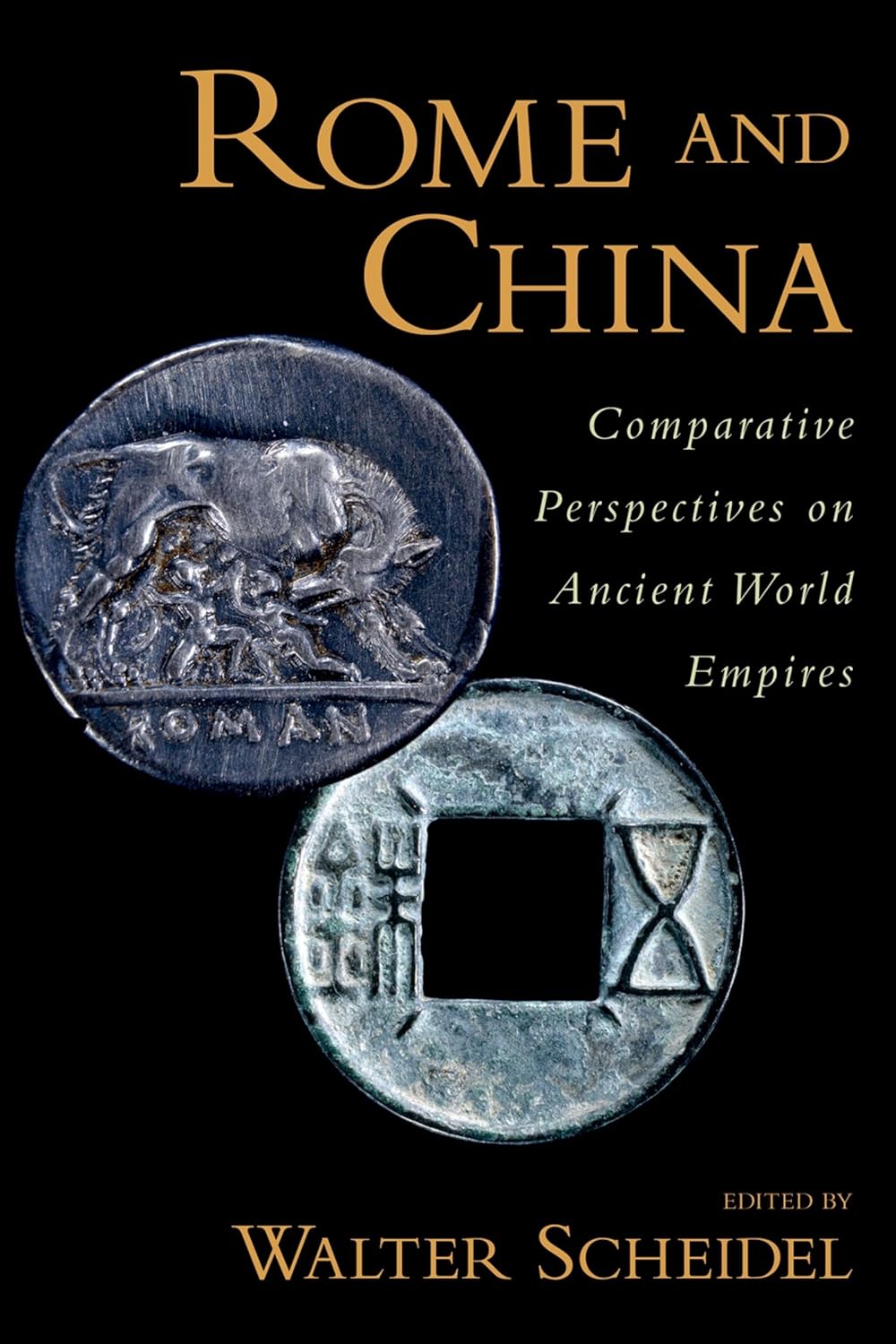
Rome and China: Comparative Perspectives on Ancient World Empires, edited by Walter Scheidel, represents an ambitious effort to bring rigorous comparative analysis to two of the most influential political systems of the ancient world: the Roman Empire in the West and the Qin–Han Empire in the East (221 BC to 220 AD). At a time when most scholarship on these civilizations treats them in isolation, Scheidel’s volume offers a structured dialogue between them, showing that despite differences in culture, language, and geography, both empires reveal striking parallels in their processes of state formation, governance, and economic integration – while also diverging in ways that highlight fundamental historical dynamics.
Before diving in, readers should be forewarned: although the subject matter is undeniably fascinating, the essays are uniformly academic and often exceedingly dense, making this one of the most challenging books I’ve attempted to absorb in quite some time. This volume is more certainly not for the casual reader.
The introductory chapter sets the stage by explaining the rationale for comparison, noting the surprising synchronicity of the two empires’ political trajectories. Both Roman and Qin–Han unification processes transformed fragmented regional polities into centralized powers capable of governing vast populations and territories. Scheidel frames this as a “great convergence” of imperial development, followed by a later divergence as each empire grappled with internal and external pressures.
In the first substantive chapter, Stanford professor Scheidel delves more deeply into state formation, exploring how each empire transitioned from regional rivalries to unified hegemonies. The analysis highlights shared forces – particularly war and administrative innovation – while also noting structural differences, such as China’s more centralized bureaucratic apparatus compared to the Roman Republic’s gradual evolution toward imperial rule.
Chapter Two, by Ohio State history professor Nathan Rosenstein, focuses on the role of war and military institutions in shaping state power. Warfare was not merely a tool of expansion but a formative force that molded political structures. In Ancient China, military hierarchies helped bind the early imperial state together, while in Rome the evolution from republic to principate was deeply intertwined with military command and loyalty.
Holy Cross history professor Karen Turner’s chapter on law and punishment examines how legal systems underpinned imperial order in both contexts. In Rome law participated in constructing a sense of common citizenship and institutional continuity, while in Han China law served as a mechanism of elite control and bureaucratic discipline. Though both empires used legal codes as a means of governance, the cultural underpinnings and applications of law differed, reflecting distinct philosophical assumptions about authority and social order.
The fourth chapter, by M. H. Dettenhofer from the University of Munich, examines the often-overlooked roles of eunuchs, women, and imperial court politics. Both empires deployed eunuchs as instruments of central authority; in China especially, institutionalized eunuch factions wielded significant power, counterbalancing aristocratic elites. The chapter also touches on influential women who shaped court dynamics, revealing how gender and access to the imperial household could translate into political influence.
The University of Copenhagen’s Peter Fibiger Bang’s contribution, titled “Commanding and Consuming the World,” shifts to economic history, exploring empire, tribute, and trade. His analysis highlights how both Rome and Han China integrated vast economic networks that extended beyond agricultural subsistence. Bang argues that while political elites publicly denounced merchants, markets and long-distance trade were integral to imperial economies. Both empires managed wealth distribution through tributary systems that relied on extraction and redistribution rather than purely market-driven mechanisms.
The sixth chapter, by Stanford’s Mark Edward Lewis, turns to the social customs of gift circulation and charity. Imperial benevolence functioned as a political strategy in both empires, used by rulers and elites to reinforce loyalty and social cohesion. In Rome, public beneficence took visible forms – such as sponsorship of games, roads, and public buildings – while in Han China much of the charitable activity directed resources toward rural populations. This contrast reflects broader differences in societal organization and political legitimacy.
The final and lengthiest chapter (70 pages), authored by Scheidel himself, analyzes the monetary systems of the Roman and Han empires. This chapter stands out for its depth and technical detail, as it traces the evolution of currency systems from imperial unification onward. Both empires came to monopolize minting authority, tying the stability of currency to the fiscal health of the state. Yet the specific forms these systems took diverged significantly. Whereas Roman monetary economy was dominated by precious metals – silver and later gold – Chinese monetary practice centered on standardized bronze coinage, supplemented by uncoined bullion of precious metals.
Scheidel carefully dissects the evolution of monetary systems in both the Roman and Han Empires. From Rome’s traditional founding in 753 BC to roughly 300 BC, the Roman economy relied primarily on a simple bronze coinage. Between 300 and 50 BC, silver coins were introduced, while gold and silver increasingly functioned as stored bullion rather than circulating currency. From 50 BC to AD 200, gold coins entered circulation in substantial quantities – perhaps as many as 120 million pieces – accounting for roughly 60 percent of the total coin value in circulation (with silver representing about 30 percent and bronze just 10 percent).
During the turbulent third century (ca. AD 200–270), silver coinage was progressively debased, and bronze coins were driven almost entirely out of circulation. The following century (270–370) saw repeated but unsuccessful efforts to restore full-bodied silver currency, while gold remained the only consistently stable medium of exchange. Finally, between 370 and 700, attempts to revive silver were abandoned altogether, and the imperial monetary system effectively standardized on a gold-and-bronze framework.
Meanwhile, in China, bronze currency – first in the form of tool-shaped money and later round coins – emerged between roughly 1000 and 220 BC. From 220 to 112 BC, centralized imperial authorities introduced a standardized bronze coinage in varying denominations with fixed weight standards, while limited quantities of gold circulated primarily as bullion. Between 112 BC and 170 AD, the imperial government maintained a state monopoly over minting and consolidated the system around a single fixed-weight standard. Finally, from 170 to 250, the standardized bronze currency system broke down, and inflation accelerated dramatically.
Scheidel explores why these differences emerged and persisted. In early China, the relative scarcity of precious metals made empire-wide gold or silver currencies impractical, leading to the persistence of bronze-based money. In contrast, the Mediterranean’s richer access to silver and gold facilitated a monetary economy with a far greater emphasis on full-bodied metal coins. In both systems, however, the exchange value of money was shaped by a combination of intrinsic metal content and trust in its nominal value, complicating simplistic comparisons between “metallic” and “fiat” currency regimes.
One of Scheidel’s central conclusions challenges traditional narratives that sharply separate “Western” and “Eastern” monetary models; he argues that the supposed dichotomy between fiduciary and full-metal currencies is often overstated, and that both empires exhibited hybrid monetary practices that reflected complex economic and social underpinnings. Nonetheless, the Roman economy appears to have been considerably more monetized than the Han counterpart, a difference with implications for broader economic integration and market activity.
Scheidel’s chapter also situates the monetary systems within the broader arc of each empire’s fiscal and administrative history, showing how coinage served not just economic functions but also political ones. Standardized currency systems reinforced imperial unity, facilitated long-distance trade, and embodied state authority. They also reveal how each empire grappled with tensions between intrinsic and nominal value, an issue that would continue to shape monetary thought long after the fall of both Rome and Han China.
In sum, Rome and Han China were strikingly alike and dissimilar in several ways. They were alike in that both emerged from prolonged interstate warfare and consolidated rule through military superiority. Each governed tens of millions of subjects across enormous territories using hierarchical administrative systems, codified law, taxation, and standing armies.
A second recurring theme in the volume is the structural similarity of imperial finances. Both states devoted a massive share of revenue to maintaining frontier armies. Military expenditure dominated fiscal policy, and both empires struggled to balance taxation with political stability. In both cases expansion initially generated revenue, but then stabilized borders increased fiscal strain.
Finally, as explored in detail in the final chapter on monetary policy, both empires developed extensive coinage systems to facilitate taxation, payments to soldiers, and market exchange. Each experienced episodes of debasement and inflation tied to fiscal pressures.
On the flip side, the most important contrast emphasized in the essays is the degree of political centralization. The Qin–Han state created a highly centralized bureaucratic empire with appointed officials selected (increasingly over time) through meritocratic mechanisms. In contrast, Rome remained far more decentralized and aristocratic. Provincial elites retained substantial autonomy, and imperial governance depended heavily on cooperation with local notables. China developed a durable, professionalized bureaucratic tradition. Rome relied more on negotiated rule and elite co-optation. This difference helps explain why imperial unity was repeatedly restored in China after collapse, whereas the Western Roman Empire fragmented permanently.
Second, Han China promoted a relatively coherent ideological orthodoxy rooted in Confucian statecraft and bureaucratic governance. The Roman Empire, by contrast, was more pluralistic and legally integrative rather than ideologically uniform. Rome excelled at extending citizenship and incorporating diverse peoples under a shared legal identity. China excelled at administrative standardization and cultural-political continuity.
This issue bleeds over into the final salient point of difference. The essays argue that Roman monetary pluralism reflected its decentralized, Mediterranean commercial system, whereas China’s bronze-based standardization reflected stronger bureaucratic control and more unified internal markets. Rome’s currency system was more diversified and market-driven but politically fragile; Han China’s was more centralized and administratively controlled but vulnerable when state authority weakened.Rome and China stands as both a scholarly introduction to comparative institutional history and a call to expand such scholarship beyond traditional boundaries. The essays show that Rome excelled at legal integration, elite co-optation, and flexible governance, while Han China excelled at bureaucratic centralization, administrative continuity, and ideological coherence. Both faced similar structural constraints – military costs, fiscal strain, frontier pressures – but responded through different institutional designs. Those differences help explain why imperial unity became a recurring pattern in Chinese history, while Rome’s western half permanently fractured.
 What's Tim Reading Now?
Leave a comment