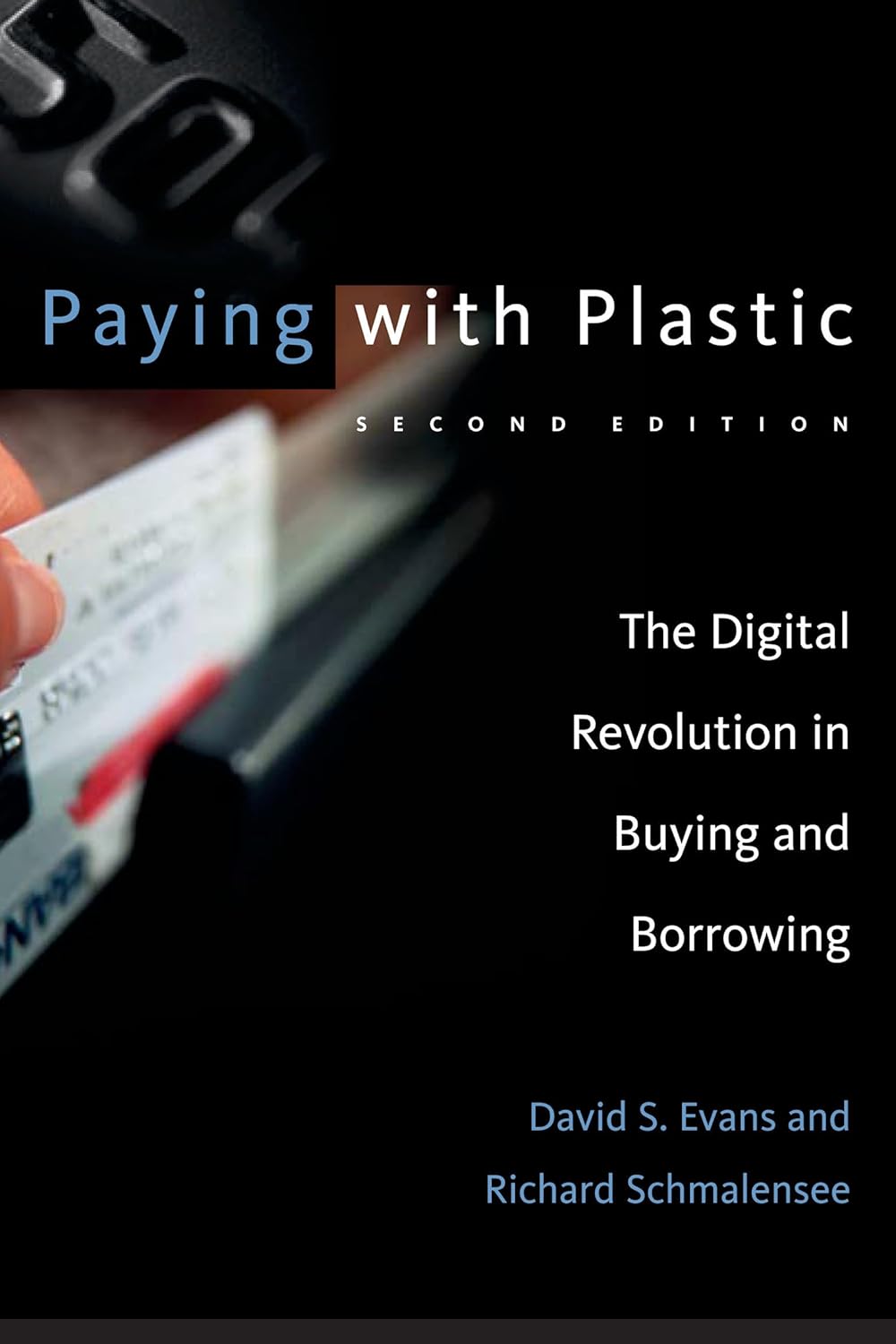
Paying with plastic – especially now using our smartphones to tap-and-pay – is so easy and ubiquitous that it’s almost hard to imagine a time before credit cards transactions. Perhaps the most incredible part of the process is how fast and relatively secure it is when you consider all the moving parts and various players involved. It truly is a graceful ballet of finance, technology and risk mitigation.
The authors begin by placing the charge card revolution in historical perspective. In their view, there have been only four truly consequential innovations in how humans transact with one another. The first was the shift from barter to coinage, beginning around 700 BC. The second was the introduction of early forms of checks by Venetian merchants in the twelfth century. The third was the widespread adoption of paper currency in the seventeenth century. The fourth – and most recent – was the payment card, first developed by Frank McNamara in 1950.
Two forces fundamentally shaped this final stage of payment innovation. The first was the fragmented nature of the American banking system. In 1966, the United States had 13,821 commercial banks – roughly seventy banks for every one million people. In such a vast country, this fragmentation was the “root cause,” the authors argue, of America’s early reliance on checks. “The manner in which banks cooperated on checks,” they write, “provides a preview of what was to come for payment cards.” To manage this complexity, banks created clearinghouses that met at designated times and places, allowing representatives to exchange checks drawn on one another with relative speed and efficiency. As early as the 1850s, New York City’s clearinghouse included fifty-two banks. The challenge grew even more acute with the expansion of the railroads, and in 1915 the U.S. Federal Reserve responded by establishing a national system for the clearing and collection of checks at par.
The second thing that shaped the industry was the computer revolution. The computer revolution of the 1960s made large-scale payment cards possible by enabling banks and card networks to process transactions, manage accounts, and reconcile balances electronically rather than by hand. Mainframe computing allowed firms like American Express and the bank consortia behind what became Visa and MasterCard to centralize authorization, clearing, and settlement across thousands of merchants. Without batch processing, magnetic-stripe data handling, and early telecommunications links, nationwide – and eventually global – card acceptance would have been administratively impossible.
Frank McNamara (1908–2001) and Malcolm McLean (1913–2001) died just 130 days apart. Both are largely forgotten today, yet each stands as the undisputed grandfather of one of the most consequential innovations in the history of global commerce: payment cards and intermodal shipping. The authors are careful to note that store credit long predates McNamara. American Express – founded in 1850 as a courier company – introduced the traveler’s cheque in 1891 and its first charge card in 1958. Merchants were extending credit as early as the nineteenth century. For decades, trusted customers routinely received access to revolving credit. By 1930 most consumer durables purchases – automobiles, furniture, washing machines, phonographs – were made on credit.
McNamara’s breakthrough, which culminated in the launch of the Diners Club card in 1950, was the creation of a true two-sided platform – bringing together many consumers and many merchants through a single, universally accepted card. At the time of the Diners Club card’s first anniversary McNamara had generated a two-sided platform boasting 42,000 card holders paying a $32 annual membership fee (adjusted to 2025 dollars) and 330 merchants paying a whopping seven percent merchant discount rate. Diners Club made just over $100,000 profit (again in 2025 dollars) its first year. Importantly, the authors say, not only had McNamara discovered the idea of a general purpose payment card, he also developed a pricing strategy that got both cardholders and merchants on board simultaneously to create a balanced two-sided platform, although seventy percent of its revenues came from merchants.
By 1958, Diners Club’s gross profits exceeded $70 million. That same year marked a turning point in the industry: Bank of America launched BankAmericard in Fresno, California; American Express introduced its Green Card; and Hilton Hotels rolled out the Carte Blanche card (later acquired by Citigroup in 1965 – the same bank that would purchase Diners Club in 1981). What set BankAmericard apart was its introduction of revolving credit. By 1959, nearly two million Californians held the card, and 25,000 merchants accepted it. The rapid expansion came at a cost: fraud ran five times higher than expected, and the program lost Bank of America more than $80 million (in 2025 dollars) in 1960, though it returned to operating profitability the following year. American Express, by contrast, leaned into exclusivity and high-volume travel and expense accounts for corporate America. Initially, all of these cards – Diners Club, BankAmericard, American Express, and Carte Blanche – operated as closed systems, or what the authors describe as “go-it-alone” models.
A fundamentally new model emerged in 1966: what the authors call “co-opetitive.” Under this approach, banks competed fiercely to sign up merchants and cardholders, while simultaneously cooperating at the system level by setting common operational standards and agreeing to shared rules. “A co-opetitive was the only way banks found to establish a viable card platform on a national level,” the authors write. Their key innovation was their organizational structure. They are, in effect, the largest joint ventures in the world today. The co-opetitives set essential standards and “run the railroads” of electronic commerce – processing, authorization, and settlements. The authors compare the open association model of Visa and MasterCard to Microsoft and the fully integrated approach of American Express and Discover to Apple. The advantage of the former is a vast membership base and relentless competition against the challenge of maintaining network-wide cooperation; the advantage of the latter is economies of scale and a holistic view of metrics and insights from across the network against reduced experimentation and vulnerability to external shocks. By the 1980s American Express was charging an interchange fee roughly fifty percent higher than the co-opetitive networks (3.6 percent versus 2.5 percent)
This cooperative framework took shape when Bank of America agreed to transform its “go-it-alone” BankAmericard platform into a membership-owned corporation with 243 charter members. That same year, its rival Interbank adopted a similar structure. The former would rebrand as Visa in 1976, the latter as MasterCard in 1979. These cooperatives focused on issuing cards with revolving credit lines, while most operational decisions remained at the member level. Association fees and dues for Visa and MasterCard represented only about 1.5 percent of the total direct card-related expenses incurred by member banks.
From the mid-1970s onward, Supreme Court decisions and usury laws increasingly shaped the payment card industry. The authors identify “two major wars” that have defined its structure and evolution. The first – and longest-running – concerns the allocation of costs in a two-sided platform between cardholders, who spend, and merchants, who accept cards. Over time, merchants have shouldered the overwhelming share of these costs, a burden they have contested vigorously for decades, often through litigation. The second war revolves around the attempts of “go-it-alone” card platforms to gain access to the cooperative associations run by Visa and MasterCard, following the reluctant adoption of duality in 1976, which allowed banks to issue – and merchants to accept – both Visa and MasterCard brands. Between 1971 and 1981, the number of American banks issuing credit cards nearly tripled to 1,750. Yet fraud and defaults were rampant, and the industry struggled financially, as credit cards proved to be risky loans with low returns. Despite these challenges, the payment card industry’s growth remained relentless. By 1991, the Visa association alone included 4,200 issuing financial institutions, while 2.5 million merchants accepted the card.
The 1980s brought a wave of innovations in payment cards, including nonbank issuers like MBNA, affinity and cobranded cards linked to sports teams or charities, debit cards, and – most notably – frequent-flier rewards cards. By 1991, the number of cards per household had doubled compared with five years earlier. For the first time, credit card debt was securitized, allowing financial institutions to consolidate diverse debts from multiple lenders. Over the same period, the fifty largest banks consolidated into just eighteen, with the top ten card issuers accounting for 75 percent of Visa and MasterCard volume – up from 44 percent a decade earlier. Around 2000, the rise of the Internet opened a new era of payment card opportunities. At that time, only 27 percent of consumer expenditures were made electronically, a figure that has climbed inexorably to rise to 65 percent by 2025, split nearly evenly between credit and debit cards.
One of the book’s most compelling sections examines the advertising battles of the 1980s and 1990s, especially Visa’s strikingly successful “Everywhere You Want to Be” campaign, launched in 1985. Although the campaign ostensibly targeted the closed-loop American Express network, its real rival was MasterCard. By positioning itself as the primary alternative to American Express’s premium brand, Visa differentiated itself from both competitors and reshaped consumer perceptions. The results were dramatic. Despite near-identical merchant acceptance, Visa entered the campaign with a modest perception advantage: 35 percent of consumers believed Visa was accepted at more locations, compared with 28 percent for MasterCard. Less than a decade later, Visa had nearly tripled that lead, 69 percent to 25 percent. The campaign also altered views of overall value. Seven years in, 59 percent of Americans considered Visa the better choice, versus just 22 percent for MasterCard – even though the two networks were functionally indistinguishable.
The irony is striking: Visa’s campaign against MasterCard was funded largely by association member banks, most of which also belonged to MasterCard. In effect, the advertising shifted volume from one column of the same banks’ ledgers to another. The real payoff was strategic rather than competitive – weakening American Express and strengthening the banks’ collective position in the market.
When a customer uses a credit or charge card, several different companies each perform a specific function and each takes a small cut of the transaction. Those fees are bundled together and ultimately paid by the merchant, even though the money flows through multiple parties.
At the merchant end of the system sits the merchant acquirer, usually a bank. The acquirer provides the merchant account, underwrites the business, assumes certain fraud and chargeback risk, and is responsible for settling funds to the merchant after a transaction is approved. In the U.S., the largest acquirers include JPMorgan Chase, Fiserv (First Data), Worldpay (FIS), Global Payments, and Elavon. Collectively, the top five acquirers handle well over half of U.S. card payment volume.
The acquirer charges the merchant what’s commonly called the merchant discount rate (MDR). This is not a single fee but a bundle that typically totals ~2.0%–3.0% of the transaction amount, plus a small per-transaction fee (often $0.05–$0.30). From the merchant’s perspective, this is the all-in cost of accepting cards. Funds are usually settled to the merchant on T+1 to T+3 business days, depending on the acquirer and merchant risk profile. The average net MDR fell sharply during the 1980s as technological efficiencies and intense competition drove costs down. From more than 8 percent in 1980, the MDR declined to just over 3 percent by the end of the decade – a level that has remained largely stable ever since, even as issuers introduced costly loyalty and frequent-flier rewards programs.
Behind the scenes, most acquirers rely on a payment processor to move transaction data. The payment processor is the technical backbone that routes the authorization request from the merchant to the card network and on to the issuing bank, then returns an approval or decline in milliseconds. Some processors are pure infrastructure providers (like FIS/TSYS or Worldline), while others are customer-facing platforms. The merchant acquirer usually takes ~10 to 20% of the MDR. The acquirer’s share covers merchant underwriting, risk and chargeback exposure, settlement, compliance, and margin. This can range widely but is often ~0.20 to 0.40 percentage points on a 2.5% MDR. Acquirers make less per transaction than issuers but play a critical balance-sheet and risk role.
Processors are paid by the acquirer, not directly by the merchant, and their fees are embedded inside the merchant discount rate. Processing fees are typically a few basis points per transaction plus a per-transaction fee, and are negotiated at scale. Large processors include FIS/TSYS, Worldline, Global Payments, and Adyen, while developer-friendly platforms like Stripe and PayPal also function as processors. Processors collect transaction processing and gateway fees that usually combine to ~5 to 10% of the MDR. Processors earn fees for authorization routing, transaction handling, settlement, reporting, and sometimes gateway services. Their share might be ~0.10 to 0.25 percentage points of the transaction, depending on scale and contract structure. Large merchants negotiate this down aggressively; small merchants pay more on a per-transaction basis.
Next are the card networks – Visa, Mastercard, American Express, and Discover – which sit between acquirers and issuers. The networks do not issue cards or hold merchant accounts. Instead, they set the rules of the system, operate the global switching infrastructure, and define interchange categories.Networks charge assessment and network fees, usually around 0.10% to 0.15% of transaction value, paid by the acquirer and passed through to the merchant as part of the MDR. The card networks charge an assessment & network fees that account for ~5–7% of the MDR. Thus, the card networks take a relatively small but very consistent cut for operating the network, setting rules, and routing transactions. While small in percentage terms, this is extremely high-margin revenue for the networks.
On the consumer side are the issuers, the banks that issue cards to cardholders, approve transactions, extend credit, and bill the customer. Major U.S. issuers include JPMorgan Chase, American Express, Citi, Capital One, and Bank of America, which together account for more than half of U.S. credit card purchase volume.
Issuers receive the largest single component of the fee stack: the interchange fee. Interchange is set by the card networks and paid by the acquirer to the issuer, but it is ultimately funded by the merchant. Interchange typically ranges from ~1.4% to 2.6% of the transaction amount, plus a fixed fee (often $0.10–$0.25), depending on card type, rewards level, merchant category, and whether the transaction is card-present or online. Interchange revenue helps issuers fund rewards programs, fraud protection, and credit risk. Interchange fees are paid to the issuing bank to compensate for credit risk, fraud, rewards programs, and funding the cardholder float. On a 2.5% MDR, the issuer often receives around 1.6 to 1.9 percentage points of that ~65–75% of the MDR). The interchange fee is by far the largest share of the MDR. High-rewards credit cards push this higher; debit cards and regulated debit transactions push it lower.
However, these interchange fees – by far the largest slice of the merchant discount rate – represent only the second-largest source of bank revenue from credit cards, accounting for roughly 15 percent. The vast majority of revenue – more than 70 percent – comes from finance charges, as banks routinely charge interest rates exceeding 20 percent on balances carried from month to month. The average delinquency rate on U.S. credit card loans, measured as the share of balances past due, is about 3 percent as of 2025, down from more than 4 percent when the book was published in the early 2000s. Penalties and cash advance fees make up the next largest category, contributing about 12 percent, while annual fees account for just 3 percent of the total.
The cardholder, by contrast, usually pays no direct transaction fee at the point of sale. Instead, the cardholder pays interest if they carry a balance, annual card fees if applicable, and sometimes foreign transaction fees — all of which flow to the issuer, not the merchant or acquirer.
Finally, modern payment service providers (PSPs) bundle many of these roles together. Companies like Stripe, PayPal, Square, and Shopify Payments abstract away the complexity by acting as the merchant’s single integration point. PSPs often function as the processor, gateway, and merchant aggregator, while partnering with banks for acquiring services. They charge a simple, flat rate – commonly 2.6% to 2.9% plus a ~$0.30 per transaction – and pay the acquirer, processor, network, and issuer out of that fee. PSPs are especially dominant among small and mid-sized merchants, with Stripe and PayPal each supporting millions of businesses globally.
In short, the merchant pays a single bundled fee and receives funds within a few days; that fee is then divided among the issuer (interchange), the card network (assessment), the processor, and the acquirer. The issuer earns the largest share (two-thirds to three-quarters), the acquirer (8 percent to 16 percent) card networks (4 percent to 6 percent) and processors (4 percent to 8 percent) take smaller slices, and PSPs simplify everything by packaging it into one predictable price.
The credit card industry has been fundamentally shaped by court cases almost from the very inception of the offering. In Worthen Bank (1973), the court looked at whether or not BankAmericard (the predecessor to Visa) could restrict membership and operate as an exclusive, bank-controlled association. The court held that restrictive membership rules violated antitrust principles by limiting competition among issuing banks. This case was foundational. It pushed BankAmericard away from a tightly controlled consortium toward a more open membership model. Banks could join more freely, accelerating geographic expansion and scale. In effect, it helped turn Visa from a club into a true network—an essential precondition for nationwide acceptance.
The Supreme Court’s decision in Marquette (1978) addressed whether a national bank issuing credit cards could charge interest rates permitted in its home state to customers residing in states with lower usury caps. The Court held that under the National Bank Act, a national bank may “export” the interest rate of the state in which it is chartered, regardless of the borrower’s location. This ruling was a watershed moment for consumer credit. By allowing issuers to bypass restrictive state interest rate ceilings, it enabled the nationwide scaling of credit cards and incentivized banks to relocate to states with permissive usury laws, such as South Dakota and Delaware. Without Marquette, mass-market revolving credit as we know it would likely not exist. At the same time, the decision shifted regulatory power away from states and toward federal banking law, setting the stage for decades of debate over consumer protection, interest rates, and the balance between financial innovation and regulation.
The case of MountainWest (1984–1986) considered whether Visa’s interchange and pricing rules constituted illegal price fixing under antitrust law. Courts ultimately rejected the per se price-fixing argument, recognizing Visa as a joint venture whose collective pricing could be evaluated under the “rule of reason.” This was a major win for card networks. By affirming that interchange could exist within a cooperative network, the decision preserved the economic engine of modern card payments. Without this ruling, the four-party model (issuer, acquirer, merchant, consumer) might not have survived. At the same time, it signaled that networks were not immune from scrutiny – just not automatically illegal.
At roughly the same time, the NaBanco case explored whether Visa’s interchange fee system and related network rules constituted unlawful price fixing and an illegal restraint of trade under Section 1 of the Sherman Act, particularly from the perspective of merchant acquirers who claimed interchange inflated merchant discount rates. The Eleventh Circuit held that Visa’s interchange fees were not per se illegal and should instead be analyzed under the rule of reason. The court concluded that interchange was a necessary mechanism to balance incentives between issuing and acquiring banks in a four-party network and that NaBanco failed to demonstrate net anticompetitive harm. NaBanco is arguably the foundational antitrust case legitimizing interchange. It provided the first clear judicial articulation of why interchange is economically necessary in a payment card network, framing Visa as a pro-competitive joint venture rather than a cartel. This ruling gave networks and banks the legal confidence to scale credit card acceptance nationwide and internationally. Nearly every subsequent interchange and network-rules case—from MountainWest to Ohio v. AmEx—rests on the analytical framework established in NaBanco.
United States v. Visa (2001) reviewed two issues: whether Visa and MasterCard violated antitrust law by prohibiting member banks from issuing American Express or Discover cards, and allowing overlapping bank ownership of Visa and MasterCard. In this case, the Justice Department prevailed. The court ruled that exclusionary rules preventing banks from issuing rival cards were anticompetitive. This case fundamentally altered competitive dynamics. Banks were suddenly free to issue AmEx and Discover products, intensifying competition for affluent and high-spend consumers. It also weakened the tight alignment between banks and the Visa/MasterCard duopoly, paving the way for differentiated card products, rewards innovation, and co-brand proliferation.
Next, Wal-Mart Stores (2003) looked at whether Visa and MasterCard had illegally tied acceptance of debit cards to acceptance of credit cards (“honor-all-cards” rules). Merchants won a massive settlement (over $3 billion) and changes to network rules. This was the moment merchants gained real leverage. The ruling allowed merchants to reject signature debit while still accepting credit cards, increasing pressure on interchange levels – especially for debit. It also set the stage for later regulatory intervention (notably Durbin), as courts acknowledged that network rules could distort merchant choice.
Finally, Ohio v. American Express (2018) addressed the issue of American Express’s anti-steering rules (preventing merchants from encouraging customers to use lower-cost cards). The Supreme Court sided with AmEx, holding that credit card platforms are two-sided markets and that plaintiffs must show net harm across both cardholders and merchants. This was a doctrinal turning point. The Court elevated the two-sided market framework, making antitrust challenges to card networks significantly harder. While merchants lost the case, the decision reshaped how courts analyze digital and payments platforms more broadly – from cards to tech marketplaces.
Paying with Plastic is dated in many respects, but it remains useful both as a primer on the payments ecosystem and as a historical snapshot of the industry’s early structure. The authors’ repeated references to Palm as a model two-sided platform are a steady reminder that the book was written in another era, and whole sections – such as the detailed tour of merchant acquirers and processors circa 2000 or their comment that “You cannot buy stock in MasterCard [went public in 2006] or Visa [went public in 2008] – now read like an archaeological record. Nearly every company mentioned has since been acquired, spun off, re-acquired, or rebranded: First Data is part of Fiserv, Alliance Data Systems became Bread Financial, and Total System Services was absorbed by Global Payments, which was then acquired by FIS. The forward-looking speculation from 2003 can feel quaint, even amusing at times, yet the core arguments have aged surprisingly well. If anything, the penetration and use of payment cards hasn’t grown that much compared to when this book was first published a quarter century ago. Today more than 80 percent of U.S. adults carry at least one, cards account for roughly two-thirds of consumer transactions, and they support a vast and growing pool of revolving credit – about $1.3 trillion – often at interest rates north of 20 percent. The only figure that has dramatically changed over the intervening two decades is the amount of credit card debt.
 What's Tim Reading Now?
Leave a comment