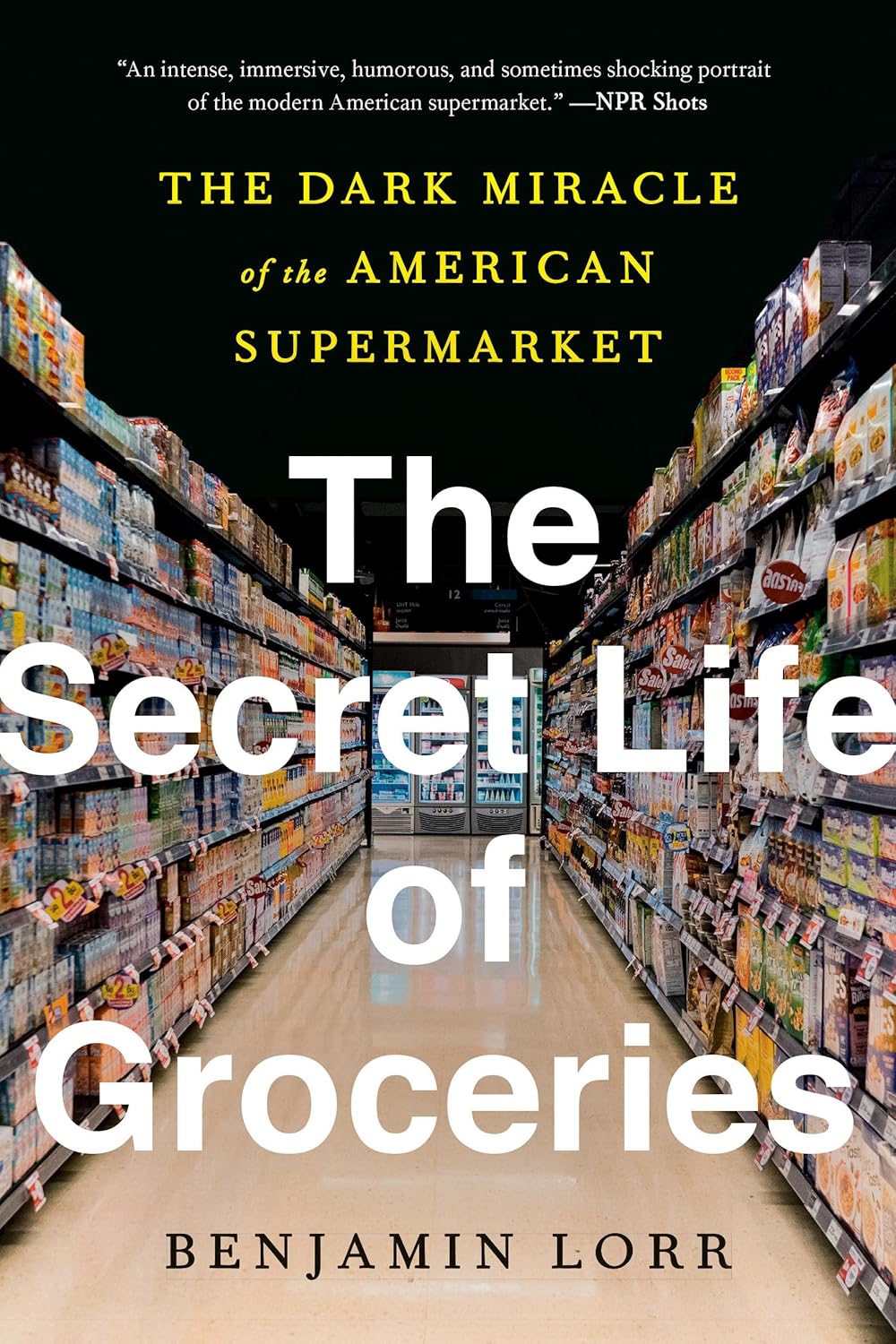
Life is short, and the list of worthwhile books is inexhaustibly long, so it pays to exercise some due diligence when choosing what to read. I picked up The Secret Life of Groceries: The Dark Miracle of the American Supermarket (2020) by Benjamin Lorr for two reasons. First, Confluent’s Startup of the Year was a company building real-time, intelligent shelf cameras for grocery stores, which sparked my interest in how technology can support retailers operating on razor-thin margins. Second, the reliably dorky podcasters at Acquired cited the book in their episode on Trader Joe’s – enough of an endorsement for me to click “buy.” In hindsight, I should have paid closer attention to the word “Dark” in the subtitle, as well as to the author’s background. The Secret Life of Groceries turns out to be less a thoughtful investigation of the modern miracle that is the American supermarket – what I was looking for – than a superficial and often condescending screed masquerading as exposé.
The first thing to know about the author – a Columbia University creative writing graduate who taught sex education at a New York City high school before gaining notoriety for a scathing takedown of Bikram yoga – is that he very much wishes he were writing for The New Yorker. He randomly peppers his account of the American grocery store with adjectives like “chthonic.” To give a sense of what you’re in for, here is a representative sentence from The Secret Life of Groceries: “Retail is a performance, the very embodiment of some long-caricatured avant-garde ‘theater of the now,’ where, rather than passive audience, you as person are cast as the lead in a piece revolving around you as customer, targeted at you as financial instrument, and supported by a wide ensemble of living and nonliving players out to solve your problems and satisfy your dreams.”
The book is structured around a series of character-driven narratives, each spotlighting a different piece of the supermarket ecosystem – from trucking logistics and the invention of new consumer snacks to the daily realities of frontline grocery workers and the world’s modern day slaves (meant literally, not figuratively or euphemistically) working the shrimp industry in Thailand. What unites these chapters is Lorr’s consistently cynical disdain for the very people he profiles. One suspects that nearly everyone who cooperated with the author in the making of this book now deeply regrets having done so.
When this book appeared in 2018, Americans were spending just over $700 billion annually on groceries across roughly 38,000 stores – about ten percent of the average household budget. Efficiencies in agriculture and the global supply chain have made food more abundant and cheaper than at any point in history. The average American grocery store now carries around 32,000 SKUs, with some stocking as many as 120,000. In the 1950s, our grandparents spent nearly a third of their household budget on food; the generation before them spent almost half. A few centuries ago, virtually everyone was involved in food production; today, fewer than three percent are. These achievements are nothing short of miraculous – yet the author insists on framing them as a “dark” miracle. I finished the book still believing that the American grocery store is far more amazing than it is disturbing.
“Industrial food is a paranoid business,” Lorr writes, and consequently “secrecy in retail grocery [where profit margins hover at around 1.5 percent] is staggering.”
Not sure why the book is laid out the way it is. The book starts out with a sixty-plus page chapter dedicated to the origin story of the most atypical grocery store in the country, if not the world – Trader Joe’s. Why Lorr decided to devote so much time to the one store that doesn’t play by the same rules as virtually every other grocer is unclear.
The first of many dismal links in the global grocery supply chain that Lorr examines is trucking. Trucking is the circulatory system of the economy: nearly everything in modern life – from apples to Xanax – arrives by truck. Close to thirteen million commercial drivers in the United States, a population roughly the size of Pennsylvania, move nearly eleven billion tons of freight each year. Lorr tells the trucking story largely through the striking example of a six-foot-two female driver named Lynne, whom he describes – in a typically contemptuous and disrespectful aside – as looking like “she walked off some Cro-Magnon shot-put team.” Lynne allegedly grossed around $200,000 in revenue but, after taxes, fees, and deductions, took home less than $17,000 – a staggering figure if accurate. Lorr characterizes the American trucking industry as “structurally vampiric.” The Motor Carrier Act of 1980 deregulated an industry once dominated by Jimmy Hoffa and the Teamsters, and shipping costs fell by roughly twenty percent almost overnight, directly lowering food prices. Since then, Lorr argues, the industry has systematically driven down labor costs by churning through a steady supply of desperate new recruits, many of whom pay nearly $10,000 for a commercial driver’s license and haul freight at rock-bottom “training rates,” often in team configurations that enable round-the-clock driving. Turnover rates, he claims, routinely exceed one hundred percent, and this relentless churn is what sustains the industry’s vampiric structure. “It’s hard to explain just how vulnerable you are as a trucker,” Lorr writes – especially for women, like Lynne, who face nonstop sexual harassment on top of grueling hours and wage gouging. For all of the dooms-daying, Lorr almost completely ignores the coming autonomous vehicle revolution.
The next topic Lorr takes up is specialty food items, specifically the trendy products that seem to burst out of nowhere and suddenly become ubiquitous – sriracha-flavored everything, Greek yogurt, or flavored popcorn. His central character here is another female firebrand: Julie Busha, CEO of Slawsa, a coleslaw–salsa mashup she insists “will change your life,” whom Lorr met at the Fancy Food Show. He callously dismisses both Busha and her product as “clumsy and sincere and evincing zero cool.” If trucking is portrayed as a low-paid and miserable existence, specialty foods fare little better. “The rate of failure in food is stunning,” Lorr writes. Buyers at Whole Foods’ national office receive roughly 500 new products to review each month. The lucky ones fail fast; the unlucky ones win a chance at distribution. A major source of grocery-store revenue comes from selling shelf space to desperate newcomers. Of the roughly 20,000 new food products launched each year, nearly 90 percent are pulled within eighteen months – often after tens of thousands of dollars have been spent on so-called “slotting fees,” which can run as high as $55,000 per month for a 22-by-12-inch patch of shelf space, a figure I find shocking. Altogether, these fees generate about $9 billion annually in profit for retailers, which Lorr calls “rocket fuel to their bottom line.” Slotting fees are only the beginning. Retailers also levy a bewildering array of additional charges: “promotional fees” to subsidize discounts, “free fill” shipments that can be sold at 100 percent profit, compulsory advertising fees for store circulars, and even “radio fees” to promote products over in-store PA systems. In short, specialty food makers must pay thousands of dollars in “trade spend” simply for the chance to sell their goods. For most food manufacturers, this expense is second only to “cost of goods sold” and far above traditional line items like production and advertising. Lorr estimates that total trade spend reached $75 billion in 2015 and argues that much of it is purely extractive, offering little or no benefit to vendors.
As part of his research, Lorr spent a couple of months working the fish counter at Whole Foods. Here, his condescension is aimed at the relentlessly chipper training staff who genuinely believe that working at Whole Foods is more than a job – it is a privilege. Lorr disagrees, and not subtly. He says little about pay and benefits, focusing instead on the seemingly innocuous but revealing issue of employee scheduling. He recounts that in 1956, Toyota engineer Taiichi Ohno visited the United States and was astonished by the American supermarket, where suburban shoppers navigated vast aisles independently filling their baskets as desired. This experience inspired the principles of what became known as Toyota’s just-in-time manufacturing. Ironically, that logic later boomeranged back to supermarkets in the form of “just-in-time scheduling,” or “variable scheduling,” allowing retailers like Whole Foods to summon workers only as demand requires. For all its efficiency, Lorr calls the practice “simply sinister,” arguing that it robs employees of predictable, stable hours. “Humans tend to react differently than automobile parts when ripped from one place to another according to algorithmic whim,” he quips with his usual sarcasm. This chapter is the weakest in an already weak book.
Perhaps the most illuminating chapter examines the vast certification industry underpinning the American food system. The privatization of ethics has become big business: over the past two decades, certified organic and fair trade labels have grown into a billion-dollar industry. Lorr compares it to medieval simony, where the wealthy could pay to absolve their sins. The U.S. government largely outsources the policing of its food supply. Half of all fresh fruit and four-fifths of all seafood are imported, yet Lorr notes that only one-thousandth of one percent of these imports are inspected by government officials. In the mid-1990s, E. coli outbreaks at Jack in the Box, Odwalla, and others triggered multi-million-dollar class action lawsuits. The threat of bad press and crippling litigation has largely supplanted the FDA as the primary enforcer of food safety. Tort lawyer Bill Marler, who has secured $600 million in food safety judgments over his career, has emerged as the nation’s most powerful enforcer. Meanwhile, Price Waterhouse went from conducting zero supply chain audits in 1996 to six thousand just two years later. Today, the for-profit auditing industry generates $50 billion annually – ten times larger than all federal inspections combined. Surprisingly, Lorr argues that this hybrid system of weak government regulation, aggressive tort litigation, and private auditing has nonetheless produced positive results.
The final chapter is downright shocking. Lorr investigates the full-scale slavery system underpinning Thailand’s shrimp industry. Drawing on fifteen years of research funded by eBay billionaire Pierre Omidyar, he exposes the brutal exploitation of illegal migrants fleeing poverty and oppression in Myanmar. Lorr cites estimates that Thailand captures roughly ten percent of the world market for shrimp, with between seventeen and sixty percent of that catch involving slave labor, and half of that exported to the United States. Shrimp farming surged in the 1990s with the rise of aquaculture. Since the 1980s, wholesale shrimp prices have plummeted even as production increased three thousand percent. Although the shrimp are farmed, it takes two pounds of wild-caught fish to produce one pound of shrimp, requiring fleets of trawlers to scoop vast amounts of random fish from the benthic layer of seafloor. The industry’s rapid expansion created a labor shortage for these trawlers, which was filled by migrants from Myanmar, many of whom were held captive on fishing boats for up to a year and never paid. Lorr writes that on these boats “human slavery was not just common but flourishing … the horror is so vast that it risks overwhelming anyone who learns about it.” He notes that over 35 million people worldwide are coerced into labor in an industry generating roughly $150 billion annually, claiming it exceeds the scale of the entire Atlantic slave trade. While these figures are staggering – and some seem completely outlandish – the opacity of the global shrimp supply chain makes it virtually impossible for consumers to verify that their shrimp is free of slave labor.
The book concludes with Amazon’s June 2017 announcement that it would acquire Whole Foods for $13.7 billion. Lorr notes that the deal was treated in industry trade journals “with an almost eschatological force,” prompting incredulous reactions of “How could they?!” Yet he argues that Whole Foods was “far more Texas libertarian than it ever was East Coast liberal.” From that perspective, the acquisition was hardly shocking. Indeed, Lorr calls it “one of the least surprising developments” in The Secret Life of Groceries – a move that Trader Joe’s founder and visionary Joe Coulombe had been predicting since the 1970s, when he foresaw how GI Bill–educated young consumers, newly able to travel cheaply abroad thanks to the advent of the 747, combined with the decline of network TV viewership and the weakening grip of legacy consumer brands on advertising mindshare, would reshape retail.
Coulombe believed grocery retailers ultimately face only two viable paths. The first is ruthless price competition, where scale and efficiency determine the winner; in that model, the largest chain or platform will inevitably prevail, and in the long run that winner is likely Amazon. The second path is to become an “active retailer,” a model Coulombe effectively pioneered at Trader Joe’s. This approach rejects the passive role of the “supermarket-as-shelf-landlord” and instead curates a rotating lineup of distinctive, exceptional products that may not always be in stock. In short, it is a store built to buy for people, rather than merely sell to them.
 What's Tim Reading Now?
Leave a comment