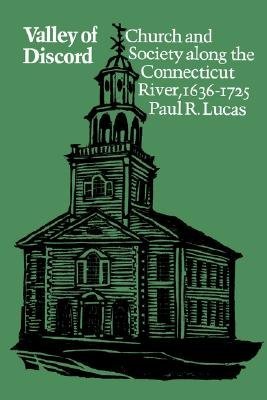
Paul R. Lucas’s Valley of Discord stands as a compelling corrective to the mid-twentieth-century tendency among historians to treat early New England’s Puritan society as a harmonious, monolithic community of like-minded settlers dedicated to a shared religious mission. Lucas argues that, far from an orderly cultural consensus, the Connecticut River valley was a crucible of theological disputes, factional strife, and shifting ecclesiastical practices that mirrored larger tensions in the Atlantic Protestant world. Rather than painting a static portrait of Puritan piety, Lucas shows how religious discord was woven into the social fabric of colonial life from the first decades of settlement in the 1630s through the early eighteenth century.
To understand the stakes of Lucas’s project, it helps to recall the basic religious landscape of colonial New England. The dominant religious tradition was Puritanism – Calvinist in theology, deeply concerned with personal piety and moral conduct, and insistent on the necessity of a regenerate church membership (“regenerate” refers to a person who has undergone a genuine, inward spiritual rebirth – what Puritans called conversion – through the saving grace of God).But even within Puritanism, significant divisions existed. In the early years of the Connecticut settlements (Hartford, Wethersfield, and later Springfield and Hadley), religious leaders upheld Congregational polity, a form of church organization that emphasized the autonomy of each local congregation. Under this model, each congregation was a self-governing body of believers, empowered to define its own membership, examine its own ministers, and enforce its own discipline without hierarchical oversight from outside authorities. Congregationalists rejected centralized ecclesiastical authority and insisted on voluntary covenant commitments among members, a stark contrast with the episcopal system of the Church of England and the presbyterial governance elsewhere.
This Congregational model distinguished New England’s religious culture from that of many European churches. In England and Scotland, for instance, Presbyterian churches operated under a tiered system of assemblies and courts: individual congregations were accountable to regional presbyteries and larger synods, which provided doctrinal oversight, standardized discipline, and collective authority over ministers. While both Congregationalists and Presbyterians shared Calvinist theology, they differed sharply in ecclesiology – the theory and practice of church government. Congregationalists prized local autonomy and direct accountability of members to one another, whereas Presbyterians accepted broader institutional structures to maintain doctrinal unity and manage ministerial affairs. In Connecticut, these differences became a real point of tension by the late seventeenth and early eighteenth centuries, as leaders sought ways to address church decline and theological disputes.
Connecticut began, as Lucas puts it, as a “bastard Puritan colony” in the mid-1630s. Its population initially numbered roughly 800 people, growing to about 30,000 by 1700 – approximately half the size of neighboring Massachusetts and far less developed economically. According to the author, the colony’s first four decades were defined by political insecurity and economic stagnation, while the period after 1680 was marked by rapid economic growth coupled with highly volatile political instability. Valley of Discord is therefore not a general history of early Connecticut, but an examination of its social order through a close analysis of the colony’s ecclesiastical system – especially the colonists’ understanding of proper church order and the correct relationship between church and world.
The colony’s earliest settlers had arrived without clear legal authority, effectively squatting on land claimed by the Dutch, Massachusetts Bay, Plymouth, and other English interests. Lacking an official royal charter until 1662, Connecticut’s land claims remained uncertain and legally precarious for decades.
Lucas’s narrative charts how these tensions manifested in everyday life. In the first generation, churches in the Connecticut River valley benefited from a sense of shared purpose and usually unwavering support of a charismatic minister, such as Thomas Hooker, who they may have followed as refugees from Puritan Massachusetts. This focus and loyalty established disciplined congregations, set moral standards for town populations, and sustained strict disciplinary practices that regulated both spiritual and social behavior. But by the mid-seventeenth century, cracks began to emerge. One of the central flashpoints was the question of church membership and baptism. Early Puritan churches required evidence of a personal conversion experience before admitting members and granting them the right to baptize their children. As the generations passed and not all children experienced demonstrable conversions, this requirement posed a dilemma – should entire families be excluded from the covenant community? The Half-Way Covenant was one response: it allowed children of baptized but unconverted parents to be baptized themselves while withholding full membership privileges from the parents. This compromise, though widely adopted across New England, was deeply controversial and became a marker of theological division within Congregationalism. Conservatives feared the relaxation of standards would undermine the purity of the church; radicals saw it as insufficiently inclusive of the evolving community realities.
The Fundamental Orders of Connecticut, written in 1639 by settlers in the Connecticut River towns, were a practical agreement to establish a clear system of self-government in the absence of distant royal authority. Unlike charters granted by a king, the Orders created a civil government based on the consent of the governed, outlining elected offices, regular elections, and lawmaking procedures. They reflected Puritan values while separating civil authority from direct church control. Historically important, the Fundamental Orders are often seen as one of the earliest written constitutions in America and an early foundation for ideas central to later American constitutional democracy.
Rather than abolishing the Orders outright, the 1662 charter granted by Charles II largely absorbed their principles – such as elected government and local autonomy – into a royal framework that provided legal security against external threats, especially claims by neighboring colonies. In this way, the Fundamental Orders ended not through rejection or failure, but by being folded into a more durable legal authority while preserving their core constitutional ideas.
As Lucas follows communities from the 1630s through the late 1600s, he shows how religious contention intersected with social change: questions about church discipline often masked deeper anxieties about social authority, land claims, and generational change. The author argues that one of the most striking developments in colonial Puritanism was the creation and implementation of a lay form of Congregationalism, one that sought to strip the clergy of all but preaching and sacramental functions, while vesting decisive authority over doctrine and community discipline in the hands of the united brethren. The result, he says, “was a new version of congregational order: one created and nurtured in the wilds of New England.”
Lucas writes that Connecticut’s founder, Thomas Hooker (1586-1647), feared the earliest Puritan churches in Massachusetts Bay were becoming “islands of the elect rather than engines for conversion.” He sharply criticized John Cotton’s practice of restricting church membership to demonstrably regenerated believers who could articulate a convincing “experience” of conversion. These so-called “visible saints” were bound together by a covenant under the “government” of Christ, with each church autonomous and governed by a delicate balance between elders and brethren. Hooker, by contrast, was preoccupied with the active work of saving souls through gospel preaching. When he died in 1647, Lucas argues, he largely took this evangelical vision of Congregationalism with him. The next generation of Connecticut clergy imported competing definitions of Congregational order, many of which placed little emphasis on evangelism. The result, in Lucas’s words, was “ecclesiastical chaos.”
In addition to Hooker’s evangelical form of Congregationalism, competing variants emerged, commonly referred to as “rigid” and “moderate.” Rigid ministers saw their role primarily as safeguarding admission to the church and nurturing the spiritual growth of those already saved. 1602-1663) – envisioned a church-within-a-church: a core of fully saved members surrounded by a larger group of children and adults who might eventually attain full privileges. This raised two central questions. First, how stringent should admission be? Should it require only a simple confession of faith and a blameless life, the so-called “broad way” of the Half-Covenant, or a publicly and convincingly recited narrative of a divine conversion experience? Second, who would decide admission: the minister or the brethren? Lucas notes that “by the mid-1650s, Congregationalism in Connecticut revealed a bewildering array of contradictory beliefs and practices … The pattern of disorder, separation, and more disorder quickly spread to other towns along the Connecticut River and proved the source of Connecticut’s agony for generations to come.”
The intra-Congregational turmoil helped spur the growth of Presbyterianism in Connecticut. Traditionally, “Presbyterian” had been used as an epithet to deride moderate Congregational ministers – those who opposed mandatory conversion narratives, admitted members of strong moral character on the basis of a simple profession of faith, supported extending the bounds of baptism, and upheld a minister’s ultimate authority in matters of doctrine and discipline. By the mid-1660s, particularly in Hartford, where the Congregational church split in 1670, moderate Congregationalists such as Samuel Stone still believed that each local church should govern itself, even while allowing for different levels of membership within the congregation. Presbyterianism, by contrast, argued that individual churches should be overseen by a hierarchy of regional church bodies with binding authority. At root, the dispute was about where authority properly resided: Congregationalists located it in the local congregation, while Presbyterians vested it in an external, structured system of church governance. Thus, just as the Roman Catholic Church understood authority as flowing from Christ to St. Peter and then to successive popes, and Congregationalists saw it flowing from Christ to a community of saved believers, Presbyterians understood authority as passing from Christ to the original Apostles and, in turn, to a small circle of senior elders. As Lucas observes, “Presbyterianism both symbolized and contributed to the continuation and expansion of Connecticut’s discord.”
By the 1670s, Lucas writes, the Connecticut River Valley had endured two decades of “bitterness, schism, withdrawal, and anticlericalism … [while] colonial government – the General Assembly – proved unable to shape the development of either churches or towns.” The result was an “ecclesiastical revolution,” as the colony’s leadership proved incapable of enforcing consensus or effectively managing dissent. Even the town meeting – “the most powerful local institution – perhaps the most powerful colonial institution,” in Lucas’s words – became less a mechanism for resolving conflict than a vehicle for amplifying and institutionalizing it.
The Synod of 1667 gathered New England ministers and magistrates to address the growing religious disorder and declining church membership within the Congregational churches. It sought to restore unity and moral discipline by diagnosing the colony’s spiritual “declension” – often attributed to “worldliness” – and by reaffirming shared standards of doctrine, church governance, and practice. Most notably, the Synod endorsed compromises like the Half-Way Covenant to stabilize church life without abandoning Congregational principles. Lucas claims it was “disastrous” and marked a “dramatic turning point” in the evolution of the Connecticut ministry. The ministers concluded that the crux of the problem was selfishness and a quest for power that resulted in a fundamental moral breakdown. The people had lashed out at all forms of authority, with a special focus on the ministers. The ministers believed that God’s revenge came in the form of King Philip’s War of 1675-76 when the heathen was unleashed against an increasingly ungodly and disobedient settler community where religion meant little more than the appearance of piety. The ministers were obsessed with social and spiritual decay and that their authority continued to wane. The Connecticut Valley appeared to them to be on the precipice of chaos and social disintegration. They emphasized spiritual awakening while the brethren clung tenaciously to proper conduct and upholding the covenant as of paramount importance. The covenant set the standards of behavior for the group and gave it the power to command obedience. Lucas calls this group-determined and group-enforced consensus “lay Congregationalism.” The ministers were furious over the layman’s desire to substitute conduct for conversion and spirituality in defining the church’s mission.
Lay reforms following the 1675 Synod were implicitly anticlerical, Lucas argues. Revised covenants throughout the Connecticut Valley exalted the power and unity of the fraternity, sharply limited – or even nullified – ministerial authority, and redirected communal attention toward maintaining peace through proper behavior. At their core, these reforms prioritized moral reformation over spiritual awakening. The central mechanism of this moral evangelism was the redefinition of church admission: decision-making was removed from ministers, public examination before the membership replaced private interviews by elders, and demonstrable moral conduct supplanted personal narratives of conversion as the primary criterion for acceptance. At the same time, the church increasingly embraced an educational role in cultivating proper behavior, especially among children and, to a lesser extent, the wider community of nonmembers. For the remainder of the century, this lay-driven reformation of behavior and attitudes swept across Connecticut.
By 1690, the Half-Way Covenant had become an integral part of the church system in nearly every community in Connecticut, even though only about one in five half-members eventually attained full membership. Those who did were disproportionately women, leaving many congregations with full memberships that were seventy percent female or more. Lucas argues that these developments left many ministers seething with bitterness and resentment.
The latter part of Lucas’s book deals with how established Congregational churches responded to these pressures. In Connecticut, religious leaders and civil authorities sought to stabilize church practice by negotiating new forms of ecclesiastical organization. The Saybrook Platform of 1708 formalized a more centralized structure for Congregational churches: local associations of ministers and laymen gained authority to examine ministerial candidates and oversee discipline, and consociations could adjudicate disputes and even disfellowship churches that did not conform. In effect, this platform moved Connecticut’s Congregationalism closer to a Presbyterian mode of governance, with inter-church bodies exercising authority beyond the individual congregation. Although still distinct from full Presbyterianism, the Saybrook Platform marked a significant shift in how New England churches managed diversity of belief and practice.
Between the Synod of 1675 and the Saybrook Synod of 1708, New England’s clergy slowly unleashed a counteroffensive. A new theological struggle emerged between the radical Puritan minister Solomon Stoddard (1643-1729) of Northampton, Massachusetts, and the clerical establishment of Massachusetts Bay, represented above all by the Mathers – Increase (1639-1723) and his son Cotton (1663-1728).
Stoddard, a Harvard graduate with impeccable Puritan credentials, arrived in the remote frontier town of Northampton in 1669 and quickly aligned himself with what contemporaries called the Presbyterian, or “broad way,” position on church membership and open communion, which emphasized moral character and religious seriousness over demonstrable conversion experiences. In 1700 he published The Doctrine of Instituted Churches, in which he argued for a conception of the church that unified the Old and New Testaments. Lucas calls the treatise a “proclamation of war” against Congregationalism and Reformed discipline. In Stoddard’s reading of scripture, Christ’s death fundamentally altered the terms of salvation. God’s original covenant with Israel had promised salvation through obedience to divine law, but after Christ’s sacrifice, redemption came solely through Christ as savior. From this premise, Stoddard concluded that New England Puritans wasted excessive energy debating the precise form of the primitive Christian church. The church of Israel had been a national institution limited to one people; in Christ, God extended his covenant and its benefits to all humanity. The mission of the New Church, therefore, was the saving of sinners.
On these grounds, Stoddard rejected any scriptural basis in either Testament for restricting church membership to proven “regenerates,” and he denied that any external tests could reliably determine spiritual worthiness. The true function of the church, he argued, lay primarily in the administration of the sacraments. Admission, accordingly, should rest more on a basic understanding of Christian doctrine than on strict discipline or a narrated experience of saving grace.
In response, Cotton Mather published Magnalia Christi Americana in 1702, and his father, Increase, published Order of the Gospel around the same period. Together, these works represented a learned defense of traditional New England Congregationalism at a moment when clerical authority and church discipline were under sustained pressure. Lucas says that Cotton Mather’s Magnalia was a call to arms against Presbyterian deviators, who he believed generated “worldliness” and a general decay of religious interest. He argued that the good, orderly, and religious society depended upon the enlightened rule of the few, especially the ministers, and the obedience of the many. Increase Mather’s Order of the Gospel was more explicitly polemical, arguing that Christ had instituted a specific form of church government that vested meaningful authority in ministers and elders rather than in the unchecked will of the laity. Both Mathers sought to restore clerical influence, reinforce standards of orthodoxy and discipline, and push back against what they saw as the theological laxity, anticlericalism, and moral decline fostered by lay-dominated Congregational practices such as the Half-Way Covenant.
Lucas argues that the clash between Stoddard and the Mathers was unprecedented. Stoddard rejected what the Mathers regarded as a foundational principle of the Reformation: the strict separation of saints from reprobates. Instead, he contended that God intended the church in New England to resemble the church of ancient Israel – comprehensive, corporate, national in scope, and open to saints and sinners alike. In doing so, Stoddard fundamentally challenged one of the Reformation’s central preoccupations: the recovery of the primitive New Testament church. The Mathers ultimately rejected Stoddard because, in their view, he called the Reformation itself into question. Most Connecticut clergymen, Lucas notes, regarded the Stoddard–Mather controversy not as a productive debate but as an outright “disaster.”
In sum, at the heart of Lucas’s account is a fundamental insight: Puritanism in practice was not a single, unified creed but a set of contested beliefs and practices that generated internal pressures and discord – about membership, discipline, polity, and the relationship between church and state. The author concludes that Connecticut’s clergy “sought spiritual awakening, while the brethren demanded conformity to universal and clearly defined standards of behavior.” The result was “a century of discord … a cycle of internal disharmony and social change.” Cut off from England, Puritanism succumbed to “drift, dissension, and institutional instability,” particularly in the frontier society of the Connecticut River Valley, where the Puritan quest for social order ultimately produced “the values and institutional apparatus for quite another.” Unlike earlier histories that depicted Puritan governance and church discipline as highly integrated, Lucas places dissent and debate at the center of his narrative.
What makes Lucas’s account particularly valuable is his insistence that religious discord was not simply the result of latent secularization or social decay, but rather an expression of deeply held theological convictions within Protestantism itself. The conflicts he describes were often about how to sustain the core principles of Puritan spirituality – conversion, covenant, discipline – while adapting to changes in family structure, demographics, and cultural expectations. His narrative shows that what might look like decline or fragmentation was, in fact, the product of competing visions of what a godly community ought to be and not merely self-interested “worldliness” and anti-clericalism, which is how many leading ministers interpreted it.
 What's Tim Reading Now?
Leave a comment