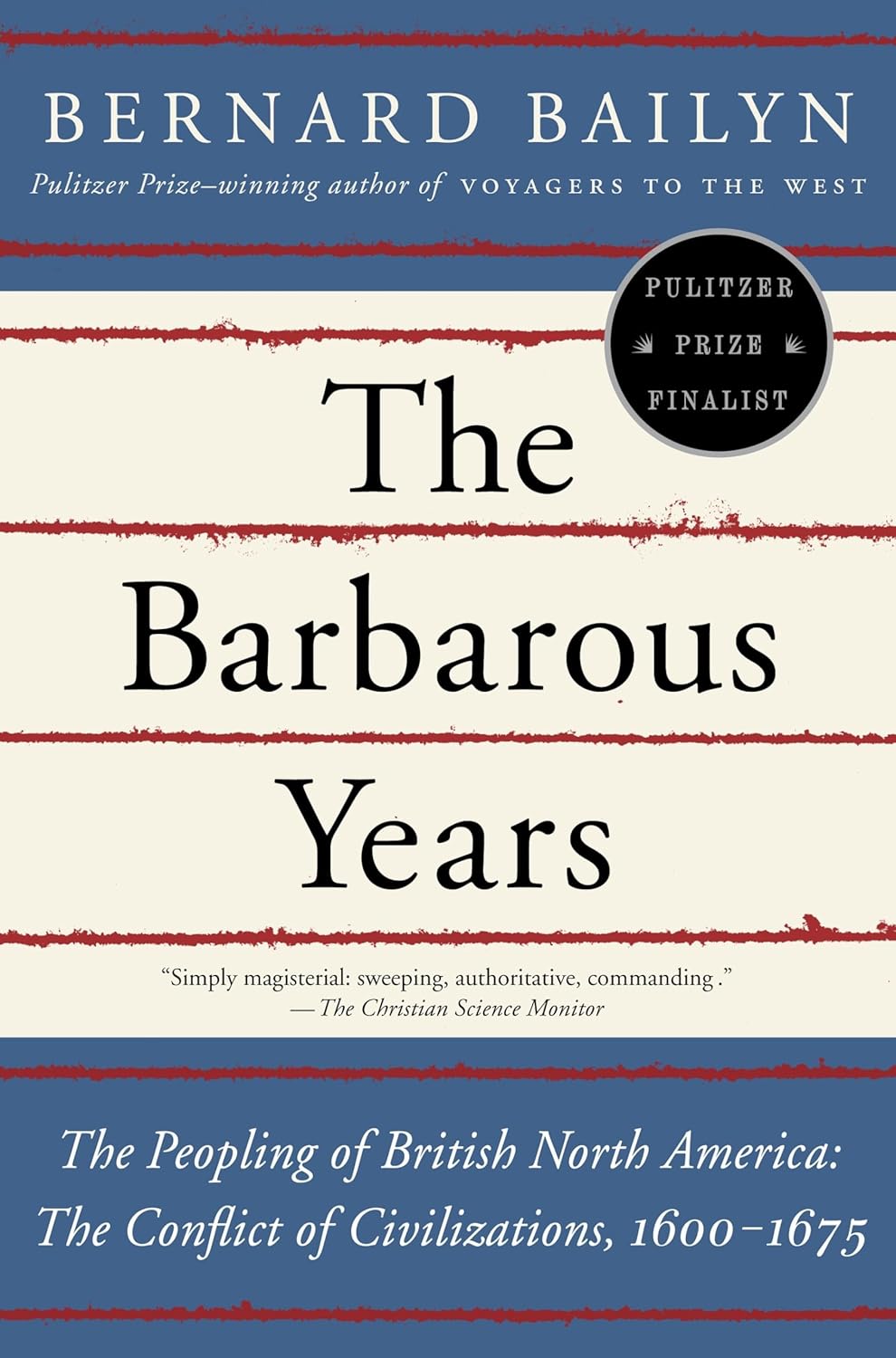
Bernard Bailyn’s The Barbarous Years: The Peopling of British North America, 1600–1675 (2012) is something of a reset on how we should think about early American settlement. His core insights, which he develops through “studies within stories,” run against the tidy, teleological “origins of the United States” story. In short, Bailyn claims that early American settlement was not some sort of extended but purposeful prologue to the United States. Rather, he argues, it was a long stretch of improvisation, coercion, near-failure, and above all, a barbarously violent process whose outcomes were anything but foreordained.
Bailyn portrays pre-Columbian North America as a “magico-animist world” in which reciprocity and a kind of reckless, heedless courage underpinned social stability, well-being, and survival. Native societies lived largely peripatetic lives, shifting rhythmically among hunting, fishing, gathering, and simple horticulture. Material possessions were limited to what could be used – tools for farming or hunting – while land was not owned in any private or absolute sense. A market in real estate, Bailyn argues, was simply “inconceivable,” as was any shared identity as “Indian” prior to European contact.
Nor was North America before 1492 an Eden. Child mortality was high, overall life expectancy was no better than in Europe and likely worse, and those who survived to age fifteen could expect to live only into their mid-thirties. Nothing in pre-Columbian America, Bailyn writes, was “settled, final, consolidated, or secure.” Yet the arrival of Europeans – especially their insatiable demand for furs – triggered a “degenerative spiral” among Native societies of the Northeast and Mid-Atlantic, destabilizing existing patterns of life and accelerating conflict and dislocation.
The sixteenth century was a period of rapid population growth in Western Europe. England’s population alone increased by roughly thirty-five percent during the reign of Queen Elizabeth I (1558–1603). Bailyn notes that the English viewed Native Americans much as they did the Irish: simple, brutish, debased, and possibly satanic. With the end of the Spanish War in 1604, an ambitious cohort of “adventurous gentlemen” began to look to the New World as both a fascinating exotic frontier and a potential source of wealth and national prestige. Early English settlers even expected that the mountain lakes feeding the James, York, and Rappahannock rivers might connect westward to outlets flowing to the Pacific Ocean.
“Everything was exotic,” Bailyn writes; “much was unimaginable, especially the people.” On the whole, these early English adventurers were well connected, well educated, and relatively sophisticated – quite unlike the desperate dregs sent by Spain, France, and the Netherlands. For most of them, however, the New World yielded neither fame nor fortune, but early death in the Virginia Tidewater. Jamestown itself came close to abandonment in 1610.
Yet British investors continued to pile in. Between 1609 and 1612, with the colony barely surviving and no reliable source of profit in sight, the Virginia Company attracted 1,152 investors—ten times more than the East India Company. By 1616, roughly 2,000 colonists had arrived under the company’s auspices, but only 351 remained. Nearly twenty percent had been killed in skirmishes and raids with the local Powhatan Indians. Under the rigid leadership of Sir Thomas Dale and Sir Thomas Gates, and governed by a harsh new legal code known as the Laws Divine, Moral, and Martial, Jamestown’s civilian settlers were subjected to military-style discipline and lived under the constant threat of attack.
The imposition of martial law saved the colony in the short term, but it was the later relaxation of those rules – and the introduction of the “headright” system of private enterprise – that ultimately shaped and drove the success of colonial British America. In 1616, the Virginia Company dissolved its seven-year joint-stock arrangement established in 1609. Unable to pay dividends, the company instead offered investors fifty acres of land for each share of stock they owned, to be held and developed as private property. The system was soon expanded to grant fifty acres per person to any adventurer – and to each family member – who migrated to the colony.
When combined with the extraordinary – and newly discovered – profits generated by tobacco cultivation, this land-based incentive proved transformative. Tobacco exports surged from just 1,250 pounds in 1616 to roughly 400,000 pounds a decade later. Together, virtually free land and the economics of a highly lucrative cash crop drew an estimated seventy thousand migrants to the Chesapeake over the next fifty years, laying the economic and demographic foundations of English America. Yet these newcomers were, in Bailyn’s estimation, “a miscellaneous collection of disparate people” who were distributed in isolated settlements ten miles apart or more. Nor was the journey cheap: it cost roughly £20 to recruit, equip, and transport a single man to Virginia, and once there, more than eighty percent were dead within two years. Marriages lasted at most nine years before one partner died. Thirty percent of children were orphans before their eighteenth birthday. Virtually no one knew their grandparents.
An inflection point in colonial American history came on March 22, 1622, when the new Powhatan chief, Opechancanough, launched a coordinated and devastating surprise attack across the Chesapeake. Within a matter of hours, 330 men, women, and children were killed; nearly seven hundred more soon died from disease and starvation. The colony was reduced to just 1,274 people. Bailyn argues that the consequences of the massacre were simultaneously physical, psychological, and political. Any lingering notions of benevolence toward the native population vanished, replaced by fear and fury. A brutal ten-year war followed.
Public opinion in England, once inclined toward racial accommodation and peaceful conversion, hardened into calls for vengeance and holy war. The Virginia Company – already deeply in debt and now under sustained physical attack – collapsed. Yet rather than destroying the colony, the failure of large-scale corporate control cleared the way for a new class of small English merchants, whom Bailyn describes as “unsentimental, quick-tempered, crudely ambitious men concerned with profits and increased landholdings, not the grace of life.” Under this new planter-merchant regime, the colony expanded relentlessly. By 1634, 175 London merchants were engaged in the Virginia trade; by 1640, that number had risen to 330.
The mid-seventeenth century was a period of extraordinary mobility for the British, what Bailyn calls a “demographic phenomenon.” In the dozen years after 1630, roughly 120,000 English and Scots migrated to Ireland, some 60,000 to the West Indies, and another 20,000 to New England. At the same time, Catholics numbered only about 60,000 in England and Wales – roughly one percent of the population. Against this backdrop, the Catholic nobleman Lord Baltimore was granted by King Charles I a vast proprietary domain of some twelve million acres, stretching north from the Potomac River and down the Eastern Shore of the Chesapeake.
More remarkably, Baltimore was invested with the powers of a palatine lord – authority not granted since the fourteenth century. He held near-absolute control over the use, defense, and administration of the province, and governed a population whose legal status was not that of subjects of the Crown but tenants of the lord proprietor. Crucially, Baltimore also controlled recruitment. He envisioned Maryland not as a Catholic colony per se, but as a colony safe for Catholics – a refuge within a hostile Protestant empire. The first settlers arrived in March 1634.
Unlike the English in Virginia, the Maryland settlers initially sought “to civilize, cherish, and preserve” the native population and its culture. Baltimore also attempted to restrict tobacco cultivation in the colony, a policy that was almost immediately – and entirely – ignored. Drawn from scattered sources, the settlers shared little sense of collective identity or regional culture. For decades, Maryland would be described as primitive and chaotic. Internal divisions emerged almost at once. The Jesuits proved an especially bitter and unexpected source of disorder. Only eleven priests were sent to Maryland over eleven years, and eight died there, yet their presence and defiance sparked recriminations with Catholic overseers in England, who were themselves under mounting pressure from rising anti-Catholic agitation at home. Papal authorities ultimately sided with Lord Baltimore’s more cautious approach. By 1649, however, Parliament had reasserted its authority over all of England’s overseas dominions, Maryland included.
England’s population surged during the seventeenth century, increasing by roughly thirty percent – from 4.1 million to 5.3 million – in the first half of the century. Real wages fell and poverty became widespread. An estimated 100,000 Britons – “an amalgam of people, largely English,” as Bailyn puts it – emigrated to the Chesapeake tobacco coast over the course of the century, as many as 85 percent of them arriving as indentured servants. As population growth slowed and political and economic conditions stabilized after the Restoration in 1680, enthusiasm for emigration to the New World waned.
The Chesapeake and New England colonies were, by comparison, relatively homogeneous and pious, especially when set against New Netherland, which Bailyn describes as a “multicultural, polyglot farrago.” The United Provinces of the Netherlands itself was a veritable melting pot, drawing people from across Europe. By the early seventeenth century, nearly half of those registering for marriage in Amsterdam were foreign-born. The result was a Dutch society and economy that were unusually dynamic – “an era of fabulous accomplishment, overseas as well as at home,” as Bailyn puts it.
The New Netherland Company, founded in 1615 with a three-year monopoly on the Indian trade, was soon eclipsed by the much larger Dutch West India Company, chartered in 1621. This was, Bailyn emphasizes, “not a colonizing company,” but rather a “hydra-headed commercial-military machine,” devoted to piracy against the Catholic Iberian powers and to imperial conquest in the New World. At its height, the company maintained some eighty vessels patrolling in the Atlantic and in 1630 seized northeastern Brazil from the Portuguese, renaming it New Holland – territory the Portuguese would reclaim two decades later. Bailyn stresses that the West India Company was fundamentally a trading enterprise, not a settlement organization, and that this mismatch between commercial ambition and colonial reality would ultimately prove fatal.
Even after the West India Company recognized that recruitment was the key to the colony’s survival, it struggled to attract and retain settlers of quality. In 1638, the company was forced to radically restructure the organization of the colony, ending its monopoly on the fur trade and on shipping to the colony. It offered generous inducements: two hundred acres of free land, along with hunting and fishing rights, to any colonist who brought five adult family members or servants. Henceforth, any citizen of the United Provinces could trade in furs, provided they paid a ten percent export tax. Over the next fifteen years, roughly 2,200 people emigrated from the Netherlands, raising the colony’s total population to about 3,500. Over fifty thousand beaver pelts worth £34,000 were traded in a single season at the trading post on the Hudson called Beverwyck.
Yet New Netherland was no pleasant place. The seventeenth-century Dutch were widely known – and rightly so – as tolerant and comparatively benevolent, and the Netherlands itself was Europe’s most sophisticated state. According to Bailyn, however, the colony bore little resemblance to its metropolitan parent. He likens the administrative chronicles of a succession of short-tempered and autocratic governors – Minuit (1626–31), Van Twiller (1633–38), Kieft (1638–47), and Stuyvesant (1647–64) – to Tacitus’s annals of imperial Rome, filled with bitter rivalries, assassination plots, and bloody Indian massacres. Bailyn describes Dutch reprisals against local Native peoples as “savagery that beggared the most sadistic imagination.” At various points, he characterizes the West India Company itself as erratic, autocratic, profiteering, maladroit, neglectful, anomalous, narrow-minded, and arbitrary.
Meanwhile, the Dutch colony was slowly encroached upon by roughly two thousand Puritan refugees from New England – what Bailyn memorably calls “dissenters from dissenters” – particularly on Long Island. By 1657, Quakers began appearing throughout New Netherland, a group Bailyn describes as “relentless, irrepressible, [and] passionate.” Black Africans, whose numbers increased after the Dutch lost Brazilian New Holland back to the Portuguese, comprised nearly a quarter of New Amsterdam’s population and perhaps ten percent of New Netherland overall. By 1664, when the British seized the colony, its total population stood at approximately nine thousand. Yet because slave labor was not essential to the colony’s economic structure, the enslaved population did not expand significantly. Bailyn also notes that during the entire Dutch period in New Netherland, not a single Native American converted to any form of Christianity.
Next, Bailyn turns to the “short, strange, and well-recorded career” of the Swedish West India Company, which between 1637 and 1655 sponsored eleven expeditions – only nine of which actually arrived – to the Delaware River in pursuit of trade and colonization. Over those dozen years, just four supply and reinforcement ships reached a colony that never exceeded six hundred settlers, nearly half of them Finnish. Bailyn characterizes New Sweden as “an obscure, forlorn colony…impoverished and riven with internal conflicts.” Under the leadership of Johan Printz, a disgraced Swedish army officer and rigid martinet, the settlement was governed with a severity reminiscent of Jamestown’s early military regime. A Plymouth-like New Jerusalem was also established along the Delaware by a Mennonite zealot named Pieter Plockhoy, in the improbably named settlement of Whorekill. In the summer of 1655, New Netherland’s governor, Peter Stuyvesant, sailed up the Delaware with more than three hundred soldiers aboard seven ships and easily wrested control of the colony from the Swedes – ironically, Dutch allies in Europe. In the nine years of Dutch West India Company rule that followed, the renamed colony of New Amstel grew rapidly, spurred by an unusually generous package of land grants, subsidies, and tax exemptions.
In 1620, seventy London merchants and craftsmen, led by Thomas Weston, raised a joint stock of £7,000 and secured a patent under the Plymouth Company of Virginia’s jurisdiction over New England to establish a colony of Netherlands-based religious exiles known as the Pilgrims. While Weston’s involvement made the expedition possible, it also imposed commercial terms – most notably communal labor and joint-stock arrangements – that proved ill-suited to the settlers’ survival and quickly became a source of friction. His role thus encapsulates the uneasy, and often counterproductive, marriage of religious idealism and commercial capitalism at the heart of early English colonization.
There were 102 passengers aboard the Mayflower, only forty-four of whom were Pilgrims. Yet they regarded their arrival in New England as a moment of profound, even redemptive, significance in Christian history. In the nine years that followed, just fourteen vessels entered Plymouth Harbor, and only six carried additional settlers to bolster the colony’s population. By 1630, fewer than three hundred people – only a portion of them Pilgrims – remained, surviving precariously with the assistance of local Native Americans. Meanwhile, as a counterpoint to the Pilgrims’ austere attempt to recreate the primitive Christian life of Christ and his followers, a very different settlement took shape nearby: a raucous trading outpost led by Thomas Morton. Bailyn calls Morton “one of the strangest, most flamboyant, and belligerent impious people ever to wander into a coastal scene.” Pilgrim leader William Bradford derisively labeled him “the Lord of Misrule.” Morton himself christened his colonial playground Merrymount.
A decade after the Pilgrims landed at Plymouth, a very different kind of religious zealot arrived some fifty miles to the north. “[The Puritan] leaders were anything but humble,” Bailyn writes, “and their ambitions were the opposite of modest.” In the first year alone, seventeen vessels carrying roughly a thousand settlers – drawn from a wide range of regions and social, economic, and cultural backgrounds – reached New England. Unlike the Pilgrims, they were not seeking escape from the metropolitan world but intended to remake it. The Puritan-led Great Migration began in the early 1630s amid a convergence of powerful pressures: Charles I’s dissolution of Parliament, the collapse of the cloth trade, falling wages, rising unemployment, repeated poor harvests, and the elevation of the conservative William Laud to archbishop of Canterbury in 1633, all of which generated what Bailyn calls “fear and a sense of desperation.” Although some 400,000 people left Britain for the Western Hemisphere – and another 180,000 moved to Ireland – fewer than 20,000 settled in New England. Yet the Puritan exodus was distinctive: it consisted largely of nuclear families led by literate patriarchs and was “concerted, collectively purposeful, and coherent.” These migrants sought not to invent a radically new society but to reproduce the ordered social world they had left behind. The result was neither a democracy nor a theocracy, but a hierarchical English society grounded in traditional ranks. Nearly one hundred clergy emigrated in the 1630s. “Those who left,” Bailyn observes, “were tougher, more defiant, more self-assured, more self-absorbed,” and they brought with them divergent understandings of spirituality that would soon generate destructive animosities. “They came together only as associates in migration,” Bailyn concludes, “and their group identity therefore was fragile and transitory.”
Drawn from every region of England and committed to varying shades of religious reform, the Puritans quickly discovered that their dream of a single, organic community – a model of disciplined Christian civility untainted by the corruptions of the Old World – was difficult to sustain. Almost from the outset, regional differences began to erode that ideal, nowhere more clearly than in disputes over land use. Should New England follow the open-field system of separately enclosed, family-worked farms common in East Anglia, or the common-field system of cooperatively managed land more typical of the Midlands? Settlers’ expectations were shaped by where they had come from in England, and those assumptions traveled with them across the Atlantic.
These practical disagreements were compounded by a deeper theological rupture over the nature of salvation, known as the Antinomian Controversy. Was divine grace attained through an inner, direct assurance – known as justification – or through an outward process of moral striving and good works – sanctification? This dispute culminated in the scandalous banishment of Anne Hutchinson and helped prompt the founding of Harvard College to ensure doctrinal orthodoxy. As with land management, the varied social and regional origins of the Puritan migrants shaped the factions in the Antinomian struggle, and its resolution would decisively influence the character of New England Puritanism.
Finally, political and religious developments in England itself unsettled the colony’s sense of divine purpose. The triumph of Oliver Cromwell and the advance of reform at home raised doubts about whether New England still occupied a special place in God’s plan. As a result, at least 1,500 settlers returned to England, including roughly a third of the clerical immigrants and fully half of Harvard College’s graduates before 1660.
Amid these internal conflicts ran a continuous, brutal, and often degrading struggle with Native American peoples. By 1669, nearly 90 percent of the approximately 125,000 Algonquian-speaking Indians of southern New England had been destroyed by a combination of epidemic disease and warfare. Meanwhile, between 1640 and 1660 the European population of the Chesapeake region grew at an extraordinary rate of nearly eight percent per year, expanding from about 8,000 to 38,500. Land speculation surged, alongside the rising importation of enslaved Africans to labor on tobacco plantations, and by the 1670s nearly eighteen million pounds of tobacco were being exported annually.
Taken together, Bailyn’s account strips early British America of its comforting myths and replaces them with a far harsher reality: a world born not of idealism but of desperation, violence, and profound instability. Migration was driven by economic collapse and social dislocation, the Atlantic crossing itself was often lethal, and survival in the New World depended on coercive labor systems and fragile, frequently imposed forms of order. Colonial societies were fragmented and insecure, sustained in their earliest years by Native peoples who were decisive actors rather than passive background figures, until relations deteriorated into catastrophic violence. Above all, Bailyn insists there was nothing inevitable about the later emergence of American liberty or republicanism – early British America could just as plausibly have failed outright, hardened into authoritarian plantation regimes, or remained marginal imperial backwaters.
 What's Tim Reading Now?
Leave a comment