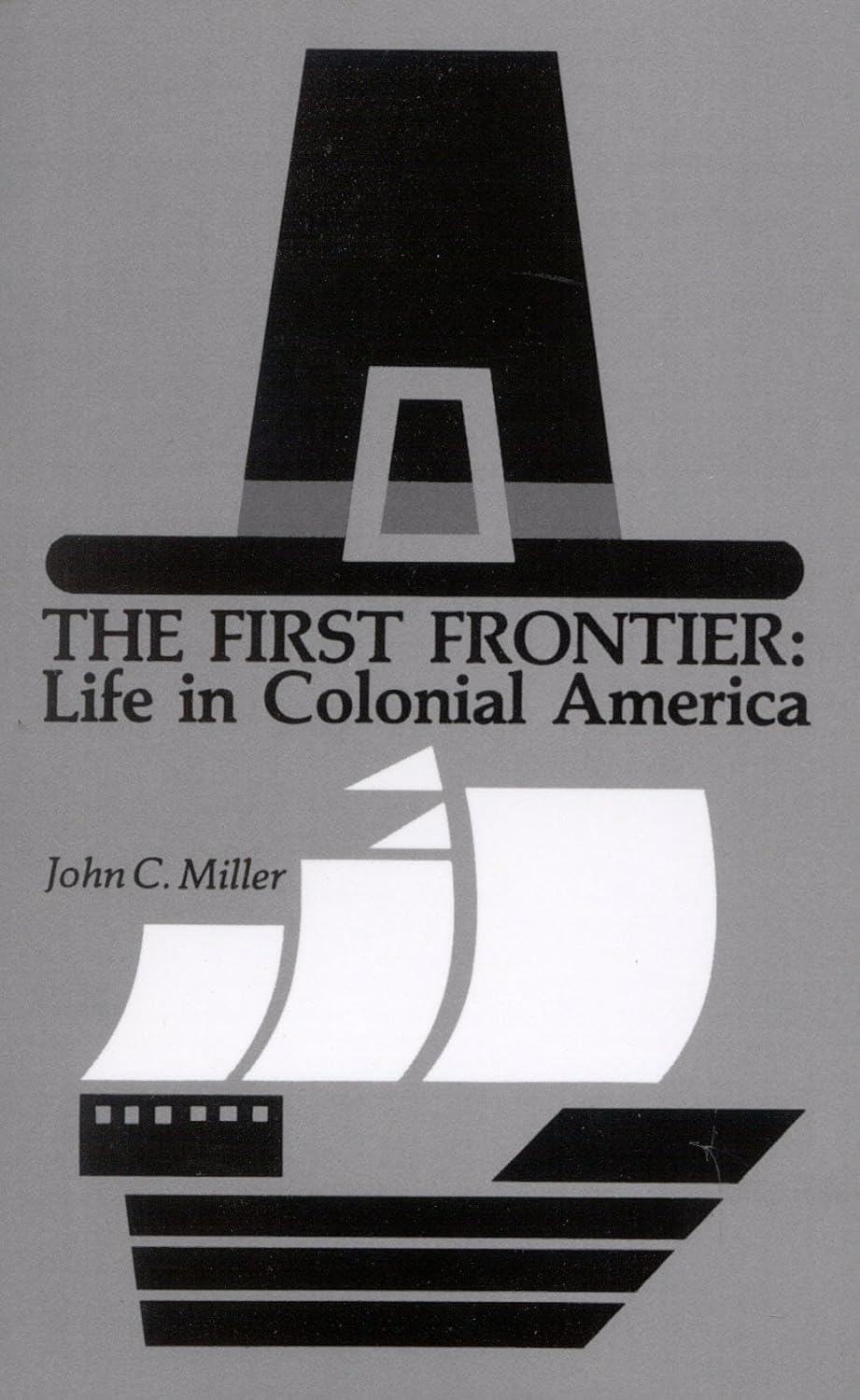
John C. Miller’s The First Frontier: Life in Colonial America (1966) is a tightly argued synthesis that reframes early American history by shifting attention away from elites, institutions, and ideology toward ordinary life on the colonial frontier. Its originality lies more in emphasis and perspective than in overturning established interpretations.
Americans have always put a high premium on success. During the 170-year span of British colonial rule in North America, Americans attained the highest standard of living enjoyed by any people in the world, whether sovereign or colonial. “Prosperity engendered a sense of self-sufficiency,” Miller writes, “a feeling of pride of achievement and a demand for equality of rights within the British Empire that, in the end, defeated every attempt to abridge American liberties.” Throughout the book, Miller quotes regularly from Michel-Guillaume-Jean de Crèvecœur’s (1735–1813) Letters from an American Farmer (1782), one of the most influential books ever written about early America. Crèvecœur, who Americanized his name to J. Hector St. John, captured this transformation in his portrait of the American as “the new man”: a potent blend of industry, self-reliance, mechanical ingenuity, and tolerance for religious and political diversity. In Crèvecœur’s telling, the metamorphosis of the downtrodden European peasant into a fiercely proud citizen defined by thrift, sobriety, and ambition ranked among the most consequential events in world history.
A core theme of this book is that the “frontier” was a way of life, rather than a line on a map. Miller treats the “first frontier” not as Frederick Jackson Turner’s later westward movement, but as the constantly shifting edge of European settlement from the seventeenth through mid-eighteenth centuries. It was a zone of improvisation marked by insecurity, isolation, and contingency, not orderly development and expansion. It was the hardscrabble life on this frontier, deeply held religious beliefs, and the perilous relationship with native Americans that shaped habits, values, and social arrangements long before the Declaration of Independence.
The author centers his analysis on the belief systems that animated early American settlers’ ways of life, beginning with Puritan New England. In the eyes of Massachusetts’s early leaders, their effort to build a City of God on earth was the most consequential human undertaking since the time of Christ. As Miller notes, the Puritans “not only believed in the Bible; they believed in nothing but the Bible.” They held that humanity’s sole purpose was to glorify God on earth, and they ordered their lives around the pursuit of godliness rather than happiness. Materialism, covetousness, and ostentation were condemned as moral failings, and the governing maxim of daily life was to work and pray. In their view, an hour of idleness was as sinful as an hour of drunkenness. However, this worldview inevitably created an enviable work ethic that led directly to sustained economic growth and, ultimately, wealth creation. “The Puritan ideal,” Miller writes, “was an enterprise where profit and religion went hand in hand.” Discipline, conformity, and collective action were paramount. “Much of the freedom and individualism traditionally associated with American life,” Miller observes, “was conspicuously absent in Puritan New England.” The individual was subordinated to the group and to the larger religious mission, and society was conceived as an association of families laboring together toward a shared sacred purpose. But these hardworking, communally-focused individuals eventually became rich and physically secure, an achievement that worked to undermine the foundations of their original success.
Dissident theocratic communities soon emerged along the Connecticut River Valley, led by figures such as Reverend Thomas Hooker, and in New Haven under Reverend John Davenport, each seeking an even purer and more fundamentalist Christianity than that found in Boston; in New Haven, civil law was even drawn directly from the Bible. Rhode Island, by contrast, charted a radically different course. Its founder, Roger Williams, insisted on religious liberty and the separation of church and state, making the colony the most liberal, inclusive, and democratic of the early settlements. Compared with the rigid conformity of Connecticut and New Haven, Rhode Island appeared, in Miller’s words, as “a crazy quilt of strange sects, many of which were persecuted everywhere except Rhode Island.”
The Quakers likewise sought to reintroduce what they believed to be a pristine, apostolic form of Christianity in the New World based on a literal interpretation of the Bible, establishing communities in Pennsylvania, New Jersey, and Delaware, while also exerting a strong influence on neighboring Rhode Island. The founder of the Society of Friends, George Fox, preached a mystical variant of Puritanism centered on what he called the Inner Light. To Fox, the Puritan emphasis on intellectual theology and Old Testament law risked leading believers away from God. Instead, he urged his followers to focus on the New Testament and the teachings of Jesus, cultivating a posture of simplicity and patience while awaiting direct revelation from the Holy Spirit.
In England, Quakers were treated as dangerous social radicals, perceived as threats to both church and state. Between 1660 and 1685, some 8,000 Quakers – including George Fox and William Penn – served lengthy prison sentences in places such as the infamous Newgate. For the Quakers, the search for refuge from persecution was even more urgent than it had been for the Pilgrims in 1620 or the Puritans in 1630. William Penn’s ultimate aim closely mirrored that of New England’s Puritans: the recreation of true, primitive Christianity in the American wilderness. If John Winthrop envisioned a “shining city on a hill,” Penn pursued what he famously called a “Holy Experiment.” Yet in the Quaker view, the essence of Christianity was so plain and self-evident that it required neither coercion nor indoctrination. As a result, Quaker colonies embraced religious freedom from the outset, while adhering to a moral code that even the most devout Puritan would have admired.
Another of Miller’s most persistent themes is the pervasiveness of violence in colonial life and the weakness of institutions of authority. Imperial authority along the frontier was thin and local autonomy strong. Settlers often acted first and sought approval later; governors, courts, and churches had limited reach. This combination of frontier violence and self-reliance, Miller argues, fostered a suspicion of authority and a hard pragmatism that bred an early habit of autonomy and distrust of distant authority, long before Parliament or taxation without representation became flashpoints.
Miller devotes most of the book to exploring life in the colonies from a variety of thematic perspectives, from sports and recreation to courtship and education. In many ways it is like a condensed version of David Hackett Fischer’s magisterial Albion’s Seed: Four British Folkways in America (1989).
The American colonies were, by modern standards, a profoundly godly society, regardless of their original religious affiliations. Christmas went largely uncelebrated for most of the colonial period, and in many colonies failure to attend church services was a finable offense. Legislatures across British North America enacted Sabbatarian – or “blue” – laws, one of the most enduring legacies of seventeenth-century Puritanism in America. Equally durable was the Puritan emphasis on public education. “Puritans made mass education an article of their faith,” John C. Miller writes. The ability to read – and thereby gain firsthand knowledge of Scripture – was essential to salvation and served as a safeguard against spiritual perdition. “The little red schoolhouse,” Miller observes, “as much as the blue laws, remains one of the by-products of the Puritans’ obsessive concern with holiness.”
Puritans believed that scholars sat at the right hand of God and accorded them a level of honor, obedience, and reverence unmatched in any other period of American history. Their educational system was strikingly democratic and embodied an early American ideal of equality. As early as 1647, Massachusetts mandated publicly funded, compulsory education; by century’s end, every town of fifty households was required to employ a schoolmaster to teach children to read, with daily Bible reading as a central task. The result was that New England children became the best educated in the English-speaking world, England included. Even the Quakers – often associated with anti-intellectualism and a reliance on an innate Inner Light – absorbed this lesson, emphasizing practical education through their Friends’ schools. The major exception lay in the southern colonies, where educational provision lagged badly; in late seventeenth-century Virginia, for example, there were only two public schools in the entire colony. Although colonial America was among the most literate societies in the world at the time, its conservative religious sensibilities were firmly hostile to art and literature. The first drama written by an American, Thomas Godfrey’s The Prince of Parthia, was staged in Philadelphia in 1767.
Courtship and marriage in colonial America were largely unromantic affairs. The principal objectives of marriage, Miller observes, were “wealth, social position, and love – usually in that order.” High mortality rates in the seventeenth and eighteenth centuries, combined with the laws of primogeniture and the relatively generous inheritance rights of widows – who typically received one-third of their late husband’s estate – made the competition for wealthy widows and widowers especially intense.
Marriage itself was regarded as a wholly civil institution, particularly in Puritan New England, where ministers were not authorized to perform marriage ceremonies until 1692. Because women were relatively scarce in early America, they were more highly valued than in the Old World and, from a utilitarian perspective, indispensable to the many household tasks required for survival. Yet wives were expected to regard their husbands – to whom they were legally subordinate, almost as chattel – with a blend of reverence, affection, and fear. Among their most important roles was the bearing and disciplining of large families, whose children provided essential labor on farms. Puritans, for their part, viewed children as inherently depraved and especially vulnerable to the machinations of the Devil, whom they believed to be more powerful and more omnipresent in the untamed wilderness of America.
In closing, Miller contends that American habits of independence, suspicion of authority, and readiness to use violence did not originate in the Revolution – they were forged in generations of frontier life. Moreover, the core American ideals of equal opportunity, individual rights, and religious freedom also took shape during the colonial era. “There was an American character before there was an American nation,” he writes. From the outset, America was a land of opportunity, and the “new man” that Crèvecœur observed emerging was defined by ambition, restlessness, and a persistent dissatisfaction with his present circumstances. Paradoxically, Miller notes, “idealism and materialism were made to go hand in hand.” The First Frontier has endured not because it overturned the field of colonial studies, but because it subtly reframed it – reminding readers that American history was shaped less by ideas proclaimed in bustling commercial centers or across the Atlantic in the capitals of Europe than by lives lived, struggled through, and improvised at the edge of settlement.
 What's Tim Reading Now?
Leave a comment