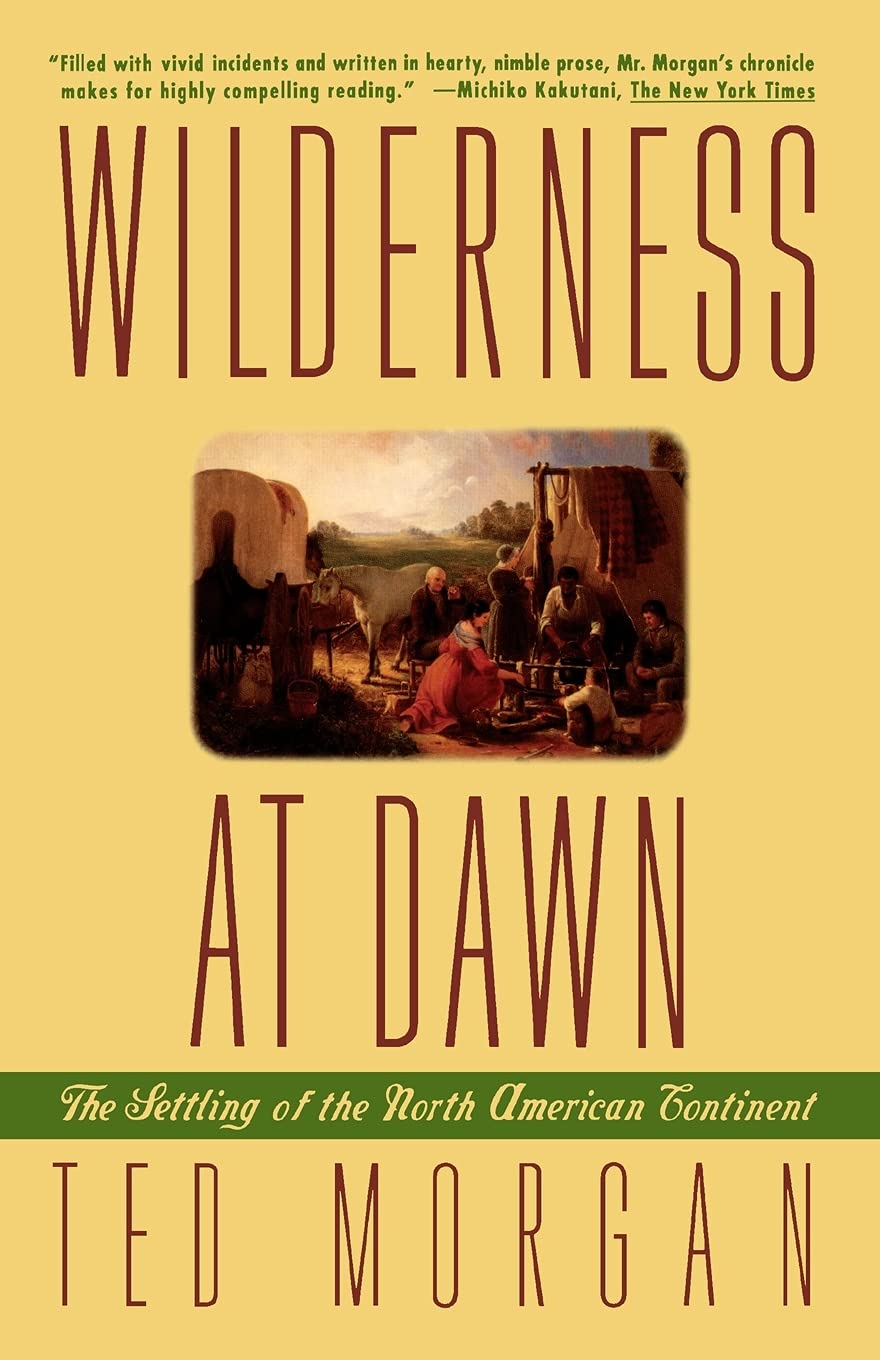
French-American biographer, journalist, and historian Ted Morgan was born Count Sanche Charles Armand Gabriel de Gramont in Geneva in 1932. He became an American citizen in 1977, renouncing his French noble titles and adopting the Americanized name “Ted Morgan,” an anagram of “de Gramont.” His 91-year life was a full one – ranging from service as a junior officer in the French-Algerian War to a distinguished career as a Pulitzer Prize – winning journalist. In 1993 he published Wilderness at Dawn: The Settling of the North American Continent, a highly readable account of the peopling of North America from the era of the Bering land bridge to the late nineteenth century and the closing of the frontier.
Morgan opens by observing that the first humans in North America arrived from Asia as refugees of the Ice Age some thirty thousand years ago. Tens of millennia later, the Spanish arrived as conquerors, the French as traders, and the English as settlers and religious dissenters – followed, tragically, by Africans brought in chains. Wilderness at Dawn unfolds as a group biography of this epic collision of three empires – Spanish, French, and English – and of the peoples devastated in its wake, namely Native Americans and Africans. Morgan highlights one of the enduring mysteries of world history: the fate of the great North American Indian civilizations – including the Adena–Hopewell, the Moundville culture, and the cliff dwellers of Mesa Verde and Chaco Canyon – which flourished from roughly 1000 to 1300 AD before all but disappearing. First contact with Europeans unleashed waves of infectious disease that decimated up to ninety percent of the native population within decades. To deeply religious Europeans, this catastrophe seemed like divine providence – a sign that a benevolent, if biased, God was clearing the New World for his chosen people. In reality, Morgan writes, “The history of America’s settlement … is not a particularly uplifting tale.”
The Spanish literally cleared the way for European imperial domination of North America, even though they ultimately played only a limited role in the conquest and settlement of lands north of the Rio Grande. Their early presence – especially the expeditions of Hernando de Soto across the Southeast and Francisco Vásquez de Coronado across the Southwest between 1539 and 1542 – triggered devastating epidemics, catastrophic population loss, and the collapse of long-standing Native village systems. By the late sixteenth century, Spain’s “slow, corrupt, and cumbersome” imperial bureaucracy was still staggering forward, and it remained the only European power with permanent colonies in what is now the United States. Yet lacking the silver of Peru or the gold of Mexico, these northern outposts became impoverished and neglected backwaters of the empire. St. Augustine, founded in 1565 by Pedro Menéndez de Avilés, stands as the oldest European settlement in the modern United States. In 1598, Juan de Oñate launched the first major colonizing expedition into the upper Rio Grande Valley, and Santa Fe was formally established in 1610 under Governor Pedro de Peralta, who made it the capital of the new province of Nuevo México. It would also become the site of the only successful Native rebellion to expel a European occupying power.
Nineteenth-century American historian Francis Parkman famously observed, “The Spanish slaughtered the Indians, the English pushed them away, and the French embraced them.” Morgan notes that this so-called embrace proved “fatal,” bringing with it missionaries, alcohol, and environmental ruin. The French viewed the New World primarily as an inexhaustible reservoir of valuable furs; while the Spanish and English were building towns and hunting for gold, the French were charting waterways and carving portage routes across a vast, two-thousand-mile arc stretching from the St. Lawrence Seaway to New Orleans. To satisfy European demand, Native peoples killed beavers by the millions, destroying delicate ecosystems in the process. By 1630, at the dawn of sustained European colonization in North America, there were roughly 2,000 English settlers in Jamestown, 200 Dutch in New Amsterdam, and just 55 Frenchmen in Quebec. Few French emigrated to New France. “The French were stay-at-homes,” Morgan writes; “they lacked the imperial drive of the Spanish and the mercantile tradition of the English.” According to the author, the French monarchy’s “biggest mistake” was banning the emigration of French Protestants from Canada and Louisiana. In 1685, King Louis XIV revoked the Edict of Nantes, which guaranteed Protestants religious tolerance. The French had their own Great Migration in the last decade of the seventeenth century when an estimated two hundred thousand Huguenots fled the country, but unlike with the English, the door to the New World was closed to them.
According to Morgan, “The settling of Jamestown has all the elements of a horror story – expecting a land of milk and honey and finding instead suffering and death.” From the outset, Jamestown was a private, commercial venture, and Morgan likens the Virginia Company of London – which ran the colony from 1607 to 1624 – to the savings-and-loan institutions of the 1980s that issued junk bonds to finance speculative real estate schemes. In 1612, King James I even authorized the failing company to run lotteries to raise funds, much of which was promptly embezzled. Jamestown faced two overwhelming problems, the first being catastrophic mortality: of the 104 settlers who arrived in 1607, only 38 were alive six months later. Over the eighteen-year lifespan of the Virginia Company, 83 percent of the 7,289 settlers it sent either died or fled back to England. The second problem was poor leadership. Morgan describes three distinct phases in Jamestown’s early history. The first was near-anarchy (1607–1611), marked by a failed experiment in communal living that culminated in “the starving time,” the colony’s “absolute nadir.” The second (1611–1619) was a period of strict, garrison-style military rule that brought stability and ushered in the third phase, defined by two forces that would shape Virginia’s future: tobacco and African slavery. Introduced by John Rolfe in 1614, tobacco quickly became the colony’s substitute for gold; between 1616 and 1628, exports to England soared from 2,500 pounds to one million – a staggering 65 percent annual compound growth rate. In 1622, a Powhatan uprising killed 347 men, women, and children across thirty-one settlements, prompting King James to finally pull the plug on the Virginia Company. In 1624, the Crown took control, imposing policies of Indian extermination and enslavement modeled on the conquistadors. Yet Morgan argues that, despite its disastrous beginnings, English control of the Chesapeake ultimately proved a long-term strategic gain: by 1627, fifteen hundred settlers were living on fifty plantations. By the early eighteenth century, Virginia’s tobacco planters had amassed considerable wealth and experienced rapid social ascent, all while still living on the edge of the wilderness and vulnerable to Indian raids. Even so, the Tidewater elite eagerly embraced and imitated the architecture, customs, and manners of the English gentry – despite the fact that most had never witnessed that world firsthand.
Thirteen years after Jamestown – and six hundred miles to the north – a very different kind of British colony took root at Plymouth. Unlike the profit-driven enterprise in Virginia, Plymouth, Morgan argues, operated under a “not-for-profit ideology,” more akin to “a conservative affinity group devoted to collective self-improvement,” although they did manage to ship back to England twelve thousand pounds of beaver skins between 1631 and 1636 alone. And unlike the early waves of Jamestown settlers, the Pilgrims arrived as intact nuclear families within a close-knit, devout community. Yet within three years, Governor William Bradford learned the same hard lesson that had confronted Jamestown’s leaders: a free-market system, in which each household received an acre of land per person, proved far more productive than the colony’s initial experiment with communal labor. By 1624, Plymouth’s population stood at 180, and it was already clear that the settlement was not unfolding as its founders had hoped. Bradford grappled with two intractable problems. First, it was nearly impossible to maintain a stable population when the lure of new land continually drew young men and families elsewhere. Second, as more newcomers arrived to claim available land, preserving ethnic and religious homogeneity became untenable. Crime and fornication spread through the community. Bradford, who died at sixty-seven in 1657, went to his grave heartbroken that the Devil in the American wilderness had proved stronger than the devout community of faith he had envisioned.
The Dutch were a colonial presence in North America for only a brief forty years (1624–1664). New Netherland along the Hudson River was, as Morgan writes, never more than “a minor cog in the great worldwide Dutch mercantile conglomerate … the Dutch were traders, bottom-line-oriented, indifferent to imperial strategies.” They largely avoided both strategic Indian diplomacy and religious conversion efforts, focusing almost exclusively on the fur trade – particularly beaver pelts – often to the exclusion of all else. Though the Dutch showed little empathy for or understanding of local Native peoples, they nonetheless created a commercial society that was by far the most tolerant, pluralistic, and cosmopolitan of any seventeenth-century European colony in North America. Yet, like the French, Dutch ambitions in the New World were ultimately undone by a simple deficiency in numbers.
In 1630, another group of religious dissidents – the Puritans – founded Boston and expanded throughout Massachusetts and Connecticut. Unlike the other imperial powers in North America, England’s growth was driven by tens of thousands of newcomers who left their homeland during the Great Migration. By 1640, some 35,000 English settlers lived in North America. Morgan argues that it was not financing, trade policy, political structure, or religious orthodoxy that ultimately determined the success of English colonization, but rather the steady influx of new families. Political turmoil in England became the true engine of New World expansion. Charles I, who succeeded James I in 1625, leaned Catholic, dissolved Parliament for more than a decade, and imprisoned Puritan leaders. “What was a trickle in 1607 and a stream in 1620,” Morgan writes, “became a flood after 1629.” More than twenty thousand English emigrated to North America in the 1630s alone. By 1640, the English population in America numbered roughly thirty-five thousand: 15,000 in Massachusetts, 6,500 in Virginia, 5,700 in Connecticut, 3,000 in Plymouth, 2,000 along the northern frontier, and 1,000 in Maryland. (By comparison, the population of New France was only 3,200 in 1666.) The victory of Oliver Cromwell in the English Civil War and the execution of King Charles in 1649 ended the era of mass Puritan migration to the New World, but by then the flywheel was already in motion.
John Winthrop joined the Massachusetts Bay Company in 1630, a fully self-governing and self-financed enterprise free from direct crown oversight. No New World settlement grew as quickly as Boston, which expanded from roughly two thousand settlers to more than eight thousand in the short span between 1632 and 1637. Unlike the comparatively tolerant Dutch of New Netherland, New England society was discriminatory, undemocratic, and relentlessly expansionary; by 1635, settlers were already moving up the Connecticut River Valley from present-day Hartford to Springfield. Westward migration was constant. Winthrop may have envisioned a stable “City on a Hill,” but Morgan says the Massachusetts frontier contained “the germ of continuous expansion.” Frontier settlers looked back at the coastal Puritan hinterland with a mix of emulation and resentment, just as those in the hinterland looked back toward England. Life on the frontier was egalitarian and lived under constant threat of violence, while the safe communities of the hinterland grew more hierarchical and class-conscious. As the old frontier became the new hinterland, Morgan argues, the Puritan ideal of “being knit as one” quickly frayed, giving way to rising self-interest, litigation, and loosening morals. “The generation that had fought for its religious freedom,” he writes, “could pass on the freedom but not the fight.” The Salem witch hysteria of 1692, he suggests, was an irrational outburst born of this erosion of Puritan authority.
By the latter half of the seventeenth century, three European powers were spreading across North America from their original footholds, and collision, Morgan argues, was inevitable. By 1680, the French had pushed as far south as New Orleans, a move the Spanish sought to counter balance with outposts in Texas, Pensacola, and New Mexico. Morgan characterizes Spanish imperial policy in North America as shambolic. Unlike the largely self-governing English settlements and far flung and lightly populated outposts of New France, Spain’s colonies were direct extensions of the all-powerful Catholic monarchy – “a gargantuan but arthritic piece of work directed from Madrid … overregulated and undermanned.” Spanish society in the New World closely mirrored that of Spain itself, yet more than any other European power, the Spanish intermixed with Indigenous peoples, producing a deeply hybrid, irreversibly Hispanicized culture.
After the mercantile experiment of Virginia and the religious dissent of New England came a new English colonial model: the proprietary province. In these colonies, the Crown granted authority to an individual, a family, or a small group of investors, often to advance a specific social or religious vision. Maryland, the first proprietary province, was founded as a refuge for English Catholic gentry, while Pennsylvania – the last – was established in 1682 by the Quaker radical William Penn and grounded in principles of pacifism and religious tolerance. Morgan calls Penn and Plymouth’s William Bradford “the two most complex figures in the first century of English settlement in North America.” He notes that Penn’s father, Admiral Sir William Penn, was the seventeenth-century equivalent of a member of today’s Joint Chiefs of Staff, while Quakerism at the time was viewed as an eccentric and unsettling movement. Though estranged from his unconventional son, the admiral nonetheless left Penn a vast estate – about 120,000 acres – which Penn used to finance his Quaker refuge. Morgan portrays Penn as a “great promoter” but largely an “absentee landlord” – he spent only four years in Pennsylvania between 1681 and 1718 – who incurred enormous debts in his effort to build a productive, peaceable colony based on accommodation with the Native population. Penn’s ideal of a harmonious Quaker commonwealth, however, was overwhelmed by a flood of non-Quaker settlers and an ocean of debt. By 1700, Quakers made up only a third of the population, and as they grew wealthier and less persecuted, they lost both their collective cohesion and their reputation for modesty. Near the end of his life, Penn offered the entire colony for sale for £30,000. “Pennsylvania had cost him his life as well as every penny he had,” Morgan concludes.
South Carolina, the second proprietary colony, was granted in 1663 to eight investors and developed primarily around rice cultivation, the Carolinas’ first major cash crop. In 1702, Queen Anne designated rice an “enumerated commodity” under the Navigation Act of 1660, requiring it to be exported exclusively to England on English ships. The grueling, labor-intensive flooding and draining demanded by rice cultivation in the Low Country fueled a dramatic expansion of slavery. By 1708, the enslaved population had reached parity with whites – about four thousand of each – and by 1729 enslaved Africans outnumbered Europeans two to one. By 1740, roughly forty thousand slaves were producing 43 million pounds of rice annually for the benefit of just twenty-five thousand whites; in some parts of the Low Country, blacks outnumbered whites by as much as fifteen to one. Spain exploited this imbalance from its base in St. Augustine, harassing Carolina settlements and, in 1733, issuing a proclamation under King Philip V that offered freedom to runaway slaves who converted to Catholicism and served four years as public laborers. Morgan describes the decree as “a beacon sending out a powerful signal to the slaves of Carolina.” The result was the Stono Rebellion of September 1739, the largest and deadliest slave uprising of the colonial period. By the mid-eighteenth century, the Carolinas had added yet another lucrative cash crop – indigo, the region’s “blue gold” – which was designated an enumerated commodity in 1748.
Georgia was the last British colony established in what would become the United States. Founded in 1733 as a refuge for reformed convicts and impoverished debtors, Georgia was, in Morgan’s words, a “multi-purpose colony: part reform experiment, part buffer state, part Protestant refuge, and part would-be silk producer.” For its first fifteen years, the colony enforced strict prohibitions on both rum and slavery. It was also home to a fiercely independent and insular community of persecuted Lutheran exiles from Salzburg, Austria, who founded the isolated silk-producing settlement of New Ebenezer. In 1750, the ban on slavery was repealed; a decade later, Georgia’s population stood at roughly six thousand whites and 3,600 enslaved Africans.
By 1750, North America had become a profoundly imbalanced, three-cornered continent, home to roughly 1.3 million English colonists, seventy thousand French, and just eight thousand Spanish. The result was the emergence of three distinct “Americas,” separated by a vast and fluid frontier zone inhabited largely by Native peoples. The conflict that followed – known in the colonies as the French and Indian War – was more accurately termed in Britain the “Great War for Empire.”
After General Braddock’s disastrous defeat at the Battle of the Monongahela near present-day Pittsburgh in 1755 – often called the “Pearl Harbor of the Seven Years’ War” – Britain responded by flooding North America with regular troops. Through a strategy of multiple, simultaneous offensives, the British overwhelmed the thinly spread French forces. In 1759, the French were decisively defeated on the Plains of Abraham outside Quebec, effectively ending their imperial ambitions in North America. France was expelled from the continent, and some sixty-five thousand French inhabitants became British subjects overnight. Spain, meanwhile, acquired Louisiana and traded Florida for Cuba in the convoluted peace settlement. “More North American territory changed hands at the Treaty of Paris than through any other international agreement before or since,” Morgan writes. France emerged as the war’s “big loser,” while Spain, he argues, was both “a winner and a loser.” Yet scarcely had the war ended in 1763 when Pontiac and his Native allies launched attacks on British forts across Pennsylvania, Ohio, and Michigan. The Pontiac Rebellion jolted British policymakers into recognizing the need for a coherent western policy, resulting in the Royal Proclamation of 1763. This decree drew a boundary from Canada to Florida beyond which European settlement was prohibited – effectively reserving most of the territory Britain had just wrested from France for Native Americans.
In 1765, the British colonies erupted in anger over taxes imposed by Parliament to finance the Crown’s mounting military debt from the recent global war. Only five years earlier, in 1760, the colonists had greeted the accession of George III with what Morgan calls “a mood of astonishingly uncritical pro-Britishness,” yet within fifteen years they would commission George Washington to lead a citizen army in open war against England. Even as the conflict unfolded along the eastern seaboard, settlers continued to push westward across the Appalachians into Kentucky and Tennessee.
As Morgan observes, “In America, the history of land distribution is more instructive than the history of the battles.” Nowhere was this clearer than in the Land Ordinance of 1785, which he describes as “a document as important as any that Congress ever passed.” Public lands were opened on a first-come, first-served basis and organized into a rational grid: six-mile-square “townships” divided into thirty-six one-mile-square “sections,” one of which was reserved for a church and public school. These 640-acre sections were later subdivided into halves and quarters, shaping patterns of settlement for generations. “The township system,” Morgan writes, “shaped the American character as definitely as the Declaration of Independence.” To implement this vast undertaking, Congress appointed a Geographer of the United States to oversee the surveying of public lands – a powerful and enduring office that remained active until the closure of the General Land Office in 1946.
In 1787, an association of Revolutionary War veterans seeking to settle in Ohio successfully lobbied the Continental Congress for the right to purchase 3.5 million acres of western land using depreciated Continental currency. Over the course of just four days in 1787, the Northwest Ordinance was drafted, introduced, debated, amended, and unanimously approved by the minimum eight states then present and voting. The ordinance established both the method of land distribution and the framework of government for the western territories, as well as a clear pathway to statehood. In the first stage, a territory would be governed by officials appointed by the federal government; in the second, once the adult white male population exceeded five thousand, it would become an organized territory with a representative legislature. Finally, when the population reached sixty thousand, the territory could petition for statehood, subject to popular ratification.
From the outset, the Northwest Territory was closed to slavery. Morgan argues, first, that the ordinance’s ban applied only to the Northwest and had no direct implications for the South. Second, southern leaders were content to confine and thereby monopolize slave-based cash crops—tobacco, rice, and indigo—within the regions that permitted chattel slavery. Finally, he notes the presence of genuine antislavery sentiment among several influential Virginians involved in shaping the legislation, including Thomas Jefferson and Patrick Henry. In practice, however, the distribution of public lands in the Northwest was soon marred by graft and corruption, most notably in the scandal surrounding the Scioto Company. The first three states admitted after the original thirteen—Vermont, Kentucky, and Tennessee—had each struggled to separate from their parent states, and only one of the three passed through the full territorial process prescribed by the Northwest Ordinance of 1787.
In closing, Morgan’s history of the peopling of North America is a highly engaging and informative narrative ideal for the curious and informed reader.
 What's Tim Reading Now?
Leave a comment