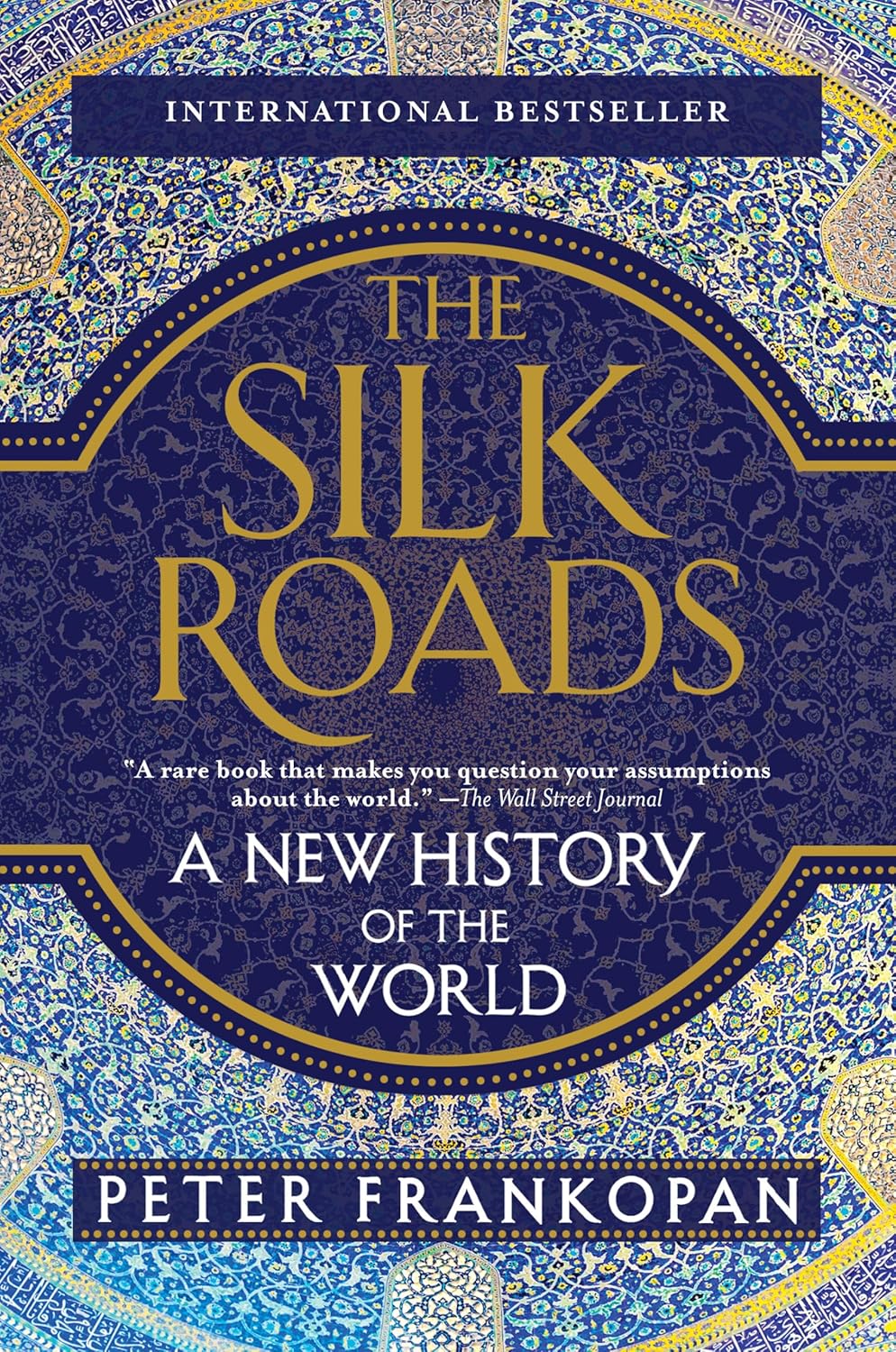
Western civilization – and, by extension, much of world history – is often presented as a seamless chain of causally linked events stretching back to antiquity. In its simplest form, the narrative runs like this: Ancient Greece gave rise to Imperial Rome; Rome shaped Christian Europe; Christian Europe produced the Renaissance, which sparked the Enlightenment and then the Industrial Revolution, culminating in the rise of the United States and its universal ideals of life, liberty, and the pursuit of happiness. To Oxford historian Peter Frankopan, this familiar story is not only too linear but also excessively Eurocentric. In The Silk Roads: A New History of the World (2015), he offers an alternative framework – one that shifts the geographical and historical center of gravity from the Greco-Roman world to Persia and the vast spine of Eurasia.
The originality of The Silk Roads lies not in new archival discoveries or radically revisionist interpretations, but in Frankopan’s selection and emphasis. Each of the book’s twenty-five chapters is organized around a political or economic “road” that turned on developments in the Middle East or Central Asia. Each chapter picks up a different lens (faith, empire, crisis, war, oil, compromise, genocide, superpower rivalry) but all occur along the same geographic corridors. The narrative emphasizes that the “roads” of antiquity persist in modified form into the modern world (oil pipelines instead of silk caravans, superpower rivalry instead of nomad incursions). “These pathways,” he says, “serve as the world’s central nervous system.” Frankopan stretches the concept of “silk roads” broadly, sometimes thinly, but his cumulative effect is clear: he wants readers to rethink world history from a different vantage point.
Trade and communication networks emerged across Eurasia at the dawn of the Agricultural Revolution some ten thousand years ago. In addition to the eponymous silk and spices, furs, slaves, gold and silver also played central roles in connecting Northern Europe with Africa and the nomadic steppe economics of Central Asia. It is also how religious ideas from Buddhism to Zoroastrianism and Christianity to Islam proliferated around the world. By showing how the Christian sphere reached into Central Asia (via e.g. Nestorian Christianity) and how Eastern Christian movements engaged in the broader networks, Frankopan emphasises that the “West” is not the only actor and that Christianity had deep engagement across Eurasia. These different groups competed strenuously, but also often found accord, co-existed and interacted in ways that created stability, synthesis, and cross-cultural harmony, Frankopan says.
At the heart of Frankopan’s argument is that the Middle East and Central Asia have long functioned as the strategic corridor connecting East and West, a region crucial to the movement of goods, people, diseases, ideas, and imperial power for millennia. From this perspective, the Persian Empire – not Greece – emerges as the ancient world’s true superpower, “the heart of the world,” Frankopan says. “The Persian Empire was a land of plenty that connected the Mediterranean with the heart of Asia.” Europe’s westward voyages are reframed as attempts to circumvent this wealthy, highly advanced and powerful Middle Eastern-centered world. By re-centering the map around the spine of Eurasia, Frankopan contends, we gain a fundamentally different view of what has driven global change: forces originating in the Middle East and Central Asia, not Europe, are often the real engines of world history.
The so-called Silk Roads, in this telling, are not specific caravan routes but recurring strategic corridors – zones of intense exchange rather than fixed pathways – through which trade, migration, disease, religious movements, and imperial rivalries repeatedly flowed. The book is therefore less about literal merchants and more about the enduring centrality of Eurasia as the pivot of world history.
Frankopan argues that Rome’s conquest of Egypt – and its resulting pivot toward the eastern Mediterranean and beyond – propelled the empire into a transformative new era. During the first phase of globalization beginning around 100 BC, silk was an international currency, as well as a luxury product. The East, he writes, was “vibrant, competitive, efficient and energetic,” a world “connected, complex and hungry for exchange.” The economic effects were immediate: grain prices across the Roman world plummeted, interest rates fell from twelve to four percent, and property values surged. Commerce with India did not merely open but, in Frankopan’s words, “exploded.” An estimated 100 million sesterces poured out of Rome each year to pay for eastern luxuries – more than half the empire’s annual mint output and over ten percent of the imperial budget. Yet this eastern world, he insists, “was the antithesis of everything that stern, martial Rome stood for.” In Frankopan’s telling, it was only a matter of time before the seductive abundance of the East eroded the discipline and resolve of the Roman state.
The chain of events triggered by the fierce rivalry between the Roman Empire and Persia produced extraordinary – and largely unanticipated – consequences. By the early seventh century, Frankopan’s “heart of the world” had descended into chaos. The Roman–Persian War had pushed Persia to the brink of collapse; between 628 and 632 alone, no fewer than six kings (and possibly eight) claimed the throne. Into this vacuum swept Islam, ushering in a political, military, and economic revolution. Muhammed declared that goods seized from non-believers were to be retained by the faithful – a policy that Frankopan characterizes as a highly effective pyramid scheme, creating a “highly efficient motor to drive expansion.” “The heart of the world now gaped open,” Frankopan writes; by the mid-seventh century, “Persia had been broken by the spectacular rearguard action of the Romans, but it had been swallowed up by Muhammed’s followers.”
Ironically, Europe’s underdevelopment ultimately shielded it from the advancing Islamic armies: it lacked the economic sophistication and tax base to be worth conquering. Instead, the armies of Islam pushed eastward into the vast, productive, and monetized empires of the Silk Road. The wealth they captured fueled a golden age of prosperity and intellectual flourishing. “The Islamic conquests created a new world order, an economic giant, bolstered by self-confidence, broad-mindedness and a passionate zeal for progress,” Frankopan writes. Christian Europe, meanwhile, “withered in the gloom, crippled by a lack of resources and a dearth of curiosity.” Relative poverty would shield Western Europe again in the thirteenth century when the Mongol hordes also determined that Christian Europe wasn’t worth the effort. “Simply put,” Frankopan writes, “Europe was not the best prize on offer.”
The lure of the Islamic world’s wealth and trade drew peoples from the far edges of Eurasia – including the Vikings of Scandinavia, whose expansion into the Caucasus and Ural regions helped lay the foundations of the Russian people. The Viking Rus controlled the great waterways of the steppes and amassed immense profits through commerce with both the Muslim world, centered on the caliphate in Baghdad, and with Constantinople. Much of this trade revolved around furs and slaves. “Slavery was a vital part of Viking society,” Frankopan writes, “and an important part of its economy.” In the Muslim world, as in the Roman world before it, slaves were ubiquitous – valued not only as labor but also as a form of currency.
The Crusades played a pivotal role in drawing western Europe closer to the heart of the world. The capture of Jerusalem opened lucrative commercial opportunities for Italian city-states such as Venice, Genoa, and Pisa, whose provisioning of the Crusader states transformed them from regional trading hubs into international economic powers. The struggle for dominance in the eastern Mediterranean became a medieval version of the Great Game. Frankopan describes the competition among the Italian city-states in the Levant as “frantic and ruthless,” in contrast to their generally “calm and considered” relations with the Muslim world. Spices, silk, and other eastern luxuries began to flow into Europe through these Italian conduits in growing volumes. The Crusades thus simultaneously invigorated western European economies while enriching the Muslim intermediaries who facilitated the trade. Frankopan even suggests that the sack of Constantinople by Christian forces during the Fourth Crusade was “the obvious culmination of the desire of Europe to connect and embed itself in the east.”
Frankopan is notably appreciative of the Mongols, crediting Genghis Khan and his heirs with far more thoughtfulness and pragmatism than they are typically afforded. The Mongol Empire reshaped the economies of Eurasia by imposing stability, ensuring safe travel, and establishing a predictable rule of law. They also transformed the monetary landscape from east to west, promoting the use of silver and paper money as lubricants of long-distance trade. “Militarily dominant, politically astute and theologically tolerant,” Frankopan writes, “the Mongols’ template for success was far removed from our common perceptions of them.”
At its core, the empire functioned as a brutal meritocracy that was nevertheless remarkably tolerant of religious diversity. Conquered tribes had their identities broken—communities were physically dispersed and then reorganized into standardized units loyal to a central Mongol authority that controlled the distribution of booty and tribute. The Mongols also kept taxes deliberately low and trade impressively efficient. Goods passing through Black Sea ports rarely paid more than five percent of their value in tax, while officials in Alexandria routinely charged ten, twenty, or even thirty percent. “The great achievement of Genghis Khan,” Frankopan argues, was “the meticulous checks put in place that enabled one of the greatest empires in history to flourish for centuries to come.”
The Mongols also inadvertently facilitated one of the most consequential events in world history: the arrival of the bubonic plague in Western Europe in 1348. Within a few years, the disease wiped out roughly one-third of the population, triggering profound social upheaval. Labor shortages sent wages soaring, the landed classes saw their power erode, interest rates fell sharply, and demand for luxury goods surged. “The transformations triggered by the Black Death laid foundations that were to prove crucial for the long-term rise of north-western Europe,” Frankopan argues. Greater openness to competition, increased social and economic flexibility, and a strengthened work ethic helped set the stage for what historians call the “industrious revolution,” as productivity, wealth, and ambition rose in tandem. Estimates suggest that disposable wealth quadrupled between 1300 and 1450. By the fifteenth century, however, the global supply of precious metals was dwindling – a “bullion famine” that would only be alleviated by the discovery of the seemingly inexhaustible silver mines of the New World.
Viewed from Frankopan’s “heart of the world” vantage point, familiar episodes assume new shapes and meanings. The rise of Islam becomes the story of a dynamic civilizational center rather than a threat encroaching on Europe’s periphery. The Crusades read as Europe’s reaction to a wealthy and technologically sophisticated East, not a simple religious campaign to reclaim the Holy Land. The Mongol Empire appears not merely as a destructive force but as the political order that truly integrated Europe and Asia. Even the “discovery” of the Americas is reframed as a desperate effort to bypass Middle Eastern power. In this narrative, Europe’s ascendancy between 1500 and 1900 is less an inevitability than an anomaly – a brief reversal in a far longer pattern of Eastern centrality.
Frankopan argues that the term Renaissance is a misnomer; it should instead be called the Naissance – a birth rather than a rebirth. Fueled by the immense wealth generated by the Age of Discovery, Europe found itself, for the first time, at the center of the world economy. In Adam Smith’s words, “the discovery of America and that of a passage to the East Indies by the Cape of Good Hope, are the greatest and most important events recorded in the history of mankind.” Rising disposable income spurred a cultural transformation that reshaped the continent. As a New World emerged overseas, a new world was simultaneously being forged at home.
The explosion of silver production after 1500 made tax collection more efficient and sent demand for luxury goods soaring. The discovery of the sea route to the East, Frankopan notes, ultimately became “a story of co-operation rather than conquest.” Lisbon had outmaneuvered Venice, but mass-market demand for spices, silks, and purebred Arabian horses was so strong that the two rival entrepôts coexisted for decades. The founding of Manila in 1571 further altered the rhythm of global trade: silver from Potosí in modern-day Bolivia flowed west across the Pacific into China, where it was valued at roughly 6:1 against gold – far above Europe’s prevailing ratio of about 14:1. The result was a dramatic boost in the purchasing power of Spanish silver in Chinese markets.
As seafaring power became increasingly central to global commerce, the balance of power in Europe shifted north and west, where the English – and soon after the Dutch – built ever larger and more formidable fleets. England’s maritime revolution rested on three key developments. First, the construction of specialized, heavy vessels capable of delivering concentrated firepower proved decisive; the number of English ships of one hundred tons or more tripled in the two decades after 1560. Second, naval tactics were systematically reevaluated, refined, and disseminated through training manuals, helping reduce the combat fatality rate of English (and later British) captains by 98 percent between 1660 and 1815. Third, the navy evolved into an institution defined by meritocracy, prioritizing officers with deep experience in critical postings. Once seen as distant and peripheral, England turned its geographic isolation into a strategic advantage. The sea shielded it from continental rivals, and with no land frontier to defend, the British could lavish resources on a navy that served both national security and commercial ambitions.
These rising Protestant powers viewed Catholic Europe as their principal adversary, while the sultans of Constantinople – whose own faith also rejected the worship of images and idols and viewed the papacy with deep suspicion – appeared as potential partners. It is no coincidence that the vaunted English navy was conspicuously absent from the Holy League that defeated the Ottoman fleet at Lepanto in 1571. As Frankopan notes, the English saw the Spanish Empire as one of “intolerance, violence and persecution,” whereas the Ottomans were regarded as “trustworthy and resolute when it came to making promises.”
The Dutch, meanwhile, rose to the pinnacle of the global economy through a combination of pragmatism, hard work, and world-class shipbuilding and cartography. Frankopan says that the ensuing Dutch Golden Age was the result of “a finely executed plan.” In 1601 alone they launched fourteen separate trading expeditions to Asia; the following year they founded the Dutch East India Company (VOC), a model Frankopan describes as “astonishingly successful.” Backed by military power, the Dutch seized and fortified a chain of strategic ports that formed a global spiderweb of commerce, all ultimately anchored to the homeland. Batavia, Banda, and Ceylon became major spice centers in Asia; Cape Town, Mauritius, and Malacca secured naval chokepoints across the Indian Ocean; Formosa, Dejima, and Makassar functioned as hubs of intra-Asian trade; Curaçao, Elmina, and St. Eustatius anchored their Caribbean and Atlantic slave-trading network; while New Amsterdam, Suriname, and Dutch Brazil served as key fur and sugar production zones. Rivals were forced out of West Africa as the Dutch came to dominate first the gold trade and then the transatlantic slave trade. By 1640, they effectively controlled the Atlantic sugar trade.
This ruthless global competition among European powers spurred dramatic advances in military power and effectiveness – advances that would eventually overwhelm the traditional states of the Silk Road, which had experienced long periods in relative peace, stability and prosperity. The frequency and rhythm of warfare in Europe was dramatically different. Frankopan says that only a European like Thomas Hobbes would have concluded that the natural state of man is a constant state of violence. In 1500, there were roughly 500 political units in Europe; in 1900, there were twenty-five. The European Gold Age was “forged by violence,” Frankopan says, “the strong devoured the weak.” Europeans were the world leaders in building fortresses and storming them. “The truth was,” Frankopan continues, “that it was the relentless advances in weapons, warfare and tactics that laid the basis for the success of the west.”
The next phase of the story is the so-called Great Game – the strategic rivalry between the British and Russian Empires for dominance in Central Asia, which unfolded roughly from 1830 to 1907. Driven by British fears that Russian expansion southward toward the khanates of Khiva, Bukhara, and Kokand threatened the security of India, and by Russian suspicions of British interference along its frontier, the contest featured espionage, clandestine mapping expeditions, and proxy conflicts. Two hot wars were fought: the First Anglo-Afghan War (1839–1842), sparked in part by British efforts to install a friendly regime in Kabul to block Russian influence, and the Second Anglo-Afghan War (1878–1880), prompted by similar anxieties. Russia’s steady advance into Turkestan in the 1860s and 1870s, culminating in its absorption of Central Asian khanates, intensified the rivalry, while diplomatic crises such as the 1885 Panjdeh incident nearly triggered open war. The Great Game formally concluded with the Anglo-Russian Convention of 1907, which delineated spheres of influence in Persia, Afghanistan, and Tibet and marked the end of a century-long struggle for supremacy across the heart of Eurasia.
Frankopan argues that the conclusion of the Great Game led directly toward the outbreak of the Great War. After the 1907 Anglo-Russian Convention, keeping Russia satisfied became the central aim of British foreign policy. As one British diplomat observed in 1908, “it is far more essential for us to have a good understanding with Russia in Asia and the Near East than for us to be on good terms with Germany.” London pursued this goal by encouraging Russia to shift its focus away from Asia and toward its western frontier. The “nightmare scenario” for British policymakers, Frankopan notes, was a Russo-German alliance. This fear produced a “fossilization of alliances in Europe,” a dense web of guarantees designed above all to keep Russia—still a rival, though now treated as an ally – contained and compliant in Asia. Ultimately, Frankopan contends, “it was the fear of what would happen if Russia cast its lot elsewhere that drove policy”: British anxiety about war with Russia along the Silk Roads helped set the stage for war with Germany in Europe – and the demise of European empires in Asia.
At roughly the same time that Britain was winding down its imperial rivalry with Russia along the Silk Road, the Shah of Iran signed a 1901 concession that Frankopan calls “one of the most important documents of the twentieth century … its global significance on par with Columbus’s transatlantic discovery of 1492”: the agreement that led to the discovery of oil in the Middle East and the creation of the Anglo-Persian Oil Company, later British Petroleum.
Meanwhile, Nazi Germany demonstrated that the Silk Roads could be coveted for far more than silks, spices, or oil. For Hitler, the vast wheat fields of Ukraine and southern Russia were irresistible. Frankopan argues that securing this projected agricultural “surplus zone” was the primary motivation behind Operation Barbarossa in 1941 – and that the failure of the invasion to deliver the food Germany expected and required led directly to the Holocaust. “Having attacked the Soviet Union with thoughts of surplus zones,” Frankopan writes, “thoughts now revolved around surplus populations – and how to deal with them.” The genocide of the Jews, he contends, was the regime’s brutal response to this perceived problem.
By the end of the Second World War, Britain was economically exhausted yet determined to preserve two strategic pillars of its global position: control over the Suez Canal and continued access to Middle Eastern oil fields. But its heavy-handed policies across the region had already fostered “reservations, misgivings and mistrust,” Frankopan argues. Unable to maintain its influence, Britain ceded the stage to the United States, which stepped into the resulting vacuum under what became known as the Eisenhower Doctrine.
The Silk Roads became a major battleground of the Cold War as the United States assembled a “Northern Tier” of pro-Western states stretching from the Mediterranean to the Himalayas. This arc was designed to block Soviet expansion, secure the vital oil fields of the Persian Gulf, and provide listening posts and forward airbases aimed at the soft underbelly of the Soviet empire – an arrangement that evolved into a new Great Game. The 1955 Baghdad Pact brought together Turkey, Iraq, Iran, and Pakistan in a declared effort to maintain “the peace and security of the Middle East.” Yet Afghanistan, lying just beyond this buffer zone, proved chronically unstable and would draw in both superpowers over the coming decades. From the end of the Second World War to the present, Frankopan argues, the United States repeatedly pursued short-term goals with little regard for the long-term consequences – from the Iranian Revolution to arming the mujahideen against the Soviets, backing Saddam Hussein against Iran, and later embarking on nation-building in post-Taliban Afghanistan.
For Frankopan, modern globalization – oil pipelines, container shipping, China’s Belt and Road Initiative, and the strategic entanglements of the United States in Iraq and Afghanistan – is simply the latest iteration of the same east-west connective forces that have shaped history since the time of Persian emperor Cyrus the Great. The rise of the West appears, in this view, as a 500-year detour rather than the defining arc of human history.
In closing, Frankopan consistently emphasizes that the “roads” of antiquity persist, transformed but recognizable, in the modern world: oil pipelines replace silk caravans, and superpower rivalry echoes the incursions of nomadic empires. A recurrent argument is that these routes have always carried both creative and destructive forces, fostering trade, cultural exchange, and synthesis while also transmitting disease, enslavement, war, and genocide. This duality animates many chapters (“The Road to Heaven” and “The Road to Hell,” “The Road of Death and Destruction”). Throughout, Frankopan illustrates that control of these corridors has long equated to power and that global history is structured by who commands the routes and the resources along Eurasia’s central axis. The book concludes by drawing these patterns into the present, arguing that the “new Silk Road” signals not only deep historical continuity but also the future trajectory of globalization, renewed Asian influence, and a shifting center of world power.
 What's Tim Reading Now?
Leave a comment