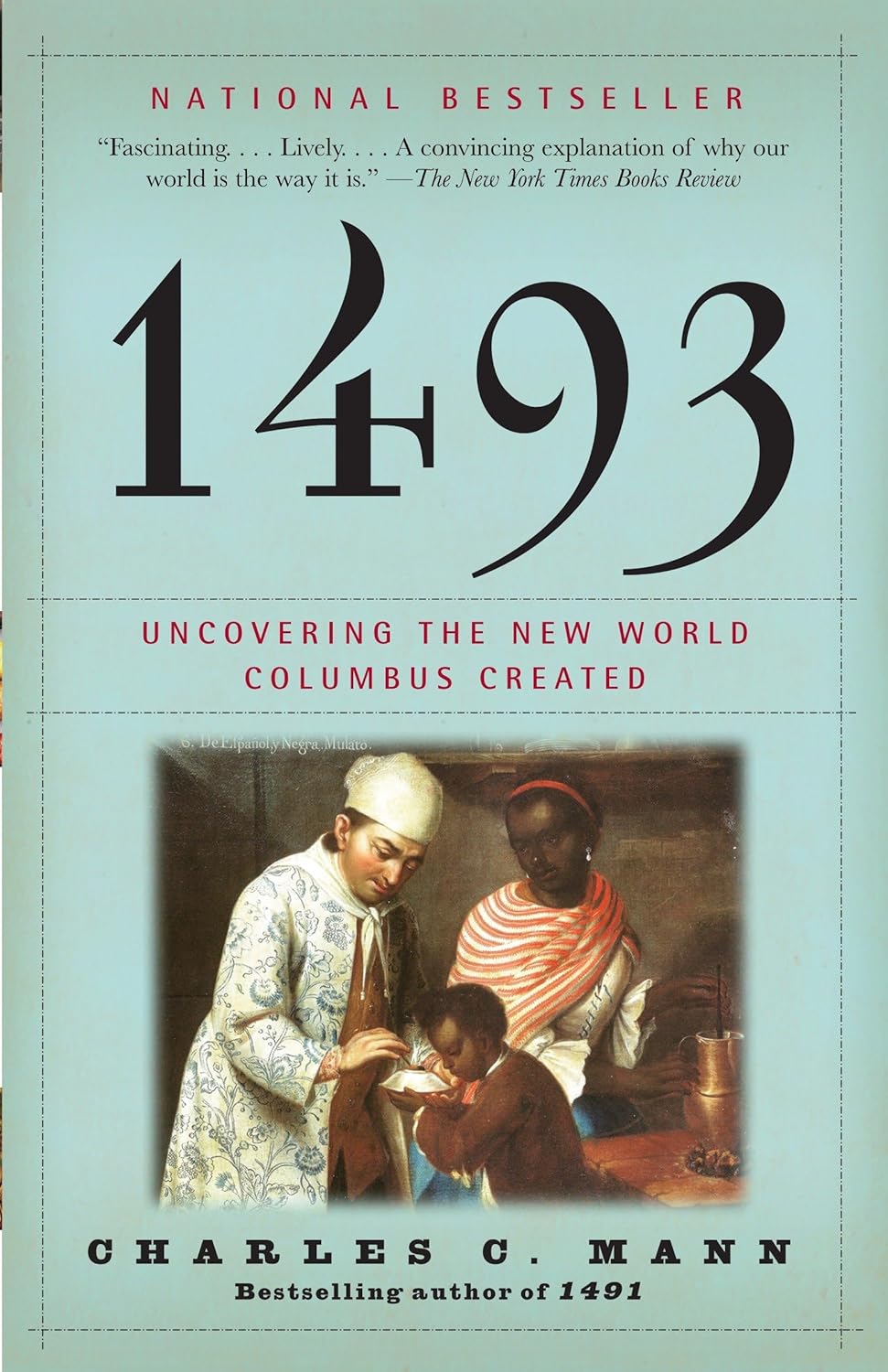
In 1493: Uncovering the New World Columbus Created (2011), Charles C. Mann examines how the voyages of Columbus set in motion one of the most transformative events in human history – the creation of the Homogocene, a truly globalized, borderless world. Building on the foundation of his earlier work 1491 (2005) and Arthur Crosby’s seminal The Columbian Exchange (1972), Mann traces the far-reaching consequences of the movement of plants, animals, diseases, people, and ideas across oceans, and how their intersections reshaped every continent, for better and worse. He develops several powerful themes, but especially focuses on the rise of a connected global economy – linking silver from the Americas to markets in China – and the ecological upheaval that accompanied it, as species and pathogens crossed oceans for the first time. The result is a sweeping and often illuminating narrative that reveals how the modern world was born from the collisions and connections of the sixteenth century.
Mann covers a lot of territory in this book of over 500 pages broken into four parts and ten chapters. However, I found four key insights and themes to be most compelling. The first is that the Columbian Exchange created the first truly globalized world.
Mann is no admirer of Christopher Columbus – whom he pointedly refers to by the name he used himself, Cristóbal Colón. Columbus, Mann writes, was “a cruel, deluded man … dominated by overweening personal ambition” whose arrival in 1492 proved “in every way a calamity for the Americas’ first inhabitants.” Yet, among the billions who have walked the earth over millennia, he alone inaugurated an entirely new era in the history of life. His voyage did not so much discover a New World as it inadvertently created one. The story of how that new world came into being is the overall macro subject of this remarkable book.
According to Mann, the two great pivot points in recent world history occurred in March 1493 and May 1570, each marking the inadvertent unification of previously distinct and completely separate worlds. The first European colony in the New World was founded during Columbus’s second voyage in 1493 – a small settlement on the north shore of Hispaniola called La Isabela. Though it was abandoned less than five years later, its long-term impact was earth-shaking. Mann argues that La Isabela marks the true beginning of globalization and the emergence of a new, universal global ecology he calls the Homogocene – “arguably the most important event since the death of the dinosaurs,” as he puts it. Instead of a meteor, however, this new epoch was ushered in by a “pathogenic cavalcade” that decimated the native populations of the Americas with stunning speed. By a quirk of evolutionary history, the New World had never known many of the Old World’s most lethal pathogens – smallpox, influenza, measles, hepatitis, encephalitis, viral pneumonia, along with bacterial killers such as tuberculosis, diphtheria, cholera, typhus, scarlet fever, and meningitis – and they tore through previously thriving societies. As Mann writes, “It was as if the suffering these diseases had caused in Eurasia over the past millennia were concentrated into a span of decades.”
Less than a century later, and nearly half a world away, another transformative “first” occurred: Miguel López de Legazpi founded the Spanish trading colony of Manila in the Philippines, establishing a permanent commercial link with China. “Legazpi [was] to economics what [Columbus] was to ecology,” Mann writes – the inadvertent architect of a new global unification. The second theme of 1493 is that global commodity booms – specifically tobacco, silver and sugar – reshaped nations and empires.
Europe and China each possessed an almost insatiable appetite for what the other produced: European silver for Chinese silk and porcelain. In the sixteenth century, China surpassed the West in nearly every meaningful measure – per capita income, life expectancy, agricultural productivity, and even military technology – but it lacked one crucial element: a large and stable money supply. Spanish silver filled that void; it became, in effect, the U.S. dollar of its day. No matter how tightly Spanish authorities tried to control the flow of New World silver in order to pay their spiraling debts, as much as half of the immense output from the Potosí mines still poured westward across the Pacific to China, often in smuggling operations.
Meanwhile, this flood of bullion unleashed a price revolution in Europe, where the cost of living doubled – and in some regions, tripled – by the late sixteenth century. Spain, awash in silver yet mired in debt, soon found itself financially crippled, with obligations fifteen times greater than its annual revenues and interest rates hovering around forty percent. Madrid defaulted five times between 1557 and 1627. Three other seemingly benign New World imports – tobacco, sweet potatoes, and corn – would soon produce their own surprising and far-reaching consequences.
Like La Isabela, Jamestown was established as a trading post in the New World. Unlike the failed Spanish settlement, which was sponsored and controlled by the crown, Jamestown was founded and operated by a group of seventeenth-century venture capitalists known as the Virginia Company. This English joint-stock company was born of necessity, first created in 1553, because the English Crown lacked the financial resources to fund risky overseas ventures and therefore outsourced the opportunity. By 1610, there were only ten such companies in all of England, most of which – like Roanoke – proved disastrous, falling victim to both hostile natives and Spanish attacks. Between 1607 and 1624, over 7,000 colonists were sent to Virginia, yet eighty percent perished. Still, the Virginia Company persisted, and the local Powhatan tribe allowed the settlement to survive. But why? Mann seems to suggest sunk costs kept pushing the investors to throw good money after bad.
To European colonists, the New World appeared completely virgin and undeveloped. Mann suggests this perception arose from a failure to understand how Indigenous peoples deliberately managed their ecosystems. Much of the difference stemmed from the lack of domesticated mammals. While many large mammals can be tamed – that is, lose their fear of humans – only a select few can be fully domesticated, meaning they can be easily bred in captivity. In all of human history, only about twenty-five mammals have been domesticated, and almost none are native to the Americas. Mann argues that this absence profoundly shaped Native American culture and technology. Without draft animals, labor and transportation relied entirely on human bodies, so travel and communication were slower and more limited, roads were smaller and fewer, pastures and plowed fields scarce, and battles fought primarily hand-to-hand. One consequence was the lack of formal property demarcation, which led Europeans to assume that Indigenous peoples had no concept of land ownership. To the English colonists, Mann writes, North America seemed a “random snarl of marshes, beaver ponds, unkempt fields, and hostile forest” – when in reality it was a carefully managed ecosystem, shaped through fire, multi-use plots, and sophisticated environmental stewardship.
In 1610, Jamestown colonist John Rolfe, husband of Pocahontas, brought tobacco seeds from Venezuela and Trinidad to Virginia. This modest act proved to be, as Mann writes, “the leading edge of the Columbian Exchange” and ignited “the first truly global commodity craze.” Tobacco was “fun, exciting, and wildly addictive,” and for the first time in human history people on every continent became captivated by the same novelty at virtually the same time. Mann likens Virginia tobacco to crack cocaine: just as crack was a cheaper, less refined form of powdered cocaine that dramatically expanded its user base, Virginia tobacco – though inferior to the Caribbean variety – was vastly more affordable, opening the market to a far broader population. Even at lower prices, Virginia planters were earning astonishing returns, sometimes as high as one thousand percent. Indentured laborers making £2 a year could produce up to £200 worth of tobacco.
Yet even this windfall could not offset the Virginia Company’s years of losses. Matters worsened dramatically on March 22, 1622, when the Powhatan launched what Mann describes as a “brutal, widespread, and well-planned” assault, killing an estimated 325 men, women, and children, with seven hundred more dying in the famine that followed. It is believed that two-thirds of Europeans in Virginia perished that year. The Virginia Company effectively collapsed with them; in May 1624, its charter was revoked by King James I after investors had sunk £200,000 into the ill-fated venture, an enormous sum for the time.
In the process, the success of English tobacco had two profound and far-reaching impacts on the New World. First, tobacco cultivation transformed the landscape. The crop rapidly depleted potassium and nitrogen from the soil, and the English made little effort to let fields recover. Clearing forests and plowing large tracts of land increased runoff, which in turn produced regular, devastating floods. Tobacco production was also enabled by an unintended consequence of the Columbian Exchange: the introduction of the common earthworm to the Americas. Its tunneling aerated the soil and increased water absorption, effectively turning over the upper foot of earth every decade or two. Mann further argues that European honeybees acted as an invasive ecological force, transforming plant communities, supporting the spread of European agriculture, disrupting native pollination networks, and helping Old World species – both plant and human – gain a foothold in the Americas. As Mann puts it, “Jamestown was the opening salvo, for English America, of the Columbian Exchange … bringing the Homogenocene to North America.”
Mann summarizes the environmental upheaval starkly: “Removing forest cover, blocking regrowth on fallow land, exhausting the soil, shutting down annual burning, unleashing big grazing and rooting animals, introducing earthworms and honeybees, and other alien invertebrates – the colonists so profoundly changed Tsenacomoco [the Powhatan name for the Virginia region] that it became harder and harder for its inhabitants to prosper there.” In effect, the colonists had refashioned the land into a facsimile of Europe.
The third macro-theme is that disease – especially mosquito-borne malaria and smallpox – transformed demography, labor systems, and colonization patterns.
Tobacco acted as a magnet that directly or indirectly pulled a host of other non-human creatures across the Atlantic. None were more consequential than malaria, which most researchers agree did not exist in the Americas until after 1492. Unlike the other major western viruses and bacteria that burned through Native American populations in deadly epidemics, malaria quickly became endemic – an ever-present, debilitating disease. Mann says that malaria – along with Yellow Fever, another mosquito-born disease – “turned the Americas upside down.” Africans proved to be significantly more resistant to the disease than either Europeans or Indians, which made them vastly more valuable as laborers on the cash-crop sugar and tobacco plantations. Thus, the ecological introduction of malaria and yellow fever directly shaped economic exchange, which in turn had long-lasting political implications.
There are two primary forms of malaria, Plasmodium vivax and Plasmodium falciparum, distinct parasite species that infect humans in markedly different ways. P. falciparum is the deadlier of the two but also more temperature-sensitive, unable to survive below 66°F. It infects red blood cells of all ages, multiplies explosively, and often causes severe, organ-damaging disease – particularly in sub-Saharan Africa, where it originated before being carried to the New World. P. vivax, by contrast, originated in Europe, arrived in the Americas with European colonists, and can survive at much cooler temperatures, even in the 50s. Although it causes milder illness, it employs a stealthier strategy: it leaves behind dormant liver forms, or hypnozoites, that can reactivate months or years later, triggering recurrent malaria. The exact timing of malaria’s arrival in the Americas remains uncertain, but Mann argues that the Virginia colonists’ clearing of forests for tobacco likely created ideal conditions for P. vivax to take hold and flourish.
Mann argues that malaria – especially the P. falciparum variety – played a direct role in the rise of chattel slavery in the New World. In the seventeenth century, indentured servants were generally far cheaper than enslaved Africans – roughly £10 for a servant contract versus £25 for a prime-age male slave. Moreover, enslaved people, for obvious reasons, had every incentive to flee, resist, or sabotage their captors, making them, in theory, less reliable and less productive laborers. By contrast, European indentured servants appeared to be the cheaper, more manageable, and less threatening option, a view echoed explicitly by Adam Smith in The Wealth of Nations. Early on, slavery was relatively uncommon in English America: Mann notes that as many as half of all Europeans who arrived between 1600 and 1650 came as indentured servants, and that by mid-century Virginia likely held no more than 300 enslaved Africans. But the situation shifted dramatically. Between 1680 and 1700, the enslaved population more than quintupled from roughly three thousand to sixteen thousand – a transformation Mann calls “a pivot in world history.” Several forces contributed: the ready availability of land made it difficult to keep indentured servants tied to farms; the English Civil War produced a population decline and rising real wages, reducing the supply of cheap indentured labor; and most crucially, Africans possessed far higher survival rates in the malarial environment of the New World than any other labor population.
Mann uses the short-lived Scottish colony of New Edinburgh to illustrate just how difficult it was for Europeans to survive and prosper in the New World. Founded on the coast of Panama in 1698, the colony began with over 1,200 settlers and a year’s worth of provisions spread across five ships. Within eight months, fewer than 300 colonists remained alive, and fewer than 100 ever made it back to Scotland. The financial losses were catastrophic, wiping out a significant share of Scotland’s investable capital. According to Mann, this disaster was one reason Scotland agreed to unify with England in 1707: London promised to reimburse the Scots for their ill-fated attempt at New World colonization.
In the early years of colonization, enslaved Indigenous people were considered the most cost-effective alternative to indentured servants and enslaved Africans. Indian captives could cost as little as £5 – half the price of an indentured servant contract and a fifth the cost of an African. The first census in the Carolinas, conducted in 1705, recorded four thousand Europeans, fifteen hundred enslaved Indians, and only 160 indentured servants. For its first four decades, the Carolinas functioned as a slave-exporting colony, purchasing between thirty and fifty thousand enslaved Indigenous people between 1670 and 1720, most of them sent to plantations in the Caribbean or Virginia. But this lucrative trade collapsed by 1715. Indigenous people proved as vulnerable to malaria and yellow fever as Europeans, forcing planters to seek a new, more resilient labor force.
They found it in West and Central Africans. Roughly 97 percent of people from this region are negative for the Duffy antigen, giving them inherited immunity to P. vivax malaria, and about half possessed resistance to P. falciparum. In the New World, Europeans died at rates three to ten times higher than Africans; even in the nineteenth century, half to two-thirds of British soldiers stationed in West Africa died annually, compared to mortality rates of only about three percent among Africans. Biologically, African captives were far more resistant to the region’s deadliest diseases – and, as Mann notes, “their immunity became a wellspring for their enslavement.”
“Slavery and falciparum thrived together … the slave trade took off, its sails filled with the winds of Plasmodium,” he writes. In North America, the geographic boundary where P. falciparum was endemic corresponded almost exactly to the Mason–Dixon Line of 1768. Mann labels this region “the Plasmodium Zone,” where annual malaria infection rates never fell below forty percent. Malaria likely prolonged the American Civil War and may have played a decisive role in undermining British campaigns during the American Revolution, including the crippling of Cornwallis’s forces at Yorktown. “Anopheles quadrimaculatus stands tall among the Founding Fathers,” Mann quips.
Yellow fever – known as “yellow jack” to the Europeans of the time – also came from Africa and would wipe out over half of the virgin European population exposed to it. It arrived relatively late in the New World – around 1647 – and was pronounced in the sugar colonies of the Caribbean. “Sugar plantations were like factories for producing yellow fever,” he says, and it was a lethal environment for those not immune (i.e. Europeans and Native Americans).
For millennia, China was the most advanced and sophisticated civilization on earth. Between 1405 and 1433, the Ming admiral Zheng He commanded the grandest fleet of the age – more than 300 ships, a force more than twice the size of the later Spanish Armada, with vessels far larger than anything Europe could launch. “Zheng’s armadas were a political triumph,” Mann writes, “scaring the wits out of every foreign leader who saw them.” Yet China’s extraordinary prowess had an unintended consequence: everywhere Zheng’s fleets traveled, they found no society technologically or administratively comparable to their own, only places that could offer natural resources the empire scarcely needed. The result was a deepening insularity. As Mann puts it, “the Chinese lacked range, focus, and above all, curiosity.”
The Ming dynasty (1368–1644) ultimately curtailed private maritime trade and turned inward, effectively sealing China off from the world until the nineteenth century. The imperial court had long feared that uncontrolled commerce would bring instability – and, ironically, Mann argues, they were right. When the Homogenocene finally washed ashore, the ecological upheaval it unleashed helped destabilize the empire, contributing to its collapse well before the rise of the modern West.
China was ultimately drawn into the Homogenocene because of its pressing need for a reliable money supply. For centuries, the empire minted bronze coins – cheap, undervalued, and required in such massive quantities that the system strained under its own weight. Mann likens it to a modern investment bank trying to pay for a multibillion-dollar acquisition with rolls of quarters. Paper money offered temporary relief but eventually triggered runaway inflation, leaving the world’s largest and most sophisticated economy without a functioning currency. Domestic copper and silver mines had long been exhausted; as Mann puts it, “the Ming government was at war with its own money supply.”
At almost the same historical moment – around 1550 – the world’s richest silver deposit was discovered high in the Andes at Potosí. Over the next two centuries, Potosí produced roughly 150,000 tons of nearly pure silver, an astonishing 80 percent of global output. The influx transformed the Spanish silver peso, the famed “piece of eight,” into the first truly global currency. For China, silver from the New World appeared to be the only solution to its chronic monetary instability. The need for that silver finally compelled the empire to open its borders to sustained trade with the outside world.
To facilitate the newly sanctioned silver-for-goods trade and inject desperately needed specie into the Chinese economy, Spanish authorities established a Chinese quarter – known as Parian – just outside Manila. It became the first Chinatown in the Western world. By 1591, barely twenty years after its founding, Parian’s population already dwarfed that of Manila itself. Chinese merchants were willing to pay twice the global price for silver, and although the Spanish tried to regulate exchange rates and restrict the trade, smuggling and contraband quickly proliferated. The crown needed silver from its American mines to finance troops and supplies for its seemingly endless wars, yet no matter the policy, too much silver flowed toward China while too much silk and porcelain flowed into Europe. Officials limited transpacific traffic to two ships per year, prompting the construction of ever-larger galleons – some reaching two thousand tons. But the profits from illicit trade overwhelmed any attempt at control.
Chinese textile production was so vast and efficient that Spanish manufacturers could not hope to compete; Chinese silk remained cheaper than domestic European alternatives even after crossing two oceans. Tensions between the Spanish in Manila and the Chinese in Parian frequently erupted into violence, sometimes killing hundreds and, on occasion, nearly half of the European population in the Philippines. Yet the trade endured. For Spain, Manila functioned both as a commercial hub and a projection of imperial power in the Pacific – two aims that often collided. Meanwhile, China’s growing reliance on imported silver for monetary stability pushed its political system toward crisis. In essence, China exported high-value goods to obtain silver mined elsewhere, but these reserves had to be constantly replenished – a fragile structure that could not hold indefinitely.
In addition to silver, European tobacco also swept into mainland China in what Mann describes as “an unplanned ecological invasion that shaped, for better or worse, modern China.” At the time, China held roughly 25 percent of the world’s population but only 8 percent of its arable land, making Chinese agriculture the most efficient on earth. Yet its two essential staple crops – wheat and rice – could not be grown on marginal terrain. Three crops from the Americas, however, could: maize, sweet potatoes, and tobacco. For nearly two millennia, China’s population had risen slowly and steadily. With the arrival of these hardy, calorie-rich imports, it surged. Mann cautions that the new crops alone did not cause China’s demographic explosion, but he emphasizes that the Columbian Exchange played a major, transformative role.
Tobacco demanded up to six times more fertilizer and twice as much labor as rice, yet it proved far more profitable. Growers used their earnings to purchase food from other regions of China or from abroad. Meanwhile, maize and sweet potatoes were planted wherever they could take root, spreading rapidly across the landscape. The environmental consequences were severe: widespread deforestation and soil erosion triggered an average of thirteen major floods each year – what Mann compares to “a Katrina every month.” These relentless floods brought equally relentless famine and unrest, while the cost of repairing the devastation drained the resources of the state. In the end, Mann argues, the combined pressures of American silver and American crops helped push the Qing dynasty to collapse.
The West experienced its own mix of prosperity and hardship from the Columbian Exchange. Native to the Andes – where more than two hundred wild potato species grow – the potato reached Europe not through this rich genetic inheritance but through a handful of tubers carried back by Spanish explorers. The result was a potato monoculture of striking genetic uniformity. Yet the impact was transformative. In caloric terms, the potato effectively doubled Europe’s food supply. It was simple to cultivate, reached maturity in just three months, and could be harvested in August – before unpredictable autumn weather threatened other crops. Much as sweet potatoes and maize had helped drive China’s population boom, the potato did the same for Europe, not by increasing birthrates but by ensuring that more children survived to adulthood. Some historians have even argued that the potato helped fuel the rise of the West, its introduction as pivotal to the modern era as the invention of the steam engine.
A major reason the crop initially flourished was the simultaneous arrival of nitrogen-rich fertilizer harvested from the fifteen-story mountains of ancient seabird guano piled across the Chincha Islands, five hundred miles south of Lima. The 147 guano islands contained a natural fertilizer nearly twenty percent pure nitrogen, and exports surged almost overnight – from fewer than 2,000 tons in 1841 to 220,000 tons just four years later. Over the next four decades, thirteen million tons of guano – most of it bound for Europe – helped drive the rise of high-yield, input-intensive agriculture. In 1856, the U.S. Congress passed the Guano Islands Act, allowing American citizens to seize any guano-covered island they discovered; by 1903, nearly one hundred islands and atolls had been claimed under its authority. Mann argues that this era marked the world’s first Green Revolution, as heavily fertilized potato and maize crops lifted living standards across Europe and the United States. The global population, roughly one billion in 1700, climbed to seven billion by 2000.
Yet the same intercontinental guano trade that propelled modern agriculture also ferried exotic pests across oceans, including potato blight – a disease that ravaged Europe’s genetically narrow potato crop. First reported in Ireland in 1845, only a few years after guano shipments began arriving, the blight devastated the country; Ireland would not regain its pre-famine population for nearly two centuries. The late nineteenth century became an era of insect plagues: the boll weevil ravaged southern cotton, the cottony cushion scale attacked California citrus, the elm leaf beetle defoliated elms, and phylloxera destroyed vineyards.
Another striking example of the Columbian Exchange reshaping an ecosystem is the rubber tree, which before 1492 grew nowhere outside the Amazon basin. The Spanish didn’t even have a word for “bounce” until a troupe of Indigenous athletes arrived in Europe in the 1520s with their springy rubber balls. Yet it took centuries for rubber to find a meaningful place in the Western economy. Rubber galoshes appeared in the 1820s, but the material was prone to melting in warm weather and did not become broadly useful until vulcanization – discovered almost simultaneously in 1844 by Charles Goodyear in the United States and Thomas Hancock in England – transformed it into a durable, versatile industrial input. Mann calls this breakthrough “profound.”
The resulting rubber boom was almost without precedent. In the nineteenth century, Brazil became the world capital of rubber, with the coastal city of Belém – closer to Lisbon than to Rio de Janeiro – serving as its financial hub, and the inland outpost of Manaus emerging as the bustling center of collection and trade. Brazil’s rubber exports increased tenfold between 1856 and 1896, then quadrupled again by 1912. Even with this dramatic surge in supply, prices continued to climb: rubber tripled in price in London between 1870 and 1910, and an ounce of prepared rubber became as valuable as an ounce of silver.
Brazil’s dominance, however, was short-lived. In 1876 an English entrepreneur named Henry Wickham smuggled thousands of rubber tree seeds out of the country. By 1897, Malaysia and Sri Lanka had only about 1,000 acres of rubber plantations; by the start of World War I, they had 650,000. By 1950, 95 percent of the world’s rubber came from Asia. Today, none of Brazil’s top four agricultural exports – beef, soybeans, sugar, and coffee – are native to the Americas. The rubber trees in Asia, however, are mostly clones of the original trees brought in by Wickham and thus, like the European potato, highly vulnerable to a catastrophic disease.
Rubber, essential for insulating electrical wiring and powering machines with flexible belts, became one of the three foundational materials of the Second Industrial Revolution, alongside steel and fossil fuels. Yet the science behind its remarkable properties remained obscure until 1953, when Swiss chemist Hermann Staudinger won the Nobel Prize for showing that rubber – and many other materials – is composed of long, chainlike molecules known as polymers. Once scientists accepted the existence of such large molecules, they could design new materials with unprecedented intention and precision, laying the groundwork for modern materials science. Even today, no synthetic substitute matches natural rubber in its resistance to fatigue and vibration, and natural rubber still accounts for roughly forty percent of global consumption.
The final theme is that Africans played an outsized role in the shaping of the Americas – not just as labor, but also as ecological and cultural agents.
“Slavery was the foundational institution of the modern Americas,” he writes, underscoring the vast forced migration of Africans to the New World, a movement that powered the plantation economy and created a distinctive cultural synthesis. Between 1500 and 1840, nearly twelve million captive Africans were transported to the Americas, compared with fewer than three and a half million voluntary European migrants. In effect, Mann argues, “America was an extension of Africa rather than Europe until late in the nineteenth century.” He also emphasizes that Africans themselves controlled the supply of enslaved people. Their role in the trade, he insists, was not that of “hapless pawns,” but of participants in a system in which slavery was “part of the furniture of everyday life” in both Europe and Africa. In much of Africa, labor – not land – was the primary form of property, and land could be controlled only by controlling the people who worked it.
Mann further contends that African demand for slaves was as significant as European demand in driving the trade. “African merchants bought slaves from African armies, raiders, and pirates,” he writes, “and paid Africans to convey them to African-run holding tanks. Once a contract was arranged, Africans loaded captives onto slave ships, whose crews often included a substantial number of Africans. Other Africans provisioned the vessels with food, water, rope, and timber.”
Sugar is the archetypal plantation crop: a labor-intensive monoculture grown on vast tracts of land near a port or river, supported by an industrial processing facility and a large, permanent labor force. Once refined, it can be packaged easily and shipped long distances without spoiling. The Portuguese-controlled island of Madeira was the first major sugarcane plantation zone, introducing the crop in the 1440s; between 1472 and 1493, Mann notes, production there increased a thousand percent. On Madeira, he writes, “Iberian slavery was transformed,” as plantation agriculture fused with African slavery for the first time. In 1486, Portugal colonized São Tomé and Príncipe in the Gulf of Guinea. Unlike Madeira, these islands were rife with malaria and yellow fever; within a century only a few hundred Europeans lived there alongside tens of thousands of enslaved Africans. São Tomé alone eventually produced four times as much sugar as Madeira. “São Tomé and Príncipe were the progenitors of the extractive state,” Mann observes. Yet by the 1560s, the rise of large plantations in Brazil pushed the African islands out of the global sugar market. Madeira shifted to winemaking – an industry ill-suited to plantation organization – while São Tomé limped on with sugar and endured slave revolts for much of its history.
Between 1550 and 1600, sugar production soared even as prices tripled. In those same decades, an estimated 650,000 enslaved Africans were transported to the Americas to labor on the expanding sugar plantations of the Caribbean, Mexico, and Brazil. Their numbers more than doubled those of European arrivals. “By the seventeenth century,” Mann writes, “Africans were everywhere in the Spanish world,” comprising fully half the population of Lima and outnumbering Europeans seven to one on the Central American isthmus by 1565. A hybrid culture was rapidly taking shape. The Spanish eventually attempted to regulate it through the elaborate casta system – a dizzying taxonomy of racial classifications. At its apex stood the peninsulares, Spaniards born in Spain who dominated the ranks of governors, bishops, and high officials. Just below them were the creoles, Spaniards born in the Americas, still wealthy and powerful but a step down in status. Indios, the Indigenous peoples of the Americas, were theoretically protected by law yet remained socially and economically subordinate, often bound to tribute and labor obligations. Negros, enslaved or free people of African descent, formed the lowest rung of the hierarchy in most colonial settings, especially in the early period.
Intermixing among these groups gave rise to dozens of sub-categories: mestizo (Spanish + Indio), mulatto (Spanish + Negro), zambo or lobo (Negro + Indio), castizo (Spanish + Mestizo), morisco (Spanish + Mulatto), coyote (Mestizo + Indio), chino (Asian migrant), maroon (escaped African slave turned pirate), cambiguo, albarazado, and many more – each attempting to capture the complexities of a society in flux.
In closing, 1493 stands as a sweeping and illuminating account of how the Columbian Exchange reshaped the world in ways both transformative and irreversible. Mann shows that the modern era – its global markets, ecological upheavals, population booms, and enduring inequalities – was built not by a single “discovery,” but by the ceaseless circulation of plants, animals, microbes, and peoples across continents. He traces how tobacco and silver bound economies together, how malaria and yellow fever directed the course of empires, and how the forced migration of millions of Africans created new societies even as it entrenched systems of brutal exploitation. Again and again, Mann reveals that globalization is not a recent innovation but the defining engine of the last five centuries – creative and destructive in equal measure. 1493 ultimately leaves the reader with a humbling recognition: the world we inhabit is the product of countless entangled exchanges, many accidental, some catastrophic, and all profoundly shaping the human story.
 What's Tim Reading Now?
Leave a comment