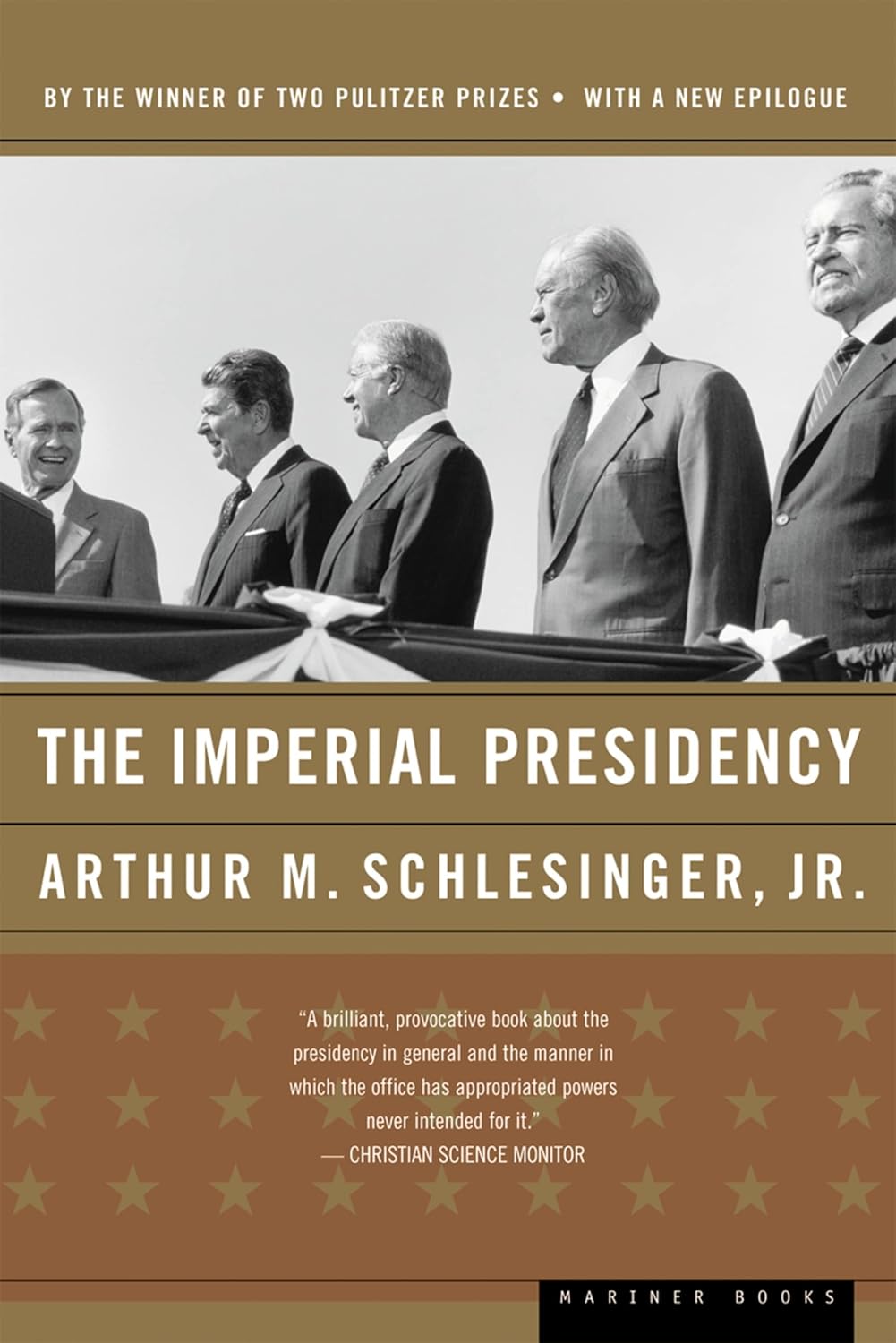
Arthur Schlesinger Jr. is one of the most celebrated American historians of the twentieth century, having won two Pulitzer Prizes while teaching at Harvard for several decades. He also had significant and relevant experience in government, first as an intelligence officer in the Office of Strategic Services during World War II and later as a White House aide in the Kennedy administration. In this way, he is a rare historian who combines the perspective of both the trenches and the Ivory Tower.
The Imperial Presidency was written in the early 1970s when the country was wracked by the twin crises of Vietnam and Watergate. At times the book shows its age. The book is a serious analysis of the constitutional separation of powers that sometimes shades into a jeremiad against the Nixon administration. The objective reader needs to possess some patience and forbearance to tease out the important points and main insights. Here are the central themes that I took away from The Imperial Presidency.
First, the separation of powers is a distinct and fundamental part of American government. European kings possessed the right to both declare and make war, along with the ability to both raise funds and raise armies. The Founding Fathers were determined to separate those war powers. “They vested in Congress the authority to commence and authorize war,” Schlesinger writes, “whether that war be declared or undeclared. At the same time they vested in the Presidency the conduct both of ongoing foreign relations and ongoing war as well as the right to respond to sudden attack when Congress was not in session. The division of powers was inherently unstable,” he says. Schlesinger’s central point is that the presidency can be said to have become “imperial” when that constitutional balance is upset in favor of presidential power and at the expense of presidential accountability.
For most of American history, the author says, things worked more or less as intended. The United States has only declared war five times in over two hundred years: War of 1812, Mexican American War, Spanish American War, World War I, World War II. Instances of unilateral military action conducted by the American president was relatively rare. “The imperial Presidency began with the first Roosevelt and was nourished by the second Roosevelt. It burst into full splendor in the days after the Second World War.” The root cause of the imperial Presidency, according to Schlesinger, was the messianic U.S. foreign policy adopted at the beginning of the Cold War, a fundamentally new policy based on “the delusion that America has been charged by the Almighty with a global mission to redeem fallen humanity,” according to the author. Simply put, “It is hard to reconcile the separation of powers with a foreign policy driven by an indignant ideology and disposed to intervene unilaterally and secretly everywhere around the planet.”
This growth in presidential power was driven by the somewhat ambiguous nature of the Constitution along with implied executive rights during crisis situations. The solemn presidential oath calls for the executive to “preserve, protect, and defend the Constitution of the United States.” “Taken literally,” Schlesinger writes, “this could be seen both as a mighty obligation and as a mighty mandate.” Moreover, he concedes that there are a host of legitimate arguments in favor of presidential supremacy in foreign policy: unity, secrecy, superior expertise, superior sources of information, decision, and dispatch. These arguments in favor of executive supremacy are superficially valid but highly overblown, he says, at least in non-crisis situations, which he claims is most of the time.
Schlesinger argues that much presidential executive power is derived from the doctrine of emergency prerogative as expressed in John Locke’s Second Treatise on Civil Government. “Locke had said in essence, not that emergency created power,” Schlesinger writes, “but that authentic emergency created exceptions.” The trouble, it seems, is that America in the latter half of the twentieth century was beset by foreign policy emergencies. However, in Schlesinger’s estimation, there have only been three genuine crises in American history that have warranted unilateral executive emergency action: the Civil War, World War II, and possibly the Cuban Missile Crisis.
The power of the presidency has grown tremendously over the second half of the twentieth century. “The vital difference between the early republic and the imperial Presidency,” he writes, “resides not in what Presidents did but in what Presidents believed they had the inherent right to do.” And this notion of presidential power is both accelerating and expanding. For instance, he says that Roosevelt’s controversial Lend-Lease actions in 1940 wouldn’t have raised anyone’s eyebrows a mere decade later. Meanwhile, presidential power is expanding behind the shield of executive privilege. Schlesinger writes that “executive privilege” has the advantage of sounding like a very old term and has “acquired the patina of ancient and hallowed doctrine.” In fact, the term is of rather modern vintage, first gaining currency in the Eisenhower administration. “What had been for a century and a half sporadic executive practice employed in very unusual circumstances was now in a brief decade hypostatized into sacred constitutional principle,” he writes.
These powers came to full form under Johnson and then were extended to truly criminal heights under Nixon, who dramatically extended presidential power into domestic affairs by an unprecedented use of the pocket veto and the introduction of impoundment (invalidating Congressional legislation by refusing to spend officially allocated resources). “Johnson and Nixon had surpassed all their predecessors in claiming that inherent and exclusive presidential authority, unaccompanied by emergencies threatening the life of the nation, unaccompanied by the authorization of Congress or the blessing of an international organization, permitted a President to order troops into battle at the his unilateral pleasure.”
By the early 1970s, Schlesinger says, the official and implied powers of the American president had reached terrifying dimensions. “Certainly Brezhnev in the Soviet Union, even probably Mao Tse-tung in China,” Schlesinger says, “had to consult more people and secure more institutional clearances before sending armies into battle” than had Johnson or Nixon in Vietnam. It’s a shocking claim and likely accurate.
In the wake of Vietnam and Watergate, Congress and the American people recognized that something needed to be done. “The events of the sixties had exploded the notion of presidential infallibility, as the events of the thirties had ended the idea that Congress knew best.” The chief result was the War Powers Act of 1973, which Schlesinger coldly dismisses as nothing but “toy handcuffs,” a “pretentious and ill-considered measure” that essentially amounts to “an undated, 90-day declaration of war.” In fact, the Act gives something to the president he hadn’t possessed before: statutory authority to begin wars without congressional consent. “Before the passage of the resolution, unilateral presidential war was a matter of usurpation,” Schlesinger writes. “Now, at least for the first ninety days, it was a matter of law.”
So what is to be done? Unfortunately, Schlesinger writes 500-pages but doesn’t offer up any promising solutions. In fact, his specific recommendations as listed in his lengthy (80 pages) epilogue written in 1989 are so unimaginative and obvious they’re almost comical: “Secularize the Presidency (whatever that means), elect Presidents who understand their business (Um, OK), cut the White House staff in half (literally?), revitalize the system of accountability (how exactly?) – and forever seek serious solutions to substantive problems (oh, that’s what we should be doing?).”
The simple fact of the matter is times have changed and it has to do with more than just the Cold War foreign policy of containment. The United States Constitution – drafted in Philadelphia in 1787 when America was a small, isolated nation of perhaps 4 million white farmers and half a million black slaves – has remained virtually unchanged after two hundred years, even after America had morphed into a world-girdling industrial empire of over 300 million widely diverse people.
Alexis Tocqueville observed, “It is chiefly in its foreign relations that the executive power of a nation finds occasion to exert its skill and its strength.” However, in 1830 when he wrote Democracy in America, “the President of the United States possesses almost royal prerogatives which he has no opportunity of exercising.” As we have seen, that has changed dramatically. “The presumed requirements of a global and messianic foreign policy had thus begun to swallow up the congressional power to oversee international agreements as well as the congressional power to send armed forces into battle against sovereign states.” Over the years, Schlesinger concedes that this growth in power was as much a matter of congressional abdication as of presidential usurpation. Simply put, “This vision of the American role in the world unbalanced and overwhelmed the Constitution.” The problem of chronic executive overreach is, it seems, likely insoluble without a major restructuring of the United States Constitution.
 What's Tim Reading Now?
Leave a comment