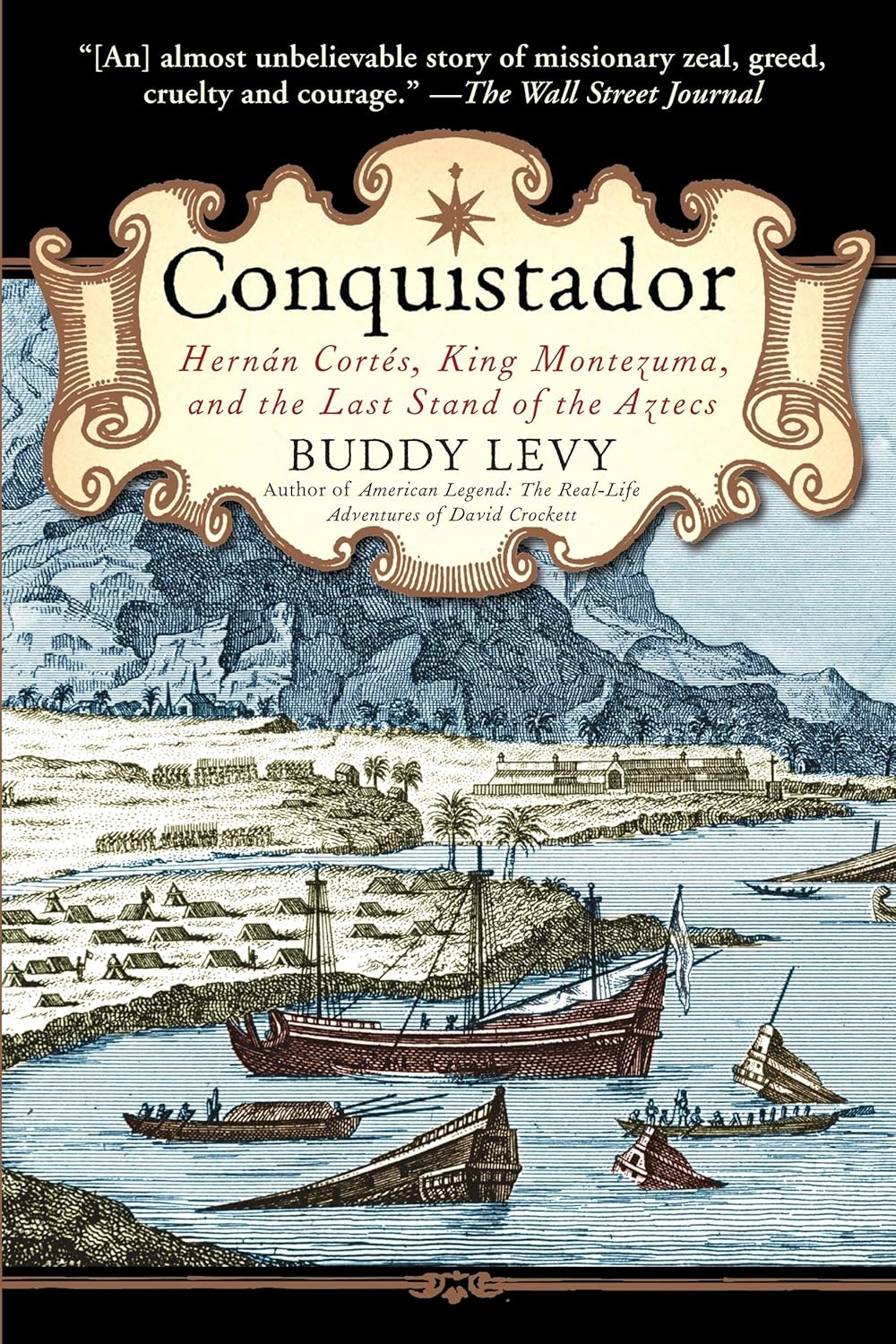
“Conquistador: Hernán Cortés, King Montezuma, and the Last Stand of the Aztecs” (2008) by Buddy Levy may seem an unlikely work from an English professor at Washington State University, yet it delivers with striking success. Levy brings to life one of the most astonishing and tragic episodes in world history – the Spanish conquest of the Aztec Empire from 1519 to 1521 – crafting a page-turning narrative as gripping and unpredictable as Game of Thrones.
The book opens in 1519 with Hernán Cortés landing on the coast of Mexico, just a few years after the first doomed Spanish encounters with Mesoamerica – a moment that would prove pivotal in the age of exploration. At 34, Cortés was a Spanish nobleman of modest means but boundless ambition: charismatic, cunning, and driven by both religious zeal and personal glory. In Levy’s telling, he is a man willing to defy kings, burn ships, and manipulate allies to secure his place in history. Appointed to lead an expedition to explore the Mexican mainland, he instead defied the orders of Cuban governor Diego Velázquez and launched an unauthorized campaign of conquest.
Fueled by ambition, steel, a hunger for gold, and Christian fervor, the Spanish quickly overran the vast and sophisticated civilization of the Mexica (commonly known as the Aztecs) – a society of immense wealth and ritualized violence centered on the magnificent floating city of Tenochtitlán. Their distant and enigmatic ruler, Montezuma II – part man, part general, part president, part god – longed for nothing more than to see the foreign invaders gone.
Cortés first made contact at the modern-day resort island of Cozumel before landing on the mainland at present-day Tabasco. On June 28, 1519, he founded Vera Cruz, the first colony in New Spain. As Levy notes, Cortés was “always thorough, especially concerning legal matters,” and he swiftly severed ties with the Cuban governor, Diego Velázquez, sending word to King Charles that he would conquer the Aztec Empire in the monarch’s name—hoping that victory would absolve any reported sins or disobedience. He then famously burned the ships that had brought his men to Mexico. “He had staked everything, his very life and [his crew’s], on the future,” Levy writes, marking it as the first in a series of bold psychological gambits – aimed as much at his own troops as at his enemies. At the same time, Cortés began forging crucial alliances with indigenous foes of the Aztecs, notably the Totonacs and, later, the formidable Tlaxcalans.
Crucially, Cortés landed in Mexico in the very year that Quetzalcoatl—a feathered serpent deity revered as the god of wind, learning, and creation – was prophesied to return, a coincidence that worked greatly to his advantage. Montezuma spoke of a prediction “that men would come from the direction of the sunrise to rule these lands, and that the rule and domination of Mexico would come to an end.” To many, these pale-skinned, bearded strangers on horseback – wielding fantastic weapons that roared like thunder and could slice a man’s arm off with one swipe – seemed the fulfillment of that prophecy. Yet rather than surrendering outright to superstition, Levy portrays Montezuma as a shrewd and politically cautious ruler, constrained by prophecy, factional rivalries, and deep uncertainty over how to confront an unprecedented threat.
As the Spaniards marched inland, Cortés relied heavily on two translators: Jerónimo de Aguilar (his Squanto) and the native woman Malinche (his Sacagawea). Together, they proved indispensable in the diplomatic negotiations that would, in many ways, shape the fate of the New World. Levy draws on their presence to give the campaign a vivid, ground-level perspective, relying especially on the memoir of Bernal Díaz del Castillo – a foot soldier whose firsthand account remains one of the most important sources for historians of the conquest.
The hardened conquistadors were stunned by profound culture shock. They encountered an array of unfamiliar – and to them, horrifying – rituals, including brutal violence against women and children. Most shocking was the scale and significance of human sacrifice across the Yucatán. Levy emphasizes that sacrifice was not sport or spectacle, but a central pillar of Mesoamerican life – “a requirement, needed to live, like air or water, needed for the continuation of the world.” Cortés, by contrast, is portrayed as “authentically, deeply religious,” determined to become “the first man to sow the seeds of Christianity on the soil of the Americas.” Levy’s account captures the jarring collision of two worlds whose values, beliefs, and cosmologies could not have been further apart.
If Cortés is the protagonist of this saga, Emperor Montezuma II is its most enigmatic – and at times pathetic – figure. Levy depicts him as a ruler trapped in both spiritual and political turmoil, incapable of decisive action. As tlatoani (Great Speaker) of the Aztec Empire, Montezuma commanded vast armies and ruled a tribute-based empire with a blend of brutality and divine authority. “At the height of Montezuma’s rule,” Levy writes, “he was the supreme warlord of the most powerful military machine in the Americas, with effective dominion over fifteen million people.” Yet many of those subjects chafed under oppressive taxes and the forced taking of children and young women for human sacrifice. For them, Cortés and his small band of seemingly invincible marauders became an unlikely hope for liberation from Aztec rule.
The Aztec Empire was, in fact, a Triple Alliance – a NATO-like pact between three great lacustrine cities: Texcoco, Tacuba, and, most importantly, Tenochtitlan, which by 1500 boasted a population far larger than either Paris or Peking. At its heart rose the Great Pyramid of Quetzalcoatl, the largest freestanding man-made structure in the world, twice the length of Egypt’s Great Pyramid of Cheops. The Spanish were awestruck by the city’s architecture and craftsmanship. Aztec jewelry, more intricate than anything seen in Europe, dazzled them – though few pieces survive, as most were melted down for their gold and silver. To the Aztecs, however, jade and quetzal feathers were more precious than any metal, and Montezuma even offered the Spaniards all the gold they could carry if they would only depart.
Cortés called Tenochtitlan “the city of dreams,” describing the enchanted metropolis on its lake as “the most beautiful thing in the world.” On November 8, 1519 – just nine months after sailing from Cuba – he reached its gates, some 250 road miles from the coast. Montezuma’s eventual decision to allow the Spaniards into the heart of his capital, even housing them in a palace near the sacred precinct, proved catastrophic. What follows was one of the most astonishing acts of audacity in history. “Deviously and deceitfully,” Levy writes, “Cortés played on Montezuma’s trust, generosity, and hospitality.” Fearing a plot against him and desiring control, Cortés took Montezuma hostage in his own palace. Cortés skilfully exploited the political cleavages among the native tribes and their relationship to the Aztec at Tenochtitlan. His “brazen, bloodless coup was perhaps the most astonishing takeover in the annals of military history.”
Meanwhile, Spanish reinforcements under Pánfilo de Narváez arrived with orders to arrest Cortés for insubordination. In a masterstroke of tactical brilliance, Cortés slipped out of Tenochtitlán under cover of secrecy, swiftly defeated Narváez’s larger force, and persuaded most of his men to join him. His army now swelled to roughly thirteen hundred soldiers, including nearly one hundred cavalry – virtually unstoppable against the Aztecs on open, flat ground. Levy describes the Spanish horsemen as “a killing machine.”
While Cortés was away battling his own countrymen on the coast, disaster struck Tenochtitlán: the senseless and brutal Massacre in the Great Temple. Fearing an imminent uprising, Cortés’s lieutenant in the capital, Pedro de Alvarado, launched a preemptive assault during a religious festival, slaughtering hundreds of unarmed prestigious Aztec nobles. The city erupted in fury. Levy calls the attack “an act of barbarity, defying all protocols of proper warfare,” one that had “devastating and irreparable consequences” and shattered Montezuma’s public authority. Once revered as a god on earth, the emperor was left “imprisoned, withered and enchained, bereft of dignity.” On June 30, 1520, he died from injuries inflicted by his own people who were attacking the Spanish. Montezuma had grievously misjudged the conquistadors, believing that his immense wealth and power would overawe and intimidate them. Instead, it only inflamed their greed and ambition.
The Aztec rebellion was fierce and relentless. On July 1, 1520 – later called La Noche Triste (The Night of Sorrows) – Cortés and his conquistadors were nearly annihilated as they attempted to flee Tenochtitlán along the narrow causeway linking the city to the mainland. Nearly six hundred Spaniards—half of the entire force, including almost all the Narváez reinforcements—perished, along with some four thousand Tlaxcalan allies. Many survivors were captured and sacrificed atop Tenochtitlán’s pyramid temples, while nearly all their gunpowder and the treasure looted from Montezuma’s vaults sank to the bottom of Lake Texcoco, lost forever. Yet Levy calls Cortés’s daring escape one of his “greatest military achievements.” He survived to fight another day.
Then came what Levy calls “perhaps the greatest and most destructive irony in the history of the Spanish conquest.” An African porter who accompanied the Narváez forces sent to capture or kill Cortés carried an active case of smallpox. The disease arrived in Tenochtitlán just as Cortés and his battered forces limped away, spending seventy days recovering. In less than three months, as much as half of the Aztec population perished. Smallpox devastated the Aztecs both physically and psychologically: the Spanish appeared immune to the deadly plague, reinforcing their reputation as superhuman – more gods than men. Moreover, the smallpox epidemic gave Cortés time to regroup and formulate a plan, a strategy so “overly ambitious,” Levy says, “some might even say that it was insane.”
Levy is positively rapturous about Cortés’s audacious plan to retake Tenochtitlán. The Spanish intended to construct thirteen three-masted brigantines, each fifty feet long and carrying up to thirty men, transport their disassembled parts some fifty miles over the mountains using ten thousand native porters in a caravan over five miles long, and then reassemble the ships on the shores of Lake Texcoco. Their indigenous allies dug a mile-long canal, twelve feet deep and twelve feet wide, to safely launch the warships. The Spanish fleet then blockaded the floating city in a naval siege, cutting off supplies of fresh water and food. Levy exclaims that the operation “ranks among the most astounding achievements in military history: ingenious, audacious, unprecedented, unequaled.” The true hero may have been the Spanish boatbuilder Martín López. The campaign remains “among the largest landlocked naval operations ever conducted in the history of warfare,” with the amphibious assault on the two-hundred-year-old city described as “a stupendous spectacle and something of a military miracle.”
Cortés now faced a new Aztec emperor, Montezuma’s 25-year-old nephew Cuauhtémoc, who took a hardline stance against any accommodation with the Spanish or Christianity, ensuring the siege would be existential and zero-sum. Alliances with indigenous groups hostile to the Aztecs were central to Cortés’s strategy. Levy describes him as a “consummate gambler,” adept at using “guile and bravado and misinformation and politics” to co-opt native armies in his campaign. Without the thousands of auxiliaries these allies provided – as infantry, messengers, and porters – the Spanish effort would have been hopeless. By the time Tenochtitlán fell on August 13, 1521, Cortés commanded upwards of 150,000 native allies. Levy calls the final defeat of the Aztecs – the bloody siege of Tenochtitlán – “the longest and costliest single battle in history, with estimated casualties of 200,000 human lives.”
Cortés, a minor noble who landed in Mexico in 1519 without authority or royal sanction, by the end of 1521 he had emerged as the supreme ruler of New Spain and much of Central America. “For nearly three years,” Levy writes, “he had operated independently, a free agent in a foreign land, with absolutely no justification or sanction from his government, either in the West Indies or across the Atlantic.” Yet nothing succeeds like success. Mexico represented the largest acquisition of land and treasure ever secured for the Spanish empire by a single individual up to that time. In 1523, Cortés’s extraordinary risks and achievements were formally recognized: he was named captain-general of Mexico and chief justice of New Spain – an event Levy calls “the highlight of his life.” He had proved, decisively, that it is often better to ask forgiveness than permission.
“Conquistador” does not make radical historical claims, but it subtly reorients familiar narratives, arguing that the conflict was as much a native civil war as a European invasion. Levy handles a complex, multi-ethnic, multi-perspective story with care, clarity, and sensitivity, humanizing both sides without casting the Spaniards as purely odious or the Aztecs as faultless. He acknowledges that Cortés was “a rogue, a rebel, a pirate,” while also highlighting him as a “military, tactical, and political genius.” The author challenges simplistic myths of Spanish superiority and Aztec fatalism, emphasizing the fragile contingencies of history: the Spanish were few, often desperate, and heavily reliant on indigenous allies who saw them as the lesser of two evils. This nuanced, balanced approach stands out in a field too often swayed by ideological extremes.
In closing, for readers unfamiliar with the conquest of Mexico – as I was before reading “Conquistador” – Levy provides a compelling and accessible entry point. For those already acquainted with the basic history, his focus on character, motivation, and atmosphere brings fresh emotional depth. While the book may not radically reshape the scholarly landscape, it remains a gripping and deeply resonant account of one of history’s most profound and tragic encounters.
 What's Tim Reading Now?
Leave a comment