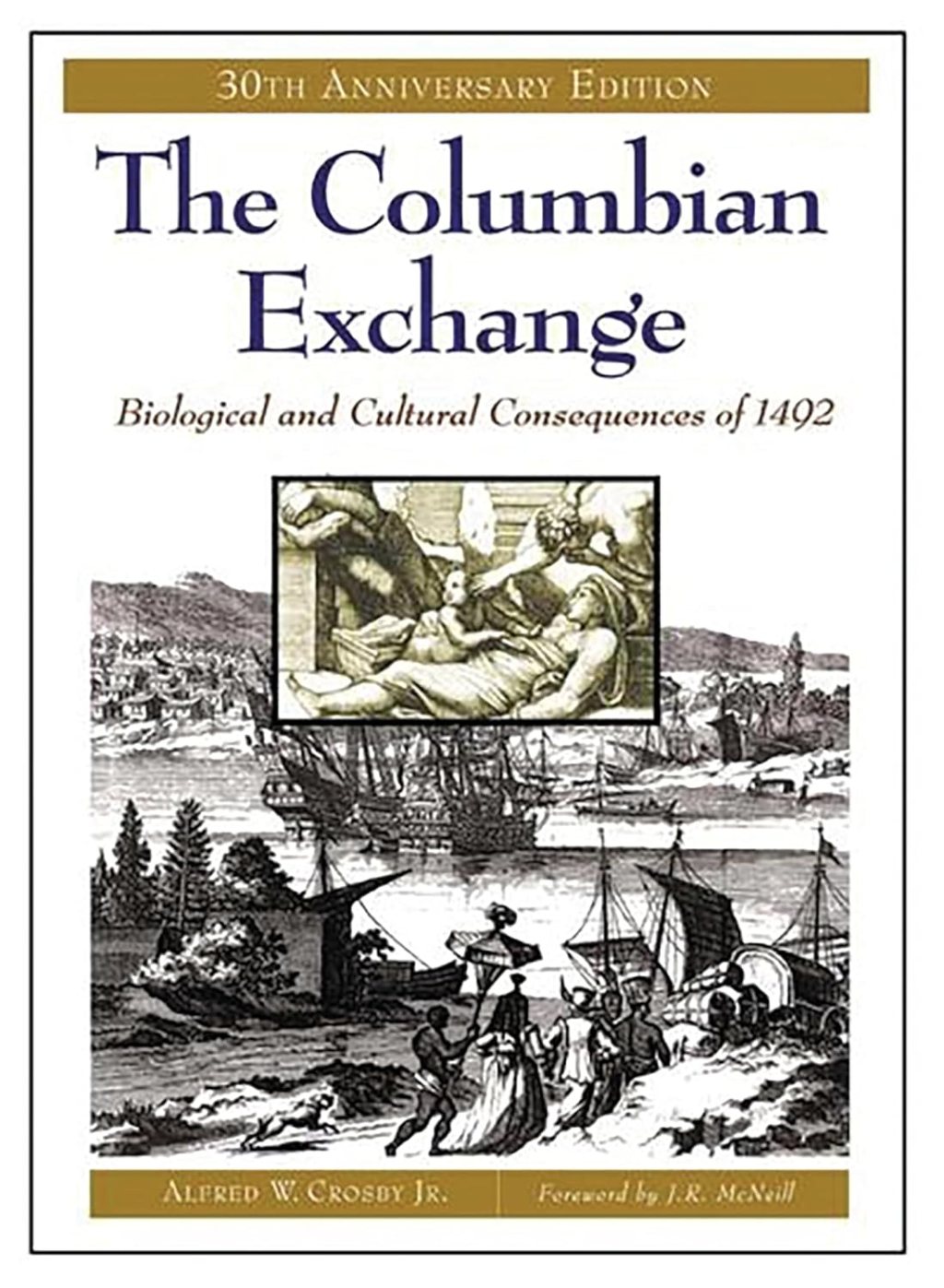
Arthur Crosby’s unassuming little book “The Columbian Exchange: Biological and Cultural Consequences of 1492” (1972) is actually one of the most important works of historical scholarship of the twentieth century. It launched a field of study, altered a paradigm, and continues to shape the way we think about global history. It ultimately spawned a Pulitzer Prize-winner (“Guns, Germs, and Steel”) and multiple national bestsellers (“1491” and “1493”). At a time when most historical narratives about the Age of Exploration were still written in heroic or nationalistic tones, Crosby offered something radically different: a deeply ecological, transcontinental view of the consequences of 1492, focusing not on explorers or empires but on plants, animals, germs, and soils. What he described was not just the political conquest of the New World by Europe, but a vast, ongoing biological event – one that essentially reconfigured the entire globe, in some ways horrible (the near extermination of Native Americans) and other ways positive (calorie-rich New World horticulture helped propel human population and society to new heights).
Crosby’s central argument was as deceptively simple as it was transformative: the most enduring legacy of Christopher Columbus’s voyages was not Spanish gold or European colonies, but the transfer of living organisms back-and-forth between the Old and New Worlds. These transfers – of crops, diseases, animals, and even weeds – created a truly global ecological system for the first time in human history. The exchange was unintentional, unbalanced, and often devastating. And it was irreversible. Indeed, Crosby says that the “trend toward biological homogeneity is one of the most important aspects of the history of life on this planet since the retreat of the continental glaciers.”
To make this case, Crosby lays out a wide array of evidence that stretches across disciplines – botany, zoology, epidemiology, demography, and history. He was a historian writing in an age before “interdisciplinary” was a fashionable term, and yet he treated scientific and historical data with equal respect. In a style that is erudite but never obscure, Crosby maps out how European contact led to the decimation of Native American populations, not just by the sword but by the far more lethal invasion of smallpox, measles, and influenza. These diseases, entirely foreign to the immunologically naïve populations of the Americas, spread faster than the conquistadors themselves, clearing entire regions and hastening European conquest.
Diseases tend to be endemic rather than epidemic and the American Indian had the dangerous privilege of the longest isolation from the rest of man. The New World suffered as many as seventeen epidemics between 1520 and 1600. None was worse than smallpox, which has historically had a 35 percent mortality rate among virgin populations, such as Iceland in 1707. However, the disease often struggles to spread over long distances for a variety of reasons. First, the disease usually runs its course in twenty days. Second, unlike plague or malaria, there is no non-human carrier of smallpox. Third, unlike typhoid or syphilis, there are no long-term human carriers of smallpox. Indians were likely devastated by a cocktail of deadly European diseases, all of them new, and therefore incredibly virulent, among the local population. Moreover, the diseases robbed the native civilizations of their military leaders, governors, and royalty. “The psychological effect of epidemic disease is enormous,” Crosby says, “especially of an unknown disfiguring disease [like smallpox] that strikes swiftly.”
But disease was only the beginning. Crosby detailed the movement of Old World domesticated animals into the Americas, where they transformed indigenous landscapes and economies. “The Old World pig, horse, cow, chicken, dog, and goat were superior in nearly every way to what the Americas had to offer,” Crosby says. European livestock quickly adapted to their new salubrious environment and began procreating at an astounding rate. These animals were allowed to roam free across the three great grasslands of Spanish America: the North American prairie, the Ilanos of modern day Colombia and Venezuela, and the pampas of Argentina. They exploded in numbers. Cattle herds doubled every fifteen months. Open ranching, a concept almost unheard of in the Old World, quickly became prestigious and lucrative in the New. More cattle were killed for hides and tallow than for meat. Income from hides (720,000 pesos) from the original (and highly profitable) island colony of Hispaniola in the 1560s was greater than that of sugar (640,000 pesos). In many parts of Spanish America hides generated more income than even gold and sugar.
Meanwhile, European explorers were struck by the small size and weakness of animals in the Americas and interpreted it, along with the supposed weaknesses of Indians, as a sign of universal American inferiority. The native llama and alpaca populations, far weaker and slower than European horses, plummeted just as precipitously as their Native American domesticators. However, unlike with the introduction of European disease, the author says the European livestock, especially horses, cattle and sheep, was a godsend to the Native Americans, serving as food, clothing, and energy. The Indians had no way of turning grass into food. The Europeans introduced several – cattle, sheep, and goats. By 1600 the cheapest food in the colonies was often meat. The horse, ass, and ox (when combined with the plow) also generated a revolution in power in the New World as dramatic as the Watt steam engine of the late eighteenth century. Crosby says that the greatest effect of the horse on the Indian was to enhance his ability to resist the advance of Europeans into the interior of both North and South America.
It’s hard to overstate how startling these insights were at the time. Crosby was, in effect, telling readers that the Columbian voyages had not just changed who ruled whom, but what the land itself looked like, how it functioned, and who – or what – could live there.
Many staple European crops – particularly wheat, grape vines, and olive trees – failed in the New World, depriving colonists of bread, wine, and oil. Meanwhile, other Old World crops, like bananas, mangos, and yams flourished. Crosby says that the total number of cultivatable plants in the New World may have tripled after the Columbian Exchange. Yet undesirable Old World plantlife, such as Kentucky bluegrass and dandelions, also arrived in the Americas like smallpox and spread just as fast.
Crosby is equally attentive to what traveled in the other direction. He devotes an entire chapter to the subject of syphilis and its disputed origins, which he says “is doubtlessly the most controversial subject in all medical historiography,” although I’m not sure why, as the evidence of its American origins seem pretty clear. The disease first appeared in Europe in the years immediately after Columbus’s maiden trans-Atlantic voyage. Carried by sailors and distributed by prostitutes in bustling port cities, it only took a few years to reach India in 1498. At first it struck with devastating virulence, which is common when new diseases are introduced to virgin populations, such as smallpox in the New World. Crosby concedes that the documentary evidence supporting the claim that syphilis originated in the Americas is “quite impressive.” The fact that there are Indian skeletons with signs of syphilitic damages that have been dated to before Columbus’s arrival, yet none in Europe or Asia seems to be fairly conclusive. However, supporters of the Unitarian theory maintain that venereal syphilis is actually just a derivative of a more ubiquitous disease called treponematosis commonly associated with yaws. (“Tobacco, which has killed many more than syphilis,” Crosby says, “is the true Montezuma’s Revenge.”)
Most of what the New World had to share with the new was positive, Crosby says. American crops like maize, potatoes, tomatoes, chili peppers, cacao, and tobacco – previously unknown in Europe, Asia, or Africa – became vital staples and luxuries across the globe. Crosby points out that these crops helped support population growth in Europe and Asia.
World population has exploded since 1492, even in the face of virtual genocide in the Americas. How is that possible? Crosby says it’s not due to a lack of wars or advances in medical science and public health or the establishment of large, stable governments or the dramatic improvement in transportation. Rather, it all comes down to the increase and improvement of food supply, which the author says was driven by New World crops, especially the Indian “alimentary trinity” of corn, beans and squash, but also the calorie-rich potato and manioc. The Irish alone grew their population from roughly three million in 1750 to eight million in 1850 even after almost two million people emigrated from the island. In Egypt, Crosby says corn helped generate a population boom of roughly six million in 1880 to nearly thirty million in 1960, a growth rate of 400 percent. The introduction of manioc, which generates twice the calories per hectare than rice, to India around 1850 did the same thing, the author says. The population of Indonesia grew from almost five million in 1815 to twenty-four million in 1890 on account of several American food imports: corn, manioc, and sweet potatoes. Crosby says that the cumulative impact of calorie-rich American staples on world population has been “simply enormous.” The Columbian Exchange, Crosby argues, was not a one-way street. It was the birth of global ecological interdependence – though, he cautions, not an equal one.
When The Columbian Exchange was first published, its implications were, for many, unsettling. History had long been told as the story of kings and empires, revolutions and ideas. Crosby proposed a different kind of history, one in which germs, weeds, and livestock were the main actors, often more powerful than human will. In so doing, he helped launch a new field now known as environmental history. At the time, his emphasis on ecological causality was both provocative and refreshing, implicitly challenging the Eurocentric and anthropocentric narratives that dominated the academy.
Perhaps most controversially, Crosby suggested that the demographic collapse of indigenous American populations was not primarily the result of conquest in the traditional sense, but of microbial invasion. This reframing had ethical and political implications. It undermined the romanticized image of the conquistador and forced a more sober reckoning with the unintended consequences of contact. In Crosby’s telling, European expansion was as much an accident of biology as it was an expression of cultural superiority or military might. This was not a moral absolution – Crosby never excuses conquest – but it is a powerful reframing of how and why history unfolded as it did.
In the fifty years since its publication, The Columbian Exchange has become foundational. It is cited in textbooks, referenced in academic monographs, and taught in high school and college classrooms around the world. And yet, as with all groundbreaking works, our understanding has evolved. New research has both deepened and, in some cases, complicated Crosby’s insights. Scholars have expanded on his framework to explore other exchanges – such as the transatlantic slave trade, which was deeply entangled with ecological processes, especially in the context of plantation agriculture. Others have highlighted the agency of indigenous peoples in shaping and sometimes resisting these exchanges, pushing back against a purely deterministic model of ecological domination. But the lesson Crosby offered – that history cannot be understood without nature, and that nature cannot be isolated from human history – has become foundational not only to environmental history, but to our understanding of globalization itself.
In the end, we all know that 1492 “changed everything,” but Crosby shows us how – and why – and at what cost. “The Columbian exchange has included man,” he writes, “and he has changed the Old and New Worlds sometimes inadvertently, sometimes intentionally, often brutally.” Crosby’s work challenges us to think not just in terms of centuries or empires, but in terms of ecosystems, epidemiological curves, and global feedback loops. And in doing so, it transforms our understanding not only of the past but of the world we now inhabit.
 What's Tim Reading Now?
Leave a comment