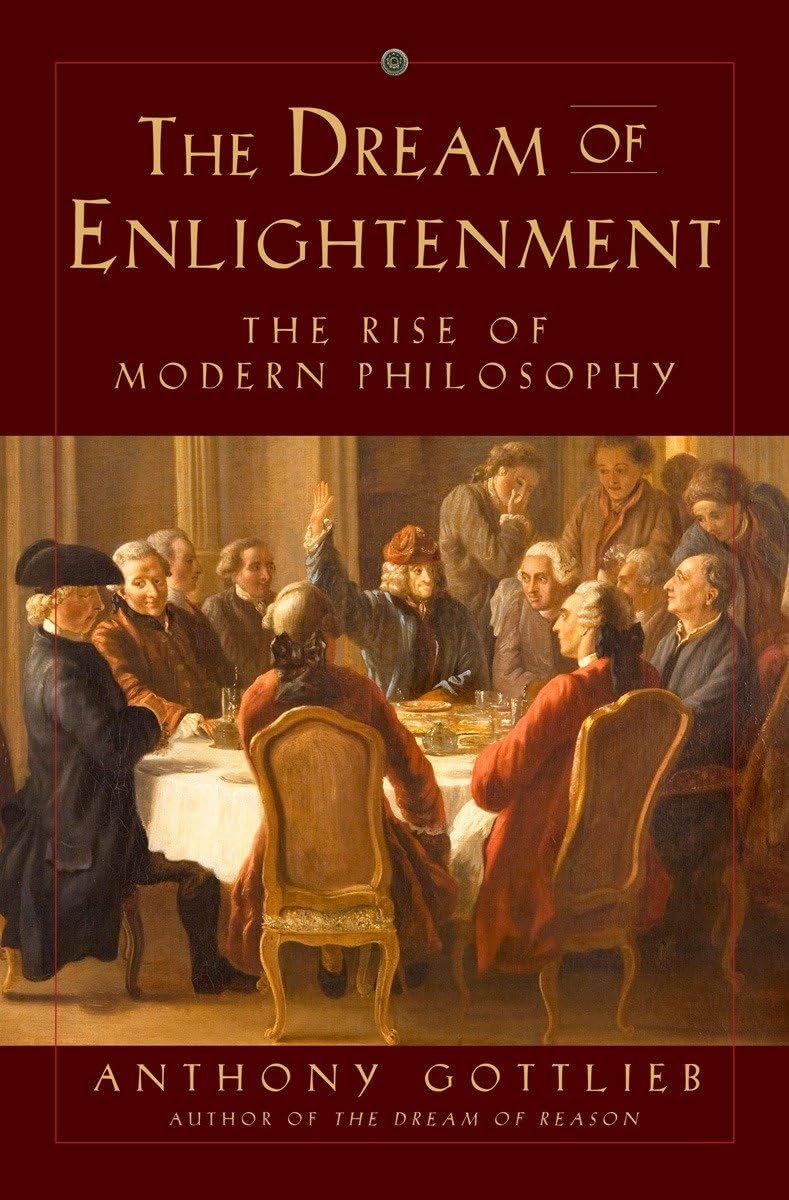
Anthony Gottlieb claims that the foundations of western philosophy were created in two “staccoto bursts” of 150 years each separated by nearly two millenia. “The Dream of Reason” (2000) covered the first burst centered on Athens from the middle of the fifth century to the late fourth century BC. “The Dream of Enlightenment: The Rise of Modern Philosophy” (2016) covers the second, which arose in northern Europe between the 1630s and late 1700s. Both books are excellent group biographies of groundbreaking thinkers and how their philosophies influenced each other. The Dream of Enlightenment focuses on six of the most influential thinkers of the Age of Reason and the Enlightenment – Descartes, Hobbes, Spinoza, Locke, Leibniz, and Hume – while offering briefer treatments of Bayle, Rousseau, and Voltaire, making this volume far more digestible than The Dream of Reason, which profiled nearly two dozen ancient philosophers, both celebrated and obscure, in varying depth.
First, Gottlieb presents René Descartes (1596–1650) as the thinker who set modern philosophy in motion by radically rethinking how we pursue knowledge. Living amid the collapse of medieval Scholasticism and the rise of science, Descartes sought absolute certainty. He was determined to escape what he perceived to be the limitation of the senses. His solution was to doubt everything until he reached a truth that could not be denied. He is perhaps most famous for his saying: Cogito, ergo sum – “I think, therefore I am.” (An idea St. Augustine had put forward hundreds of years earlier.) From this, he built a philosophy grounded in reason rather than tradition or sensory experience. He aimed to call everything into question and start out afresh.
Descartes famously divided reality into two distinct substances: the immaterial mind and the material body, launching debates on consciousness and the problem of how mind and matter interact. For Descartes, the mind or soul inhabited the body like a “ghost in the machine.” Gottlieb highlights how this dualism, along with Descartes’s mechanistic view of nature as a vast machine governed by laws, fueled both the Enlightenment’s faith in reason and the Scientific Revolution’s drive to uncover nature’s workings.
Though Descartes claimed to break with the past, Gottlieb shows he was deeply shaped by it. His introspective certainty echoed Augustine, his logical rigor came from Scholastic training, and his method of doubt was inspired by ancient skepticism – though he used it to secure knowledge, not to suspend belief. His book “Meditations” (1641) was the most discussed philosophical work of the early modern period.
So to be called a Cartesian is to align oneself with this rationalist, dualist, methodologically rigorous approach to philosophy – seeing reality as something best understood through the powers of human reason, often skeptical of purely empirical or sensory foundations. He made the problem of knowledge the most basic question of philosophy. Descartes’s legacy, Gottlieb argues, is profound but double-edged. He gave philosophy a new foundation in individual reason, setting the stage for thinkers like Locke and Hume, even as his mind-body split created enduring puzzles that still trouble philosophers and scientists today. Thus, Descartes emerges in Gottlieb’s account as both the father of modern philosophy and the source of some of its most persistent dilemmas.
Next, Gottlieb portrays the irascible Thomas Hobbes (1588-1679) as “the pioneer of modern political philosophy. He was the most controversial and vilified British thinker of the seventeenth century and earned the damning sobriquet “the Monster of Malmesbury.” “Hobbes was not seen merely as an atheist, but as the arch-atheist of his day,” Gottlieb writes, although he says he doesn’t believe he was. Hobbes was denied membership in the Royal Society, founded in 1660; not too surprising for a man who argued that learning by experience did not on its own count as rational knowledge. The author says Hobbes was mostly understood. Hobbes’s writings were certainly dangerously irreligious for their time, and he was a fiercely original thinker who rejected Descartes’s notion of an immaterial mind or spirit (the two contemporary philosophers did not think much of each other) and brought a cold, uncompromising rationalism to questions of politics and human nature. But he also maintained that our innate desire for self-preservation would bring us to seek peace and mutual security.
Writing in the shadow of the English Civil War, Hobbes saw first-hand how disorder and fanaticism could tear a nation apart. This drove him to seek a scientific understanding of society grounded in a stark view of humanity. In his most famous work, “The Leviathan” (1651), Hobbes argued that in a “state of nature” humans are fundamentally driven by fear, greed, and the relentless pursuit of self-preservation. Without a powerful authority to keep them in check, life would descend into what he memorably called a “war of all against all,” making life “solitary, poor, nasty, brutish, and short.”
Gottlieb highlights how Hobbes attempted to apply the new mechanistic philosophy – championed by thinkers like Galileo (1564-1642) and Descartes – not just to nature but to human behavior itself, treating people as complex machines motivated by predictable motions of desire and aversion. This was deeply unsettling to many contemporaries who preferred to see humans as divinely guided or naturally sociable. From this mechanistic anthropology, Hobbes concluded that only an absolute sovereign – the eponymous “Leviathan” – could impose the order needed for peace, a view that would set him apart from later Enlightenment thinkers who emphasized liberty and natural rights.
Gottlieb also shows that while Hobbes borrowed from Descartes’s mechanical philosophy, he rejected Descartes’s mind-body dualism, insisting instead on a purely material account of thought. In this, Hobbes was more radical than even some modern philosophers. Through Gottlieb’s lens, Hobbes emerges as both a founder of modern political theory and a relentless pessimist about human nature, whose grim but clear-eyed analysis forced later philosophers to grapple with the true basis of social order and authority. In the eighteenth century, Gottleib says “it was common practice to denounce Hobbes and then copy him.”
The third profile focuses on Baruch Spinoza (1632-1677), a Portuguese Jew, who was quite unlike the detested Hobbes. According to Bertrand Russell, Spinoza was “the noblest and most lovable of the great philosophers.” He was also, according to Gottleib, one of the most daring and unsettling thinkers of the early modern period – someone who took the rationalist spirit of Descartes and pushed it to its most radical, even scandalous, conclusions. Like Descartes, Spinoza believed that sensory perception provides only confused and erroneous ideas of things. Living in the religiously tense Dutch Republic of the seventeenth century, Spinoza rejected not only the orthodox doctrines of Judaism (which led to his excommunication) but also the comforting dualism of Descartes. Where Descartes divided reality into mind and body, Spinoza argued that there is only one substance – God or Nature – of which everything else is merely a mode or expression. A God who is infinite in every respect is bound to fill the world completely and cannot be confined to a separate existence. In this sweeping, monistic vision, God was not a providential figure like a king or indeed any other sort of person who intervened in human affairs, but the totality of the universe itself, governed by impersonal, unbreakable laws. To know and to love God, he insisted, required only “the practice of justice and love toward one’s neighbor.”
Gottlieb shows how this philosophy was both exhilarating and deeply troubling. Spinoza was determined to “tear the mask of human personality from the idea of God.” He reasoned that from God’s point of view he did not sympathize with the sufferings of His creatures and saw no such thing as evil or suffering, which is how he explained why God never sought to do anything about it. In short, God, or nature, has no use for such categories as good and bad. Rather, it was general scientific laws that expressed truths about God.
Spinoza’s determinism further meant that free will was an illusion: human beings, like everything else, were subject to the necessary workings of nature. Yet Spinoza did not see this as cause for despair. Instead, he believed that by understanding these natural laws – including the causes of our own emotions – we could achieve a kind of rational freedom and tranquility, living in accordance with reason and attaining what he called “the intellectual love of God.” His magnum opus – Ethica Ordine Geometrico Demonstrata (Ethics, Demonstrated in Geometrical Order) – laying out his philosophy of God or Nature, strict determinism, monism (there is only one substance), and mind-body parallelism was published post-homously in 1677.
Spinoza’s work was so bold that it was widely condemned as atheistic and dangerous at the time, banned in many places, and read by admirers in secret. Gottlieb emphasizes that Spinoza’s serene, geometrically structured philosophy laid the groundwork for Enlightenment critiques of superstition and authoritarian religion, influencing figures from Goethe to Einstein, who wrote “I believe in Spinoza’s God, who reveals himself in the harmony of all being, not in a God who concerns himself with the fate and actions of men.” Through Gottlieb’s narrative, Spinoza emerges as both a profoundly disruptive thinker and a luminous example of how radical reason could challenge inherited beliefs, offering a new, if austere, path to human flourishing.
Englishman John Locke (1632-1704) is the fourth philosopher profiled. He is depicted as the quintessential philosopher of the early Enlightenment – practical, moderate, and deeply influential in shaping modern views on knowledge, politics, and human nature. Amazingly, he didn’t publish his main philosophical works until he was 57-years-old in 1689. Along with Isaac Newton (1642–1727), who published Principia in 1687, Hobbes is considered one of the “twin prophets of the Enlightenment.”
Writing in the aftermath of England’s turbulent civil wars and the Glorious Revolution, Locke sought to construct a philosophy that combined empirical observation with reasonable restraint. His writings are plainer and more simple than other philosophers of his time. In the words of Bertrand Russell: “Locke was the spokesman of common sense.” He repeatedly argued that one should avoid pinning one’s faith on the opinions of others. In contrast to Descartes and Spinoza, who placed their faith in abstract rational systems, Locke argued that all our ideas ultimately come from experience: the mind at birth, he famously said, is a blank slate – tabula rasa – upon which sensation and reflection gradually write. “Reason,” he wrote, “must be our last Judge and Guide in every Thing.” Unlike Spinoza, Locke viewed God as a king-like ruler of the universe and unlike Rousseau he was a passionate defender of private property.
Gottlieb highlights how Locke’s “Essay Concerning Human Understanding” (1689) laid the foundations for modern empiricism by rejecting innate ideas and emphasizing that human knowledge is built up from simple sensory inputs combined and compared by the mind. This was both a liberating and a sobering insight, encouraging intellectual humility while also opening the door to systematic inquiry grounded in observation. Gottlieb says that the Essay played a central role in helping to erase the medieval world view of Aristotelian scholasticism.
In politics, Locke was equally influential. In his “Two Treatises of Government” (1689), he established himself as the pre-eminent intellectual defender of the right to rebel. He argued that legitimate government rests on the consent of the governed and exists to protect natural rights to life, liberty, and property. If rulers betray this trust, people have the right to overthrow them – a doctrine that would resonate profoundly in both the American and French Revolutions. It was all part of his view on the social contract. “In exchange for the protection of the government that is entrusted to make and enforce laws on their behalf,” Gottlieb explains, “they give up their natural entitlement to take the law of nature into their own hands and privately punish those who steal from them.”
Yet Gottlieb shows Locke was no radical firebrand; he sought to safeguard order and prevent the kind of fanaticism that had torn England apart. Through Locke, Gottlieb paints a picture of a philosophy rooted in cautious optimism: a belief that by understanding the sources and limits of human knowledge, and by constructing governments to secure individual rights, humanity could inch toward a more reasonable and tolerant world. In this way, Locke emerges as both a champion of liberty and a careful architect of the Enlightenment’s empiricist, rights-based worldview.
Next, Gottlieb provides a brief sketch of Pierre Bayle (1647-1706), a lesser known philosopher who may have been the sharpest skeptic of his age – a man who relentlessly questioned dogma, both religious and philosophical. Living in the tense aftermath of France’s religious wars, the French Calvinist (Huguenot) Bayle argued that certainty was elusive and that people should tolerate opposing views precisely because no one could claim absolute truth. His monumental “Historical and Critical Dictionary” (1697) dismantled cherished beliefs with meticulous erudition and biting irony, exposing contradictions in both Catholic and Protestant thought. Bayle’s radical insistence that morality did not depend on religion was especially shocking, laying groundwork for secular ethics. Gottlieb presents Bayle as a kind of intellectual troublemaker: not offering a grand system like Descartes or Spinoza, but rather pricking holes in every system, clearing space for the Enlightenment’s pluralism and its defense of conscience over coercion. In this, Bayle becomes the Enlightenment’s great patron of doubt and tolerance, who cautioned that human reason is fragile and limited. In the spirit of Socrates and Pyrrho he urged society to keep probing and questioning and never get complacent.
If Bayle is less remembered today, so too is the fifth subject of The Dream of Enlightenment, Gottfried Leibniz (1646-1716), who was nevertheless perhaps the most dazzling intellect of the age. Bertrand Russell declared that Leibniz was “one of the intellects of all time,” while Gottlieb gushes that he “was the greatest polymath since Aristotle; there has not yet been a third person who can stand alongside them.” Leibniz was a genius possessed by “uncontrollable curiosity,” the author says, who left a staggering literary record of over a million pages. After reading his profile in The Dream of Enlightenment I’m not sure what he did to deserve such encomiums.
Leibniz tried to reconcile the new mechanistic science with a deeper, almost metaphysical optimism about the universe. Unlike Descartes or Spinoza, whose systems could seem cold or austere, Leibniz offered a vision of reality that was at once rigorously logical and profoundly hopeful. He famously argued that we live in “the best of all possible worlds,” a universe orchestrated by a perfectly rational God who chose, out of infinite possibilities, this world because it achieves the greatest balance of order, richness, and goodness. Leibniz was later lampooned as the excessively and naively optimistic Dr Pangloss in Voltaire’s acidic parody “Candide” (1759).
Gottlieb highlights how Leibniz sought to harmonize the emerging science of matter with a theory that preserved purpose and spirit. Rejecting Descartes’s crude dualism, Leibniz proposed that reality is composed of countless immaterial “monads” – tiny, indivisible centers of force and perception that reflect the universe from their own unique perspectives. This was his way of preserving individuality and internal activity in a world that Newtonian mechanics threatened to flatten into mindless collisions.
Leibniz was also a tireless conciliator, trying to bridge gaps between Protestants and Catholics, and between ancient philosophy and modern science. He saw apparent evils and suffering as necessary parts of a larger divine plan we could not fully grasp. In short, God could have constructed another world out of better pieces, but He put this one together perfectly.
For all his metaphysical flights, Gottlieb shows that Leibniz was deeply engaged with mathematics and the practical progress of science, co-inventing calculus alongside Newton and advancing logic in ways that foreshadowed modern computers. In Gottlieb’s narrative, Leibniz emerges as a figure of astonishing range: a philosopher who tried to show that reason, science, and faith could together reveal a universe that was not only intelligible but profoundly benevolent, although I’m uncertain that much if any of his thinking has stood the test of time.
Gottlieb treats the last philosopher profiled in The Dream of Enlightenment, Scotsman David Hume, as one of the most radical and disruptive thinkers of the eighteenth century – a philosopher who pushed skepticism and empiricism to their furthest limits and, in doing so, profoundly reshaped modern philosophy. Gottlieb admires Hume’s courage in following reason wherever it led, even when it led to deeply unsettling conclusions about knowledge, religion, and human nature. He did it all with great aplomb and was deeply admired by even his fiercest critics, such as Samuel Johnson, James Boswell, and Adam Smith. Gottlieb notes that in a 2009 poll of modern philosophers, Hume was the dead thinker they most identified with (Aristotle placed and Kant showed).
Gottlieb explains that the core of Hume’s philosophy, laid out in “A Treatise of Human Nature” (1739), lies in his rigorous empiricism: the conviction that all ideas derive ultimately from sensory impressions. He argued that there are two fundamental categories of human knowledge. First are “matters of fact”: truths we learn from experience, which tell us about the world as it actually is. They depend on empirical observation and could always have been otherwise (e.g. the sun rises in the east). Second is “relations of ideas”: truths that are known purely by reason, without any need to look at the world. These are statements that are necessarily true just by virtue of how the ideas involved relate to each other (e.g. 2+2=4).
Hume famously argued that if we look carefully at any concept, we should be able to trace it back to some original impression in experience; if we cannot, it is mere sophistry or illusion. This principle, which he called “induction,” had radical consequences. Bertrand Russell said “Induction raises perhaps the most difficult problem in the whole theory of knowledge.” For instance, it led Hume to undermine traditional notions of causation. We never actually perceive causation itself, he argued – only that one event follows another. The supposed “necessary connection” is something the mind projects onto events because of habit, not because we can logically or empirically demonstrate its necessity. This was a major departure from the confidence of earlier rationalists like Descartes and Leibniz in clear, necessary truths discoverable by reason alone.
Hume also famously attacked arguments for God’s existence. His “Dialogues Concerning Natural Religion” (which was based on Cicero’s “The Nature of the Gods” (45 BC) and Gottlieb notes was so controversial that Hume delayed publication until several years after his death in 1776) dismantled the design argument by showing that the analogy between human artifacts and the universe was weak and that even if the analogy held, it might just as easily suggest many gods, an incompetent designer, or a morally indifferent one. In ethics, Hume advanced the idea that reason is the “slave of the passions,” arguing that our moral judgments stem from feelings, not rational deductions.
Compared to other philosophers profiled by Gottlieb – such as Descartes, Spinoza, or Leibniz, who built ambitious rational systems aimed at demonstrating truths about God, the soul, and the universe – Hume was deeply suspicious of metaphysical speculation. His approach was modest, naturalistic, and psychological: he wanted to describe how the mind actually works, not how it should ideally work. This empirical turn would have enormous influence, preparing the ground for later thinkers like Kant, who admitted Hume’s skeptical arguments “awoke me from my dogmatic slumber,” and for modern philosophy’s emphasis on the limits of knowledge.
In short, Gottlieb presents Hume as the Enlightenment’s most unsettling voice – a thinker who stripped away comforting certainties and left us to grapple with the possibility that our deepest convictions about causation, morality, and religion might be products of custom and sentiment, not reason. That, paradoxically, is what makes Hume so foundational: by questioning so thoroughly what we can know and why we believe as we do, he permanently altered the course of philosophy.
Finally, Gottleib portrays Voltaire, Rousseau, and the broader group of philosophes as pivotal figures who both embodied and propelled the spirit of the Enlightenment, yet each with distinct approaches and tensions. Voltaire is depicted as the sharp-witted critic and champion of reason, religious tolerance, and freedom of expression, using satire and eloquence to challenge dogma and tyranny. Rousseau, by contrast, is presented as a more complex and sometimes contradictory figure – celebrated for his ideas on popular sovereignty and natural human goodness, but also criticized for his skepticism of reason’s ability to perfect society and his embrace of emotion and intuition. Gottlieb emphasizes that the philosophes were not a unified movement but a diverse circle of thinkers who shaped the intellectual and political currents of the eighteenth century, advocating progress through knowledge, reform, and secularism. Together, they laid the groundwork for modern democratic ideals, while also revealing the inherent tensions between reason, emotion, individual liberty, and social order that would continue to define Enlightenment thought and its legacy.
In closing, Anthony Gottlieb vividly traces how a small group of seventeenth- and eighteenth-century thinkers – Descartes, Hobbes, Spinoza, Locke, Bayle, Leibniz, and Hume – transformed humanity’s understanding of knowledge, nature, morality, and God. Breaking from medieval certainties, they questioned what could truly be known, wrestled with the tension between faith and reason, and laid the foundations of modern secular and scientific inquiry. Far from being a smooth march of progress, Gottlieb shows this was a tumultuous, often deeply personal struggle marked by radical doubt and profound disagreements. Yet their explorations collectively reoriented Western thought, giving us new ways to think about freedom, tolerance, and the limits of human reason – dreams and dilemmas that continue to shape our intellectual world today.
 What's Tim Reading Now?
Leave a comment