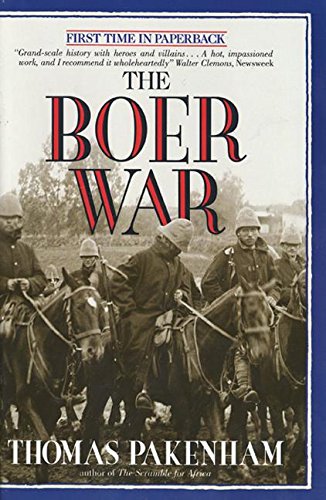
Thomas Pakenham’s The Boer War, first published in 1979, remains one of the most absorbing accounts of imperial warfare ever written. It is at once sweeping and immediate: a grand chronicle of armies clashing across South Africa’s high veldt, yet also a study of private fears and petty ambitions that together reshaped the British Empire’s sense of itself. In over 600 pages of meticulous research and colorful narrative, Pakenham reconstructs not just how the Boer War was fought, but why it happened, why the British fumbled so badly at the start, and how they eventually imposed their will on the Dutch Boers – at enormous moral and material cost.
At its heart, The Boer War is the story of a collision between two incompatible visions of freedom. On one side stood the British Empire, confident of its destiny to bring “civilization” and trade to the world, convinced that its subjects owed allegiance to London and to Queen Victoria. On the other side stood the Boers – descendants of Dutch, Huguenot, and German settlers – who, having trekked inland decades before to escape British rule in the Cape Colony, had built two fiercely independent republics: the Transvaal and the Orange Free State. For the Boers, freedom meant living as farmers and Calvinists on their own land, untrammeled by the ambitions of mining magnates or imperial governors.
Pakenham begins his story in the mid-1890s, which might be described as the “gathering storm.” During that period, gold transformed the political calculus of southern Africa. The discovery of fabulously rich gold deposits on the Witwatersrand in the Transvaal made Johannesburg one of the fastest-growing cities on earth. British adventurers and capitalists poured in – known to locals as “uitlanders” – who soon outnumbered the Boers themselves in the townships and mining camps. But political power remained firmly in the hands of Paul Kruger and his Boer volksraad, who saw no reason to grant voting rights to transient foreigners who might swamp their republic’s independence.
This brewing conflict erupted in farce before it ever reached the battlefield. In 1895, the British South Africa Company – directed by Cecil Rhodes, the arch-imperialist and prime minister of the Cape Colony – sponsored the infamous Jameson Raid, a bungled attempt to trigger an uprising in Johannesburg. Instead, Dr. Leander Jameson and his raiders were captured by Boer commandos almost immediately. The fiasco embarrassed Britain and inflamed Boer nationalism, setting the stage for a much larger confrontation.
Through 1897 and 1898, diplomatic tensions simmered. Alfred Milner, the new British High Commissioner, hardened London’s stance, insisting on political reforms in the Transvaal. Kruger remained equally defiant. In Pakenham’s telling, this was more than a clash over voting rights – it was a deeper conflict of cultures, aggravated by imperial arrogance and Boer stubbornness.
War finally broke out in October 1899 after the Boers, sensing British preparations, launched a preemptive strike. Kruger and the Orange Free State declared war, sending their commandos across the frontiers into British Natal and the Cape. Thus began the first phase of the war: the Boer offensive.
This early period, lasting from October 1899 through February 1900, was the zenith of Boer success – and one of the great embarrassments of British military history. Pakenham devotes harrowing chapters to the sieges of Ladysmith, Kimberley, and Mafeking. Boer marksmen, skilled horsemen intimately familiar with the landscape, pinned down larger British garrisons. Meanwhile, General Redvers Buller, commanding British forces in Natal, launched a series of clumsy, frontal assaults to relieve the sieges – most disastrously at Colenso in December and Spion Kop in January. At Spion Kop, British troops were so poorly led they dug trenches on the summit without realizing they were exposed to deadly rifle fire from higher ridges.
Throughout these pages, Pakenham is unsparing yet richly humane. He portrays British officers as brave but hidebound, overconfident from colonial campaigns against poorly armed foes. Used to redcoats marching against tribal spears, they were unprepared for modern Mauser rifles and smokeless powder in the hands of expert hunters. By contrast, the Boers – farmers in slouch hats on hardy ponies – used mobile, dispersed tactics, sniping and melting away before counterattacks. They fought for their farms, families, and republics with a tenacity the British badly underestimated.
Pakenham sees this as a critical inflection point: the moment when the myth of effortless imperial superiority was shattered. British generals began to realize they faced not “savages” but determined European settlers with modern weapons and a deep strategic patience.
The tide began to turn for the British in 1900. Salvation came in the form of massive reinforcements and a change in command. In early 1900, Lord Roberts took over the main army, with the brilliant young Lord Kitchener as his chief of staff. Roberts brought 180,000 fresh troops – the largest British expedition since the Napoleonic Wars – and imposed rigorous logistics. By sheer weight of numbers, the British lifted the sieges: Kimberley was relieved in February, Ladysmith in March, and Mafeking (to national jubilation back in England) in May.
Pakenham narrates these set-piece campaigns with the clarity of a war correspondent. He highlights key events such as the capture of Bloemfontein, capital of the Orange Free State, and the British march on Pretoria. By June 1900, both Boer capitals had fallen, and London prematurely proclaimed victory. Queen Victoria even ordered a thanksgiving service.
Yet Pakenham shows how misleading this triumph was. The Boers abandoned formal battles and switched to guerrilla tactics. Under leaders like Christiaan de Wet and the redoubtable Koos de la Rey, small commandos struck British rail lines, ambushed patrols, and vanished into the veldt. The war’s final phase became a grinding contest of endurance, far more costly and morally corrosive than anything that had come before.
It is here that Pakenham’s analysis is most penetrating. He details how Kitchener responded with a scorched earth counter-guerrilla war between 1900 and 1902. The British systematically burned Boer farms, slaughtered livestock, and built a vast grid of blockhouses and barbed wire to pen in the commandos. Most notoriously, the British herded tens of thousands of Boer women and children into concentration camps to deny guerrillas food and support.
Pakenham does not shy from the horror of it all. He recounts how disease – especially measles and typhoid – ravaged these camps. Some 28,000 Boer civilians died, alongside many black Africans caught in the turmoil. This was the first use of concentration camps in modern warfare, and it shocked even some voices back in Britain.
Yet these grim measures ultimately worked. By mid-1902, exhausted and out of supplies, the Boer commandos began suing for peace. The Treaty of Vereeniging in May 1902 ended the war, with the Transvaal and Orange Free State acknowledging British sovereignty – but with promises of eventual self-government. Ironically, this laid the groundwork for a unified South Africa under Boer-dominated rule in later decades and the imposition of the racist Apartheid regime.
Throughout The Boer War, Pakenham weaves several powerful themes.
First is the stunning incompetence of the early British effort. He argues this was not mere bad luck but the inevitable result of imperial hubris. British officers were veterans of colonial policing, not modern European-style warfare. They neglected intelligence, underestimated the enemy’s morale, and marched in bright uniforms into withering rifle fire. The early months of the war thus became a tragic tutorial in modern conflict.
Second is the resilience and inventiveness of the Boers. Pakenham portrays them not as backward yokels but as tough, resourceful people defending their homes and a way of life. Their mobility, marksmanship, and decentralized command allowed them to turn the vast spaces of South Africa into a force multiplier. In many ways, they presaged twentieth century insurgencies from Ireland to Vietnam.
Third is the moral cost of victory. The British eventually won by overwhelming force and ruthless methods – destroying farms, corralling civilians, engineering a logistical machine of blockhouses and armored trains. Pakenham does not let his readers forget the human toll. The book’s closing chapters on the camps are among its most powerful and haunting.
What makes Pakenham’s work endure is not just his diligent archival research, which draws on diaries, letters, and Boer memoirs, but his instinct for storytelling. He has an eye for dramatic contrasts: the dusty veldt stretching away under the African sun, the anxious faces in Ladysmith as shells crashed in, the grim conferences where Boer leaders debated fighting on. He populates his book with memorable figures: the vain Buller, the energetic but cold Kitchener, the charismatic De Wet, and ordinary Boer women who held families together under unbearable strain.
Some critics at the time thought Pakenham overly sympathetic to the Boers. It is true he often admires their tenacity and shakes his head at British blunders. Yet he is not blind to Boer racism or their own repressive practices toward Africans. What he ultimately provides is a tragic drama in which neither side emerges unstained.
For readers today, The Boer War is more than a chronicle of a dusty and largely forgotten colonial conflict. It is a reflection on how empires overreach, how small nations resist, and how modern war corrodes the values of those who wage it. The British expected a short punitive expedition and found themselves drawn into a protracted struggle that demanded ever more troops, money, and moral compromises. The British ended up losing 7,800 soldiers killed in action, more than the combined American battlefield casualties experienced in Iraq (3,500) and Afghanistan (1,900). In addition, the British lost 13,000 men to disease. Ultimately, they won – but in doing so, they exposed the brittleness of imperial arrogance and foreshadowed the guerrilla wars that would haunt the twentieth century.
Pakenham’s work stands as the definitive account of this conflict, unmatched for its combination of narrative sweep and analytical depth. Anyone seeking to understand not just the Boer War but the wider dynamics of colonial conflict will find in its pages a masterful, cautionary epic – a reminder that in war, victory often comes at a cost neither side truly foresees.
 What's Tim Reading Now?
Leave a comment