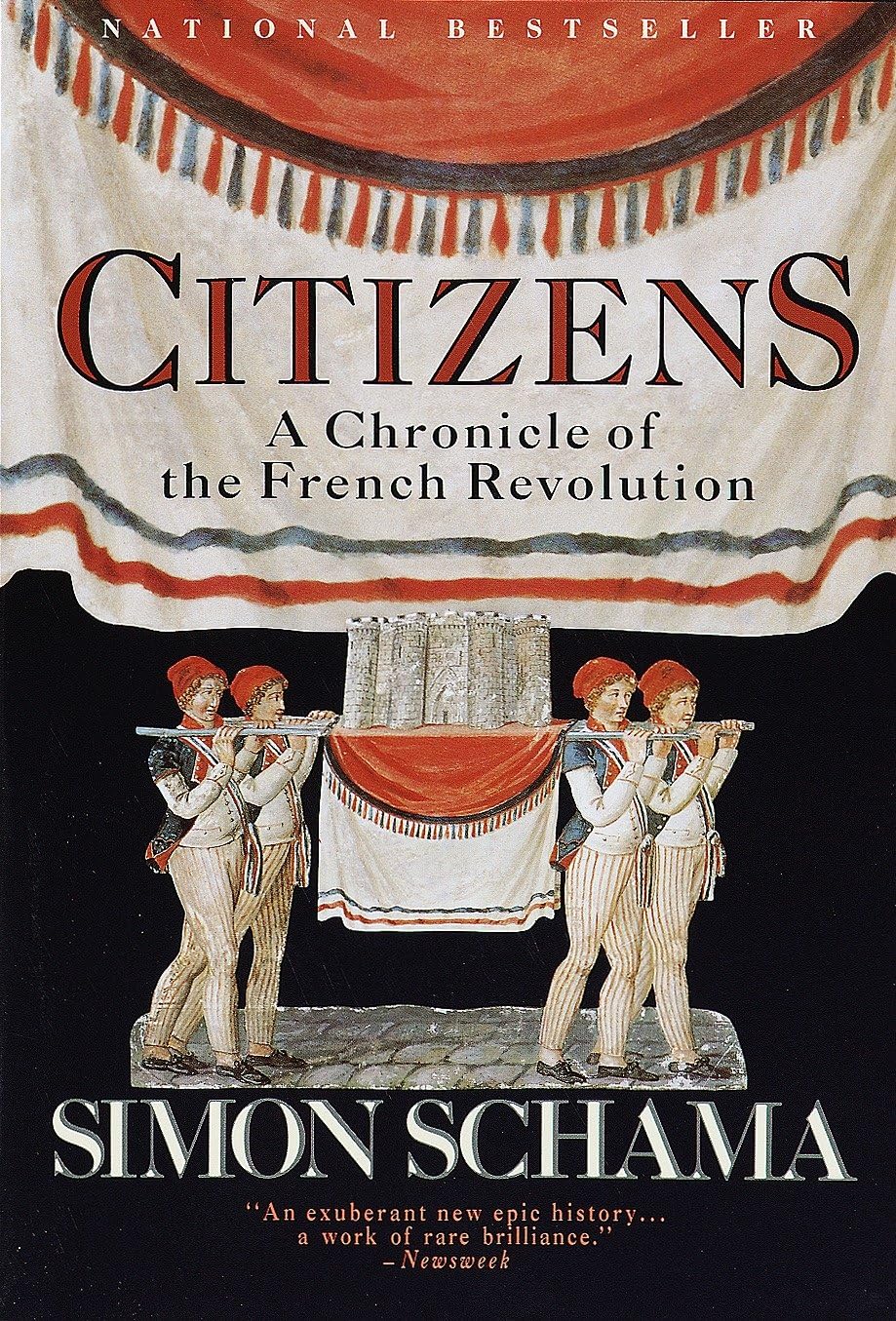
I’ve probably read close to a thousand works of non-fiction at this point in my life, and Simon Schama’s “Citizens: A Chronicle of the French Revolution” is in my Top Five. That’s really swaying something! Citizens is one of those rare works of history that truly reads like an epic novel, bursting with vivid characters, riveting scenes, and a driving narrative energy. Published in 1989 for the bicentennial of the French Revolution, the book was both acclaimed and attacked. Schama – already known as a skilled historical storyteller – brought the bloody, chaotic, and electric years of revolutionary France to life with a visceral immediacy. But he also delivered a deeply controversial interpretation of why the Revolution unfolded as it did, one that fundamentally questioned the traditional heroic narrative of the people rising to overthrow tyranny.
For Schama, the French Revolution was not primarily a glorious march of liberty, equality, and fraternity. Instead, he portrays it as an explosion of violence and social antagonism whose seeds were planted long before 1789. The Revolution, he argues, was driven less by ideals than by a pervasive cult of aggression, showmanship, and a love of power masquerading as virtue. In this telling, it was not a spontaneous upwelling of democratic fervor, but a continuation – and radical acceleration – of tendencies already present in the culture of the Old Regime.
In Schama’s view, pre-Revolutionary France was a society propelled by spectacle and conflict. The story opens not in the hallowed halls of the Estates-General, but decades earlier, in the court festivals of Versailles and the bustling streets of Paris. Schama devotes enormous attention to the texture of late eighteenth-century French life: the aristocrats obsessively staging elaborate public rituals, the bourgeois entrepreneurs hungry for status, and the urban crowds that reveled in public executions. He argues that far from a society suffocated by rigid feudalism, France before 1789 was already undergoing dramatic economic and social change. The bourgeoisie was thriving, cities were growing, and commercial wealth was reshaping old hierarchies.
Yet this transformation did not lead to stability. Instead, it bred resentment and competition. Schama sees French society as profoundly theatrical and confrontational – full of petty contests over honor, status, and credibility. The Old Regime, in his telling, was not static and decaying, but dynamic and bristling with tensions. This sets up one of Schama’s most original – and controversial – arguments: that the Revolution did not so much destroy the Old Regime as amplify its most combustible features.
Schama acknowledges the extraordinary hopes of 1789. When the Estates-General convened at Versailles, it unleashed a torrent of pamphlets, speeches, and debates that made politics into a mass spectacle. He relishes describing the electric atmosphere, the mutual embraces of nobles, clergy, and commoners as they momentarily dreamed of regenerating France.
But even here, Schama’s narrative foreshadows darker outcomes. He shows how the early Revolution was steeped in rituals of humiliation and symbolic violence. The storming of the Bastille, for instance, was not just an act of liberation but also of grisly vengeance: the heads of the fortress’s defenders were paraded on pikes after being sawed off with pen knives. The destruction of seigneurial records in the countryside was accompanied by the burning of manor houses. In Schama’s interpretation, these acts were not unfortunate excesses; they revealed a deep-seated culture of violence that would only grow.
One of Schama’s key inflection points is the October Days of 1789, when Parisian crowds – many of them women – marched to Versailles and forcibly brought Louis XVI and his family back to the capital. Schama interprets this moment as the psychological subjugation of the monarchy, an ominous signal that popular intimidation would replace constitutional negotiation. It was here, he suggests, that the Revolution began to turn from reform to coercion.
Another critical turning point for Schama is the king’s attempted flight to Varennes in 1791. While many historians see this as an understandable panic by a monarch caught in revolutionary turmoil, Schama argues that the flight fatally shattered the illusion that the Revolution still had a king. From this moment on, trust evaporated, and the political center could not hold.
By 1792, the Revolution had become a war at home and abroad. Schama depicts the attacks on the Tuileries Palace and the September Massacres (when revolutionary mobs butchered thousands of prisoners) as the culmination of a logic of violence that had been present from the beginning. The Revolution had now fully embraced what he calls a “political culture of the streets,” where legitimacy was measured by popular fervor and the capacity to inspire terror.
For Schama, the Reign of Terror was not an aberration but the fulfillment of revolutionary dynamics. He offers haunting portraits of Marat, Danton, and Robespierre – not as madmen, but as political entrepreneurs who understood that the Revolution’s legitimacy rested on purifying violence. Robespierre’s fanatic moralism, in Schama’s view, perfectly embodied the revolutionaries’ conviction that terror was not a regrettable necessity but a sacred duty. The guillotine became, literally and symbolically, the engine of revolutionary virtue.
In this, Schama sharply diverges from many leftist or social historians who have viewed the Terror as a tragic but perhaps necessary response to foreign invasion and internal treason. Instead, he emphasizes its roots in a longstanding culture of public punishment and spectacle, where violence was cathartic and politically essential. This controversial stance – that the Revolution was inherently violent from its earliest days – has drawn sustained criticism. Many scholars argue that Schama underplays the genuine social grievances and ideological hopes that animated the sans-culottes and revolutionary deputies alike.
Throughout Citizens, Schama writes with a novelist’s eye for character. Louis XVI is portrayed not simply as a bumbling king, but as a man trapped by the contradictions of a theatrical monarchy that could no longer command awe. Marie Antoinette emerges less as a frivolous spendthrift than as a deeply unpopular symbol of foreign decadence, her every action interpreted through a lens of scandal.
Among the revolutionaries, Schama gives surprisingly sympathetic sketches of Mirabeau and even of Lafayette, both of whom tried to channel revolutionary energy into constitutional order. Their failure is, in Schama’s telling, a kind of tragedy: men of talent undone by the Revolution’s irresistible drift toward extremism. Meanwhile, figures like Robespierre are depicted with chilling insight, not as mere villains but as men who believed absolutely that they were saving the world even as they starred in a grotesque public theater of cruelty.
What makes Citizens both gripping and contentious is Schama’s insistence on the continuity between the Old Regime and the Revolution. Where many historians have seen 1789 as a sharp rupture – an explosion of Enlightenment ideals against a stagnant, oppressive order – Schama argues that the Revolution grew out of the same cultural soil. The taste for spectacle, the reliance on public ritual, the obsession with honor and humiliation: all these were features of eighteenth-century French society long before the Bastille fell. In his view, the Revolution did not so much invent a new political culture as radicalize the old one.
This perspective has drawn heavy fire. Social historians have criticized Schama for downplaying structural causes like economic inequality, rising bread prices, and the fiscal crisis of the state. They argue he places too much emphasis on cultural psychology and not enough on material hardship or Enlightenment ideology. Moreover, many on the political left see Schama’s book as a conservative polemic, implicitly condemning popular revolution by emphasizing its violence.
Yet even Schama’s critics concede his literary brilliance. Few books have captured so powerfully the sights, sounds, and emotional temperature of revolutionary France. His descriptions of the Paris streets – thick with rumor, bristling with armed militias, echoing with oratory – make the Revolution feel immediate and terrifying. He shows how politics became theater, and how that theater so often ended in blood.
For students of revolution, Citizens offers a sobering meditation on how popular movements can slide into fanaticism. Schama suggests that revolutions are not only about ideas or grievances but about deep emotional needs: for unity, for purification, for spectacle, for enemies. Once violence becomes a test of political authenticity, it gains a momentum of its own.
The book also serves as a reminder that great historical ruptures do not emerge from a vacuum. By tracing continuities with the Old Regime, Schama challenges simplistic before-and-after narratives. He forces readers to see the Revolution as both a break and a culmination; it is a paradox that remains essential to understanding 1789.
In the end, Citizens is not the last word on the French Revolution, nor does it try to be. Its interpretation is deliberately provocative, its emphasis on violence and cultural inheritance a sharp corrective to more idealistic accounts. If it sometimes feels one-sided, it is because Schama wants to jolt us out of complacency. Few historians have written with such passionate intensity about the hopes and horrors of revolution.
Citizens remains a landmark work. It is indispensable not because it settles debates, but because it illuminates them – forcing us to grapple with the dark, intoxicating energy that can drive societies to remake themselves through terror as well as through dreams of justice. In Schama’s pages, the French Revolution becomes not merely a sequence of events but a grand human drama, full of triumph, tragedy, and all-too-familiar extremes. For anyone seeking to understand how revolutions can both inspire and consume, there is still no more compelling place to begin.
 What's Tim Reading Now?
Leave a comment