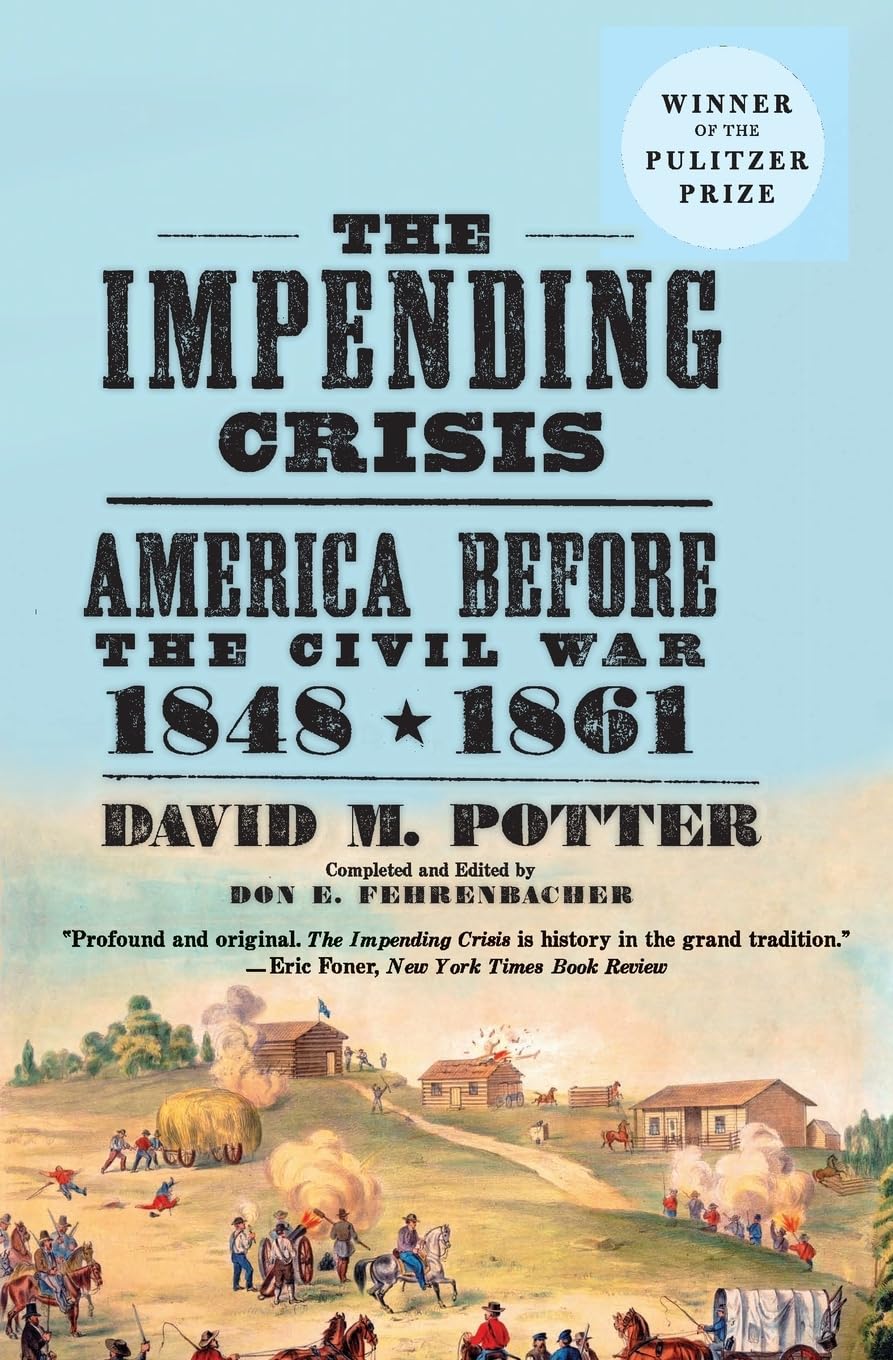
David M. Potter’s Pulitzer Prize-winning history “The Impending Crisis” (1976) is that rare historical work which, decades after its publication, remains not only authoritative but essential. Posthumously published in 1976 and completed by his Stanford colleague Don E. Fehrenbacher, the book distills nearly a lifetime of scholarship into a sweeping, judicious, and penetrating account of the social, economic, religious, and political ruptures that made the Civil War not just possible, but inevitable. What distinguishes Potter’s work is not simply its breadth or the clarity of its prose, but its ability to chart how America’s many interwoven institutions – its parties, its churches, its press, its economy – began to pull apart from one another after 1848, as if under the strain of a centrifugal force too powerful to resist. The crisis, in Potter’s view, did not emerge suddenly or irrationally, nor was it the product of a few extremists on either side. It was a structural crisis, built gradually, from the inside out.
From the opening pages, Potter is clear in his intent to avoid both teleology and moral absolutism. His goal is not to paint the war as a tragic accident, nor as the righteous culmination of a moral crusade. Rather, he seeks to understand how a democratic republic, founded on compromise, fractured so deeply that compromise itself became impossible. The twelve years between the end of the Mexican-American War in 1848 and the bombardment of Fort Sumter in 1861, he argues, should be read not merely as a countdown to catastrophe, but as a complex unraveling of consensus across every major institution in American life.
One of Potter’s most striking and influential insights is his conceptualization of sectional polarization not as a sudden rupture, but as a gradual erosion of national institutions and ideologies. In 1848, America had survived a war with Mexico, added vast new territories to its western frontier, and enjoyed a two-party political system that bridged regional differences. Yet, as Potter carefully shows, this appearance of stability masked deep structural tensions – tensions that were exacerbated, not resolved, by the victory in Mexico. The acquisition of new land raised an unavoidable question: would slavery be allowed to expand into the territories?
The Wilmot Proviso, introduced in 1846 but never passed, became a political lightning rod. Though the Proviso itself failed legislatively, Potter shows how it succeeded in laying bare the irreconcilable sectional fears that undergirded American politics. It introduced the notion that slavery was not simply a Southern concern, but a national issue that would henceforth dominate all others. The debates over the Proviso, and later the Compromise of 1850, marked the beginning of what Potter describes as the nationalization of sectionalism – a transformation of local or regional grievances into zero-sum national conflicts.
Nowhere is Potter more compelling than in his treatment of institutional rupture. The political system was the first and most visible casualty. For decades, the Whig and Democratic parties had served as cross-sectional institutions, each with Northern and Southern wings. They had managed, however uneasily, to contain the slavery debate within their national platforms. But as Potter illustrates with scholarly detail, the 1850s witnessed the collapse of that system. The Whig Party disintegrated in the wake of the Compromise of 1850 and the Kansas-Nebraska Act, as Northern and Southern Whigs could no longer reconcile their differences on the expansion of slavery.
Even more telling, Potter argues, was the transformation of the Democratic Party, once a national powerhouse into a regionally polarized coalition. The nomination battles of 1856 and especially 1860 revealed just how fractured the party had become, culminating in its split between a Northern faction backing Stephen Douglas and a Southern faction supporting John C. Breckinridge. This division ensured the election of Abraham Lincoln in 1860 – and with it, secession.
The rise of the Republican Party, meanwhile, marked a radical reorientation of American politics. Unlike its predecessors, it was an avowedly sectional party: rooted in the North, hostile to the expansion of slavery, and committed to a vision of free labor that Southern elites perceived as existentially threatening. Potter shows that the mere existence of such a party was intolerable to many Southerners – not because it immediately threatened slavery where it existed, but because it undermined the legitimacy of the slaveholding order in the national political sphere.
Religious institutions, too, suffered a parallel collapse. Potter devotes considerable attention to the fracturing of the Methodist, Baptist, and Presbyterian churches – all once national denominations that split along sectional lines in the 1840s and 1850s. The Methodist Episcopal Church, which had been the largest Protestant denomination in the United States, formally split into Northern and Southern branches in 1844. Baptists followed in 1845, and the Presbyterians in 1857. These schisms reflected more than theological disputes; they revealed how the moral and cultural divide over slavery had penetrated the spiritual life of the nation.
These church splits were more than symbolic. As Potter points out, churches had long served as forums for national moral discourse and community cohesion. When they could no longer sustain unity, it was a clear sign that sectionalism had become embedded not just in politics, but in the moral and emotional lives of Americans. If Americans could no longer pray together, how could they govern together?
While political and religious institutions were unraveling, so too was the economic integration that had once offered hope for national unity. Potter is careful not to exaggerate the economic divergence between North and South, but he makes a powerful case that their respective trajectories increasingly fostered mutual suspicion. The North, experiencing rapid industrialization, urbanization, and immigration, was becoming a society structured around wage labor and economic dynamism. The South remained a rural, agrarian society dependent on slave labor and export-oriented agriculture.
This divergence created not only different economic interests but different worldviews. Northerners came to associate free labor with moral and economic progress, while Southerners developed a siege mentality, believing themselves under attack by Northern capitalism and abolitionist ideology. Potter’s analysis of the Southern defense of slavery as a “positive good” – a transformation from earlier apologetic stances – is especially illuminating. This defensive posture, he argues, hardened as the South became increasingly isolated from national discourse.
The press and popular culture also played a role in deepening alienation. Newspapers, pamphlets, and political speeches routinely demonized the other side, fostering a climate in which compromise came to be seen not as virtuous, but as betrayal. By the late 1850s, Potter suggests, the two sections were not merely disagreeing about policy – they were speaking different moral languages.
The Kansas-Nebraska Act of 1854, one of the pivotal moments in Potter’s narrative, provides a vivid case study of how these forces exploded into conflict. By repealing the Missouri Compromise and allowing settlers to determine the status of slavery in new territories through “popular sovereignty,” the Act triggered a flood of settlers into Kansas – along with political activists and extremists on both sides.
What followed – famously dubbed “Bleeding Kansas” – was not merely a local skirmish but a symbol of the national crisis. Potter treats this episode with great care, emphasizing how it revealed the limits of political moderation and the failure of legislative compromise. Popular sovereignty, far from resolving the question of slavery’s expansion, had turned it into a contest of force.
In this environment, even violence began to feel legitimate. The caning of Senator Charles Sumner on the Senate floor by Representative Preston Brooks in 1856 – a moment that shocked and polarized the country – is presented by Potter not as an aberration but as a symptom of a deeper sickness: the collapse of shared norms.
What makes The Impending Crisis a classic is not just its comprehensiveness, but its careful tone. Potter resists the temptation to cast villains or martyrs, even as he makes clear the moral stakes of the debate over slavery. His goal is analytical, not polemical. He seeks to understand how democratic mechanisms failed – how good faith gave way to bad faith, and how institutions that once balanced sectional interests instead amplified them.
Perhaps most importantly, Potter reoriented the study of the Civil War’s origins. Before him, scholars often focused narrowly on political leaders or specific crises – Missouri, Kansas, Dred Scott, Harper’s Ferry. Potter, by contrast, offered a structural analysis that saw the 1850s not as a countdown to war, but as a systemic failure. His emphasis on institutional fracture – on how churches, parties, the press, and the economy each splintered along sectional lines – has become central to how historians now understand the period.
In retrospect, the Civil War seems tragically inevitable. Yet what The Impending Crisis shows with painful clarity is that it was not destined. It was the product of choices, divisions, and failures – not of a single moment, but of many. In Potter’s hands, the Civil War is not merely the story of North versus South. It is the story of a center that could not hold.
This, ultimately, is what makes The Impending Crisis not just a historical account, but a warning – a masterwork of narrative scholarship whose echoes remain eerily relevant today.
 What's Tim Reading Now?
Leave a comment