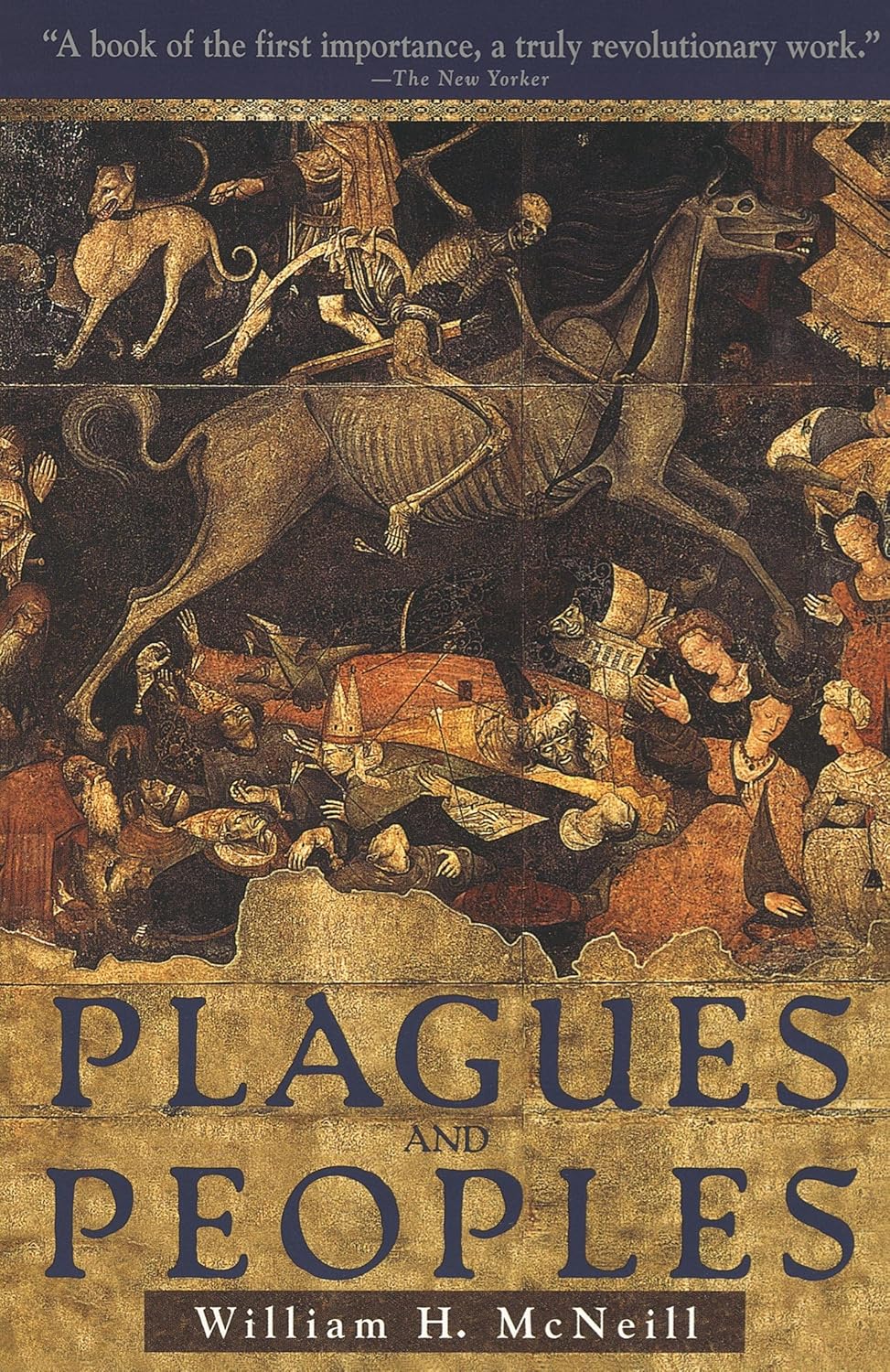
When William H. McNeill published “Plagues and Peoples” in 1976, it startled historians and anthropologists alike. Here was a sweeping, erudite global history that placed microbes – not kings, generals, or economic systems – at the center of the human story. In doing so, McNeill challenged centuries of historical writing that had largely treated disease as a grim but secondary backdrop to human affairs. Instead, he argued, pathogens have been co-authors of history, shaping the rise and fall of civilizations, redirecting migrations, and forcing profound cultural adaptations.
It is a mark of McNeill’s intellectual boldness that he chose to write such a book at all. Trained as a historian of Europe and best known for The Rise of the West, McNeill ventured into the then relatively underexplored terrain of epidemiological history. Drawing on sources from medical history, microbiology, anthropology, and classical texts, he stitched together a provocative thesis: that the interactions between human populations and infectious diseases – what he called “microparasites” – formed an ecological dynamic every bit as crucial as wars or trade routes in explaining why societies flourished or collapsed.
At its heart, Plagues and Peoples is a book about feedback loops between human social development and microbial evolution. As McNeill tells it, the shift from scattered hunter-gatherer bands to dense agricultural communities created fertile breeding grounds for disease. Larger, more settled populations allowed pathogens to circulate continuously, establishing what he terms “endemic equilibrium.” Urbanization, trade networks, and imperial conquests then acted as accelerators, carrying microbes across continents and unleashing epidemics on immunologically naive populations.
One of McNeill’s most important insights is that disease environments acted as selective pressures on human societies, both biologically and culturally. In the ancient world, for example, he describes how recurring outbreaks of diseases like malaria and dysentery may have influenced patterns of settlement around the Mediterranean. But even more consequential were the sudden shocks: devastating pandemics such as the Antonine Plague or the Plague of Justinian, which sapped imperial strength and altered the balance of power between Rome and its neighbors.
His discussion of the Black Death is particularly vivid. McNeill frames the bubonic plague not merely as a catastrophic demographic event but as a catalyst that reshaped Europe’s economic and social structures. The massive mortality accelerated the breakdown of feudal relations, boosted wages, and arguably helped set the stage for the Renaissance by disrupting traditional hierarchies. At the same time, he reminds us that the plague’s effects were not uniform. In parts of the Islamic world and China, plague outbreaks contributed to dynastic changes and a turning inward that altered global trade patterns.
One of McNeill’s most arresting examples is his treatment of European colonialism. Long before Jared Diamond would popularize the idea in Guns, Germs, and Steel, McNeill explored how Eurasian diseases decimated indigenous populations in the Americas, Australia, and the Pacific. Smallpox, measles, and influenza swept through these immunologically vulnerable societies with catastrophic results. McNeill argues that these “disease packages” did far more to ensure European dominance than did firearms or steel. Conquistadors like Cortés and Pizarro were aided immeasurably by epidemics that killed or weakened millions of indigenous people before battles were even joined.
However, McNeill differs subtly from Diamond. Where Diamond’s framework in Guns, Germs, and Steel emphasizes geographic determinism – focusing on the diffusion of domesticable plants and animals that gave Eurasia early advantages – McNeill is more interested in the dynamic, two-way relationship between human societies and their pathogens. He shows how dense human networks promoted the evolution of more specialized human diseases, which in turn shaped social behavior, state policy, and military campaigns. Unlike Diamond, who often portrays these processes as relatively static outcomes of geography, McNeill highlights the continuous, unpredictable co-evolution of humans and microbes.
For example, McNeill devotes attention to how Europeans eventually paid a price for their global expansion, encountering tropical diseases like yellow fever and malaria in Africa and the Caribbean that they could not withstand. These disease environments constrained European settlement patterns and even influenced the politics of empire. He cites the heavy mortality among European troops in places like West Africa – the so-called “white man’s graveyards” – as a key reason why European powers initially relied on coastal forts and indirect rule.
A particularly rich strand of McNeill’s argument is that societies did not merely suffer disease passively; they adapted culturally and politically. He gives examples ranging from quarantines in medieval Italian port cities to social practices like variolation (scratching a healthy person with smallpox puss) in China and the Ottoman Empire long before Edward Jenner’s smallpox vaccine. He also points to the development of large-scale public health efforts, such as sewage systems and later vaccination campaigns, which gradually tipped the balance in humanity’s favor, at least temporarily.
In this way, McNeill anticipates later scholarship on “pathoculture” – the idea that cultural norms, religious rituals, and even political institutions often emerge in response to disease threats. He shows, for instance, how the cycles of plague in Europe contributed to fatalistic attitudes and religious revivals, while high mortality in urban centers may have fed rural conservatism.
When Plagues and Peoples first appeared, it was both celebrated and questioned. Many historians praised McNeill for opening new avenues of inquiry, for daring to place microbes alongside monarchs as drivers of history. His interdisciplinary approach helped seed the field of historical epidemiology and encouraged scholars to think ecologically about human societies.
Over time, however, some critics have taken issue with the speculative leaps that occasionally appear in McNeill’s narrative. Specialists have noted that his reliance on secondary sources and lack of rigorous microbiological detail sometimes led him to overstate the certainty of disease identifications in ancient texts. Modern DNA work has confirmed some of his hunches (such as Yersinia pestis as the agent of the Black Death) but complicated others, revealing a more varied pathogen landscape than he suggested.
Others have criticized McNeill for sometimes treating disease as an almost autonomous force, downplaying human agency. They argue that political decisions, social inequalities, and the structure of medical knowledge also crucially shape disease outcomes – points now central to the field of critical medical anthropology. Yet even these critiques typically concede McNeill’s foundational importance in drawing scholarly attention to the big picture interplay of humans and microbes.
So what larger lessons does Plagues and Peoples offer to students of infectious disease and cultural anthropology? At least three stand out.
First, McNeill’s work showcases systems thinking. He views history not simply as a procession of human achievements and failures, but as a complex ecological web in which microbes, climate, trade, war, and cultural beliefs continuously interact. This ecological perspective is now fundamental to understanding pandemics, climate change, and even antibiotic resistance.
Second, McNeill underscores the asymmetry and contingency of disease encounters. The same biological traits that gave Eurasian societies immunities to smallpox rendered them highly vulnerable to malaria in tropical regions. This reminder that disease outcomes often hinge on local ecological and immunological conditions tempers any triumphalist narratives about inevitable Western ascendancy.
Finally, McNeill’s book is a profound meditation on human adaptability. While pathogens have repeatedly upended civilizations, humans have developed astonishing cultural and technological responses – from quarantine to vaccination to genome editing. This co-evolution is ongoing, and McNeill’s insistence that we see disease as a constant historical partner is perhaps more relevant today than ever, in an era of emerging zoonoses and global mobility.
Nearly half a century after it first appeared, Plagues and Peoples remains a landmark. Its prose has lost none of its clarity, and its central insight – that microbes have been indispensable players in the human story – has become almost axiomatic in both historical and anthropological studies. Even as more specialized research has refined or challenged some of his claims, the book’s sweeping vision continues to inspire.
Students and general readers alike still turn to McNeill not just for data, but for perspective. In an age grappling with pandemics from HIV/AIDS to COVID-19, his insistence that disease is not a marginal topic but a core dynamic of history feels urgently contemporary. Plagues and Peoples is more than a history of disease; it is a reminder that human destiny has always been negotiated in microscopic arenas as well as on battlefields and trading floors—a truth we ignore at our peril.
 What's Tim Reading Now?
Leave a comment