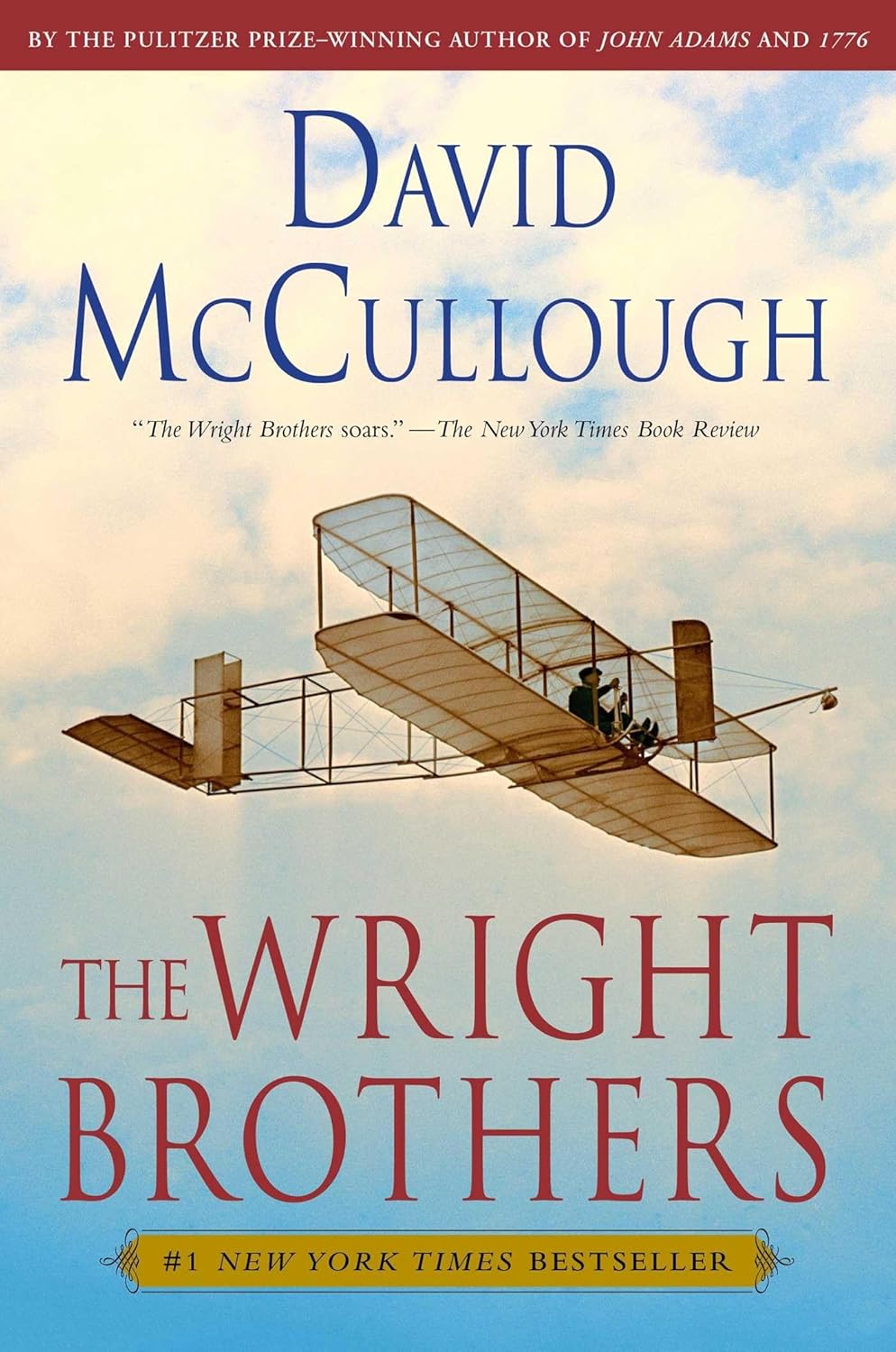
David McCullough has long been one of my favorite popular historians. He can turn almost any event into a compulsively readable, character-driven adventure story. “The Wright Brothers” (2015) was written in McCullough’s twilight years (he died in 2022) and it isn’t nearly as commanding or dense as his earlier award-winning works, like “Truman” (1992) or “The Path Between the Seas” (1977), but it is nevertheless a well-told story.
The Wright Brothers is more than a biography – it’s a quintessential American story of grit, modesty, and ingenuity. With his trademark clarity and warmth, McCullough brings Orville and Wilbur Wright to life not just as inventors of powered flight, but as patient, principled, and surprisingly down-to-earth men whose backgrounds as self-taught engineers and bicycle mechanics proved decisive in one of humanity’s greatest technological leaps.
The book opens not with the brothers in flight, but with their family: a household steeped in books, religion, and debate. Their father, Milton Wright, a bishop in the United Brethren Church, was a fierce individualist who believed in education, moral integrity, and self-reliance. Their mother, Susan, who died when they were still young, had a mechanical mind and built toys and tools for her children. From their father they inherited discipline and conviction; from their mother, a love of tinkering. These formative influences laid the foundation for a kind of mental and emotional resilience that would carry the brothers through years of obscurity, failure, and ridicule.
Wilbur, the older brother by four years and born in 1867, is portrayed as cerebral, intense, and prone to periods of melancholy. He was a voracious reader and deep thinker who was especially drawn to problems others had failed to solve. Orville was more outgoing, inventive, and optimistic, with a natural flair for mechanics and design. While their personalities differed, McCullough stresses how the Wrights functioned as a single unit, complementing each other perfectly – Orville’s creativity balancing Wilbur’s discipline; Wilbur’s analysis sharpening Orville’s intuitions. They argued often, but never competed. Their success was, in no small part, due to this brotherly symbiosis.
What makes The Wright Brothers so compelling is McCullough’s focus on their path to flight not as a story of genius or luck, but of methodical problem-solving born out of their experience running a small bicycle shop in Dayton, Ohio. In the 1890s, bicycles were all the rage – a new, thrilling form of personal transportation. The Wright brothers not only repaired and sold them—they built them from scratch. This hands-on experience gave them a deep, practical understanding of balance, motion, and mechanical systems. It also instilled a craftsman’s sensibility: respect for materials, patience with failure, and the confidence to modify and iterate. They learned how to make things work, how to experiment, and how to test assumptions – skills that proved indispensable when they turned their attention to the riddle of flight.
McCullough highlights how their background in bicycles directly translated into key insights about aviation. For one, the importance of control. Just as a bicycle must be balanced and steered with precision, so too must an aircraft be stable and controllable in three dimensions: pitch, roll, and yaw. Many contemporary aviation pioneers focused almost exclusively on power – adding bigger engines or building gliders without sufficient control mechanisms. The Wrights, by contrast, focused obsessively on how to steer and stabilize the aircraft. Their invention of wing-warping, a method of twisting the wings to control roll, came directly from their experience with bicycles and their intuitive grasp of dynamic balance.
Another key insight from their cycling days was the concept of testing iteratively. The Wrights didn’t build a full airplane and hope for the best. They built kites. Then gliders. Then wind tunnels to test wing shapes. At a time when the scientific community still relied on flawed aerodynamic tables, the brothers conducted their own tests, designing a wind tunnel in 1901 and generating over 200 new airfoil designs, many of which outperformed the established data. Their hands-on, empirical approach helped them outperform far better funded and credentialed competitors. They were mechanics, yes, but they were also data-driven engineers avant la lettre.
McCullough also describes the cultural and psychological environment in which they worked – modest, skeptical, and largely disinterested in fame or profit. Unlike other inventors who courted publicity or investors, the Wright brothers largely kept their work private, refining their machines in the dunes of Kitty Hawk, North Carolina, a remote location chosen for its steady winds and soft sand for crash landings. Their isolation allowed them to work uninterrupted and make mistakes out of the public eye. But it also meant they were frequently doubted, mocked, or ignored. After their first successful powered flight on December 17, 1903 – an astonishing 12-second hop over 120 feet – they returned home largely unnoticed. Not until 1908, when they demonstrated their improved Flyer in front of huge crowds in France and the U.S., did the world finally take them seriously.
McCullough devotes significant space to the brothers’ later years, when success brought complications. Once heralded as heroes, they became embroiled in patent disputes and legal battles, most notably with Glenn Curtiss and the U.S. government, over who owned the right to control powered aircraft. Wilbur took the lead in defending their legacy, but the stress took its toll. He died in 1912 at just 45. Orville lived until 1948, increasingly detached from the aviation industry he had helped create and which had grown far beyond his original vision.
Throughout the book, McCullough returns to the theme of character: the brothers’ humility, work ethic, and integrity. They never took a dime of public funding. They made their own machines, tested their own theories, and documented their failures as rigorously as their successes. McCullough, ever the admirer of virtuous American striving, clearly sees them as model citizens in addition to model inventors.
While some critics have noted that The Wright Brothers offers little new in terms of groundbreaking historical interpretation, McCullough’s contribution lies in his accessibility and narrative skill. He turns what could be a dry chronicle of mechanical tinkering into a rich human story of courage, curiosity, and persistence. His prose is as elegant as ever without being ornate, and his use of primary sources – letters, diaries, newspaper accounts – brings the brothers’ voices and lived experiences to life.
Perhaps most significantly, McCullough elevates the Wrights’ achievement to its proper historical place. Too often, the history of innovation is told as a parade of lone geniuses or as a product of grand institutional research. The Wright Brothers reminds us that sometimes the most revolutionary changes come not from empires or universities, but from a pair of bicycle mechanics working in a wooden shed in Dayton.
In the final chapters, McCullough lingers on the image of the brothers watching, decades later, as airplanes roared across the sky in World War I – massive, deadly, and omnipresent. It’s a bittersweet ending, hinting at the dual legacy of their invention: the liberation of humanity from gravity, and the transformation of war.
But the enduring image McCullough leaves us with is not of destruction, but of ascent. Two quiet men, working with their hands and their minds, changed the world not with fanfare but with diligence. In celebrating their story, McCullough also celebrates the virtues of patience, collaboration, and the audacity to believe that with enough persistence, humans could do the impossible.
The Wright Brothers is a tribute to the idea that big dreams can be built in small shops – and that the power of flight, once a myth, was made real not by aristocrats or armies, but by two brothers and a bicycle.
 What's Tim Reading Now?
Leave a comment