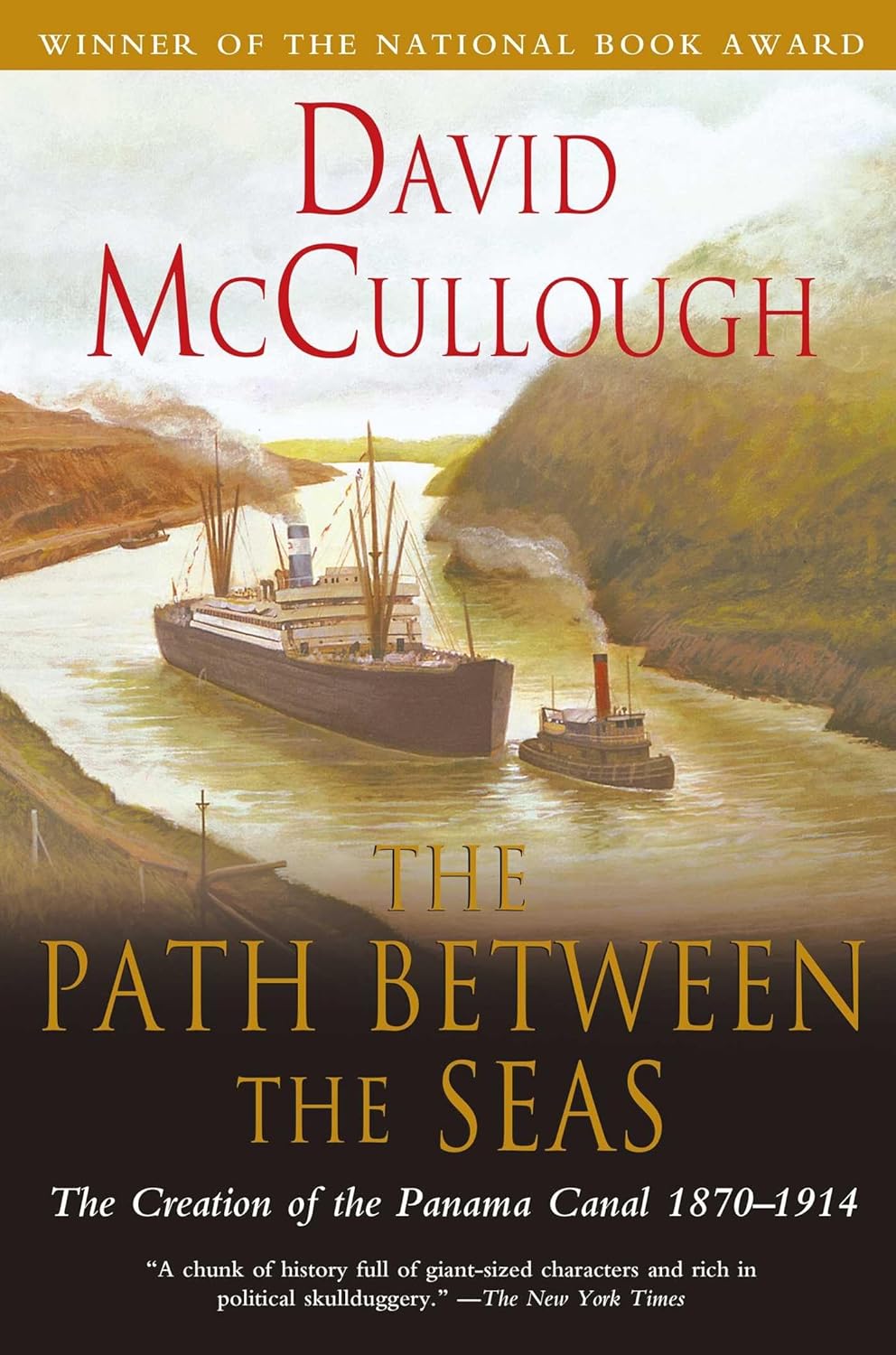
In the pantheon of “great project books,” David McCullough’s “The Path Between the Seas: The Creation of the Panama Canal, 1870-1914 (1977) may be the best. It is a sweeping and authoritative chronicle of one of the most ambitious engineering projects in human history. With characteristic narrative verve and exhaustive research, McCullough traces the efforts to cut a passage through the Central American isthmus from the failed French venture in the 1880s to the eventual triumph of the United States in the early twentieth century. More than a history of dirt and dynamite, it is also a compelling study in leadership, national ambition, military grand strategy, and the complex interplay of politics, medicine, and technology. In McCullough’s telling, the canal becomes a symbol not just of modern engineering, but of the ideological and geopolitical visions of the age.
The first half of the book focuses on the doomed French effort under the flamboyant Ferdinand de Lesseps (1805-1894), already celebrated as the builder of the Suez Canal, which opened in 1869. De Lesseps, a diplomat with no formal engineering background, was revered across Europe as a visionary. His confidence in the feasibility of a sea-level canal across Panama was rooted in his Suez experience, but McCullough shows that he was entirely unprepared for the vastly different geography and climate of Central America. Where Suez was flat and dry, Panama was mountainous and wet, plagued by torrential rains, dense jungle, and deadly diseases.
De Lesseps’s project, launched in 1881, was a tragic mix of idealism, arrogance, and financial fraud. Engineers struggled mightily with landslides, torrential flooding, and a brutal tropical climate. But the greatest enemies were yellow fever and malaria, which decimated the workforce. McCullough paints a vivid and harrowing picture of the suffering endured by thousands of workers, many of whom were West Indian laborers abandoned in horrific conditions. Despite mounting failures, de Lesseps refused to abandon his misguided sea-level design, which called for building a trench strait across the isthmus, similar in design to the vastly more simple Suez Canal. He continued raising money from credulous French investors until the company collapsed in scandal and bankruptcy. The French disaster cost over 20,000 lives and billions of francs, leaving behind a poisoned legacy and a cautionary tale of hubris.
McCullough contrasts the French debacle with the eventual American success in the first decade of the twentieth century, crediting much of the turnaround to a radically different approach in both organization and mindset. Where the French effort was driven by private capital and idealistic boosterism, the American effort was a state-directed enterprise, led by engineers and administrators with practical experience and a capacity for learning from failure. President Theodore Roosevelt played an essential role in framing the canal as a matter of national pride and geopolitical strategy. For Roosevelt, the canal was the embodiment of his foreign policy vision: assertive, modern, and interventionist.
McCullough gives Roosevelt a starring role, and rightfully so. While the French had stumbled over local resistance and international diplomacy, Roosevelt strong-armed his way through the problem. When the Colombian Senate refused to ratify a treaty granting the U.S. rights to build in Panama, Roosevelt backed a revolt in the province of Panama and quickly recognized the new nation, securing favorable canal terms from the fledgling Panamanian government. It was, as McCullough notes, an act of imperial pragmatism and constitutional controversy. Yet Roosevelt was undeterred, later boasting, “I took the Isthmus, started the canal, and then left Congress not to debate the canal, but to debate me.”
Once construction began in earnest, the U.S. faced the same geographic and medical challenges as the French, but with dramatically different results. A major reason for this was the appointment of Colonel William C. Gorgas (1854-1920), an Army doctor whose work in Havana had proved mosquitoes transmitted yellow fever. Gorgas instituted widespread sanitation measures: draining swamps, fumigating homes, installing mosquito netting, and enforcing strict hygiene protocols. His work effectively eliminated yellow fever and reduced malaria rates, saving countless lives and allowing sustained progress.
Equally important were the engineers who oversaw the project, particularly John Frank Stevens (1853-1943) and George Washington Goethals (1858-1928). Stevens, who had worked on the Great Northern Railway, was brought in by Roosevelt in 1905 to restore morale and bring order to the chaotic early American effort. A self-taught engineer with remarkable organizational skills, Stevens focused on logistics: building housing, hospitals, and infrastructure to support the workforce. He rejected the idea of a sea-level canal and championed a lock-and-dam design, which was more realistic given the terrain.
Stevens resigned abruptly in 1907, exhausted and frustrated by Washington bureaucracy. He was succeeded by Goethals, a West Point-trained Army engineer who brought military discipline and efficiency to the project. Goethals remained in Panama until the canal’s completion in 1914, commanding enormous respect from workers and overseeing all aspects of the final construction. Where Stevens was a builder of systems, Goethals was a finisher – and both were essential.
McCullough masterfully weaves together these human stories as only he can with detailed explanations of the canal’s construction. The creation of the Gatun Dam, the building of the massive locks, and the excavation of the Culebra Cut are described with clarity and drama. The scale of the engineering is staggering, but McCullough never loses sight of the individuals who made it possible, from West Indian laborers to the engineers and administrators who guided the project.
The book is also rich in political and international context. McCullough explores the shifting alliances and rivalries between the U.S., Colombia, Panama, and European powers, noting how the canal became a symbol of American technological prowess and global ambition. Roosevelt’s enthusiasm for the canal was rooted in both ideology and strategy. He saw it as essential to the projection of American naval power, enabling the fleet to move rapidly between oceans. At the same time, it fit his vision of America as a force for progress and civilization.
Yet McCullough is not uncritical of Roosevelt. He details the ethically murky origins of Panamanian independence and the ways in which American actions in Latin America foreshadowed future interventions. Still, Roosevelt emerges as a man of action whose personal energy and determination were crucial to the canal’s realization.
The Path Between the Seas is not just an engineering saga, but a story of ambition, tragedy, perseverance, and triumph. McCullough’s prose is accessible and elegant as ever, and his narrative voice is infused with both admiration and moral seriousness. He honors the visionaries and laborers alike, never losing sight of the cost in human lives or the lessons in leadership and humility.
The book has endured since its publication in 1977 as a classic of historical nonfiction. It won the National Book Award and established McCullough as one of America’s preeminent historical storytellers. Its lasting value lies not only in its detailed recounting of the canal’s construction but in its broader meditation on what it means to undertake a truly world-changing project. In contrasting the failure of the French and the success of the Americans, McCullough illustrates the importance of adaptability, planning, and the willingness to confront and solve problems rather than wish them away.
Ultimately, The Path Between the Seas stands as a monument to human achievement and a nuanced reflection on the costs and consequences of imperial ambition. In McCullough’s hands, the story of the Panama Canal is not just the story of a ditch through a jungle, but of the power of vision, leadership, and resolve.
 What's Tim Reading Now?
Leave a comment