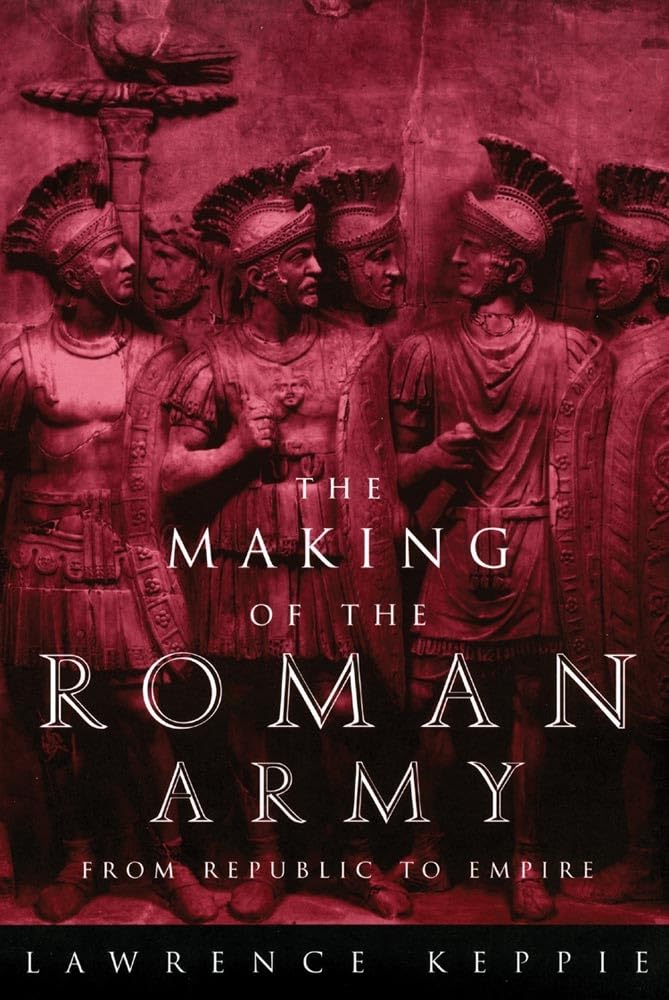
Lawrence Keppie’s “The Making of the Roman Army: From Republic to Empire” (1984) is an informed, well-structured study of one of the most formidable and influential military institutions in world history. From the rudimentary levy-based militias of early Rome to the professionalized, standing legions of the imperial era, Keppie traces the evolution of the Roman army as both a military instrument and a reflection of the political transformations of Rome itself. What emerges is not simply a chronological account of battles and generals, but a comprehensive analysis of organizational, doctrinal, and institutional change across nearly a millennium.
Keppie opens with the army of the early Roman monarchy and the Republic, situating military service within the framework of citizenship and civic duty. In the earliest days, the Roman army was little more than an extension of the landowning citizenry, organized along tribal and property-based lines. The army operated under the principle that those with the most to protect (i.e. the wealthy) had the most to contribute in terms of equipment and manpower. This system found its clearest expression in the Servian reforms of the 6th century BC, which categorized citizens into five classes based on wealth, each responsible for equipping themselves accordingly. The army was essentially a seasonal, ad hoc levy composed of those able to afford arms and armor, with little by way of permanent infrastructure or training.
The next great turning point Keppie addresses is the army’s transformation during the middle and late Republic. The Punic Wars (264–146 BC), and especially the Second Punic War against Hannibal, exposed the limitations of the citizen militia model. Although Rome ultimately triumphed, the war required unprecedented mobilization, long-term deployments, and a level of strategic coordination previously unknown. These pressures catalyzed the first steps toward professionalization. Keppie shows how, even before the famous Marian reforms of the late second century BC, the Roman military was slowly evolving: longer terms of service, state-supplied equipment, and a growing cadre of experienced commanders and soldiers returning from repeated campaigns.
The most dramatic and well-known transformation came with the Marian reforms, instituted by Gaius Marius (157-86 BC), a successful general and ultimately a highly controversial seven-time consul. Keppie devotes considerable attention to Marius not just as a military innovator but as a political actor whose reforms had far-reaching political consequences. Faced with dwindling numbers of property-qualified citizens and increasing military demands on Rome’s frontier, Marius opened army recruitment to the “capite censi” – the headcount, or landless poor. These men had previously been excluded from military service due to their inability to furnish their own equipment.
This change alone would have revolutionized the army, but Marius went further. He standardized equipment and training, introduced a more coherent system of cohort organization (replacing the older maniple system), and instituted the eagle (aquila) as the symbolic heart of each legion. Crucially, Marius also began granting land to veterans upon retirement, thereby establishing a direct bond of loyalty between general and soldier, a development that would have seismic political ramifications in the decades to come. Soldiers became more loyal to their commanders than to the Roman state, a trend that paved the way for the rise of warlords like Sulla, Pompey, and ultimately Julius Caesar.
Keppie is particularly good at illustrating how these changes were not purely military in nature. The Marian reforms emerged in a context of social tension, economic disparity, and political paralysis in the late Republic. Rome’s expansion had created a vast empire governed by a city-state mentality, and the army became both the tool of conquest and the crucible in which Rome’s political order was repeatedly tested and remade. The professional army that Marius forged was necessary to defend and expand Rome’s empire, but it also accelerated the Republic’s internal demise.
The book follows the army through the civil wars of the first century BC, culminating in the rise of Augustus and the establishment of the Principate. Keppie sees Augustus as the second great architect of the Roman military system after Marius. Recognizing both the necessity and danger of the professional army, Augustus demobilized much of the wartime legions but retained a standing army of about 28 legions, each permanently stationed in strategic frontier provinces. Veterans were settled in colonies, and a regularized pension fund (the “aerarium militare”) was established to pay for their retirement.
Keppie emphasizes Augustus’s brilliance in balancing military necessity with political control. To prevent the rise of rival warlords, Augustus placed all legions under the nominal authority of the emperor (as imperator), while limiting the ability of provincial governors to command significant forces. He also reformed the officer class, created a more reliable logistics and supply system, and established permanent military bases along the Rhine, Danube, and Euphrates frontiers. Under Augustus, the Roman army became a fully professionalized institution: salaried, uniformed, and trained.
From a doctrinal perspective, Keppie shows how the transition from Republic to Empire also entailed a shift in strategic thinking. The army was no longer oriented toward episodic, large-scale campaigns of conquest but rather toward garrison duty, frontier defense, and internal policing. The legion became a more flexible and self-contained unit, capable of independent operations across diverse terrains and against various opponents.
Keppie devotes space to the internal structure of the legions during the imperial period. The legions were composed of around 5,000 men, organized into ten cohorts, each consisting of six centuries. Officers were drawn from both the equestrian and senatorial classes, and a clear career path was established for promotion through the ranks. In addition to the legions, auxiliary forces were recruited from the non-citizen populations of the empire, often specializing in cavalry, archery, or light infantry roles. These auxiliaries provided essential support and were gradually integrated into the Roman military system, with citizenship awarded upon completion of service.
Biographical sketches of key military figures add depth to Keppie’s narrative. Beyond Marius and Augustus, figures such as Scipio Africanus, Julius Caesar, and Trajan stand out as individuals who both shaped and were shaped by the Roman military system. Scipio, victorious over Hannibal at Zama, exemplified the adaptive tactical genius that characterized Roman generalship at its best. Caesar, with his brilliant campaigns in Gaul and civil war, demonstrated how military success could translate directly into political power. Trajan, an emperor-general, led Rome to its greatest territorial extent and exemplified the ideal of the warrior-ruler.
Yet Keppie also highlights the costs and limitations of Rome’s military system. The increasingly high cost of maintaining the legions placed growing pressure on the imperial treasury. The army’s role in determining imperial succession through acclamation or assassination contributed to political instability, particularly in the third century AD. The frontier defenses, while formidable, could be stretched thin, and the reliance on non-Roman recruits sometimes led to questions of loyalty and cohesion.
In sum, The Making of the Roman Army is both a scholarly achievement and a narrative delight. Keppie presents a clear argument: the Roman army did not emerge fully formed, but was the result of centuries of adaptation to internal pressures and external challenges. From the Servian census to the Marian reforms, from Augustus’ standing legions to the crises of the later Empire, the Roman army evolved in step with the political and economic currents of Roman society.
Keppie’s great strength lies in his ability to connect organizational and doctrinal changes in the army to broader historical trends. His prose is clear and engaging, and his conclusions are supported by a wealth of archaeological, epigraphic, and literary evidence. For students of Roman history, military studies, or institutional evolution, this book is indispensable. It offers not just a history of battles and reforms, but a window into the soul of Roman power – the legions that built, defended, and, at times, imperiled the Roman world.
 What's Tim Reading Now?
Leave a comment