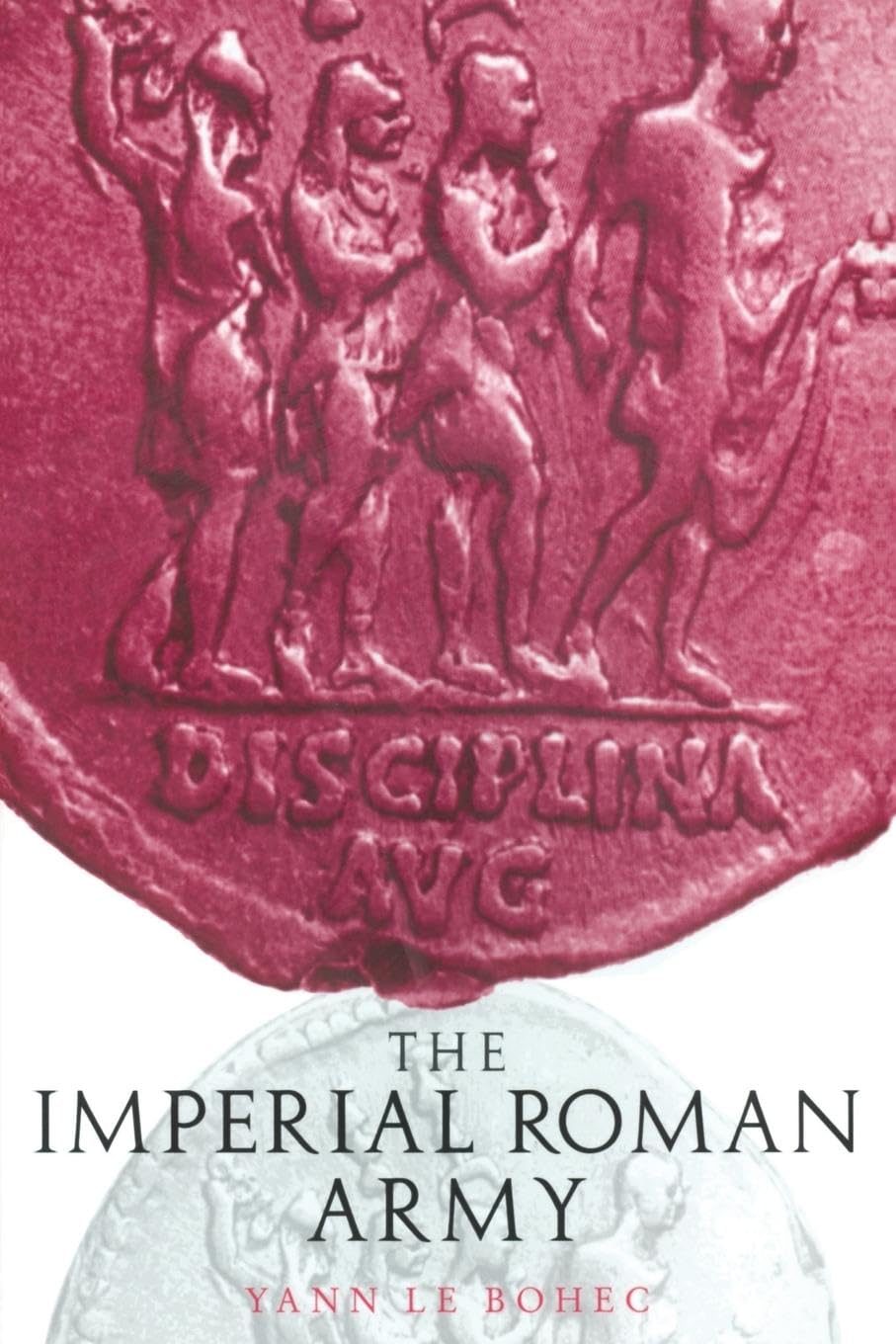
Yann Le Bohec’s “The Imperial Roman Army” (1989) is a sweeping, detailed, and authoritative account of the Roman military during the Empire’s most formative and enduring centuries. Originally published in French and translated into English in 1994, the book quickly became a cornerstone of Roman military studies. Rather than focusing solely on battlefield exploits or singular personalities, Le Bohec provides a broad and systemic portrait of how the Roman army operated as both a fighting machine and a central institution of imperial control, integration, and identity.
The book begins by tracing the army’s origins and its dramatic transformation under Augustus. The Roman military of the early Republic had been a force of seasonal citizen-soldiers, called up in times of need and tied to land ownership. But by the time of the first emperor, Rome had outgrown such an ad hoc arrangement. Augustus professionalized the military, turning it into a standing, salaried force with defined terms of service and a guaranteed payout upon retirement. This created a loyal, career-driven army that became one of the central pillars of imperial power. Le Bohec explains how this transformation laid the groundwork for Roman security and expansion for the next three centuries.
One of the book’s core strengths is its detailed depiction of the army’s structure. Le Bohec covers the recruitment process, the organization of legions and auxiliary units, and even the navy. He explains how legionaries were trained, what they were paid, how they lived, and how they were deployed across the Empire. The auxiliaries – non-citizen troops who were granted citizenship upon discharge – are given particular attention. These units, drawn from the provinces, helped Rome expand without overburdening its core citizenry. In so doing, Le Bohec shows how the Roman army became both an instrument of conquest and a vehicle for social integration.
The operational details are equally fascinating. Le Bohec explores everything from daily drills to grand strategic deployments. He emphasizes the Roman emphasis on discipline, uniformity, and innovation. Tactics such as the “testudo” (tortoise) formation, combined arms coordination with auxiliaries and cavalry, and the use of fortified marching camps reflect a culture deeply invested in military professionalism and unafraid to experiment with new forms of organization and tactics. Le Bohec connects these practices not only to Rome’s battlefield successes but also to the cultural and psychological conditioning of its soldiers.
Beyond combat, Le Bohec emphasizes the army’s economic and political significance. Soldiers built roads, garrisoned provinces, and helped create new cities. Their presence stimulated local economies and established long-term Roman influence far from Italy. Politically, the army played a crucial role in the power struggles of the Empire. Emperors could not afford to lose the loyalty of their troops, and military acclaim often became a ticket to the purple. Le Bohec shows that the Roman army was not just Rome’s sword – it was also its glue.
While Le Bohec’s focus is primarily structural and institutional, he does weave in the stories of key individuals. Augustus, of course, looms large as the architect of the imperial military system. Other figures such as Germanicus (15 BC – 19 AD), a popular general of the early Empire, serve to illustrate the army’s human dimension. These biographical sketches are not the main event, but they provide helpful anchors in a book otherwise focused on systems and reforms.
As the book progresses, Le Bohec traces the army’s evolution through the Principate and into the more chaotic third century. The Flavian (69 to 96 AD) and Antonine (138 to 192 AD) periods saw increased fortification of frontiers and further diversification of the army’s ranks. The third-century crisis brought new challenges, with emperors rising and falling in rapid succession and the army taking an ever more direct role in imperial politics. Le Bohec shows how the military adapted, expanded, and occasionally faltered in response to changing political and geopolitical conditions.
One of Le Bohec’s most valuable contributions is his use of evidence. Drawing on inscriptions, archaeological findings, and classical texts, he builds a rich and multidimensional picture of army life. He includes detailed maps, tables, and diagrams to support his arguments, making the book not only readable but also a reliable reference work. His methodological rigor sets a high standard for scholarship while remaining accessible to general readers.
The book also invites comparison with other ancient and modern military systems. Le Bohec implicitly contrasts Rome’s professional standing army with other models – such as Carthage’s reliance on mercenaries or Persia’s imperial levies – demonstrating how Rome’s system provided both flexibility and cohesion. Moreover, his discussion of how the army served to Romanize the provinces echoes themes in modern discussions about nation-building and military integration.
Le Bohec ends his study with a reflection on the Roman army’s long-term legacy. The army’s structure, discipline, and civic role influenced not only the longevity of the Empire but also modern military thought. The lessons he draws – about the dangers of politicized militaries, the benefits of professionalization, and the risks of overextension – resonate today.
If there is a limitation to the book, it is that Le Bohec focuses more on institutions than on narrative history. Readers looking for detailed accounts of famous battles or the personal exploits of great generals may find the book less dramatic than expected. However, that is not a flaw so much as a choice. Le Bohec’s goal is to explain how the Roman army worked – not just how it fought – and in this he succeeds admirably.
In sum, The Imperial Roman Army is a masterful synthesis of military, political, and social history. It explains how one of the most successful military systems in world history was built, maintained, and adapted over centuries. Le Bohec’s lucid prose, meticulous research, and broad perspective make this an essential read for anyone interested in the Roman Empire, military history, or the intersection of warfare and society. His work reminds us that the story of Rome’s army is not just a story of battles, but of institutions, identities, and enduring legacies.
 What's Tim Reading Now?
Leave a comment