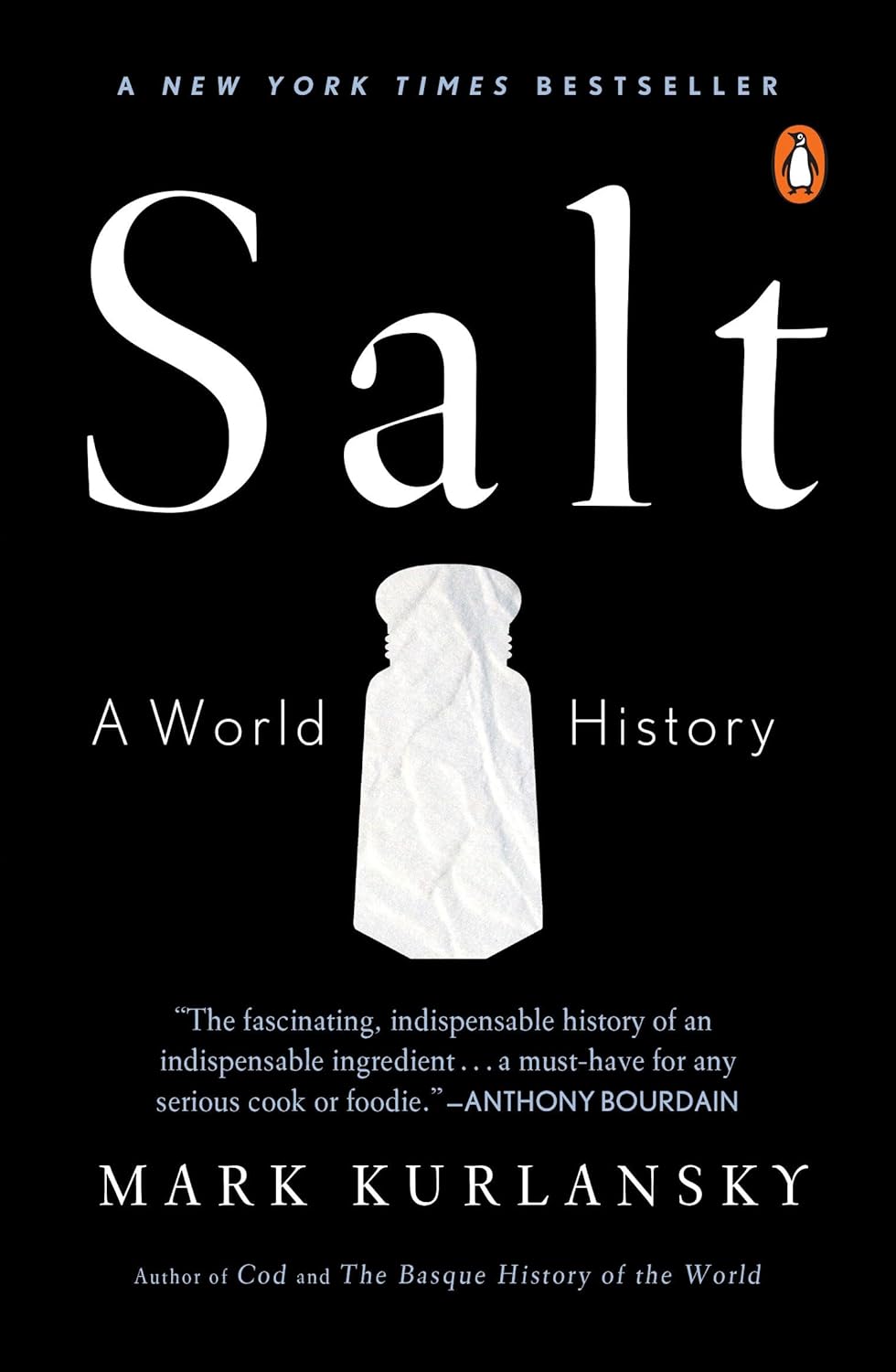
Mark Kurlansky’s “Salt: A World History” (2002) is a sweeping chronicle of how a single mineral – sodium chloride – has profoundly shaped human history. Like his earlier success, “Cod: A Biography of the Fish That Changed the World” (1998), Kurlansky uses a single commodity as a narrative lens through which to examine millennia of global political, economic, cultural, and culinary transformation. But where “Cod” focused on a vital protein source, “Salt” addresses something even more essential: the only rock we eat, a substance critical not just for flavor but for preservation and survival.
The core thesis of “Salt” is that this humble crystal has played a strategic role in human affairs on par with more conventionally glamorous commodities like gold, cotton, sugar, and oil. From Neolithic saltworks to the colonial salt taxes that helped ignite the American, French, and Indian independence movements, Kurlansky argues that salt has not merely accompanied historical change but often catalyzed it.
The book is structured as a global history, divided into three major sections: the ancient world, the medieval world, and the modern era. Each chapter is a stand-alone vignette, rich in anecdote and narrative color, while contributing to the overarching story of how salt has connected empires, fueled wars, shaped trade routes, and underpinned both empire and resistance.
One of the book’s great insights is the centrality of salt to the development of settled civilizations. In ancient China, the state monopoly on salt production funded massive infrastructure projects and helped consolidate imperial power. In Egypt, salt was used in mummification rituals, making it both spiritually and economically vital. The Roman word for salary (“salarium”) is derived from salt, as Roman soldiers were at times paid in it, demonstrating its high value. Cities such as Salzburg and Salina derive their names from salt, and ancient trade routes—like the Via Salaria in Italy—were developed expressly for its transport.
Kurlansky also explores the importance of salt in preserving food, a function that predates refrigeration by millennia. Salted fish, meats, and vegetables not only fed armies and sailors but also enabled longer voyages, thereby facilitating exploration and colonization. This made salt indispensable to the growth of European maritime empires. He devotes significant attention to the production of salted cod, drawing on material from his earlier book to underscore how salt and cod together supported the triangular trade that linked Europe, Africa, and the Americas.
One of the book’s most compelling comparisons is between salt and sugar. Both commodities fueled colonial exploitation and shaped global trade networks. But while sugar consumption exploded in modern times, driven by consumer demand and industrial food processing, salt was already ubiquitous by antiquity. Its value lay not in addiction or pleasure but necessity – it was needed for life and for the preservation of food. Unlike sugar, which became increasingly processed and refined, salt remained relatively simple in form. Yet both commodities were linked to slavery, particularly in the Caribbean, where enslaved Africans labored to produce salted fish and sugar for European markets.
In the modern period, Kurlansky explores how the discovery of underground salt deposits transformed production. The shift from artisanal salt pans and brine wells to large-scale industrial mining marks a shift analogous to that seen with other strategic resources like coal or oil. This shift, while increasing efficiency and output, also marked a turn away from salt as a luxury or sacred substance toward a cheap, industrial input – used in tanning, dyeing, bleaching, and hundreds of other applications. In this way, salt mirrors the fate of cotton, which transformed from a highly valued hand-picked material to the raw fiber of an industrialized, globalized economy.
Kurlansky doesn’t shy away from the darker elements of salt history. He examines how British salt taxes in India became a focal point for anticolonial resistance, culminating in Gandhi’s famous Salt March in 1930. Similarly, he delves into how monopolistic control over salt has often been a tool of authoritarian governance, from ancient empires to Napoleonic France. Just as control over oil pipelines and refineries defines modern geopolitics, control over salt mines and brine springs once determined the fates of empires.
Despite its ambitious scope, the book is grounded in vivid human stories. We learn about medieval Basque fishermen who perfected salt-cured cod, about Venetian traders who controlled Mediterranean salt routes, about New Englanders who built saltworks to undermine British economic control. Each story is well researched and colorfully told, making the book feel less like a textbook and more like popular history, which is exactly what it is.
In comparing salt to other strategic commodities, Kurlansky subtly highlights a paradox: salt has always been vital yet largely invisible in modern consciousness. Unlike gold, which gleams with visible wealth, or oil, which powers engines and economies, salt is an afterthought in most modern homes. Yet as Kurlansky shows, wars have been fought over it, fortunes built and lost on it, revolutions sparked by its regulation.
Perhaps the most poignant theme of the book is how salt’s decline in perceived value mirrors broader transformations in human society. As refrigeration, chemical preservatives, and global supply chains replaced salt’s traditional roles, its economic and political significance waned. But rather than diminish the book’s subject, this decline enhances the reader’s appreciation for how radically the world has changed – and how central salt once was to its workings.
“Salt: A World History” is not without its critics. Some reviewers have noted that Kurlansky’s episodic structure can at times feel disjointed, and his narrative occasionally sacrifices depth for breadth. But these are minor quibbles in a work of such ambition. His writing is consistently engaging, his research respectable, and his curiosity infectious.
In sum, “Salt” is a thoughtful meditation on the hidden currents that shape human civilization. It stands alongside other great commodity histories – like Sidney Mintz’s “Sweetness and Power” (on sugar), Sven Beckert’s “Empire of Cotton,” Peter Bernstein’s “The Power of Gold,” and Kurlansky’s own “Cod” – as a testament to the profound impact of natural resources on human destiny. For readers interested in history, economics, food, or geopolitics, “Salt” is highly recommended reading. It reminds us that sometimes the most powerful forces in history come not with a roar, but in a crystal pinch.
 What's Tim Reading Now?
Leave a comment