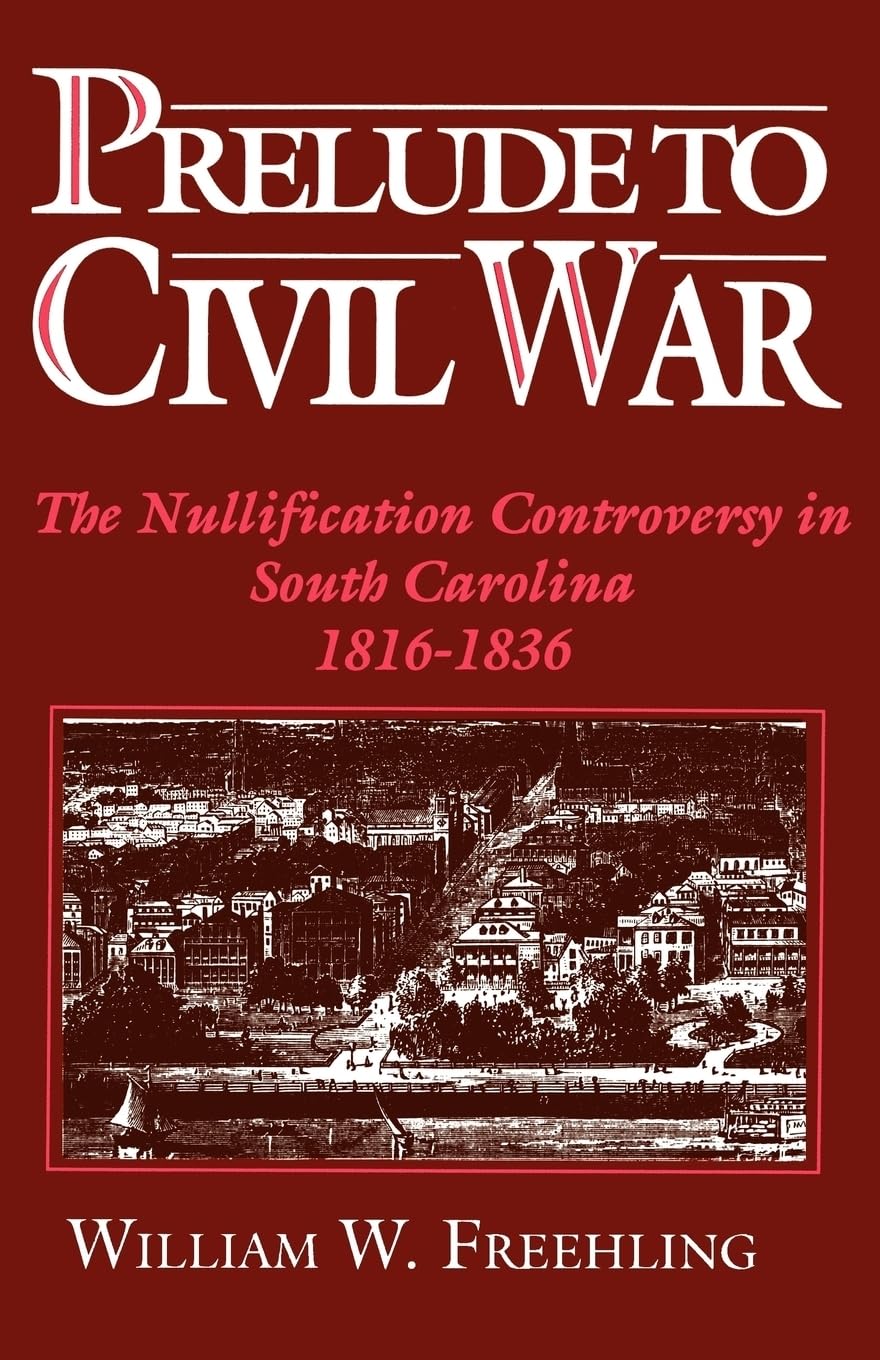
William W. Freehling’s Prelude to Civil War: The Nullification Controversy in South Carolina, 1816-1836 (1965) by William W. Freehling (1965) remains a foundational text in the study of antebellum American political development. In fewer than two hundred pages, Freehling delivers a penetrating and nuanced examination of one of the most consequential constitutional and political showdowns in American history: South Carolina’s attempt in the early 1830s to nullify federal tariff laws. The book not only explores the political and economic dimensions of the crisis but also places it in the broader context of sectional tensions, constitutional interpretation, and the evolving concept of union. The Nullification Crisis, Freehling argues, was not merely a regional dispute over tariffs but a defining episode in the nation’s ongoing struggle to balance state and federal power. Freehling’s core argument is that the nullification controversy in South Carolina served as a prelude to the Civil War – not merely because of tariff laws, but because it revealed, sharpened, and institutionalized the conflicts over slavery and state versus federal power.
At the heart of the crisis was the Tariff of 1828, dubbed the “Tariff of Abominations” by its southern critics. This legislation imposed steep duties on imported goods, designed to protect burgeoning industries in the North. Southern states, particularly South Carolina, saw the tariff as economically ruinous. Their economies relied heavily on the export of agricultural products, especially cotton, and they imported many manufactured goods. High tariffs raised the prices of those goods and threatened retaliatory tariffs on southern exports by foreign nations. For many in South Carolina, the tariff system seemed to benefit Northern manufacturers at the expense of Southern planters.
Freehling examines South Carolina’s internal transformations – especially the economic distress following the Panic of 1819, declining commodity prices, burdensome mortgages, and specie drain – which destabilized the old planter-dominated social order. Yet he emphasizes that many sectors suffering economically (up-country farmers, merchants) joined the nullification cause even though their direct interest in the tariffs was limited, making the movement more complex than simply “rich planters vs. tariff.” Freehling traces how South Carolina moved from a posture of U.S. nationalism (especially after the War of 1812) toward aggressive sectionalism by the mid-1830s. He shows how leaders like John C. Calhoun evolved – publicly committed to the Union yet privately preparing for state sovereignty and resistance to federal law. Thus, the nullification controversy became a stepping stone toward the more radical secessionist ideology that would dominate by 1860.
Freehling gives careful attention to the economic grievances driving nullification. He documents the discontent among South Carolina’s planter elite, who viewed the federal tariff policy as a form of economic exploitation. But he also shows that these economic concerns were tightly intertwined with deeper political and ideological anxieties. South Carolinians, particularly followers of John C. Calhoun, feared that federal overreach in economic affairs might soon extend to other domains, especially slavery. Nullification, in this light, was not just a protest against tariffs but a preemptive strike against what many southern leaders perceived as a dangerous trajectory toward centralized power and potential abolitionism. In other words, the state’s elite did not simply resist high tariffs; they feared that the federal government (or northern public opinion) might one day interfere with slavery – and they saw nullification as a defensive shield.
Politically, Freehling offers a vivid portrayal of the key figures and factions that shaped the crisis. Central among them is Calhoun, Vice President under Andrew Jackson, who anonymously authored the “South Carolina Exposition and Protest,” laying out the doctrine of nullification. According to Calhoun, the US Constitution was a compact among sovereign states, each of which retained the authority to judge the constitutionality of federal laws. If a state deemed a law unconstitutional, it could nullify it within its borders. Freehling details how the nullifiers in South Carolina used political institutions (malapportioned state legislature, “test oaths” of allegiance, state conventions) to press their agenda. In the author’s estimation, the Ordinance of Nullification (1832) and subsequent actions were less about immediate tariff relief than about establishing state supremacy.
Freehling is careful not to oversimplify Calhoun’s motivations or ideas. He presents Calhoun as a complex thinker whose constitutional theories were grounded in a sincere commitment to preserving the Union, albeit on southern terms. At the same time, Freehling notes the inherent contradictions in Calhoun’s logic: nullification, while presented as a mechanism to protect minority rights and maintain the Union, actually threatened national cohesion by inviting constitutional chaos.
The crisis reached its peak in late 1832, when a specially convened South Carolina convention declared the federal tariffs of 1828 and 1832 null and void within the state. Jackson responded swiftly and forcefully. Although a slaveholder himself and generally sympathetic to southern concerns, Jackson was a staunch unionist. He denounced nullification as treasonous and sent federal troops to South Carolina, threatening to use force if necessary to ensure compliance with federal law. He also pushed through Congress the Force Bill, authorizing the use of military power to enforce tariff collection.
But Jackson simultaneously worked toward a compromise. With the help of Henry Clay, Congress passed the Compromise Tariff of 1833, which gradually reduced tariff rates over the following decade. Faced with the dual pressures of Jackson’s military threats and the promise of lower tariffs, South Carolina backed down. The nullifiers rescinded their ordinance, though in a final gesture of defiance, they nullified the Force Bill – a symbolic act that underscored their commitment to states’ rights, even in defeat.
Freehling praises Jackson’s deft handling of the crisis, which he sees as a model of political balancing. Jackson upheld federal authority without resorting to outright war, while also acknowledging southern economic grievances. Clay’s role is also recognized as essential: his compromise tariff allowed both sides to save face and de-escalated a potentially catastrophic conflict.
In terms of legacy, Freehling argues that the Nullification Crisis had several lasting effects on American political development. First, it marked a decisive assertion of federal supremacy over the states in matters of constitutional interpretation. The idea that individual states could unilaterally nullify federal laws was decisively rejected. Second, the crisis cemented Jackson’s image as a powerful and determined executive, laying the foundation for a more assertive presidency.
Yet the crisis also had more ominous implications. Freehling emphasizes that while nullification failed, the underlying sectional tensions it exposed did not disappear. Instead, they deepened in the coming decades, particularly as the issue of slavery became more divisive. Many southerners drew a lesson opposite from Jackson’s: that peaceful constitutional resistance to federal policy was futile. By the 1850s, the logic of nullification had evolved into the logic of secession.
From a broader historical perspective, the Nullification Crisis foreshadowed the American Civil War. It was a dress rehearsal for the kinds of constitutional, political, and economic arguments that would eventually tear the Union apart. Freehling’s analysis reveals how the crisis highlighted the fragility of American federalism and the difficulty of maintaining unity in a nation divided by region, economy, and ideology.
The Nullification Crisis remains relevant not just as a study of a specific historical moment but as a case study in the enduring tension between state and federal power. Freehling’s meticulous research, balanced analysis, and lucid prose make the book accessible to both scholars and general readers. His ability to weave together political theory, economic interest, and personal ambition provides a rich, multidimensional understanding of the crisis.
In conclusion, William Freehling’s The Nullification Crisis offers a compact but deeply insightful account of one of the early republic’s most important constitutional struggles. By examining the crisis from multiple perspectives – economic, political, ideological – Freehling sheds light on the complexities of American governance and the persistent challenges of federalism. The crisis may have ended in compromise, but its reverberations would be felt for decades, culminating in the far greater conflict of the Civil War. As such, the book is essential reading for anyone seeking to understand the roots of American disunion and the perennial conflict between local autonomy and national authority.
 What's Tim Reading Now?
Leave a comment