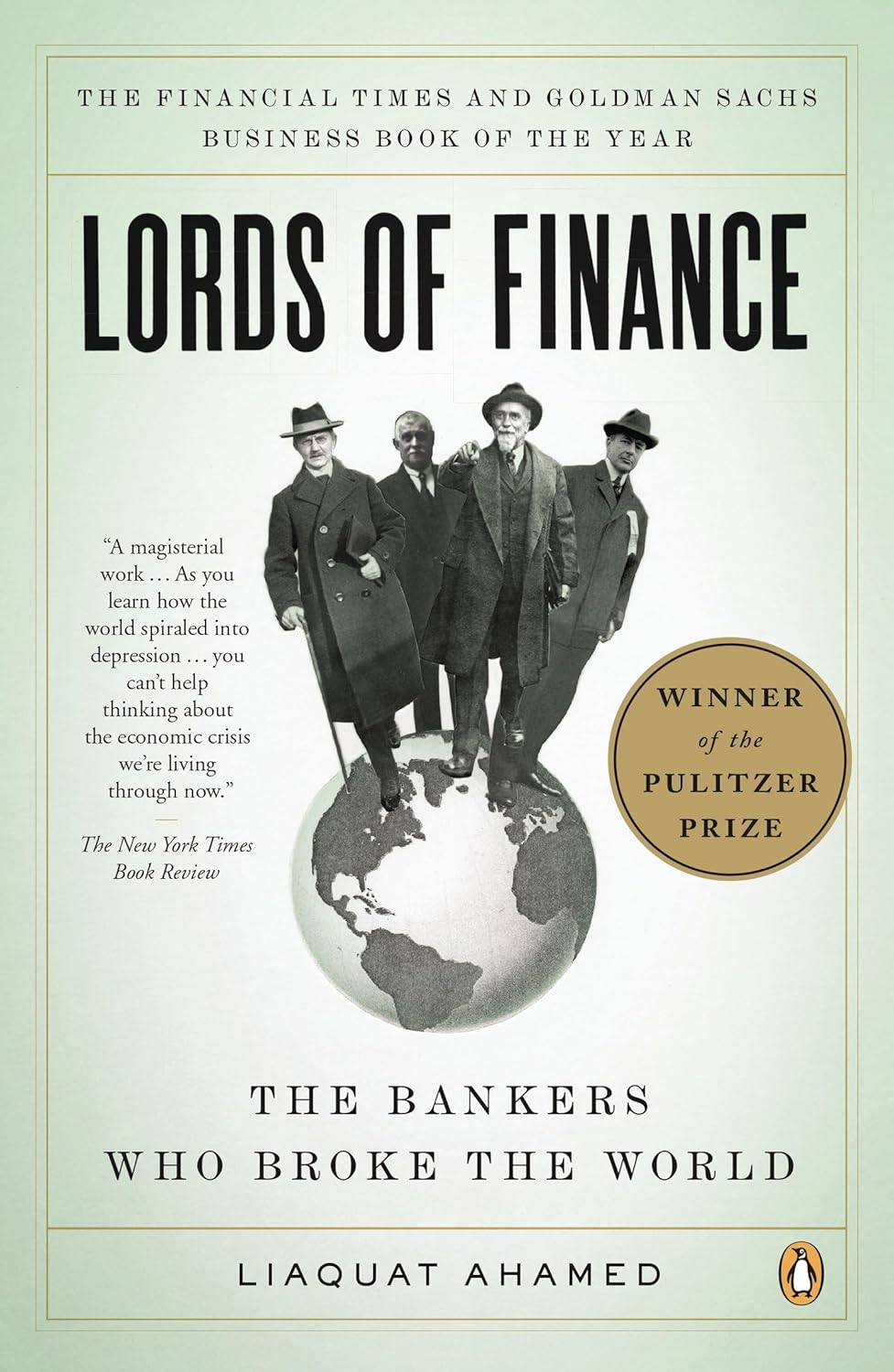
Liaquat Ahamed’s Pulitzer Prize-winning book, “Lords of Finance: The Bankers Who Broke the World” (2009), is a masterfully written and deeply insightful narrative of the economic and political turbulence that defined the early twentieth century. With the precision of a historian and the storytelling flair of a novelist, Ahamed traces the actions and missteps of four central bankers whose decisions, he argues, helped turn the global economic downturn of the 1920s and 1930s into the Great Depression. The book is both a sweeping historical account and a sobering meditation on the fragility of global finance.
At the heart of the narrative are four men: Montagu Norman of the Bank of England, Benjamin Strong of the Federal Reserve Bank of New York, Emile Moreau of the Banque de France, and Hjalmar Schacht of the Reichsbank. Each of these individuals held outsized influence over their nations’ economic policies during the interwar period. Ahamed portrays them as deeply committed, often brilliant, but ultimately fallible human beings whose adherence to outdated economic orthodoxy and personal biases led to catastrophic consequences.
The central theme of Lords of Finance is the gold standard and its role in deepening the global economic crisis. After World War I, the world’s major powers attempted to return to the prewar gold standard, believing it to be the foundation of international economic stability. However, the economic landscape had changed dramatically: wartime debts, reparations, and inflation had destabilized the financial systems of Europe, while the United States had emerged as the world’s dominant creditor. Nevertheless, under pressure from their political leaders and their own belief in the sanctity of gold, central bankers insisted on returning to the old system.
Ahamed provides a compelling argument that the re-imposition of the gold standard was fundamentally flawed. The gold standard required countries to maintain fixed exchange rates and restricted their ability to respond flexibly to economic crises. In practice, this meant that struggling economies could not devalue their currencies or adopt expansionary monetary policies to combat unemployment and deflation. Countries that clung to the gold standard, Ahamed shows, endured far deeper economic contractions than those that abandoned it, such as Great Britain in 1931.
Politically, the book reveals the limitations of elite-driven decision making in a democratic age. Ahamed carefully examines the ways in which central bankers, while operating ostensibly above politics, were in fact deeply enmeshed in the political struggles of their time. They were not immune to nationalistic pressures, personal rivalries, or the weight of public opinion. For instance, the insistence on German reparations and French occupation of the Ruhr in 1923 not only worsened the German economy but also contributed to political radicalization that would eventually culminate in the rise of Adolf Hitler.
Economically, Ahamed details how rigid commitment to the gold standard created a deflationary spiral. The Great Depression, he argues, was not merely the result of a stock market crash but a series of compounded monetary policy mistakes. One of the most critical moments in the book is the death of Benjamin Strong in 1928. Ahamed describes Strong as a moderate voice who understood the importance of liquidity and had successfully managed U.S. monetary policy throughout the 1920s. His absence, Ahamed suggests, left the Federal Reserve rudderless at a time when bold leadership was most needed.
The interwar years were a time of significant global economic imbalance. The U.S. and France held vast gold reserves, while Germany and Britain struggled with debt and trade deficits. Ahamed explains how this imbalance created a deflationary bias in the international monetary system. With the major creditor nations unwilling to adjust or expand liquidity, the debtor nations were forced into austerity, which exacerbated unemployment and social unrest. These dynamics mirror, in many respects, the sovereign debt crises of the early 21st century, giving the book a sense of contemporary urgency.
Ahamed is also attentive to the human dimension of these economic events. His portraits of the four central bankers are nuanced and compelling. Montagu Norman, for example, is depicted as eccentric and emotionally fragile, yet deeply dedicated to the ideal of international cooperation. Schacht is presented as a financial wizard whose nationalism and opportunism foreshadowed darker developments in Germany. The book excels in showing how individual psychology intersected with structural economic forces, making the events it recounts feel both inevitable and tragically avoidable.
The long-term legacy of the events described in Lords of Finance is significant. Ahamed argues that the failures of the interwar central bankers shaped the future of economic policy in profound ways. The collapse of the gold standard discredited fixed exchange rates and led to the rise of Keynesian economics, with its emphasis on active government intervention and monetary flexibility. Institutions like the International Monetary Fund and World Bank, established after World War II, were designed to prevent the kinds of imbalances and coordination failures that plagued the 1920s and 1930s.
Modern central banking, Ahamed implies, is the product of hard-earned lessons. Today, central banks understand the dangers of premature tightening, the need for international coordination, and the importance of liquidity in times of crisis. Yet the 2008 financial crisis, which occurred shortly before the book’s publication, serves as a reminder that those lessons can be forgotten. Ahamed ends the book with a warning: economic history is not linear, and the hubris of elites can always return.
One of the great strengths of Lords of Finance is its accessibility. Ahamed, a former investment manager with a background in economics, writes with clarity and elegance. He avoids jargon, making complex monetary concepts understandable to the general reader without sacrificing analytical depth. His command of archival sources and secondary literature is impressive, but he never overwhelms the reader with footnotes or tangents. The book is structured chronologically and punctuated by vivid anecdotes, which keep the narrative moving even as it tackles weighty material.
Critics have occasionally noted that Ahamed’s focus on central bankers may underplay other important factors in the Great Depression, such as structural weaknesses in the global economy, trade protectionism, or the rise of populist politics. But the narrow scope of the book is also its strength: by zeroing in on the actions of four individuals, Ahamed is able to draw clear connections between policy decisions and economic outcomes. In doing so, he restores agency to historical actors and challenges the notion that the Depression was simply the result of impersonal market forces.
Lords of Finance is not just a history of economics; it is a history of power, ideology, and the unintended consequences of well-meaning decisions. It demonstrates how central banking, once a highly secretive and technical domain, has enormous implications for global stability. The book serves as a cautionary tale about the limits of expertise and the importance of humility in the face of complex systems.
In conclusion, Liaquat Ahamed’s Lords of Finance is a landmark work of financial history. It combines rigorous scholarship with narrative flair to tell a story that is as dramatic as it is instructive. By illuminating the failures of interwar central banking, Ahamed provides invaluable insights into the practice of modern economic policy and the enduring challenge of managing global finance. For anyone interested in the intersection of politics, economics, and history, this book is essential reading.
 What's Tim Reading Now?
Leave a comment