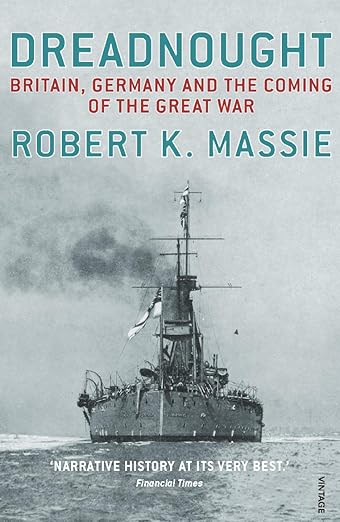
Robert K. Massie’s “Dreadnought: Britain, Germany, and the Coming of the Great War” (1991) is a monumental achievement in narrative history, weaving together biography, diplomacy, military innovation, and geopolitical rivalry into a compelling and deeply human account of the path to World War I. It stands as one of my all-time favorite books.
At its core, the book is not just about ships or strategies but about people – ambitious, brilliant, flawed individuals who shaped the fate of empires. Through Massie’s sweeping prose and solid research, Dreadnought presents the Anglo-German naval rivalry not merely as a technological arms race but as a psychological and political drama that unfolded between two great nations and their leaders.
At the heart of Dreadnought lies the argument that the Anglo-German naval arms race, driven by technological innovation and national insecurity, became the clearest expression of a broader struggle for dominance in Europe. For Germany, under the erratic and insecure Wilhelm II, building a world-class navy was a bid for global respect and colonial parity. For Britain, long accustomed to its maritime supremacy, any challenge to naval dominance posed an existential threat. Massie paints this naval competition not just as an arms race but as a symbolic contest of national identity and imperial ambition.
Massie begins his narrative with the birth of Queen Victoria (1819-1901) and traces the intertwined destinies of Britain and Germany through the late 19th and early 20th centuries. He sets the stage by introducing the reader to the complex web of alliances, rivalries, and shifting power dynamics that characterized European politics. The rise of Germany as a unified state under Bismarck, the ambitions of Kaiser Wilhelm II, and Britain’s struggle to maintain its global dominance form the backdrop against which the naval competition plays out.
Beyond the naval race, Massie places the story within the broader context of European history. He covers major events such as the Boer War, the Kruger Telegram, the Boxer Rebellion, and the assassination of Archduke Franz Ferdinand, showing how each contributed to the growing tensions between Britain and Germany. The book also explores the role of public opinion and propaganda in shaping the attitudes of both nations, with chapters devoted to the popular fear of invasion in Britain and the rise of anti-German sentiment.
Massie is one of my favorite authors and all of his books are distinguished by their rich portraits of the key figures who shaped the period. Dreadnought is no exception. Massie’s central argument is that the Anglo-German naval competition was ultimately character-driven. He contends that the rivalry was propelled as much by personality, pride, and misunderstanding as by strategic calculation.
Four characters in Massie’s sweeping narrative particularly stand out. First is the German emperor, Kaiser Wilhelm II (1859-1941). The Kaiser emerges as a central, tragic figure – a man of great ambition and insecurity, haunted by a withered arm and a desire to prove himself on the world stage. Massie paints him as impulsive, tactless, and often blinded by his quest for “Weltmacht” (world power). Consumed by emotional instability and a desperate need for validation, the Kaiser’s fascination with the British Royal Navy, stemming from childhood visits to Portsmouth, leads him to directly challenge British naval supremacy, a decision that would have disastrous consequences.
Second is Alfred von Tirpitz (1849-1930), the architect of the German naval expansion. Tirpitz is portrayed as a visionary and a shrewd political operator. His “Tirpitz Plan” aimed to build a “Risk Fleet” powerful enough to threaten Britain’s sea supremacy, thus deterring British intervention in a continental war. Yet Massie demonstrates how this logic, while superficially rational, failed to account for British resolve and the deep cultural and strategic imperative Britain placed on naval dominance. The end result was not deterrence but rather escalation.
Third is Admiral Jacky Fisher (1841-1920), who served as First Sea Lord (the professional head of the Royal Navy) from 1904 to 1910, during which he pushed through major and controversial reforms to the tradition-bound Royal Navy. In Dreadnought, Massie portrays Fisher as a visionary disruptor – deeply polarizing, often abrasive, but ultimately transformative. In addition to revolutionizing ship design with the HMS Dreadnought and the introduction of the Battlecruiser, he also decommissioned hundreds of obsolete ships, redistributed the fleet more toward home waters, elevated the status of technical knowledge and meritocracy over aristocratic birth or patronage in officer promotions, and emphasized modern gunnery training and war games to simulate naval engagements. Fisher emerges as one of the most dynamic and forward-thinking characters in the book, a man of volcanic energy and radical ideas. His crowning achievement, the commissioning of HMS Dreadnought in 1906, revolutionized naval warfare. This single ship, with its all-big-gun armament, steam-powered turbines, and unprecedented speed, rendered existing battleships obsolete overnight and reset the strategic calculus for every naval power.
Finally there is the incomparable Winston Churchill (1874-1965). As the young and ambitious First Lord of the Admiralty he demonstrated dynamic leadership and played a crucial role in the further development of the dreadnought class and the escalation of the naval race. The future prime minister was a leading political cheerleader for the disruptive activities of Jacky Fisher.
The narrative also brings to life a host of other influential personalities, including Otto von Bismarck, Lord Salisbury, Edward VII, Joseph Chamberlain, Arthur Balfour, H. H. Asquith, David Lloyd George, and Sir Edward Grey. Each is given enough space for the reader to appreciate their contributions and limitations.
Massie emphasizes the critical role played by these powerful personalities. He argues that the decisions of individual leaders – especially Kaiser Wilhelm II and Admiral Fisher – had an outsized impact on the course of events. Wilhelm’s insecurity and desire for recognition, Fisher’s zeal for reform, and Churchill’s ambition all contributed to the escalation, as did consistent miscommunication. The book repeatedly underscores how misunderstandings and misperceptions between the main characters fueled the arms race. Each side misinterpreted the other’s intentions, leading to a spiral of suspicion and hostility.
Massie explains how the launch of the revolutionary HMS Dreadnought rendered all previous battleships obsolete and reset the terms of naval competition. The British hoped that this technological leap would maintain their naval superiority. Instead, it spurred Germany to redouble its own shipbuilding efforts. Massie explores how the launch of the Dreadnought triggered a second phase of the arms race, as Germany scrambled to match Britain’s technological leap. Every new class of battleship became a test of national strength and will. Massie suggests that this cycle of innovation and counter-innovation deepened mutual suspicion, creating a climate in which diplomatic solutions grew harder to sustain.
Another key theme is how technological change outpaced diplomatic institutions. The advent of the Dreadnought class, submarines, and wireless communication created a rapidly shifting military environment that politicians and diplomats were often ill-equipped to manage. Massie implies that military innovation can destabilize international politics when not matched by corresponding innovations in diplomacy and statecraft.
Massie meticulously details the diplomatic and political maneuvers that accompanied the naval race. He describes how Germany’s desire for a “place in the sun” and its pursuit of a powerful fleet alarmed Britain, leading to the abandonment of its policy of “splendid isolation” and the formation of new alliances. It is all reminiscent of the ongoing US-Chinese military and economic rivalry in the midst of revolutionary technological changes wrought by artificial intelligence and autonomous vehicles and drones. The book explores the interplay between public opinion, political leadership, and military strategy, showing how each influenced the other in a feedback loop of suspicion and hostility, another parallel to today’s great power competition in the east.
The author places significant emphasis on the Moroccan and Agadir Crises as critical diplomatic flashpoints that deepened Anglo-German antagonism and exacerbated the naval arms race. Massie recounts how the HMS Dreadnought launched less than a year after the First Moroccan Crisis (1905–1906) when Germany challenged France’s claim to influence in Morocco, seeking to test the strength of the newly forged Entente Cordiale between Britain and France. He highlights Kaiser Wilhelm II’s dramatic intervention – the famous “Tangier Crisis” – when the Kaiser visited Tangier and publicly supported Moroccan independence, directly challenging French ambitions. Massie frames this as a calculated German attempt to drive a wedge between Britain and France, thereby weakening the alliance that threatened Germany’s position in Europe. However, Germany’s gambit backfired: instead of splitting Britain and France, the crisis drew them closer together. Massie points out that this episode led to the first serious staff talks between the British and French militaries and marked the beginning of coordinated planning against Germany, both on land and at sea.
Massie also details the Second Moroccan Crisis, known as the Agadir Crisis (1911), when Germany again challenged French influence in Morocco by sending the gunboat Panther to Agadir. This move was intended to assert Germany’s rights and extract colonial concessions from France. However, Massie underscores that Britain, under the leadership of figures like David Lloyd George and Winston Churchill, responded with a firm warning to Germany, signaling that Britain would not tolerate any threat to its interests or those of France. Massie describes how the Agadir Crisis intensified British fears of German aggression and expansionism, further solidifying the Anglo-French alliance and further accelerating the naval arms race.
Massie argues that these crises had a profound impact on the naval arms race between Britain and Germany. The Moroccan Crises demonstrated to the British government and public that Germany was a growing threat to British security and global interests. This perception fueled British determination to maintain naval supremacy and to respond decisively to German shipbuilding programs.
The crises also had a reciprocal effect in Germany. The failure to achieve diplomatic victories in Morocco led to increased pressure on Kaiser Wilhelm II and the German government to bolster both the army and the navy. Massie notes that after each crisis, German nationalist and militarist factions – such as the Navy League and the Army League – gained influence, pushing for even greater military expansion. The Kaiser, stung by diplomatic setbacks, vowed not to back down again, setting the stage for further escalation.
Massie’s narrative suggests that the Moroccan and Agadir Crises were not merely colonial disputes but pivotal moments that shaped the strategic and psychological landscape of Europe. They reinforced mutual suspicion between Britain and Germany, accelerated military and naval planning on both sides, and contributed to the sense of inevitability surrounding the outbreak of World War I. Massie emphasizes that these crises were as much about prestige, alliance dynamics, and domestic politics as they were about territorial or economic interests.
In summary, Massie portrays the Moroccan and Agadir Crises as catalysts that transformed the Anglo-German naval competition from a technical arms race into a broader struggle for power, influence, and survival. These crises not only deepened the divide between Britain and Germany but also set in motion the alliance structures and military preparations that would ultimately lead to war.
In closing, Massie’s massive narrative is a sweeping, character-driven examination of how pride, insecurity, innovation, and strategic misjudgment helped lead Europe into catastrophe. It is both a cautionary tale and a tribute to the complexity of history. It is a story of innovation and hubris, of ambition and misunderstanding, and ultimately, of the tragic cost of war. For anyone seeking to understand the origins of World War I, or the dynamics of great power rivalry, Dreadnought is an essential and compelling read.
 What's Tim Reading Now?
Leave a comment