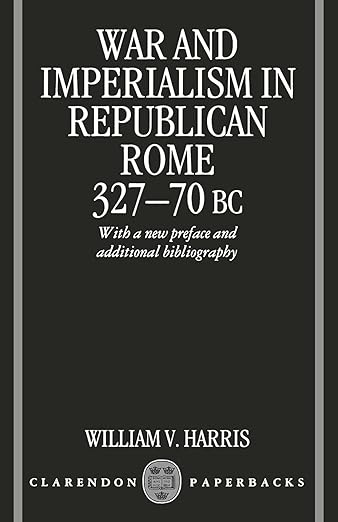
In the landscape of Roman historical scholarship, few works have proven as influential or controversial as William Harris’s “War and Imperialism in Republican Rome: 327-70 BC” (1979). This seminal study fundamentally challenged prevailing academic orthodoxy about the nature of Roman expansion, arguing that Rome’s imperial growth was driven not by defensive necessity or reluctant responses to external threats, but by an aggressive, systematic pursuit of conquest motivated by deeply embedded cultural values and material incentives. Harris’s thesis represents a radical departure from the “defensive imperialism” model that had dominated scholarly discourse for decades, offering instead a portrait of Rome as an inherently militaristic society that actively sought war and territorial expansion. The author’s general thesis is completely convincing and has fundamentally shaped my understanding of Roman history.
Harris’s work emerged at a crucial moment in Roman historiography, when traditional interpretations of Roman imperialism were beginning to show their age. The conventional wisdom, largely established by German scholars in the late 19th and early 20th centuries and refined by subsequent generations of historians, portrayed Roman expansion as essentially defensive in nature. According to this model, Rome reluctantly acquired its empire through a series of responses to external threats, gradually assuming responsibilities it had never actively sought. This “defensive imperialism” theory suggested that Rome’s leaders were cautious, generally peaceful administrators who preferred diplomacy to warfare and only fought when absolutely necessary to protect Roman interests or allies.
Harris dismantled this conventional wisdom, arguing instead that Roman society was fundamentally oriented toward warfare and conquest. His central thesis holds that Roman imperialism between 327 and 70 BC was characterized by aggressive expansionism driven by a combination of cultural factors – particularly the Roman aristocracy’s obsession with military glory and the personal social and political benefits associated with military conquest – and economic motivations, including the pursuit of booty, slaves, and tribute. This argument represented a paradigm shift in understanding Roman motives and methods.
One of Harris’s most compelling arguments concerns the cultural imperatives that drove Roman expansion. He demonstrates how Roman society, particularly its ruling elite, was structured around the pursuit of military glory and the prestige that came with successful warfare. The Roman cursus honorum – the well-defined ladder of political advancement – was intimately connected to military achievement, with consulships and other high offices serving as rewards for successful generals. Harris shows how this system created powerful incentives for Roman politicians to seek out military commands and actively pursue warfare.
The author provides evidence for this cultural militarism through his analysis of Roman historical sources, particularly the works of Livy and other ancient historians who recorded the speeches and motivations of Roman leaders. Harris examines the language used to describe warfare in Roman sources, noting how consistently Roman authors present war as glorious and desirable rather than as a regrettable necessity. He cites numerous examples of Roman commanders who actively sought out conflicts, often manipulating diplomatic situations to create pretexts for war.
A particularly striking example Harris employs is the Roman handling of the Gallic wars under various commanders before Caesar’s famous campaigns. He shows how Roman generals consistently escalated conflicts with Gallic tribes, not because Rome faced existential threats from the north, but because successful campaigns against the Gauls offered opportunities for glory, booty, and political advancement. The pattern emerges clearly: Roman commanders would provoke incidents, interpret ambiguous situations as threats to Roman interests, and then launch “defensive” campaigns that invariably resulted in territorial expansion and the enslavement of conquered populations.
Harris’s analysis of the economic dimensions of Roman imperialism represents another major contribution to scholarly understanding. While previous historians had acknowledged that Romans benefited materially from their conquests, Harris argues that these economic incentives were not merely incidental benefits but primary motivating factors. He presents evidence showing how warfare provided Roman elites with enormous wealth through the acquisition of booty, slaves, and ongoing tribute payments from conquered territories.
The author’s treatment of the Roman slave economy is particularly illuminating. Harris demonstrates how military campaigns served as the primary source of slaves for the Roman economy, with successful wars regularly producing tens of thousands of captives who were sold into slavery. He cites specific examples, such as the aftermath of the Third Punic War, when the destruction of Carthage in 146 BC resulted in the enslavement of the city’s entire surviving population – some 50,000 people according to ancient sources. The author argues that this was not an exceptional case but rather representative of standard Roman practice following successful sieges.
Harris also examines the systematic extraction of tribute from conquered territories, showing how Roman expansion created a self-perpetuating cycle of conquest and exploitation. The wealth gained from one successful campaign provided the resources necessary to fund subsequent military operations, while the need to maintain control over existing conquests required continued military presence and often led to further expansion. His analysis of Roman activities in Spain provides a particularly compelling example of this dynamic, showing how initial Roman involvement in the Iberian Peninsula during the Second Punic War evolved into centuries of warfare aimed at extracting silver and other resources from Spanish territories.
One of Harris’s most significant methodological contributions lies in his critical approach to ancient sources. Rather than accepting at face value the justifications for warfare provided by Roman historians, Harris subjects these accounts to rigorous analysis, revealing the gap between stated motivations and actual Roman behavior. He demonstrates how Roman authors consistently portrayed Roman wars as defensive responses to external aggression, even when the evidence clearly indicates Roman initiative in starting conflicts.
Harris’s examination of the Third Macedonian War (171-168 BC) provides an illuminating case study in this methodology. Traditional accounts, following Roman sources, portrayed this conflict as a necessary response to the aggressive policies of King Perseus of Macedon. Harris shows, however, that the evidence suggests Roman senators actively sought a pretext for war against Macedonia, manipulating diplomatic communications and interpreting neutral actions as hostile gestures. The war’s aftermath – the dissolution of the Macedonian kingdom and the transportation of thousands of Macedonians to Italy as hostages – reveals the true Roman objective: the complete elimination of Macedonian power rather than merely defensive action against supposed threats.
Harris also provides insights into how Roman political institutions facilitated and encouraged aggressive expansion. He analyzes the role of the Senate in war-making decisions, showing how senatorial debates consistently favored military action over diplomatic solutions. The author demonstrates how the Roman system of annual magistracies created pressure for quick military victories, as commanders had limited time to achieve the successes necessary for political advancement.
The triumph ceremony receives particular attention in Harris’s analysis as both a symbol and a driving force of Roman imperialism. He shows how the elaborate public celebrations of military victory served not only to honor successful commanders but also to reinforce cultural values that celebrated conquest and military achievement. The triumph became a powerful incentive for Roman nobles to seek military commands and pursue aggressive policies that would qualify them for this ultimate honor.
Harris’s examination of the Roman handling of Italian allies provides another window into Roman institutional approaches to expansion. He shows how Rome’s alliance system, often portrayed by earlier historians as evidence of Roman moderation and diplomatic skill, actually served as a mechanism for controlling conquered populations and extracting military service. The Social War (91-87 BC) emerges in Harris’s analysis not as an unfortunate breakdown in Roman-Italian relations but as the inevitable result of Roman exploitation of allied manpower for imperial expansion.
Throughout his work, Harris provides detailed reanalyses of major Roman conflicts that challenge traditional interpretations. His treatment of the Punic Wars, for instance, questions the standard narrative of Roman defensive responses to Carthaginian aggression. While acknowledging that Hannibal’s invasion of Italy represented a genuine threat to Roman survival, Harris argues that Roman policies before and after the Second Punic War reveal consistent patterns of aggressive expansion rather than defensive necessity.
The destruction of Carthage in 146 BC receives particularly close attention as an example of Roman brutality motivated by economic and strategic considerations rather than security concerns. Harris shows how Cato the Elder’s famous declaration that “Carthage must be destroyed” reflected Roman determination to eliminate a commercial rival rather than respond to any genuine military threat. The systematic destruction of the city and the enslavement of its population exemplified Roman methods of dealing with potentially troublesome competitors.
Harris’s analysis of Roman expansion in the eastern Mediterranean provides additional support for his thesis. He examines Roman interventions in Greece and Asia Minor, showing how Roman commanders consistently escalated local conflicts into major wars that resulted in territorial acquisitions and tribute payments. The sack of Corinth in 146 BC, occurring in the same year as Carthage’s destruction, represents another example of Roman willingness to use extreme violence to achieve political and economic objectives.
Harris’s work has had profound implications for understanding not only Roman history but also the broader dynamics of imperial expansion. His demonstration that ancient sources cannot be taken at face value in describing the motivations for warfare has influenced scholarly approaches to other ancient civilizations and conflicts. The recognition that cultural values and economic incentives could drive systematic aggression has broadened understanding of how pre-modern societies approached international relations.
The book’s influence extends beyond ancient history into contemporary discussions of imperialism and international relations. Harris’s analysis of how cultural militarism and economic incentives combined to drive Roman expansion offers insights relevant to understanding modern imperial powers and their motivations. His work has been cited by scholars examining American foreign policy, British imperial expansion, and other cases of modern imperialism.
Harris’s methodological approach represents a significant advancement in historical scholarship. His insistence on examining actual Roman behavior rather than accepting Roman explanations at face value established new standards for critical analysis of ancient sources. His integration of cultural, economic, and political factors into a comprehensive explanation of Roman imperialism demonstrated the value of interdisciplinary approaches to historical questions.
The author’s attention to quantitative evidence, including his analysis of the frequency of Roman warfare and the scale of slave-taking, introduced more rigorous empirical methods into Roman historical studies. His compilation of data on Roman military campaigns, casualty figures, and territorial acquisitions provided a factual foundation that previous scholarship had often lacked.
“War and Imperialism in Republican Rome” stands as a landmark achievement in historical scholarship, fundamentally altering academic understanding of one of history’s most significant imperial powers. Harris’s demonstration that Roman expansion was driven by aggressive cultural values and systematic economic exploitation rather than defensive necessity has stood the test of time and continued scholarly scrutiny. While some specific arguments have been refined or challenged by subsequent research, the work’s central thesis – that Rome was an inherently militaristic society that actively pursued conquest – has become the new scholarly consensus.
The book’s lasting significance lies not only in its specific conclusions about Roman imperialism but also in its methodological innovations and its broader implications for understanding imperial expansion throughout history. Harris showed that comfortable assumptions about ancient motivations and behavior must be subjected to rigorous critical analysis, and that the gap between stated justifications and actual behavior often reveals the true nature of historical actors and their societies.
 What's Tim Reading Now?
Leave a comment