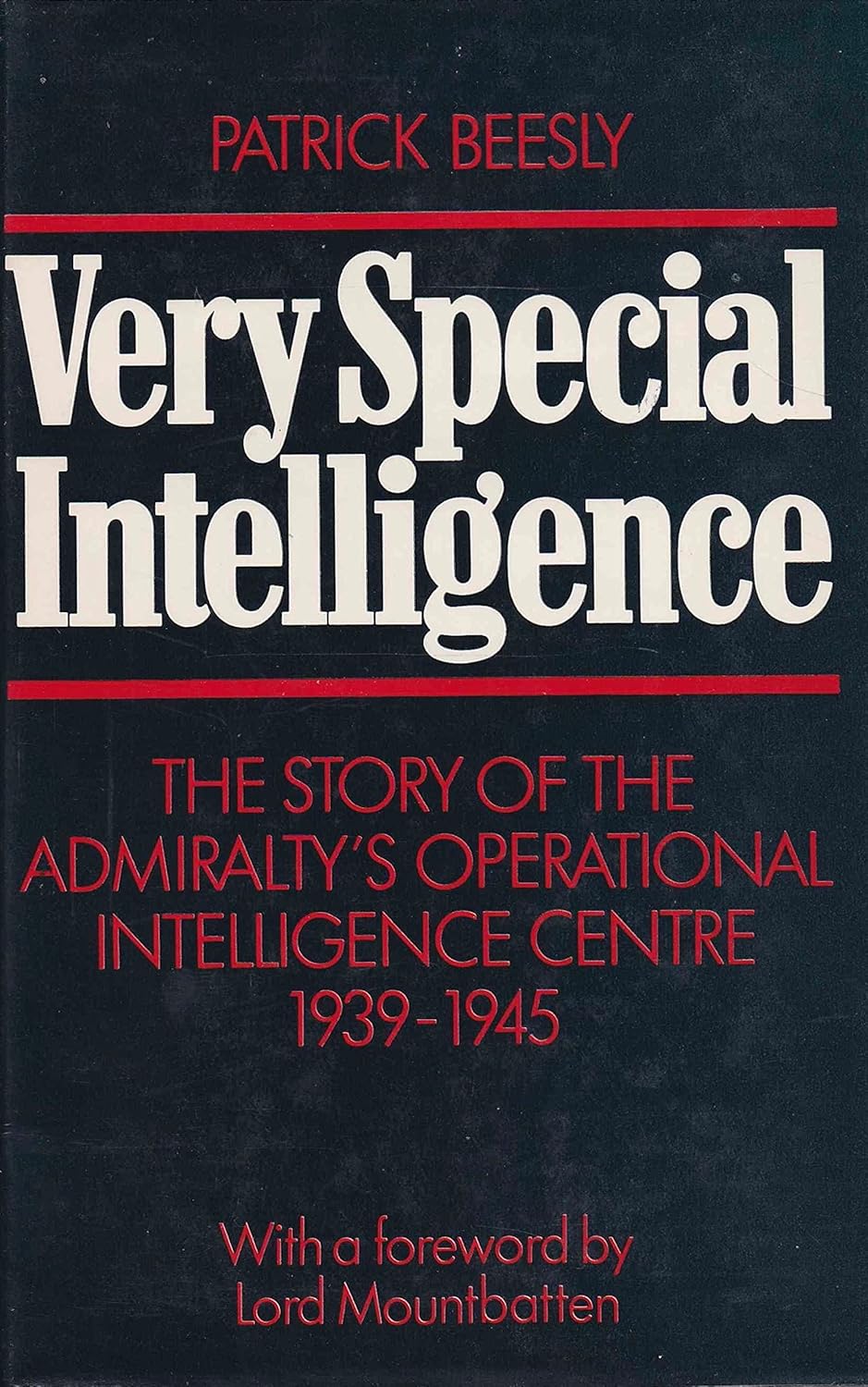
When Patrick Beesly published “Very Special Intelligence: The Story of the Admiralty’s Operational Intelligence Centre 1939-1945” (1977), he lifted the veil on one of World War II’s most closely guarded secrets. Writing from the unique perspective of an insider who served in the Operational Intelligence Centre (OIC) from 1940 to 1945, Beesly provided the first comprehensive account of how British naval intelligence transformed cryptanalytic breakthroughs into operational victories during the Battle of the Atlantic. Nearly five decades later, his work remains a cornerstone of Second World War intelligence studies, though subsequent research has both validated his insights and revealed gaps in the story he was permitted to tell.
Beesly’s greatest strength lies in his firsthand knowledge of the OIC’s daily operations. Unlike many military historians writing from archival sources, he witnessed the tension-filled nights when U-boat positions hung in the balance, the frustration of intelligence blackouts when German naval codes changed, and the exhilaration when successful decrypts enabled the Royal Navy to anticipate Kriegsmarine movements. His account reflects with the immediacy of lived experience, capturing the human drama behind the sterile statistics of tonnage sunk and convoys saved.
The British learned much from the success and failures of their cryptanalytic operation during World War I known as Room 40. According to Beasly, Room 40’s primary shortcoming was that it was purely a cryptoanalytic bureau, where the staff were neither professional intelligence officers nor experts on the German Imperial Navy. Moreover, it was highly compartmentalized and generally inaccessible. These shortcomings resulted in the flawed transmission of critical intelligence regarding the German fleet’s location, which undermined Jellicoe and Beatty at Jutland and shattered the flag officers’ confidence in the Admiralty as a reliable source of information.
The author then demonstrates how the OIC of World War II served as the critical bridge between Bletchley Park’s cryptanalytic successes and operational reality at sea. Beesly shows how information supplied by Bletchley Park was used to anticipate the German Kriegsmarine’s missions, including those of the ill-fated Bismarck. His detailed reconstruction of pivotal moments reveals the intricate choreography required to transform decoded intercepts into actionable intelligence without compromising the Ultra secret. “For the first but not the last time,” Beasly says, “accurate and rapid intelligence had enabled the Admiralty and the Commander-in-Chief to concentrate overwhelming force at the decisive point.” For long periods of time British intelligence had a more accurate picture of the deployment of German U-boats than the German Navy did. It likely turned the tide in the Battle of the Atlantic.
Particularly valuable is Beesly’s analysis of the OIC’s organizational structure and personnel. He illuminates how figures like Commander Rodger Winn built the Submarine Tracking Room into a formidable analytical engine, combining signals intelligence with operational research, prisoner interrogations, and photographic reconnaissance to create a comprehensive picture of German naval operations. The book demonstrates how institutional memory and analytical expertise proved as crucial as raw intelligence in winning the cryptographic war. In the end, Beesly says that Submarine Tracking Room leader Commander Winn was ultimately able to read Admiral Donitz’s mind.
At the outbreak of the Second World War, intelligence was still in its infancy as a distinct discipline and career path. The Royal Navy felt that paymasters would make the best intelligence officers, evidently because they possessed attention to detail. Paymaster Lieutenant-Commander Norman Denning would serve as the “father of the OIC.” Room 40’s cryptanalysis work was transferred to the Government Code & Cipher School at Bletchley Park, which broke codes and translated raw messages. Denning and the OIC would provide interpretation and meaning to Bletchley Park’s deciphered messages. OIC would collect, evaluate, and promulgate all intelligence from all sources, such as direction finding from radio signals, wireless telegraphy, photo-reconnaissance flights, and decrypted enemy signals (known as “Special Intelligence”). OIC was specially tasked to identify, track, and determine the routes and intentions of all enemy maritime forces.
In late 1939 there were upwards of 2,500 British ships at sea at any given moment. The German Navy only possessed 32 operational U-boats at that time, mostly of World War I vintage. The OIC, relying mainly on direction finding and air reconnaissance, failed several times early in the war, such as the sailing of the pocket battleships Scharnhorst and Gneisanau, and the German invasion of Norway. The German Navy’s equivalent of the OIC – known as B.Dienst – was much more effective from the start. Beesly says the advantage was equivalent to fifty additional submarines.
Beesly’s treatment of the Battle of the Atlantic fundamentally reframes our understanding of this crucial campaign. Rather than viewing it primarily through the lens of convoy battles and U-boat tactics, he reveals it as an intelligence war where success depended on the ability to read the enemy’s mind. His account shows how periods of cryptanalytic success – such as the breakthrough into German naval Enigma in 1941 – directly correlated with Allied victories at sea, while intelligence blackouts led to devastating convoy losses. On May 8, 1941 the Royal Navy captured the German U-boat U.110 off of Greenland, complete with an intact and undamaged Enigma cipher machine with all of its accompanying support materials, allowing Bletchey Park to read messages in real time sent using the U-boat cipher Triton. Beesly says “the tremendous importance of this capture cannot be overemphasized.”
The author’s insider knowledge allows him to correct numerous misconceptions about key engagements. His analysis of convoy PQ-17’s destruction in July 1942, for instance, reveals how intelligence failures and misinterpretation contributed to one of the Royal Navy’s most controversial decisions. From August 1941 to May 1945, 42 allied convoys totalling 813 ships sent supplies from the UK to northern Russia to aid the Soviet Union on the eastern front. Sixty vessels (just seven percent) were sunk by the Germans. But convoy PQ-17 in June 1942 was the only convoy during the war that was voluntarily abandoned by its escort. The decision to scatter the convoy was driven by a deep fear of the German battleship Tirpitz and a series of intelligence misinterpretations and communication breakdowns within the British Admiralty. First Sea Lord Admiral Dudley Pound, acting on this intelligence (which turned out to be incorrect or premature), believed that an overwhelming German surface force was en route to attack the convoy. Of the 35 merchant ships in PQ-17, 24 were sunk.
Beesly also captures the psychological dimension of intelligence warfare. He describes the mounting pressure on OIC personnel as German countermeasures threatened to blind Allied intelligence, and the relief when new cryptanalytic breakthroughs restored their ability to read enemy communications. This human element adds depth to what might otherwise be a technical narrative about codes and ciphers.
The decades since Beesly’s publication have witnessed a dramatic increase in research into wartime cryptanalysis, much of it enabled by the gradual declassification of previously secret materials. This new scholarship has both reinforced Beesly’s core arguments and revealed aspects of the intelligence war he could not fully address.
Recent research has confirmed Beesly’s assessment of Ultra intelligence’s decisive impact on the Battle of the Atlantic. Modern analysis shows that Ultra intelligence made a decisive contribution in the Battle of the Atlantic, with Winston Churchill writing that “The only thing that ever really frightened me during the war was the U-boat peril.” Contemporary estimates suggest that British cryptanalysts shortened the war by an estimated two years, saving approximately 20 to 30 million lives.
However, new revelations have also highlighted the limitations of Beesly’s account. Recent scholarship has revealed the extent to which Polish cryptanalysts laid the groundwork for British success against Enigma, a contribution that Beesly could only hint at due to security restrictions. Similarly, the role of captured materials – code books, machines, and key sheets seized from German vessels – proves to have been more significant than Beesly was able to acknowledge.
The most significant new understanding concerns the complexity of German naval cryptography. While Beesly described the challenges of breaking different Enigma variants, recent research has revealed the full scope of German cipher security measures. The decryption of Enigma signals to the U-boats was much more difficult than those of the Luftwaffe, involving not just the standard Enigma machine but additional security measures that made naval communications particularly resistant to cryptanalysis.
One area where subsequent research has significantly expanded our understanding concerns the intelligence blackouts that Beesly described but could not fully explain. We now know that the German introduction of the four-rotor Enigma variant in February 1942 created an intelligence blackout that lasted nearly eleven months, during which U-boat successes reached their peak. Beesly described the operational consequences of this blackout but was constrained in explaining its technical causes.
Modern research has revealed the heroic efforts required to restore intelligence access during this critical period. The capture of cipher materials from U-559 in October 1942, which cost the lives of two Royal Navy personnel, provided the breakthrough that enabled Bletchley Park to crack the four-rotor system. This operation, barely mentioned in Beesly’s account due to security considerations, proved pivotal in turning the tide of the Atlantic battle.
In the first five months of 1943 the Battle of the Atlantic reached its climax. During that time the German Navy lost nearly 100 U-boats. But the pace of construction was so great that they still possessed over four hundred boats by the summer, over half of which were operational, including 126 in operation in the North Atlantic. It’s unclear how the OIC managed it all. According to Beesly, an average of three thousand signals passed through the section daily and by 1943, at the height of the Battle of the Atlantic, the Tracking Room only staffed a dozen men and women.
Nevertheless, Donitz withdrew his wolf packs from the convoy routes. He pledged to return, but never did, at least not in the same numbers and intensity. In the last full year of the war, out of the 168 U-boats in operation, over half were under the command of a C.O. with less than six months experience. The casualty rate of German U-boat crews was an astounding 72 percent (28,000 men lost out of 39,000 in the U-boat service).
Similarly, recent scholarship has illuminated the role of High Frequency Direction Finding (HF/DF or “Huff-Duff”) in supplementing cryptanalytic intelligence. While Beesly acknowledged this technology’s importance, we now understand how the integration of multiple intelligence sources – signals intelligence, direction finding, traffic analysis, and operational research – created a comprehensive surveillance system that gradually closed the intelligence gap even during cipher blackouts.
Another area where subsequent research has enriched Beesly’s narrative concerns the human intelligence aspects of naval warfare. Recent declassifications have revealed the extent to which prisoner interrogations, particularly of U-boat crews, provided crucial intelligence that complemented signals intelligence. The Combined Services Detailed Interrogation Centre’s work, barely mentioned in Beesly’s account, proved instrumental in building the comprehensive picture of German naval operations that made effective countermeasures possible.
The German Navy’s ability to churn out new U-boats and staff them with competent crews of submariners was amazing. By April 1941 the Germans had sunk 729 Allied and neutral shipping and lost 39 U-boats, leaving them with an operational force of 32 submarines. By January 1941 the operational submarine force had jumped to 91. By July 1942 there were 140 and by the end of that year there were 212 operational U-boats in service, an increase of almost six hundred percent in less than two years. Wolf packs of up to twenty U-boats were in operation against the North Atlantic convoys. Moreover, they had a surface speed 35 percent to 55 percent faster than an Allied convoy, which could only cover 170 to 240 miles in any one 24-hour period (U-boats on the surface could achieve up to 370 miles in that time). Eight million tons of shipping was lost in 1942 alone while the Germans were commissioning 70 new U-boats a quarter.
Recent research has also provided a clearer picture of the technical evolution of both German and Allied cryptographic capabilities throughout the war. While Beesly described the general challenge of keeping pace with German cipher improvements, we now understand the specific timeline of these developments and their operational impacts.
The introduction of new Enigma variants, changes in key distribution procedures, and the implementation of additional security measures created a constantly evolving challenge that required continuous adaptation of cryptanalytic techniques. Modern research has revealed how close-run this technological race actually was, with Allied advantages often measured in weeks or months rather than years.
Similarly, we now better understand how German intelligence gradually became aware of Allied cryptanalytic capabilities. The increasing security consciousness evident in German communications, which Beesly noted but could not fully explain, reflected growing awareness that their ciphers might be compromised. This cat-and-mouse game of measure and countermeasure adds another layer to our understanding of the intelligence war. Yet, to the very end of the war, the German Navy, including Admiral Karl Donitz, remained incredulous that their signal traffic and Enigma ciphers had been broken. “The Germans,” Beesly writes, “just could not believe that their splendid system was not foolproof.”
Modern readers should approach “Very Special Intelligence” as a foundational text that must be supplemented with more recent scholarship to gain a complete picture of the intelligence war. Works by David Kahn, Stephen Budiansky, and other historians have filled many of the gaps that security restrictions forced Beesly to leave, while recent declassifications continue to refine our understanding of this crucial period.
Patrick Beesly’s “Very Special Intelligence” succeeded in its primary mission: revealing the crucial role that intelligence played in Allied victory during World War II’s longest campaign. His insider’s account demonstrated how the marriage of cryptanalytic brilliance and operational expertise transformed the Battle of the Atlantic from a near-run thing into an Allied victory that secured the lifeline between Britain and America. For contemporary readers, “Very Special Intelligence” serves both as a historical document and a reminder of intelligence’s crucial role in modern warfare. In an age of cyber warfare and electronic surveillance, Beesly’s account of how a small group of dedicated analysts changed the course of history remains remarkably relevant. The book stands as both a tribute to the men and women who fought the shadow war of codes and ciphers and a testament to the decisive power of information in human conflict.
 What's Tim Reading Now?
Leave a comment