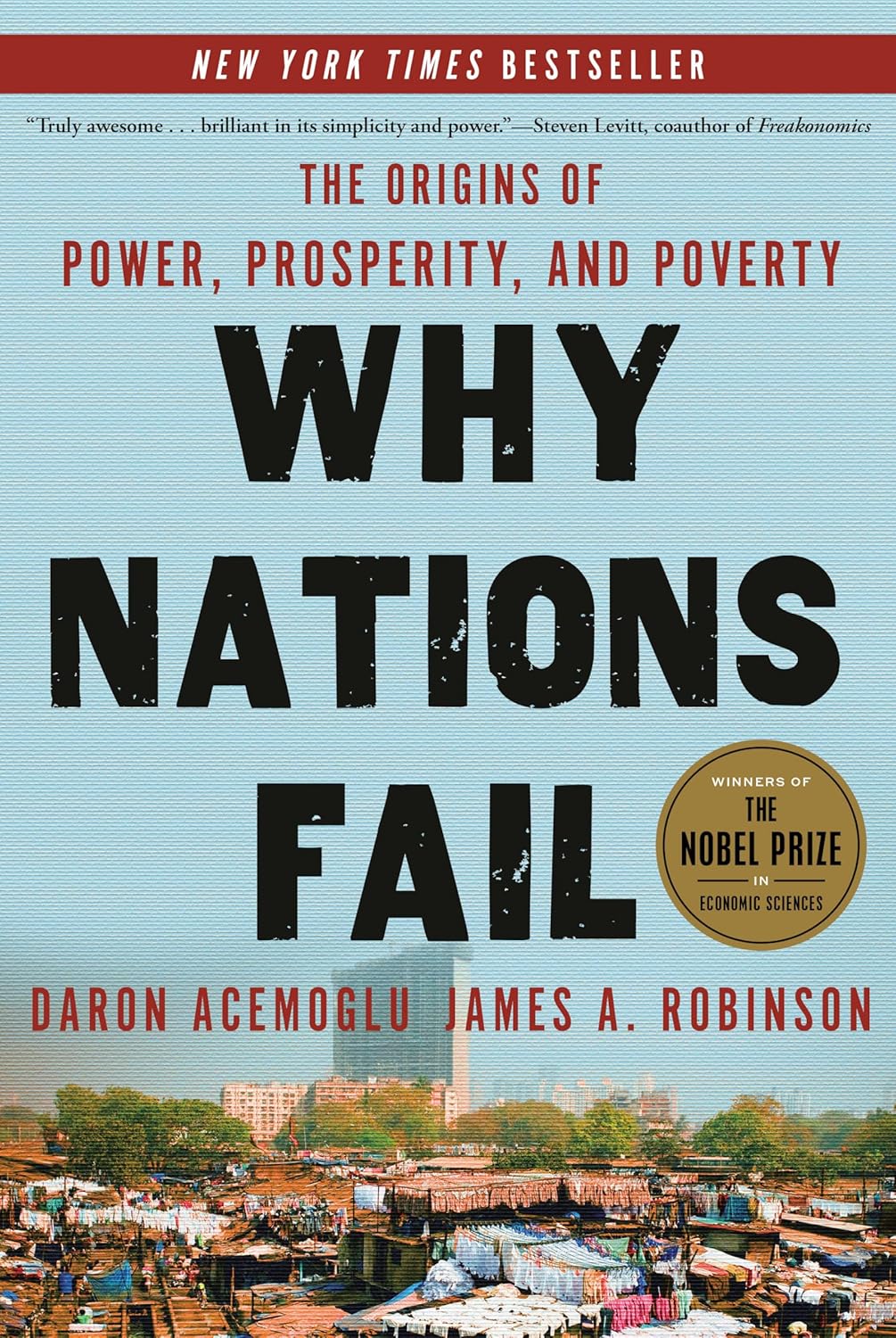
In his 2000 bestseller “Development as Freedom” Pulitzer Prize-winning economist Amartya Sen made the uplifting argument that the cornerstone of international development ought to be the promotion and growth of human freedom. What his thesis notably lacked was evidence. It seems to me that evidence supporting Sen’s important hypothesis is precisely what Daron Acemoglu and James Robinson present here in “Why Nations Fail: The Origins of Power, Prosperity, and Poverty.” This 2013 bestseller argues that only open and inclusive political institutions – those most likely to provide the freedoms Sen claims are critical – can achieve sustainable economic growth (e.g. “The central thesis of this book is that economic growth and prosperity are associated with inclusive economic and political institutions, while extractive institutions typically lead to stagnation and poverty”).
To begin with, Acemoglu and Robinson shred three of the most commonly held theses on global economic inequality, while setting the stage to argue that politics and political institutions along with their associated incentives are what really matters for long term, sustainable economic growth. First, they dismiss the Geography theory, usually associated with Jared Diamond (but also Jeffrey Sachs), which suggests that north/south continents and tropical climates are poorly suited for economic growth. That’s simply not true, the authors say. North America was once far less economically desirable than South America; the Middle East was the cradle of civilization, yet non-oil Middle East countries today are as poor as Peru and Bolivia, which are far poorer than the UK or US. “History thus leaves little doubt that there is no simple connection between a tropical location and economic success.” Second, they reject Culture theory, which started with Max Weber and the Protestant work ethic, and is just as invalid as Geography according to the authors. How can one explain the differences between North and South Korea or the US versus Mexican sides of Nogales, Arizona? Or why is it that the US, Canada, Nigeria and Sierra Leone – all former English colonies and places that have shared cultures and/ or colonial heritage – have vastly different economies today? Finally, they critique Ignorance theory, which is favored by most modern development economists, especially Jeffrey Sachs, the doyen of the poverty-can-be-eradicated school, and essentially maintains that countries are poor because they make wrongheaded policy decisions. If only they had better advisors and made smarter choices to foster economic growth, Ignorance theory proponents argue, everything would work out just fine. Acemoglu and Robinson, on the other hand, claim that leaders rarely make stupid decisions. They make rational choices that may be economically disastrous for their country, but usually align well with economic incentives that are part of the institutions that they’ve created or, more often, inherited. There is no ignorance; it’s just that the system has been set up to encourage harmful policies. In other words, “They get it wrong not by mistake or ignorance but on purpose.”
So what then is required for sustainable economic growth? The authors claim that “…to understand world inequality we have to understand why some societies are organized in very inefficient and socially undesirable ways.” They argue that “the ability of economic institutions to harness the potential of inclusive markets, encourage technological innovation, invest in people, and mobilize the talents and skills of a large number of individuals is critical for economic growth…” and that “…explaining why so many economic institutions fail to meet these simple objectives is the central theme of this book.”
They lay out a simple and compelling hypothesis to support their position, although it does have some holes. The argument goes like this. First, a country needs to have a foundation of stable political centralization in order to provide basic law and order. This quickly excludes such international basket cases as Afghanistan and Somalia. Thus, from their perspective, without a firm political foundation there is no hope for meaningful growth. Next, the political institutions must be pluralistic, thereby ensuring that the required stability will come from the rule of law and the establishment of a level economic and political playing field for all, and not merely by the use of force flexed by some powerful entrenched elite. Nations that possess these political traits (centralized, pluralistic, rule of law) tend to have inclusive economic institutions, such as free labor markets, secure property rights and free market economies. The combination of these political and economic institutions fosters creative destructive, to use Joseph Schumpeter’s famous phrase, as long established elites cannot thwart the new technologies and processes that threaten the status quo and thus their privileged political and economic position. This focus on the centrality of creative destruction or what is now more commonly referred to as “disruption” from Clay Christensen’s seminal “The Innovator’s Dilemma,” is really the linchpin of the authors’ entire case. I found that it has special merit, although it is far from air tight.
The authors view the Korean Peninsula as a powerful example of their theory at work. The two halves of the peninsula share the same geography and culture, so clearly those two explanations do not apply. But what about Ignorance? Although the South was until recently authoritarian like the North, the regime in Seoul allowed for secure private property, unbiased rule of law, proper public services, and an open labor market. Authoritarian regimes of every political stripe tend to have extractive economic institutions, the authors say. The state – and thus the economy, as the two are fundamentally intertwined – is set up for the exclusive benefit of some small elite. More inclusive economic institutions, with the potential for more rapid and broader based economic growth, are often eschewed because such growth would almost certainly come at the expense of the elites.
That isn’t to say that extractive regimes cannot produce economic growth. They certainly can, so say the authors, but they are destined to sputter out and collapse eventually according to their theory. Acemoglu and Robinson muster a truly sweeping array of historical examples to make their case, from the Natufian society in the Levant around 9500 BC and the Mayan empire in Central America from 400-800 AD to the Bushong in the Congo in the 1600s and the Soviet Union in the twentieth century. They also boldly predict collapse for the current Communist China economic juggernaut in the years to come (“China…is likely to run out of steam”). Indeed, extractive institutions come in all different shapes and sizes today, according to the authors. Some are Communist, others Socialist, a few are ostensibly free market democracies. But the inevitable common denominator is that the wealth of the nation is expropriated by a narrow and closed elite, whether that be the anti-communist Mugabe in Zimbabwe, the anti-FARC paramilitary in Colombia, the traditional Spanish elite in Argentina, the Sung family in North Korea, crony capitalists in Egypt, or the cotton kings of Uzbekistan.
These impressively diverse societies – as measured geographically, culturally, temporally – share many similar traits according to the authors: political centralization, often by force; forced re-allocation of productive resources and mainly for the enrichment of a narrow elite; general economic growth but technological and business process stagnation; and an inherently unstable political system as the incentives to displace the current elites and acquire the narrow stream of great wealth is overpowering. Thus, politically centralized (often absolutist) regimes with extractive economic institutions can deliver economic growth – often spectacular growth – but only for a limited period of time and almost never through technological innovation. The inherent conflicts in the system lead to a “vicious cycle” as “extractive political institutions [support] extractive economic institutions, which in turn [provide] the basis for extractive political institutions and the continuation of the power of the same elite.” The end result is always the same: economic and political collapse. However, the authors say nothing about how long such extractive regimes can continue to grow nor what sends them into collapse. In fact, many of the doomed extractive regimes survived and prospered for quite a long time: Rome (nearly a millennium), the Maya (half a millennium), and many European empires (centuries at least). Will China get its extractive institution comeuppance next year, next decade, next century or next millennium? The authors don’t hazard a guess.
A major theme of “Why Nations Fail” is the incredible long range importance of innovation: “The fear of creative destruction is the main reason why there was no sustained increase in living standards between the Neolithic and Industrial revolutions,” the authors boldly claim. They go on to note how William Lee developed a knitting machine for making stockings in England in the 1580s. Queen Elizabeth quickly squelched the idea, fearing the potential disruptions to employment as a threat to political stability. The authors write that this is precisely what all extractive political regimes with non-inclusive political institutions are wont to do: block disruptive technology. It would be the Glorious Revolution of 1688 – an event the authors claim was nothing less than “…the most important political revolution of the past two millennia” – that would change everything. Indeed, they write that “World inequality today exists because during the nineteenth and twentieth centuries some nations were able to take advantage of the Industrial Revolution and the technologies and the methods of organization that it brought while others were unable to do so.”
So what made the English Glorious Revolution so important? Well, to start, it promoted political centralization and pluralism, two key ingredients in their recipe for sustained economic growth. Indeed, politics is at the foundation of their case (“…while economics institutions are critical for determining whether a country is poor or prosperous, it is politics and political institutions that determine what economic institutions a country has”). As for the Glorious Revolution, it was a “…momentous event precisely because it was led by an emboldened broad coalition and further empowered this coalition, which managed to forge a constitutional regime with constraints on the power of both the executive and, equally crucially, any one of its members.” It gave England a Parliament that heard and responded to public petitions from a broad spectrum of society, which in turn laid the foundation for the Industrial Revolution. From this radical new system many popular initiatives were developed. Their combination had a profound impact, according to thesis of “Why Nations Fail”: new and improved property rights (i.e. no longer would Englishmen fear arbitrary confiscation by the Crown); improved infrastructure in the form of canals, turnpikes, and later railroads (because investors felt more secure in their investments); a fiscal regime that taxed land rather than hearths, thus shifting the tax burden to land owners rather than manufacturers (which further increased industrial investment); greater access to capital in the form of the Bank of England (a direct outcome of the Glorious Revolution allowing for ready capital to anyone with proper collateral); and aggressive protection of trade and manufacturing from outside competition, but accompanied by the dissolution of internal monopolies. In short, the authors claim that “The Glorious Revolution…was about a fundamental reorganization of economics institutions in favor of innovators and entrepreneurs, based on the emergence of more secure and efficient property rights.” Acemoglu and Robinson note just how dramatic were the waves of innovations that propelled the Industrial Revolution (e.g. the time to produce 100 lbs. of cotton fell from 50,000 hours by hand to 300 hours with a waterframe to 135 hours with a Spinning Jenny) and that these cumulative innovations were almost all developed by new men from humble backgrounds, the antithesis of the traditional ossified, hereditary elite.
Moreover, inclusive institutions tend to promote a “virtuous cycle” of “… constraints against the exercise and usurpation of power…[and also] tend to create inclusive economic institutions, which in turn make the continuation of inclusive political institutions more likely.” The exact opposite of “…extractive economic institutions [that] create the platform for extractive political institutions to persist…” The authors use Australia, the French Revolution, and China versus Japan to further their core thesis that inclusive political institutions were fundamental for taking full advantage of the Industrial Revolution, which they claim explains the global economic inequality we have today. States with an entrenched, absolutist political system and extractive economic institutions (Eastern Europe, Ottoman Empire, Africa, China) were dominated by elites that were inherently opposed to change. “The aristocracies would be economic losers from industrialization. More important, they would also be political losers, as the process of industrialization would undoubtedly create instability and political challenges to their monopoly of political power.”
“Rich nations [US, UK, Canada, Australia] are rich largely because they managed to develop inclusive institutions at some point during the past three hundred years. These institutions have persisted through a process of virtuous circles. Even if inclusive only in a limited sense to begin with, and sometimes fragile, they generated dynamics that would create a process of positive feedback, gradually increasing their inclusiveness.”
Acemoglu and Robinson conclude “Why Nations Fail” with some promising words about an unlikely economic hero: Brazil. “The rise of Brazil since the 1970s was not engineered by economists of international institutions instructing Brazilian policymakers on how to design better policies or avoid market failures. It was not achieved with injections of foreign aid. It was not the natural outcome of modernization. Rather, it was the consequence of diverse groups of people courageously building inclusive institutions.”
In closing, “Why Nations Fail” was much better and far more intellectually deep than I had anticipated. It has been one of the most thought-provoking reads I’ve had in a long time. It is an admirable blend of contemporary economic development theory to be read alongside Sachs, Easterly, Collier and Sen and an important contribution to strategic studies and cultural history, easily on par with Diamond’s “Guns, Germs, and Steel” and McNeil’s “Plagues and Peoples” or “The Pursuit of Power: Technology, Armed Force, and Society since A.D. 1000.” Overall, this is a book well worth reading.
 What's Tim Reading Now?
Leave a comment