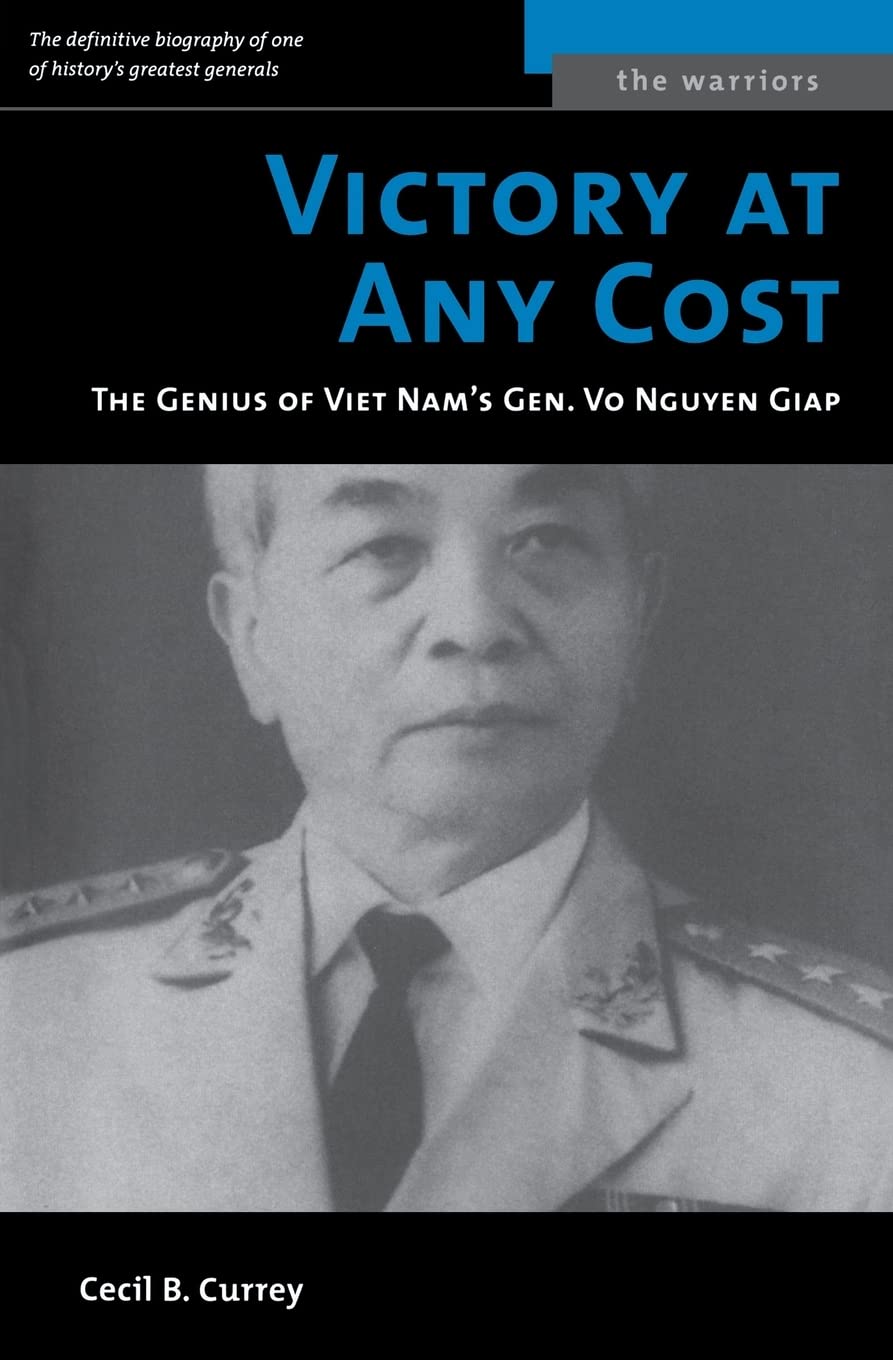
Vo Nguyen Giap died in Hanoi in 2013 at the ripe old age of 102. Given his arduous early military life in the bush followed by his decades long leadership in a brutal war for national independence, joisting continuously with firepower-rich foreign enemies and deadly internal political rivals, he at least deserves to be remembered by history for his unnatural longevity. But American historian Cecil Currey argues for a much grander legacy for Giap in this able (although occasionally plodding) biography, literally placing the North Vietnamese general alongside history’s greatest commanders. Is such a flattering assessment warranted? After reading “Victory at Any Cost: The Genius of Viet Nam’s Gen. Vo Nguyen Giap,” I’d say the answer is a qualified yes.
Giap was an unusually talented man. That much is clear. Intelligent, hardworking, well-educated and passionate, his native abilities were recognized by many, including French colonial officials when he was still in school. In an attempt to win him over to the French side, the chief of colonial police arranged for Giap to be offered an all-expense paid higher education in Paris to study whatever he liked. He turned it down without hesitation. Giap’s love of country and hatred of the colonizing enemy (and their native lackeys) was incandescent and never dimmed. “For Giap and his fellows,” Currey writes, “a divided Viet Nam was a country in crisis, suffering unnatural agonies.” It matter little to him if the foreign power dividing Vietnam were fellow Asian Japanese, abusive French or liberal Americans, or even fellow communist Chinese. Vietnam, for Giap, was sacred, inviolable. He never doubted that victory would ultimately be achieved, even if it took hundreds of years.
If Giap’s natural abilities and bona fides as a Vietnamese patriot are unimpeachable, what of his skill as a general? Here the waters get a bit murkier. If Giap possessed military genius, where was it most clearly manifested? Although Currey doesn’t describe it this way, it seems to me that Giap excelled in two specific areas. First, he possessed an intuitive understanding of the nature of the Indochinese wars. Clausewitz famously wrote: “No one starts a war – or rather, no one in his senses ought to do so – without first being clear in his mind what he intends to achieve by that war and how he intends to conduct it.” Giap was perfectly clear on what he intended by the war (national unification under a communist regime) and how he intended to conduct it (a protracted people’s war), and he never wavered from that view even when the winds in the politburo blew in a different direction. In Giap’s own words: “Our people inherently possess a tradition of persistent resistance, an art of defeating the enemy in protracted wars.” Moreover, in his mind, every single Vietnamese – some 30 million men, women and children – were potential soldiers in his army. And he didn’t flinch from tossing them indiscriminately into a meat grinder if it furthered the cause of Vietnamese independence by a single day. Again, in Giap’s own words: “Every minute, hundreds of thousands of people die all over the world. The life or death of a hundred, a thousand, or of tens of thousands of human beings, even if they are our own compatriots, represents really very little.” Are these the words and strategy of a military genius, one of the greatest commanders of all time?
Second, Giap was a master of logistics. It has been said that armchair generals talk of strategy while real generals talk of logistics. If that is the case, Giap was a “real general.” Currey describes how Giap calculated the logistical needs of his army – both conventional and guerilla – with mathematical precision and built a human conveyor belt of coolies to transport millions of tons of critical supplies over forbidding terrain, often under heavy bombardment, around the clock and in all weather. Indeed, Giap’s two greatest victories – Dien Bien Phu in 1954 and the southern insurgency in the 1960s – were essentially logistical victories. The French never dreamed that Giap could transport and re-supply an arsenal of heavy artillery deep into the Northern Vietnamese mountainous jungle, nor could the U.S. staunch the flow of men and arms from the Ho Chi Minh trail. But is logistical acumen really the quality of a great general? Rommel was a great commander who was defeated in North Africa mainly by logistical failures, yet has that diminished his martial reputation? It could be argued that Union quartermaster general Montgomery Meigs won the war for the North, but who remembers his invaluable contribution today (beyond, perhaps, Civil War buffs and professional military historians)? If Giap belongs next to Alexander, Hannibal, Caesar, William the Conqueror, Adolfus, Napoleon, Lee, and MacArthur, what is his Guagamela, Cannae, Alesia, Hastings, Breitenfeld, Borodino, Chancellorsville, or Inchon? Perhaps it is Dien Bien Phu. Or perhaps I’m a westerner hopelessly captive to my cultural bias to major conventional battlefield victories.
If Giap’s “victory at any cost” mentality and admirable logistical skill do not add up to true greatness, what about the simple fact that his armies defeated several opponents, all of whom possessed staggering advantages in firepower, technology and trained troops? In the final analysis, Currey maintains that Giap’s historical legacy ought to be measured by what he accomplished, not how it was accomplished nor at what price in blood and treasure it was won and certainly not by any single decisive and defining battle. “Giap is the only general in modern history,” he writes, “to launch battle against his foes from a position of grave weakness, lacking equipment and financial resources, beginning with no troops, yet still able to defeat in succession the remnants of the Japanese empire; the armies of France, the second-ranking colonial empire; and the United States, one of the world’s two superpowers, despite the lengthy and enormous U.S. commitment of energy, resources, manpower, and technology.” When viewed from that perspective, who is Giap’s equal? Who has done more with less? After all, Hannibal, Napoleon and Lee, among many other gifted generals, were ultimately on the losing side. What other commander emerged victorious against such tremendous odds – and against multiple opponents? I certainly can’t think of any.
In closing, Currey has written a thoughtful, but far from perfect biography on one of the most successful and enigmatic generals of the modern era. In many ways, Giap was the George Washington of his nation. He literally built his army from nothing, suffered privations that make Valley Forge look like a Club Med holiday, and ultimately emerged victorious against odds even more unthinkable than that of a group of country bumpkin colonial farmers defeating the most professional army in the world. Yet, Giap’s influence in the ruling circles of communist North Vietnam never approached that of Washington during his lifetime. In fact, the story of Giap, as Currey tells it, is one of fighting desperately for political influence and more often than not losing. Giap was unapologetically pro-soviet during his entire career and steadfastly adhered to a go-slow, protracted war approach to national unification. His rivals, most notably Trougn Chinh and Le Duan, embraced the more aggressive Chinese strategy of human wave offensives. Giap usually lost the strategic argument, which ultimately led to the Tet and Easter Offensives of 1968 and 1972, which Giap planned and executed despite his vigorous personal opposition. If Tet was a tactical defeat and strategic victory, Giap deserves neither credit nor blame, as he never agreed with the strategy and never sensed the psychological impact it could have on the U.S. commitment to the war even in defeat. And when the final push for victory came, Giap had been sent into retirement, reduced to visiting fertilizer plants and giving awards to schoolchildren as his former protégé, General Van Tien Dung, led the final victory in the south, and then assumed Giap’s traditional roles as head of the army and then minister of defense. Giap reportedly lived out his finals decade under virtual house arrest, a national hero feared and presumably loathed by the successors to his nation’s leadership.
 What's Tim Reading Now?
Leave a comment