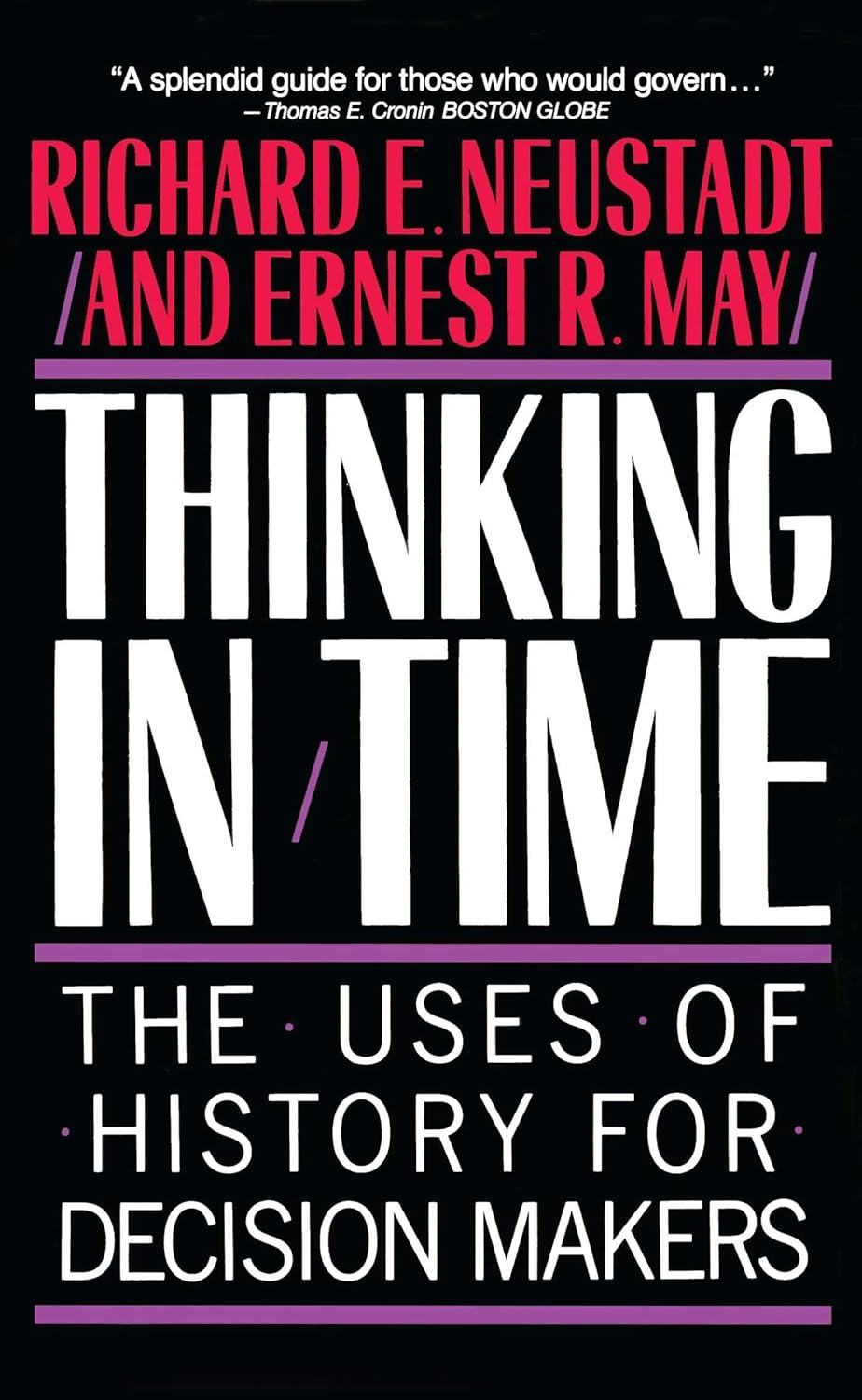
As an avid reader of history, I’ve long struggled with putting my learning to use in day-to-day situations, whether that be in evaluating critical business decisions or in helping me better observe and understand the world around me. On the one hand, there is the familiar aphorism attributed to George Santayana that those who ignore history are doomed to repeat it. But, on the other hand, each situation is truly unique, and the use of historical analogies is clearly fraught with pitfalls. “Thinking in Time” addresses this conundrum and provides a sound basis for using historical knowledge intelligently and responsibly.
To overcome the temptation of using history incorrectly, the authors put forward a specific process for decision makers in crisis situations, and they use case studies to highlight successes and failures in the use of history as guide to decision making. The case studies are all drawn from domestic and foreign policy scenarios, but the lessons are applicable to any organization (private sector, non-profit, etc.).
The authors’ decision making methodology may seem a bit didactic or formulaic at first, but it is meant to be used with the greatest flexibility. The heart of the process is to establish a system of critical inquiry and resist the temptation to jump to the “options phase” of decision making immediately. Rather, the authors argue, focus clearly on the situation at hand and confirm the intended objective. This can be started by listing what is known, what is unclear and what is presumed about the situation. Next, analogies will come to mind or will likely be invoked for advocacy (intentionally or otherwise), so quickly highlight all the “likenesses” and “differences” between the present situation and the historical analogies. This should further clarify the present situation and the intended objectives.
The authors suggest other tools that, while useful, are a bit more cumbersome than separating the known from the unclear from the presumed in any given situation, which I know do religiously at work. Some of the other techniques covered include laying out a timeline of the event, including major concurrent events along with the details; asking journalistic questions (where, how, why, what, etc.) for each major event along the timeline; setting odds for given “if – then” scenarios; explicitly laying out what kind of information (new “knowns”) would change your various “presumeds”; and for various options asking “For the objective of X, Y is the best option because….”
In closing, “Thinking in Time” is one of the ten most influential books I’ve ever read. If you are in a leadership position in business, government or even the local lodge, this book can make you a more effective leader. The only thing I regret about reading “Thinking in Time” is that I didn’t do it sooner.
 What's Tim Reading Now?
Leave a comment