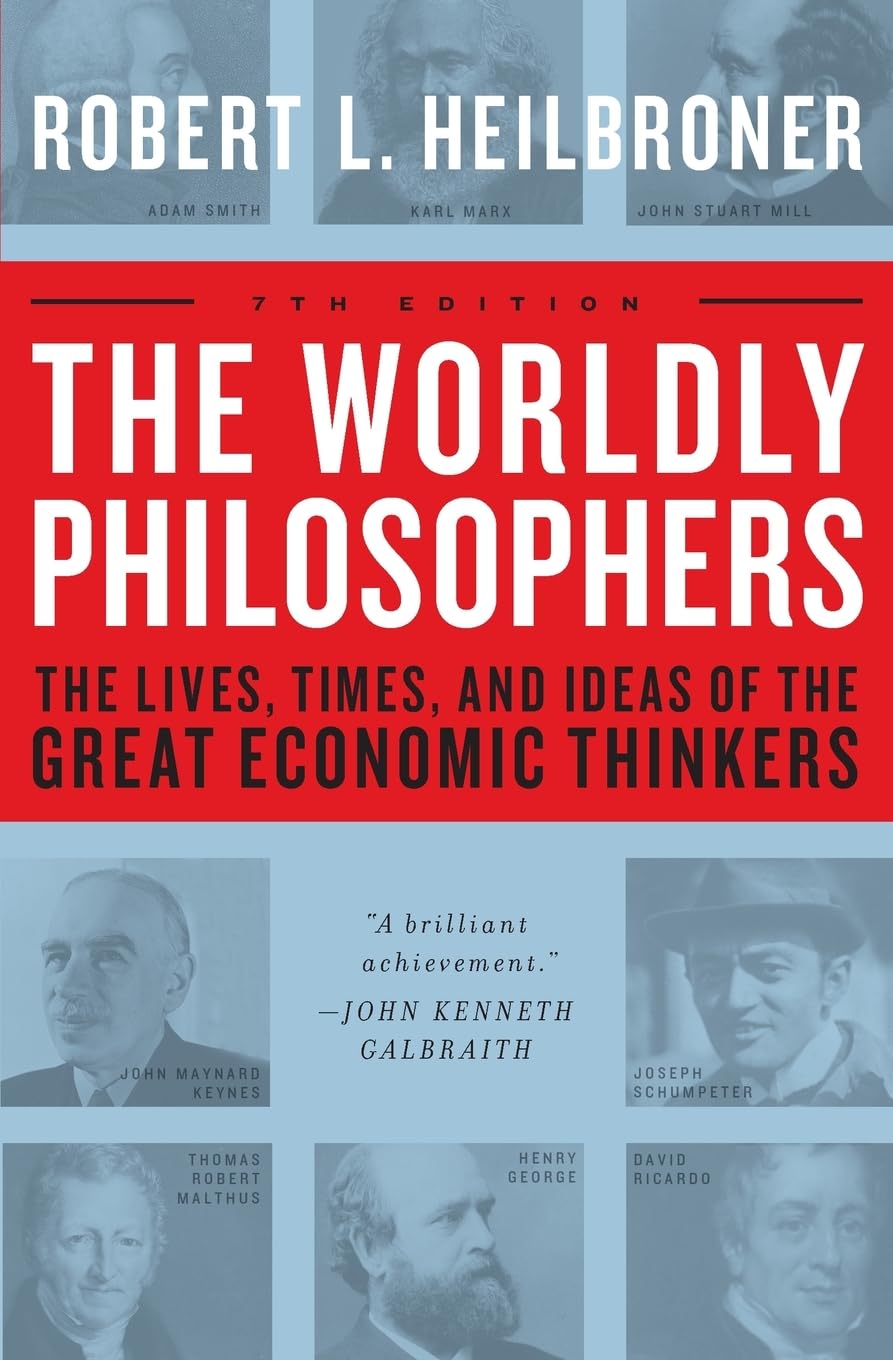
I first read this classic ten plus years ago during winter break as an undergraduate economics major. Not much sunk in back then, which says more about me than it does about the skilled author, Robert Heilbroner. The author turns a two hundred year history of rather recondite theories and inaccessible economic tomes into a clear chain of thought delivered with felicity of phrase and graceful presentation. It is recommended as much to the general educated reader as the adolescent economist on campus.
To begin, the author notes that there was no need for economics before the eighteenth century. He argues that prior to that economic interaction was either cultural or authoritarian in nature. That is, you were either born into your role in society – baker, butcher, tanner, etc. – or were explicitly told by the local magistrate what to do (i.e. build me a pyramid). In such a system, inherently devoid of free choice, there was simply no need for the study of how goods were produced and distributed – they just were.
Heilbroner’s approach in “The Worldly Philosophers” is perfect: he tells the story as an interconnected set of biographical vignettes. The narrative is told relay-fashion, with each giant of the so-called dismal science handing the figurative baton on to his successor at the end of each chapter.
Despite the author’s best efforts to emphasize (and often over-emphasize) each man’s (and they’re all men) contribution to our understanding of modern economics, only four profiles really emerge as epochal: Adam Smith, David Ricardo, Karl Marx, and John Maynard Keynes. The rest of the lives are curious, sometimes compelling, faithfully entertaining, but of significantly lesser gravitas. Many are odd balls, such as the Victorian utopians Saint-Simon, who inspired a cult, and Charles Fourier, who ventured beyond economics to prognosticate on the rise of new moons and life on celestial bodies. Others are rather musty, like Francis Edgeworth, who developed a mathematical model that solved for pleasure seeking, and Alfred Marshall, who during the Great Depression emphasized the central role of equilibrium to the proper functioning of macroeconomics.
So who were these giants – Smith, Ricardo, Marx, and Keynes – and what did they discover and argue that distinguishes them from the rest?
For Smith, it was the initial and vastly important recognition of the existence of a self-regulating market. Products, prices, and wages would all be kept in line without a government official lifting a finger. Self-interest and natural impulses would ensure that everything would work out right. If people wanted more hats, the price of hats would rise, people would exit other industries to become hat makers, and the price of hats would fall. A key hypothesis underpinning Smith’s model was that labor, if given sufficient monetary resources, would procreate and thus produce more and more future laborers, which would depress wages. Smith also has the unique distinction of being the first and only economist to create a model that reflected both in generalities and particularities the actual economy in which he lived – a collection of small and easily interchangeable capitalists and laborers.
Ricardo gave us the modern economic model (with assumptions galore and thus susceptible to the “Ricardian vice” of assuming away inconvenient realities) and the concept of economic rents that persists in many commodity markets today, the petroleum industry being most notable. What surprised me here was that Heilbroner did not once associate him with the concept of comparative and absolute advantage, which my undergraduate and graduate educations in economics always emphasized when talking about Ricardo. Given Ricardo’s concept of economic rents and the negative role he ascribed to the landlord – who contributed no value to the market and yet siphoned off the vast majority of the gains – it is no wonder that he was viewed as the apostle of free trade before the Corn Laws and even without the concept of comparative advantage.
Marx also looms large for reasons that I would not have anticipated. Heilbroner cites two achievements as especially groundbreaking. First, it was Marx who argued that society is developed and changed by its economic structure – specifically how goods are produced and exchanged – and not by political philosophy or style of government. Second, Marx was the first of the great economic thinkers to recognize the importance of technology in how the economy functioned. Marx saw labor-saving technology as ultimately the cause of capitalism’s downfall when all profits were squeezed out of the economy because labor (and the source of profits – labor’s overtime “surplus value”) was eliminated.
Finally, Keynes is portrayed as almost superhuman. A polymath who was a centerpiece of Virginia Woolf’s exclusive high intellectual Bloomsbury crowd, a balletomane who married the legendary prima ballerina from the Diaghilev Ballet Ruse, Lydia Lopokova, who wrote politically disruptive best-sellers (such as “The Economic Consequences of the Peace”), and who happened to make a fortune trading currencies on the side. Indeed, as Heilbroner writes, “He was a phenomenon.” Keynes is generally remembered for his endorsement of substantial government interference in the economy. While this may be somewhat accurate, Heilbroner emphasizes a slightly different point. Namely that Keynes argued rather persuasively that capitalism was not dynamic; it could very well stagnate at any level of national income if faith in a prosperous future was not restored. Previous economic greats from Smith onward maintained that the market was self-correcting; if times were bad, wages and interest (the price of investment) would ultimately fall until the capitalists took advantage of the opportunity. Keynes crushed that cherished concept.
In closing, my favorite character in “The Worldly Philosophers” was not one of the truly great economic minds. It was the anti-social, philandering (an odd combination for sure) Norwegian-American Thorstein Veblen. His arguments spoke to me as no others did. Veblen is perhaps best known for his 1899 publication “The Theory of the Leisure Class” in which he maintains that man’s economic behavior is not rational, but rather somewhat primordial and thus more closely related to anthropology. We strive for big houses, fancy cars, and other objects of conspicuous consumption to show the rest of society in tangible terms just how powerful we are. These possessions are the equivalents of scalps pinned to the wall of our teepees. Second, Veblen maintained that capitalists actually aimed to subvert the economy, not promote it. He argued that rational engineers were the natural captains of a smoothly functioning economy, but that rapacious capitalists sabotaged the system to make money in the financial morass. It is difficult to read Veblen’s words and not think of Wall Street bankers circa 2008.
All told, this is a well-written, easily accessible tour de force.
 What's Tim Reading Now?
Leave a comment